To lower your resting heart rate, exercise regularly. Endurance training cut it by about 3 to 6 beats per minute in trials, and yoga by about 5. Keep caffeine under 400 mg a day, drink less alcohol, quit smoking and practice slow breathing. Fish oil had a small 1.6 beat effect. Normal is 60 to 100, and a rate above 100 at rest needs a doctor.
To work out how to lower resting heart rate, we read the NHLBI pages on heart rhythm, the American Heart Association heart rate guide, fact sheets from NCCIH, FDA and the NIH Office of Dietary Supplements, and three meta-analyses that pooled more than 260 studies.[1][2][3][4][5]
Regular endurance exercise or yoga is the most reliable way to bring a resting pulse down, by about 3 to 6 beats per minute in controlled trials. Cutting back on caffeine, alcohol and cigarettes and calming the stress response add to that.[3][7][8][11]
| What it is | The number of times your heart beats per minute while you are at rest[2] |
|---|---|
| Normal adult range | 60 to 100 beats per minute; fit people and athletes can sit as low as 40[1][2] |
| Best evidence | Endurance training and yoga; across 191 studies, exercise groups averaged 3.3 beats per minute lower than controls[3] |
| Supplement with trials | Fish oil: an average drop of 1.6 beats per minute in 30 placebo-controlled trials[5] |
| Common push factors | Caffeine and other stimulants, smoking, heavy drinking, stress and thyroid problems[8][10][11] |
| Safety | High-dose fish oil can raise bleeding risk with warfarin; heart medicines need a doctor's plan[6][12] |
| See a doctor | A resting rate above 100 on repeated checks, or a slow rate with symptoms[1][13] |
What is a normal resting heart rate?
For most adults, a normal resting heart rate is 60 to 100 beats per minute. A rate below 60 is called bradycardia and one above 100 is called tachycardia, though young or very fit people often run below 60 with no problem. Some trained athletes rest as low as 40 beats per minute.[1][2]
The American Heart Association suggests checking in the morning after a good night's sleep, before you get out of bed or have coffee. Put two fingers on the inside of your wrist on the thumb side, count the beats for 30 seconds and multiply by 2.[2]
A smartwatch or phone app can also track it.[1] Stress, anxiety, hormones and medicines all shift the number, so average several mornings instead of trusting one reading.[2]
| Reading at rest | What it may mean | Next step |
|---|---|---|
| Under 60, you feel fine and you exercise | Often a sign of fitness[1][2] | Mention it at your next checkup |
| Under 60 with pauses between beats or trouble breathing | Possible slow heart rhythm[1][13] | See a doctor soon |
| 60 to 80 | Normal range[1] | The steps below can still help |
| 81 to 100 | Normal, but tied to higher risk in large cohort studies[4] | Focus on exercise and triggers |
| Over 100 on repeated checks | Tachycardia[1] | Book a doctor visit |
How to lower resting heart rate: 8 steps
The steps with the best evidence are regular endurance exercise and yoga, with cutting stimulants, alcohol and smoking as support. In a 2018 review of 191 studies, every type of exercise lowered resting heart rate, but only endurance training and yoga did so clearly in both men and women.[3]
- Do moderate cardio most days. Aim for 150 to 300 minutes a week of brisk walking, cycling or swimming.[15] Start near 50% of your maximum heart rate, which is about 220 minus your age, and build up.[2]
- Add yoga to your week. Yoga programs lowered resting heart rate by about 5 beats per minute in controlled trials.[3]
- Keep strength work, but do not rely on it alone. Guidelines call for muscle training 2 days a week, yet on its own it did not clearly lower resting heart rate.[3][15]
- Practice slow breathing. Slow, deep belly breaths help bring on the relaxation response, which includes a lower heart rate.[7]
- Keep caffeine at or under 400 mg a day. FDA treats that amount as safe for most healthy adults.[9]
- Drink less alcohol, especially at night. Alcohol was linked with more fight-or-flight activity during sleep.[10]
- Quit smoking. Quitting can lower heart rate almost at once.[8]
- Track your morning pulse weekly. Use the same time and method so you can trust the trend.[2]
Exercise produced the biggest drops in people who started with a higher resting rate and in younger groups.[3]
Which exercise lowers resting heart rate the most?
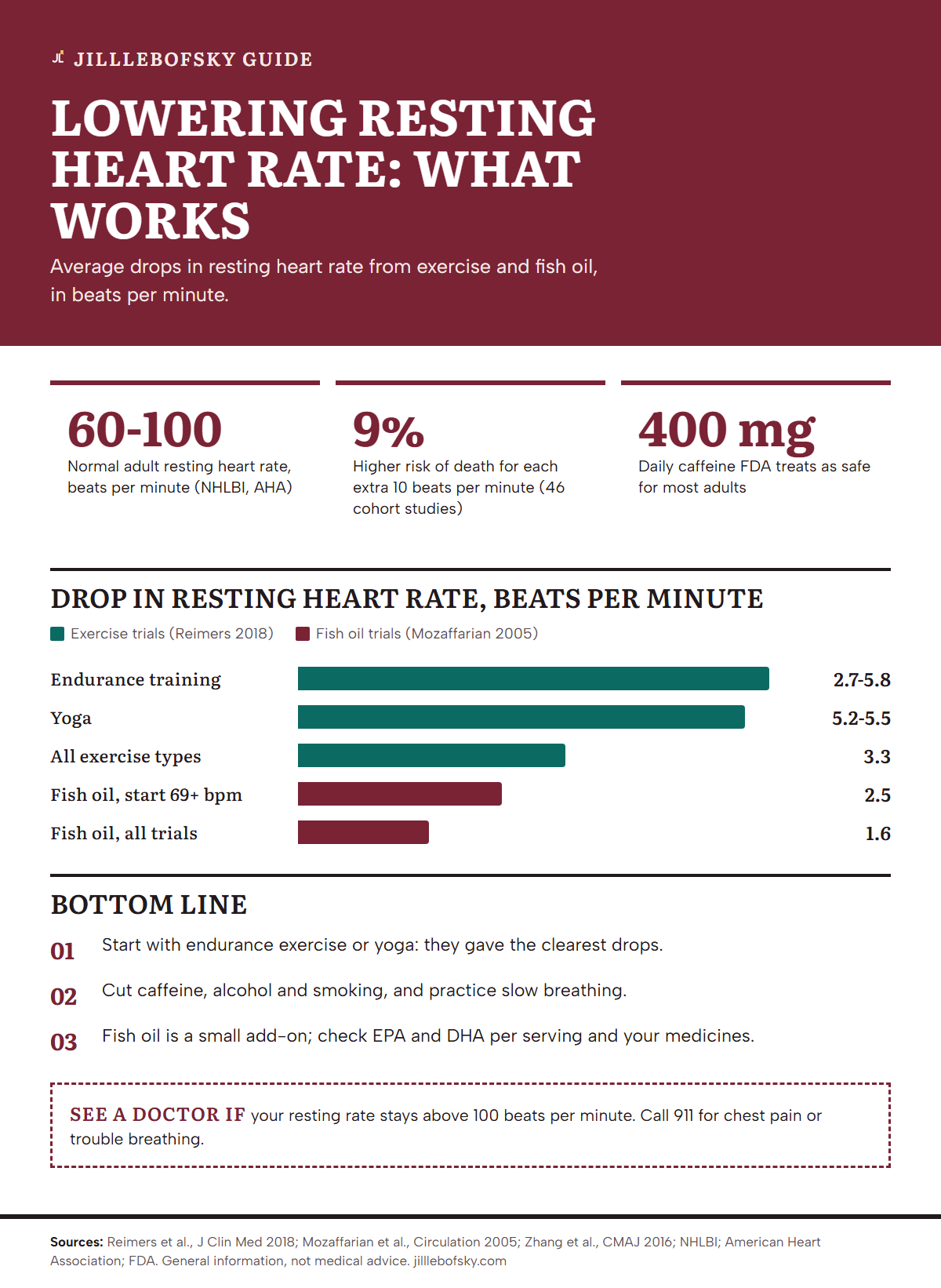
Endurance training and yoga lowered resting heart rate the most in controlled trials. The 2018 Reimers meta-analysis found endurance training cut it by 2.7 to 5.8 beats per minute depending on sex, and yoga by 5.2 to 5.5. Strength training alone did not give a clear drop across both sexes.[3]
| Study | Who and how many | What was tested | Result |
|---|---|---|---|
| Reimers, 2018 | 191 studies, 215 groups of healthy people | Endurance training | 2.7 to 5.8 beats per minute lower than non-exercisers[3] |
| Reimers, 2018 | Same review | Yoga | 5.2 to 5.5 beats per minute lower[3] |
| Reimers, 2018 | Same review | Strength training | No clear drop overall; 2.2 beats lower in women[3] |
| Mozaffarian, 2005 | 30 placebo-controlled trials | Fish oil, 0.81 to 15 g a day | 1.6 beats per minute lower[5] |
| Zhang, 2016 | 46 cohort studies, about 1.25 million people | Observation only | Each 10 extra beats tied to 9% higher risk of death[4] |
Across every type of exercise, the average drop versus control groups was 3.3 beats per minute.[3] The average is small, but it comes from a habit that costs nothing, and in the cohort data each 10 extra beats was tied to a higher risk of death.[4]
For intensity, the American Heart Association puts moderate effort at about 50% to 70% of maximum heart rate and vigorous effort at 70% to 85%. Beginners should start at the low end and build up.[2]
Can slow breathing and stress control lower your heart rate?
Relaxation techniques bring on the relaxation response, which NCCIH describes as slower breathing, lower blood pressure and a reduced heart rate. Slow diaphragmatic breathing is the simplest version. Strong stress, anxiety, anger and pain push the other way and can even set off rhythm problems in people at risk.[7][11]
Heart rate variability biofeedback uses a device that shows your heart rate while you practice breathing. A review cited by NCCIH found it helped self-reported stress and anxiety, though it did not report resting heart rate as an outcome.[7]
Yoga combines movement with breathing, and it was one of only two activity types that clearly lowered resting heart rate in both sexes.[3]
Doctors sometimes teach vagal maneuvers to slow a fast heartbeat. Examples include coughing, bearing down while holding your breath, lying down or placing an ice-cold wet towel on your face. NHLBI describes them as techniques your healthcare team guides you through, so learn them from a clinician first.[12]
Do caffeine, alcohol and smoking raise your heart rate?
Caffeine, nicotine and alcohol can all push heart rate up, and cutting them is one of the quickest changes you can make. Smokefree.gov notes that quitting smoking can lower heart rate almost immediately. NHLBI lists caffeine, other stimulants and heavy drinking among the triggers for heart rhythm problems.[8][11]
FDA says 400 mg of caffeine a day is generally safe for most adults, and that too much caffeine in children and teens can cause a faster heart rate and palpitations.[9] Medicines and products that make you more alert can do the same, so read the label of any pre-workout or energy product.[11] Our guide to how long caffeine stays in your system explains why an afternoon coffee can still matter at bedtime.
For alcohol, NHLBI advises no more than 2 drinks a day for men and 1 for women.[11] In a 2018 study of 4,098 Finnish employees wearing heart monitors, alcohol was linked with more fight-or-flight activity and less recovery in the first 3 hours of sleep. Recovery scores fell by 9.3, 24.0 and 39.2 points at low, moderate and high intake.[10]
That study was observational, and some authors worked for a heart-monitor company, so it shows an association and cannot settle cause and effect.[10]
Does fish oil lower resting heart rate?
Fish oil lowered heart rate by an average of 1.6 beats per minute in a 2005 meta-analysis of 30 placebo-controlled trials. The effect was larger, 2.5 beats, in trials where people started at 69 beats or higher and in trials lasting 12 weeks or more. It did little for people who already had a lower pulse.[5]
A higher dose did not work better. The effect held steady across doses from 0.81 to 15 grams a day.[5] The drop is also smaller than the one seen with exercise, so fish oil fits as an add-on to the habits above.[3][5]
What to check on a fish oil label
- The EPA and DHA amounts per serving. FDA advises no more than 5 grams a day of EPA and DHA combined from supplements.[6]
- Your medicines. High doses can cause bleeding problems with warfarin or other blood thinners.[6]
- Likely side effects: a fishy taste, bad breath, heartburn, nausea and stomach upset.[6]
- Food sources first. Salmon, mackerel, herring and sardines supply the same omega-3s.[6]
We check the label dose against the trial dose for every supplement we cover; our review method explains how.
Why does a high resting heart rate matter?
A higher resting heart rate is linked with a higher risk of death in large population studies. A 2016 meta-analysis of 46 studies and about 1.25 million people found each extra 10 beats per minute was tied to a 9% higher risk of death from any cause and an 8% higher risk of cardiovascular death.[4]
People resting above 80 beats per minute had a 45% higher risk of death from any cause than those in the lowest group.[4] The American Heart Association adds that a higher resting rate tends to go with lower fitness, higher blood pressure and higher body weight.[2]
These were observational studies with large differences between them and signs of publication bias. They show a link and cannot prove that lowering your pulse adds years.[4]
Resting heart rate is a free daily readout of the same habits that drive blood pressure. Our guide on how to lower blood pressure covers the overlap, from exercise to alcohol.
When should you see a doctor about your heart rate?
See a doctor if your resting heart rate is above 100 beats per minute on repeated checks, or below 60 with symptoms. Also book a visit for frequent palpitations, the feeling that your heart is skipping, fluttering or pounding. Thyroid problems, medicines and rhythm disorders can all change the rate.[1][11][13]
Keep a note of when symptoms happen, what you feel and what you were doing, since NHLBI suggests tracking these details for your doctor.[13]
If you take heart or blood pressure medicine, ask your clinician which heart rate range is right for you before you train hard.[2]
Call 911 right away if
- You have chest pain, pressure or heaviness, or pain in an arm, your back, neck, jaw or upper belly.[14]
- You are short of breath at rest or have trouble breathing.[13][14]
- You feel light-headed or suddenly dizzy.[14]
- A rapid or irregular heartbeat comes with any of the signs above, or with heavy sweating for no reason.[14]
NHLBI says to call 911 even if you are not sure it is a heart attack, and not to drive yourself to the hospital.[14]
What doctors use first
Doctors start by looking for a cause, such as a rhythm problem, a thyroid imbalance or a medicine side effect.[11] For a fast heartbeat that needs treatment, NHLBI lists beta blockers, calcium channel blockers and digoxin among the options. Beta blockers can cause tiredness, stomach or sleep problems, and calcium channel blockers can cause swollen feet or low blood pressure.[12]
Lifestyle steps sit alongside these medicines and do not replace them. Never stop or change a heart medicine on your own, and ask before adding fish oil if you take a blood thinner.[6][12]
Your resting heart rate checklist
- Check your pulse on waking, before coffee: count for 30 seconds and multiply by 2.[2]
- Log a weekly average instead of reacting to single readings.[2]
- Build up to at least 150 minutes of moderate cardio a week.[15]
- Add a yoga class or a daily slow-breathing session.[3][7]
- Keep caffeine at or under 400 mg a day.[9]
- Stay within 1 drink a day for women and 2 for men, or drink less.[11]
- If you buy fish oil, read EPA and DHA per serving and stay under 5 grams a day.[6]
- Bring your log to your next checkup, and go sooner if readings stay above 100.[1]
Bottom line
For most people the best first step is a daily brisk walk or bike ride, built up toward 150 minutes a week, because endurance exercise has the strongest trial evidence for a lower resting pulse.[3][15] Yoga and slow breathing pair well with it, and cutting caffeine, alcohol and cigarettes removes common push factors.[7][8][11]
Fish oil showed a small effect in trials and makes sense only after those habits, with a label check and a talk with your doctor if you take a blood thinner.[5][6] A resting rate that stays above 100, or any chest pain or trouble breathing, needs a doctor.[1][14] For more on heart risk factors, see our guide on how to lower cholesterol and the rest of our heart and circulation guides.
Frequently asked questions
What is a good resting heart rate for my age?
For most adults of any age, 60 to 100 beats per minute is normal, and a lower number within that range usually reflects better fitness. Exercise trials found larger drops in younger groups, but older adults still saw their resting rate fall.
Is a resting heart rate of 50 bad?
Not always. Young or physically fit people often rest below 60, and some athletes sit near 40. A rate of 50 with dizziness, trouble breathing or pauses between beats should be checked, because a doctor can tell whether it is normal for you.
Can you lower your heart rate instantly?
Slow, deep breathing can calm the body within minutes by bringing on the relaxation response. Doctors also teach vagal maneuvers, such as bearing down or an ice-cold towel on the face, but learn those from your healthcare team before you try them.
Does losing weight lower resting heart rate?
The American Heart Association links a higher resting rate with higher body weight, but we found no pooled trial giving a figure for weight loss alone. Regular exercise, which also supports weight control, lowered resting rate by 3.3 beats per minute on average.
Can a smartwatch measure my resting heart rate?
Yes. NHLBI notes that some smartwatches and phone apps can help you find your resting heart rate. For a check, count your wrist pulse for 30 seconds on waking and multiply by 2, then compare it with the watch reading.
Sources
- Arrhythmias - Types. National Heart, Lung, and Blood Institute (NIH), 2022
- Target Heart Rates Chart. American Heart Association
- Effects of Exercise on the Resting Heart Rate: A Systematic Review and Meta-Analysis of Interventional Studies. Reimers AK et al., Journal of Clinical Medicine, 2018
- Resting heart rate and all-cause and cardiovascular mortality in the general population: a meta-analysis. Zhang D et al., CMAJ, 2016
- Effect of fish oil on heart rate in humans: a meta-analysis of randomized controlled trials. Mozaffarian D et al., Circulation, 2005
- Omega-3 Fatty Acids: Fact Sheet for Consumers. NIH Office of Dietary Supplements
- Relaxation Techniques: What You Need To Know. National Center for Complementary and Integrative Health (NIH)
- Benefits of Quitting Smoking. Smokefree.gov, National Cancer Institute
- Spilling the Beans: How Much Caffeine is Too Much?. US Food and Drug Administration
- Acute Effect of Alcohol Intake on Cardiovascular Autonomic Regulation During the First Hours of Sleep in a Large Real-World Sample of Finnish Employees. Pietila J et al., JMIR Mental Health, 2018
- Arrhythmias - Causes and Triggers. National Heart, Lung, and Blood Institute (NIH), 2022
- Arrhythmias - Treatment. National Heart, Lung, and Blood Institute (NIH), 2022
- Arrhythmias - Symptoms. National Heart, Lung, and Blood Institute (NIH), 2022
- Heart Attack - Symptoms. National Heart, Lung, and Blood Institute (NIH)
- Top 10 Things to Know About the Second Edition of the Physical Activity Guidelines for Americans. Office of Disease Prevention and Health Promotion, HHS, 2018
This page is general information, not medical advice. Talk to your doctor or pharmacist before you start any supplement, especially if you are pregnant, take medicine or have a health condition. Read our medical disclaimer and how we review.