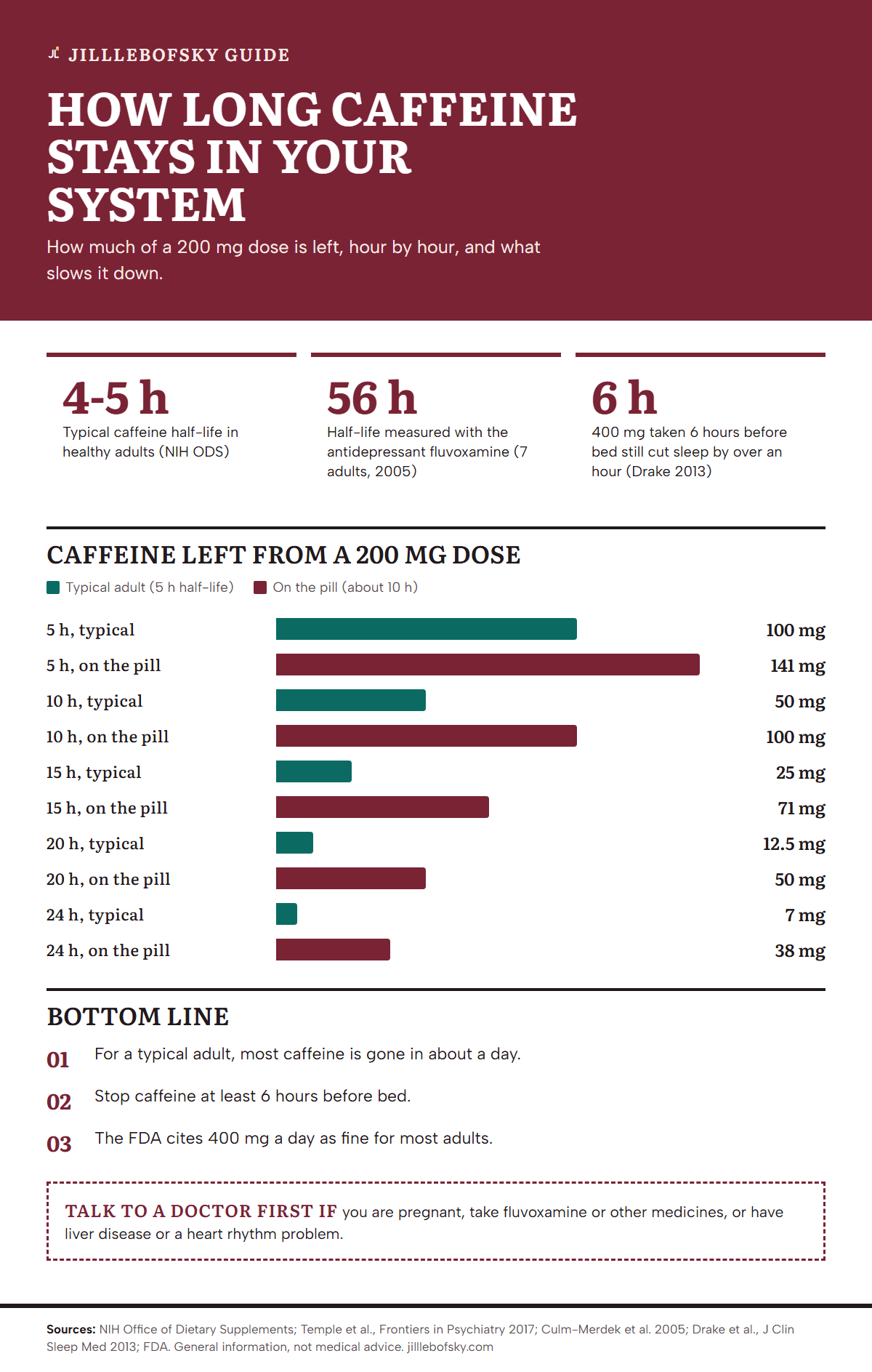
Caffeine has a half-life of about 4 to 5 hours in healthy adults, so half of a 200 mg coffee is still in your blood 5 hours later and most is gone in about a day. Pregnancy, birth control pills, fluvoxamine and liver disease slow clearance. A 2013 trial found 400 mg taken 6 hours before bed still cut sleep by over an hour.

How long does caffeine stay in your system? We read the NIH Office of Dietary Supplements fact sheet, two FDA pages, MedlinePlus, a 2017 safety review and six human studies on how fast the body clears caffeine, how it affects sleep and what happens when you stop.
The short answer: caffeine has a half-life of about 4 to 5 hours in a healthy adult, so half of a 200 mg dose is still in your blood about 5 hours later, and most of it is gone after about a day.[1]
| What it is | A stimulant found in coffee, tea, cacao, guarana and kola nut, and added to energy drinks and supplements[1][3] |
|---|---|
| Time to peak | Within 45 minutes to 1 hour after you swallow it[1][3] |
| Half-life in adults | About 4 to 5 hours on average, with a normal range of 3 to 7 hours[1][2] |
| How long you feel it | Four to six hours for most people[3] |
| Daily amount for most adults | 400 mg a day is not generally linked to negative effects[4] |
| Slows clearance | Pregnancy, birth control pills, fluvoxamine, liver cirrhosis, newborn age[2][7][9] |
| Who should check first | Pregnant or breastfeeding people, children, and anyone with heart rhythm problems, anxiety or sleep disorders[3] |
How long does caffeine stay in your system?
Caffeine has a half-life of about 4 to 5 hours, which means your body clears half of each dose in that time.[1] After five half-lives, roughly 20 to 25 hours, only about 3% of the dose is left. So for a typical healthy adult, a morning coffee is mostly gone by the next morning.
That average hides a wide spread. A 2017 review in Frontiers in Psychiatry puts the adult half-life at 3 to 7 hours.[2] The FDA notes there is "wide variation" in how fast people eliminate caffeine and how sensitive they are to it.[4]
Your liver does most of the work. The review explains that caffeine is broken down mainly by one liver enzyme, CYP1A2.[2] Anything that speeds up or slows down that enzyme changes how long caffeine lingers. That is why smokers clear it faster and why some medicines make it stick around for days.[2][7]
How long does caffeine last after you drink it?
Most people feel caffeine for four to six hours, even though it stays in the blood much longer.[3] It is absorbed quickly, even through the lining of the mouth, and blood levels peak within 45 minutes to an hour.[1][3] The lift you feel fades as levels fall, but the drug is still working on your brain at lower levels.
Caffeine acts by blocking adenosine, a brain chemical that builds up during the day and makes you sleepy.[1] When caffeine wears off, the adenosine signal comes back. Many people feel this as the afternoon slump after a morning cup.
You may stop noticing the buzz after a few hours while a meaningful amount is still on board. The sleep study in the next sections shows why that matters.
How much caffeine is left after 5, 10 and 24 hours?
From a 200 mg dose, about 100 mg is left after 5 hours and about 50 mg after 10 hours, using the typical 5 hour half-life.[1] We worked out the table below with simple half-life math. The slower columns use the doubled half-life seen with birth control pills and the 56 hour half-life measured with fluvoxamine.[2][7]
| Hours after the dose | Typical adult (5 h half-life) | On the pill (about 10 h) | On fluvoxamine (56 h) |
|---|---|---|---|
| 0 | 200 mg | 200 mg | 200 mg |
| 2 | 152 mg | 174 mg | 195 mg |
| 5 | 100 mg | 141 mg | 188 mg |
| 8 | 66 mg | 115 mg | 181 mg |
| 10 | 50 mg | 100 mg | 177 mg |
| 12 | 38 mg | 87 mg | 172 mg |
| 15 | 25 mg | 71 mg | 166 mg |
| 20 | 12.5 mg | 50 mg | 156 mg |
| 24 | 7 mg | 38 mg | 149 mg |
Treat these as estimates. Absorption takes up to an hour, so the first two hours run a little higher in real life.[1] Each person also has their own half-life somewhere in the 3 to 7 hour range.[2]
Say you drink a 200 mg coffee at 3 p.m. and go to bed at 11 p.m. With a 5 hour half-life, about 66 mg is still in you at lights out. That is about two-thirds of a typical 8-ounce cup of coffee, which NCCIH puts at about 100 mg.[11]
What makes caffeine stay in your system longer?
Pregnancy, birth control pills, the antidepressant fluvoxamine, liver cirrhosis and being a newborn all slow caffeine clearance, while smoking speeds it up.[2][7][9] The size of the effect ranges from a modest change to a tenfold jump, so the same cup can last very different lengths of time.
Pregnancy
The half-life is on average 8.3 hours longer during pregnancy and may be up to 16 hours longer.[2] The review links this to pregnancy hormones, which compete for the same liver enzymes.[2]
Oral contraceptives
Birth control pills "tend to double the half-life of caffeine," according to the 2017 review.[2] The same review found no marked difference between phases of the menstrual cycle.[2]
Smoking
Cigarette smoking doubles the rate of caffeine clearance by revving up liver enzymes.[2] The review suggests this may explain why smokers tend to drink more caffeine. Heavy alcohol use has the opposite effect and lengthens the half-life.[2]
Fluvoxamine and other medicines
In a 2005 crossover study, 7 healthy adults took 250 mg of caffeine with or without fluvoxamine. The half-life rose from 4.9 hours to 56 hours.[7] MedlinePlus also lists stimulants, certain antibiotics, asthma medicines and heart medicines as reasons to check with your provider.[3]
Liver disease
Liver disease lowers the activity of the enzymes that break caffeine down, which can lengthen its half-life.[2] A German study of 27 people with cirrhosis found lower clearance and a longer half-life, and clearance dropped further as the disease got worse.[9]
Age
Newborns clear caffeine very slowly, with a half-life of 65 to 130 hours, and reach adult speed by about 6 months.[2] Healthy older adults look much like younger ones. A small study of 8 young and 8 older men found no significant age difference, with individual half-lives from 2.27 to 9.87 hours.[8]
| Study | Who | Dose | Result |
|---|---|---|---|
| Culm-Merdek, 2005[7] | 7 healthy adults, crossover | 250 mg caffeine with fluvoxamine | Half-life 4.9 h without, 56 h with |
| Blanchard and Sawers, 1983[8] | 8 young and 8 older men | 5 mg per kg | No significant age difference; range 2.27 to 9.87 h |
| Holstege, 1989[9] | 27 people with cirrhosis plus controls | Single oral dose | Lower clearance, longer half-life, worse with severity |
| Temple review, 2017[2] | Pooled human data | Varied | Pill doubles half-life; pregnancy adds 8.3 h on average |
How long before bed should you stop caffeine?
Stop caffeine at least 6 hours before bed, and earlier if the dose is large.[6] In a 2013 trial, 12 healthy sleepers took 400 mg of caffeine at bedtime, 3 hours before, or 6 hours before. All three times disrupted sleep compared with a placebo pill.[6]
The 6 hour dose still cost more than an hour of sleep on an objective home sleep monitor.[6] On their own sleep diaries, people reported losing 41 minutes, which shows that people may not notice how much sleep they lose.[6]
The trial used a large dose, about two big coffees at once. A smaller cup leaves less behind. Still, the timeline table above shows why a 3 p.m. coffee can matter at 11 p.m., and why slow clearers on the pill or in pregnancy may need an earlier cut-off.[2]
MedlinePlus lists sleep disorders, including insomnia, as a reason to talk with your provider about limiting caffeine.[3]
How much caffeine is too much in a day?
For most healthy adults, the FDA cites 400 mg a day as an amount not generally linked to negative effects, which is about two to three 12-ounce cups of coffee.[4] Signs you have had too much include restlessness, shakiness, insomnia, headaches, dizziness, a fast heart rate and anxiety.[3]
Lower limits apply to some groups. The American College of Obstetricians and Gynecologists says that under 200 mg a day in pregnancy does not appear to be a major factor in miscarriage or preterm birth.[12] The FDA says caffeinated drinks should be avoided for children under 2, and that medical experts advise against energy drinks for children and teens.[4]
Who should check with a doctor first
MedlinePlus advises talking with your provider before using caffeine if you are pregnant or breastfeeding, or if you have migraines, anxiety, GERD or ulcers, an irregular heartbeat or high blood pressure.[3] The same applies if you take stimulants, certain antibiotics, asthma or heart medicines.[3] If you take fluvoxamine, ask your prescriber about caffeine, given the 56 hour half-life seen in the study.[7]
What doctors do first
For poor sleep, the first step is the sleep hygiene advice that the Drake trial supports: no substantial caffeine for at least 6 hours before bed.[6] For people who want to cut back, the FDA advises doing it gradually.[4] Fast or irregular heartbeat, seizures, vomiting or confusion after a high dose are signs of caffeine toxicity and need emergency care right away.[5]
How much caffeine is in pre-workout, energy drinks and fat burners?
Energy drinks hold about 70 to 240 mg of caffeine per 16 ounces and energy shots 113 to 200 mg, and supplement labels do not have to state the amount.[11] Pre-workout powders and "fat burner" pills often stack caffeine with guarana, which adds more caffeine on top.[11]
The FDA puts the energy drink range at 54 to 328 mg per 16 ounces.[4] Studies on exercise performance used about 2 to 6 mg per kilogram of body weight, or 210 to 420 mg for a 154 pound person.[1] The NIH fact sheet says taking more is unlikely to help, and 500 mg a day or more might hurt performance and sleep.[1]
Pure powdered caffeine is the biggest danger. A single tablespoon holds 10 grams, and 10 to 14 grams can be fatal.[1] The FDA says one teaspoon of pure powder can match 28 cups of coffee and that these products have contributed to at least two deaths in the United States.[5] The agency has sent warning letters to sellers since 2015 and issued industry guidance in 2018.[5]
Because a pre-workout taken at 6 p.m. follows the same half-life math as coffee, a 300 mg scoop can leave about 150 mg in your blood at 11 p.m.[1] We take the same approach in our label-first review method, where the dose gets checked before the claims.
How to read a caffeine label
- Find caffeine in the ingredient list. The FDA requires added caffeine to be listed there, but the milligram amount is often voluntary.[4]
- Look for hidden sources: guarana, kola nut, yerba mate, green tea extract and "caffeine anhydrous" all add caffeine.[1][11]
- Check whether the amount is per scoop or per serving, and count how many scoops the label tells you to take.
- Add it up with your coffee, tea and soda for the day, and compare the total to 400 mg.[4]
- Skip any bulk powder or liquid that asks you to measure a serving yourself.[5]
- If no amount is given, the FDA advises extra care the first time you try the product.[4]
- Note the time. Count back at least 6 hours from your bedtime.[6]
For more on how we judge supplement labels and sources, see our editorial policy and the rest of our nutrition and diet guides.
How long does caffeine withdrawal last?
Caffeine withdrawal usually starts 12 to 24 hours after your last dose, peaks at 20 to 51 hours, and lasts 2 to 9 days.[10] That timeline comes from a 2004 review of 57 experimental and 9 survey studies by Juliano and Griffiths.[10]
Headache is the most common symptom, showing up in 50% of people in the experimental studies.[10] Others include fatigue, low energy, drowsiness, low mood, trouble concentrating, irritability and a foggy feeling.[10] Symptoms appeared even in people stopping as little as 100 mg a day, about one cup of coffee.[10]
MedlinePlus says most symptoms go away after a couple of days.[3] The FDA notes that withdrawal is not considered dangerous but can be unpleasant, so it advises cutting back slowly instead of stopping all at once.[4]
Withdrawal timing ties back to half-life. Symptoms start once most of yesterday's caffeine has cleared, which for a typical adult is about a day.[1][10]
Bottom line
For a healthy adult, caffeine stays in your system for roughly a day, with half of each dose gone in about 4 to 5 hours.[1] Pregnancy, the pill, fluvoxamine and liver disease can stretch that to many hours or days.[2][7][9]
For most people, the better first step is moving the last cup earlier, because lost sleep from late caffeine has the clearest trial data behind it. Set a cut-off at least 6 hours before bed, count every source including pre-workout and energy drinks, and stay under 400 mg a day.[4][6] If you take medicine or are pregnant, ask your doctor what your personal limit should be.
Frequently asked questions
How much caffeine is in a cup of coffee?
MedlinePlus puts an 8-ounce cup of coffee at 95 to 200 mg of caffeine, and NCCIH uses about 100 mg as a typical figure. The FDA lists 113 to 247 mg for a 12-ounce cup of regular brewed coffee.
How much caffeine is in Red Bull or Monster?
We did not check brand labels for this guide, so read the can. As a guide, MedlinePlus lists 70 to 100 mg per 8 ounces of energy drink, and NCCIH lists 70 to 240 mg in a 16-ounce drink.
Is caffeine still in your system after 12 hours?
Yes, a little. With a typical 5 hour half-life, about 38 mg of a 200 mg dose is still there after 12 hours. If you are on the pill or pregnant, the amount left can be two or more times higher.
Does decaf coffee still have caffeine?
Yes. The FDA says decaf coffee typically has 2 to 15 mg of caffeine in an 8-ounce cup. That is far less than regular coffee, but people who react strongly to caffeine may want to avoid it.
Can you flush caffeine out of your system faster?
None of the sources we read showed that water, exercise or a detox product speeds up clearance. Your liver breaks caffeine down at its own pace, so the practical fix is to wait and avoid adding more.
Sources
- Dietary Supplements for Exercise and Athletic Performance. NIH Office of Dietary Supplements, 2026
- The Safety of Ingested Caffeine: A Comprehensive Review. Temple JL et al., Frontiers in Psychiatry, 2017
- Caffeine. MedlinePlus, National Library of Medicine, 2026
- Spilling the Beans: How Much Caffeine is Too Much?. U.S. Food and Drug Administration, 2024
- Pure and Highly Concentrated Caffeine. U.S. Food and Drug Administration, 2026
- Caffeine effects on sleep taken 0, 3, or 6 hours before going to bed. Drake C et al., Journal of Clinical Sleep Medicine, 2013
- Fluvoxamine impairs single-dose caffeine clearance without altering caffeine pharmacodynamics. Culm-Merdek KE et al., British Journal of Clinical Pharmacology, 2005
- Comparative pharmacokinetics of caffeine in young and elderly men. Blanchard J, Sawers SJ, Journal of Pharmacokinetics and Biopharmaceutics, 1983
- Correlation of caffeine elimination and Child's classification in liver cirrhosis. Holstege A et al., Klinische Wochenschrift, 1989
- A critical review of caffeine withdrawal. Juliano LM, Griffiths RR, Psychopharmacology, 2004
- Energy Drinks. National Center for Complementary and Integrative Health, 2026
- Committee Opinion 462: Moderate Caffeine Consumption During Pregnancy. American College of Obstetricians and Gynecologists, 2010
This page is general information, not medical advice. Talk to your doctor or pharmacist before you start any supplement, especially if you are pregnant, take medicine or have a health condition. Read our medical disclaimer and how we review.