The standard lymphedema treatment is complete decongestive therapy: compression bandages or garments, manual lymphatic drainage, exercise and daily skin care, with an intensive phase that averages about 15 days. Lymphedema cannot be cured, but it can be controlled. No drug or supplement has good evidence, coumarin failed a large trial, and surgery is kept for swelling that keeps worsening after therapy.
This lymphedema treatment guide draws on the National Cancer Institute's patient and professional pages, MedlinePlus, two Cochrane reviews and the main trials on exercise, weight loss and drugs[1][2][3][5][10]. We read each source and kept only what it reports. Our method is set out on our how we review page.
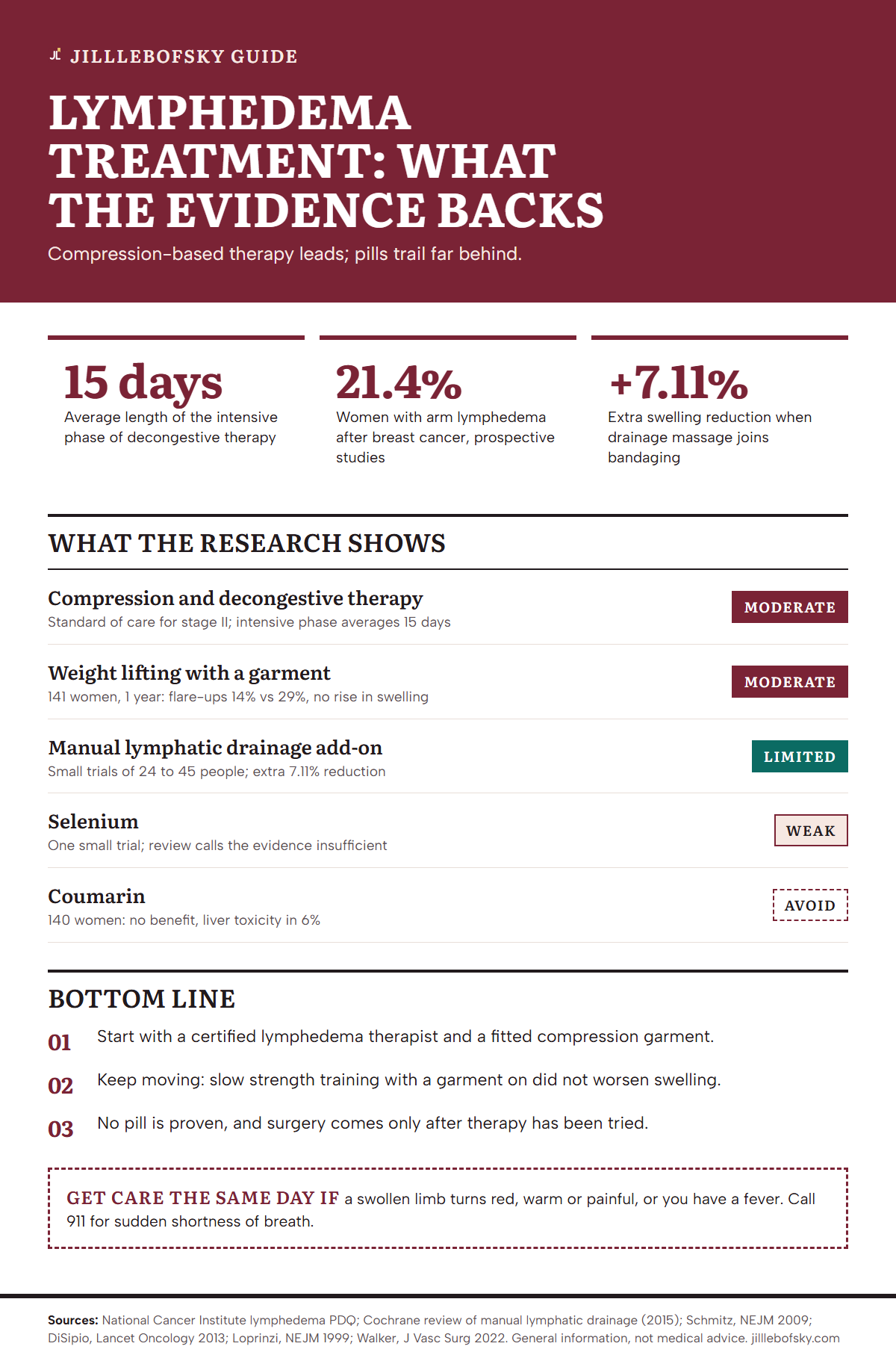
The short answer: lymphedema cannot be cured, but complete decongestive therapy, which combines compression, gentle drainage massage, exercise and skin care, is the standard of care, and its intensive phase runs about 15 days on average[1][2].
| What it is | Swelling from lymph fluid that builds up when the lymph system is damaged or blocked, usually in an arm or leg[3] |
|---|---|
| How common after breast cancer | About 1 in 5 (21.4%) in prospective studies[7] |
| Standard care | Complete decongestive therapy (CDT): compression, manual lymphatic drainage, exercise and skin care[2] |
| Can it be cured? | No, but treatment relieves swelling and helps daily function[1] |
| Drugs and supplements | No drug is approved; evidence for every pill tested is insufficient[11] |
| Surgery | Considered only after nonsurgical options have been tried[2] |
| Urgent warning sign | Red, warm, painful skin or a fever in the swollen limb may be cellulitis[1] |
What is the best lymphedema treatment?
The best-supported lymphedema treatment is complete decongestive therapy (CDT), which the National Cancer Institute calls the standard of care for stage II lymphedema. It pairs compression bandages or garments with manual lymphatic drainage, exercise and skin care, usually guided by a certified lymphedema therapist[1][2].
CDT runs in two phases. The first phase reduces swelling with skin care, exercise, drainage massage and compression bandages, done daily for an average of 15 days. The second phase keeps the gains with compression garments, exercise, skin care and drainage as needed[2].
The NCI notes that the best CDT program has not been worked out, and that cost, time and a shortage of trained therapists keep some people from getting it[2]. Lymphedema is also easier to control when treatment starts early, so report heaviness or new swelling to your doctor as soon as you notice it[1].
Treatment focus by stage
| Stage | What it looks like | Usual focus |
|---|---|---|
| Stage 0 | Lymph flow is impaired, but there is no visible swelling[2] | Watch for heaviness and report changes early[1] |
| Stage I | Pitting swelling that can go down on its own, plus heaviness[2] | Elastic garments, exercise and skin care[2] |
| Stage II | Spongy tissue without pitting; fibrosis can harden the limb[2] | CDT, then flat-knit garments[2] |
| Stage III | Swelling is mostly fat, with no pitting[2] | CDT and maintenance; liposuction may be discussed[2] |
How do you treat lymphedema step by step?
Treating lymphedema starts with a diagnosis and a referral to a certified lymphedema therapist, then moves from daily decongestion to long-term maintenance. Most of the work happens at home once the swelling is down. The steps below follow the order the National Cancer Institute describes for patients and clinicians[1][2].
- Get the swelling checked. A doctor looks for other causes, and tests such as lymphoscintigraphy can trace lymph flow and find blockages[1].
- Ask for a certified lymphedema therapist (CLT). The therapist fits garments, runs the drainage sessions and teaches you the home routine[1].
- Finish the reduction phase. Expect daily bandaging, drainage, exercise and skin care for about 15 days on average[2].
- Switch to a fitted garment for maintenance, worn during the day and at night if your therapist advises it[1][2].
- Learn self-drainage techniques so you can keep fluid moving between visits[1].
- Protect your skin every day with lotion and gloves, and call your doctor about any redness[1].
- If swelling grows despite garments, go back to your care team. A compression pump or, later, surgery may be discussed[2].
Does manual lymphatic drainage work?
Manual lymphatic drainage (MLD) is a gentle massage that moves lymph fluid toward working lymph vessels, and it seems to add a modest benefit on top of compression. A 2015 Cochrane review found an extra 7.11% reduction in swelling when MLD was added to compression bandaging[5].
That review pooled six small trials, each with 24 to 45 people. Compression bandaging alone cut swelling by 30% to 38.6%, so the bandages did most of the work. MLD was safe in every trial, and people with mild to moderate lymphedema responded better than those with severe swelling[5].
For prevention, the results are weaker. The NCI describes a trial of 160 women after breast cancer surgery: at 6 months, 24% of those who got MLD with exercise and 19% of those who got exercise alone had an arm volume rise of more than 200 mL[2].
MLD is worth having as part of CDT, especially in early stages, as long as it does not replace the garment or bandages.
Do compression garments and pumps help lymphedema?
Compression is the core of lymphedema care, because bandages and garments limit fluid buildup and give the muscles something to pump against. The NCI says flat-knit (inelastic) garments work better than elastic ones for stage II and III lymphedema, while elastic garments suit stage I[2].
Circular-knit garments put more pressure on the narrow end of the limb and are better suited to vein problems than to lymphedema[2].
Compression pumps, also called intermittent pneumatic compression, are an add-on. The NCI says to use them with garments and only when compression alone is not enough. In a small trial of 23 women, a pump plus MLD reduced arm volume by 45%, compared with 26% for MLD alone. There is a theoretical concern that pressures above 60 mm Hg could injure lymph vessels[2].
Garments alone also help. In a trial of 103 women, full CDT removed 250 mL of arm volume and garments alone removed 143 mL, yet the drop in excess volume was similar once starting sizes were taken into account[2].
Is exercise safe if you have lymphedema?
For most people, yes, and slow, supervised strength training may even reduce flare-ups. In a 2009 trial of 141 breast cancer survivors with stable arm lymphedema, twice-weekly progressive weight lifting for a year did not worsen swelling and cut flare-ups from 29% to 14%[6].
In that trial, 11% of the lifting group and 12% of the control group had swelling rise by 5% or more. The lifters reported milder symptoms and gained strength. Everyone wore a well-fitted compression garment while lifting, and there were no serious side effects from the program[6].
The NCI adds that early fears about exercise causing harm have not been confirmed. A review of 12 prevention studies found a risk ratio of 0.90 for developing lymphedema after exercise, which was not a significant difference. Muscle contractions are thought to help push lymph along[2].
Start with light weights, add load slowly and stop to check in with your therapist if the limb feels heavier or looks bigger.
When is surgery an option for lymphedema?
Surgery is for lymphedema that keeps getting worse after compression and therapy have been fully tried. The National Cancer Institute says nonsurgical options should be tried and exhausted first, and garments are usually still needed after an operation[2].
| Surgery | What it does | Usual fit |
|---|---|---|
| Lymphovenous bypass (LVA) | Connects lymph vessels to a vein so fluid has a new path[1] | Earlier stages with working lymph vessels[2] |
| Lymph node transfer (VLNT) | Moves healthy lymph nodes from another part of the body[1] | Later stages with blocked vessels; data are scant but promising[2] |
| Liposuction | Removes the excess fat that builds up in chronic lymphedema[2] | Nonpitting stage III swelling; garments still needed after[2] |
In 130 patients who had liposuction, skin infections called erysipelas fell from 0.47 to 0.06 episodes a year after surgery. The NCI also notes there are limited data to help choose between liposuction and microsurgery, and imaging helps decide who suits which approach[2].
Can supplements or weight loss help lymphedema?
No pill has strong evidence for lymphedema, and no drug is approved for it. A 2022 review of eight randomized trials called the evidence for every drug and cell therapy insufficient. Weight loss has better support: in a small trial, a weight-reduction diet shrank swollen arms over 12 weeks[8][11].
In a 1999 trial of coumarin, 140 women took 200 mg twice daily or a placebo for 6 months each. Arm volume rose by 58 mL on coumarin and 21 mL on placebo, a difference that was not significant, and 6% showed signs of liver toxicity[9]. A Cochrane review of 15 trials of this drug family found them too poor to draw conclusions[10].
Selenium has one small trial suggesting it might help, which is not enough to recommend it[11]. Horse chestnut extract was studied for vein-related leg swelling, where a 2012 review of 17 studies suggested it can ease symptoms, but that is a different condition[13].
What the trials show
| Option | Study | Dose and length | Result |
|---|---|---|---|
| Weight lifting | 141 women, 2009 trial[6] | Twice weekly, 1 year | Flare-ups 14% vs 29% |
| MLD plus bandaging | 2 trials, 83 people[5] | Varied by trial | Extra 7.11% reduction |
| Weight-loss diet | 21 women, 2007 trial[8] | 12 weeks | Swollen arm volume fell significantly |
| Coumarin | 140 women, 1999 trial[9] | 200 mg twice daily, 6 months | No benefit; liver toxicity in 6% |
| Ketoprofen (NSAID) | 34 people, placebo trial[2] | 4 months | Thinner skin, no change in limb volume |
| Selenium | 1 small trial, in a 2022 review[11] | Not pooled | Might help; low-quality evidence |
What causes edema in legs if it is not lymphedema?
Edema in legs is swelling from extra fluid in the tissues, and most cases come from causes other than a damaged lymph system. MedlinePlus lists too much salt, heart failure, kidney disease, cirrhosis, pregnancy, some medicines and long hours on your feet in warm weather[4].
Lymphedema is more likely after lymph nodes were removed, after radiation, or with cancer or infection, and it usually affects one arm or leg[3]. Heart failure tends to swell both ankles, feet and legs, along with shortness of breath and trouble lying flat[15]. A blood clot in a leg vein can make one leg swollen, tender and painful to touch[14].
| Type | Typical clue | First step |
|---|---|---|
| Lymphedema | Heaviness or swelling after lymph node surgery, radiation or infection[1][3] | Doctor visit, then a lymphedema therapist |
| General edema | Both feet and ankles, worse after salt, heat or standing[4] | Raise legs, support stockings, less salt[4] |
| Heart failure | Swollen legs with breathlessness or weight gain[15] | Prompt medical review |
| Deep vein thrombosis | One leg swollen, tender and painful[14] | Call a provider right away[14] |
For everyday edema, a provider may suggest raising your legs when you sit, support stockings, less salt or a water pill called a diuretic[4]. Cutting salt helps blood pressure as well, which our guide on how to lower blood pressure covers in more depth.
When should you see a doctor right away?
Get medical care the same day if a swollen limb turns red, warm or painful, or if you get a fever, because cellulitis can become life-threatening without antibiotics. Leg swelling with sudden breathing trouble needs emergency care, since a clot may have reached the lungs[1][14].
Call 911 or go to the emergency room if you have:
- Sudden shortness of breath or pain when breathing, with or without a swollen leg[14]
- Fever with fast-spreading redness and warmth in a swollen limb[1]
See a doctor right away if you notice:
- One leg that is suddenly swollen, tender and painful to the touch[14]
- Redness, warmth, pain or tenderness in a limb with lymphedema[1]
- Swelling in both legs with breathlessness or trouble sleeping flat[15]
- New heaviness, tightness or swelling after cancer surgery or radiation[1]
Coumarin caused liver changes in 6% of women in its main trial[9].
The adult upper limit for selenium is 400 mcg a day, and too much can cause hair loss, brittle nails and garlic breath[12]. Raw horse chestnut seeds are unsafe, and the extract's safety in pregnancy is unknown[13]. NSAIDs such as ketoprofen carry stomach and heart risks[2].
Your lymphedema treatment checklist
A short daily routine of compression, skin care and movement does most of the work between therapy visits. Use this list with your care team. It follows the NCI advice for patients and the label checks we use across our guides to circulation and swollen legs[1].
- Ask your doctor for a referral to a certified lymphedema therapist[1].
- Ask whether a flat-knit or an elastic garment fits your stage[2].
- Wear the garment as advised, including during strength training[1][6].
- Moisturize daily, wear gloves for cooking and gardening, and ask about ointment for cuts or burns[1].
- Watch for slight changes in size or tightness and tell your doctor[1].
- Skip coumarin products; the main trial found no benefit and some liver harm[9].
- If you take selenium, add up every label so the daily total stays at or under 400 mcg[12].
- Ask your doctor before any herb if you take prescription medicine[13].
Bottom line on lymphedema treatment
Lymphedema is a long-term condition, and it responds to steady care. Compression, drainage massage, exercise and skin care, delivered together as complete decongestive therapy, have the strongest support of any option we read. The swelling is also easier to control when you start early[1][2].
For most people, a well-fitted garment and a few sessions with a lymphedema therapist are a better first step than any supplement, because no pill has held up in trials[11]. You can read how we choose and check sources in our editorial policy.
Frequently asked questions
Can lymphedema go away on its own?
Usually not. The National Cancer Institute calls lymphedema a chronic condition that cannot be cured. Very early stage I swelling can go down on its own, but most people need ongoing compression, exercise and skin care to keep it controlled.
How long does lymphedema treatment take?
The intensive phase of complete decongestive therapy averages about 15 days of daily sessions. After that comes a maintenance phase with garments, exercise and skin care, which most people continue long term to keep the swelling down.
Can lymphedema start years after cancer treatment?
It can start months or years later. In a review of 72 studies on breast cancer, new cases kept rising for up to 2 years after diagnosis or surgery, so keep watching for heaviness or tightness well after treatment ends.
Who is most at risk of lymphedema after breast cancer?
Removing more lymph nodes raises the risk. A 2013 review found lymphedema in about 19.9% of women after axillary lymph node dissection, compared with about 5.6% after the smaller sentinel node biopsy.
Is lymphatic drainage massage safe to do at home?
A certified lymphedema therapist can teach you simple self-drainage for use between visits. In the Cochrane review, professional drainage massage was safe in every trial. Skip it and call your doctor if the limb is red, hot or painful.
Sources
- Lymphedema and Cancer. National Cancer Institute, patient page
- Lymphedema (PDQ), Health Professional Version. National Cancer Institute, PDQ summary
- Lymphedema. MedlinePlus, National Library of Medicine
- Edema. MedlinePlus, National Library of Medicine
- Manual lymphatic drainage for lymphedema following breast cancer treatment (Ezzo et al.). Cochrane Database of Systematic Reviews, 2015
- Weight lifting in women with breast-cancer-related lymphedema (Schmitz et al.). New England Journal of Medicine, 2009
- Incidence of unilateral arm lymphoedema after breast cancer: a systematic review and meta-analysis (DiSipio et al.). Lancet Oncology, 2013
- A randomized controlled trial of weight reduction as a treatment for breast cancer-related lymphedema (Shaw et al.). Cancer, 2007
- Lack of effect of coumarin in women with lymphedema after treatment for breast cancer (Loprinzi et al.). New England Journal of Medicine, 1999
- Benzo-pyrones for reducing and controlling lymphoedema of the limbs (Badger et al.). Cochrane Database of Systematic Reviews, 2004
- A systematic review of pharmacologic and cell-based therapies for treatment of lymphedema, 2010-2021 (Walker et al.). Journal of Vascular Surgery: Venous and Lymphatic Disorders, 2022
- Selenium: Fact Sheet for Health Professionals. NIH Office of Dietary Supplements
- Horse Chestnut: Usefulness and Safety. NCCIH, National Institutes of Health
- Venous Thromboembolism: Symptoms. NHLBI, National Institutes of Health, 2022
- Heart Failure: Symptoms. NHLBI, National Institutes of Health
This page is general information, not medical advice. Talk to your doctor or pharmacist before you start any supplement, especially if you are pregnant, take medicine or have a health condition. Read our medical disclaimer and how we review.