The best way to lower blood pressure is to stack proven habits: eat the DASH way, keep sodium under 2,300 mg a day, get potassium from food, move most days, lose 3% to 5% of your weight if needed and drink less. In a 2001 trial, DASH plus low salt cut systolic pressure by 11.5 mm Hg in people with hypertension. Many people still need medicine.
How to lower blood pressure comes down to which daily habits move the numbers, and by how much. We read the NHLBI treatment, causes and DASH pages, MedlinePlus, the NIH potassium fact sheet, the NHLBI home monitoring fact sheet and seven trials or meta-analyses on diet, salt, weight, exercise, alcohol and magnesium.
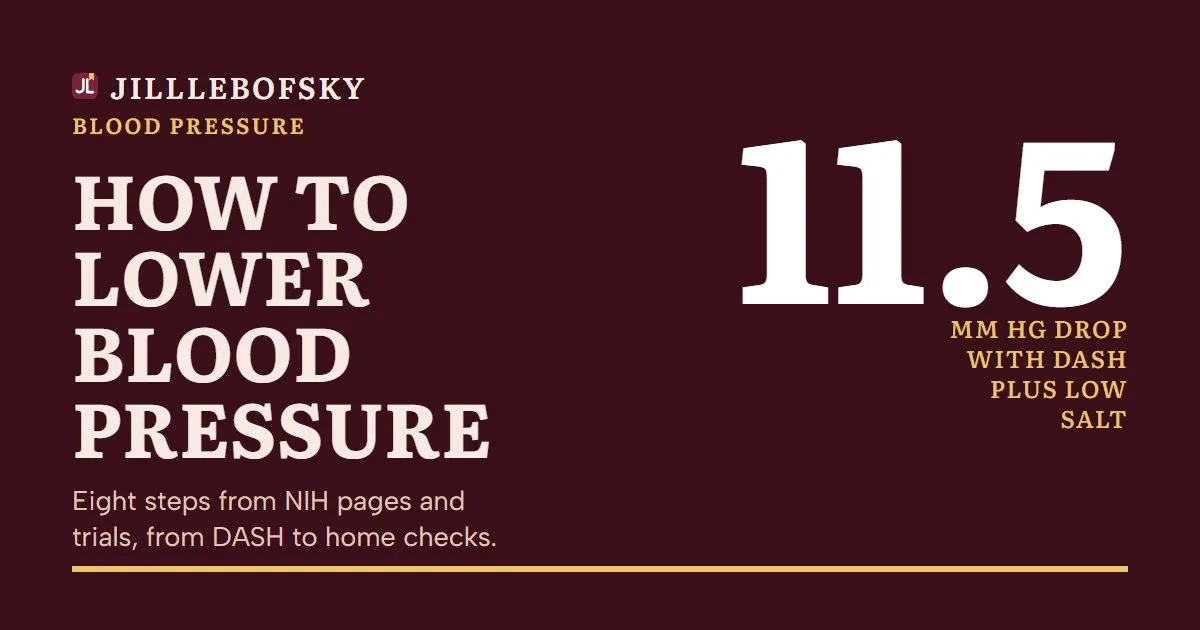
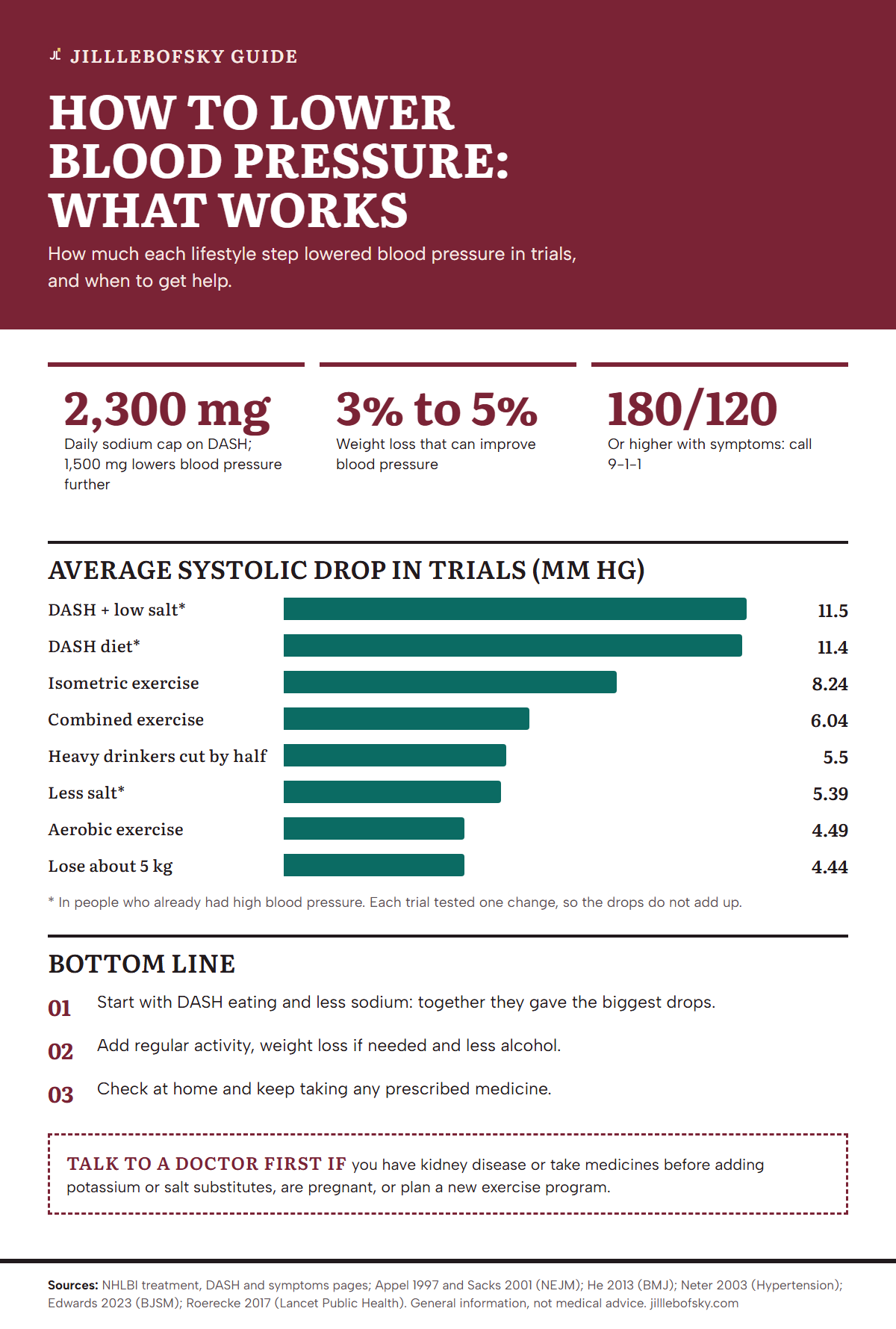
The DASH eating plan with less salt lowered systolic pressure by 11.5 mm Hg in people with hypertension in a 2001 trial, and NHLBI says it can work as well as medicine.[4][1] Exercise, weight loss and drinking less each add a few more points.
| What counts as high | 130/80 mm Hg or higher on repeat checks; normal is below 120/80[12] |
|---|---|
| Best-studied steps | DASH eating, less sodium, weight loss, regular exercise, less alcohol[1][3][5] |
| Sodium target | Under 2,300 mg a day; 1,500 mg lowers blood pressure further[2] |
| Typical drop per step | About 4 to 11 mm Hg systolic in trials, larger in people who already have hypertension[3][5][8] |
| How fast it shows | Within 30 days to 8 weeks in the DASH feeding trials[3][4] |
| Medicines | Many people need two or more; a provider sets and changes the dose[1] |
| Get help now | 180/120 or higher with chest pain, a severe headache, trouble breathing, weakness, or vision or speech changes: call 9-1-1[11] |
How to lower blood pressure in 8 steps
The steps with the best evidence are the DASH eating plan, less sodium, more potassium from food, regular activity, weight loss and less alcohol, backed by home checks and medicine when needed.[1][2] NHLBI says a treatment plan may use these lifestyle changes alone or together with medicines.[1]
- Eat the DASH way. On 2,000 calories a day that means 4 to 5 servings of vegetables, 4 to 5 of fruit and 2 to 3 of low-fat dairy daily, plus 4 to 5 servings of nuts, seeds or beans a week. It needs no special foods.[2]
- Cut sodium below 2,300 mg a day, then work toward 1,500 mg, which lowers blood pressure further.[2]
- Get more potassium from food. Adult targets are 3,400 mg a day for men and 2,600 mg for women.[6] Beans, lentils, potatoes, dried fruit and leafy greens are good sources.
- Move most days. NHLBI says even 10 minutes of walking a day may help, and sitting less helps too.[1] Walking, strength work and wall squats all lowered blood pressure in a 2023 review of 270 trials.[8]
- Lose weight if you carry extra. Losing just 3% to 5% of your body weight can improve blood pressure.[1]
- Drink less alcohol, or stop. Heavy drinkers who cut back by about half saw the clearest drop.[9][1]
- Check your blood pressure at home. NHLBI says home readings with support from your care team can help people with hypertension lower their numbers.[10]
- Take prescribed medicine as directed. Lifestyle changes work alongside it, and many people need two or more medicines.[1]
NHLBI also advises quitting smoking and sleeping 7 to 9 hours.[1] The National Institute on Aging adds that treating sleep apnea and managing stress can help lower blood pressure.[14]
How much each step lowered blood pressure in trials
| Step and study | Who was studied | Average drop | Note |
|---|---|---|---|
| DASH diet (Appel 1997)[3] | 459 adults, 8 weeks | 5.5/3.0 overall; 11.4/5.5 with hypertension | Food was provided; salt held steady |
| DASH plus low sodium (Sacks 2001)[4] | 412 adults | 11.5 systolic with hypertension; 7.1 without | Compared with a typical diet high in sodium |
| Less salt (He 2013)[5] | 34 trials, 3,230 people | 5.39/2.82 with hypertension; 2.42/1.00 without | Salt cut by about 4.4 g a day |
| Weight loss (Neter 2003)[7] | 25 trials, 4,874 people | 4.44/3.57 after about 5.1 kg lost | Roughly 1 mm Hg per kg |
| Exercise (Edwards 2023)[8] | 270 trials, 15,827 people | Aerobic 4.49/2.53; combined 6.04/2.54; isometric 8.24/4.00 | Isometric data come from fewer, smaller trials |
| Less alcohol (Roerecke 2017)[9] | 36 trials, 2,865 people | 5.50/3.97 in people having 6 or more drinks a day who cut by half | No clear drop at 2 or fewer drinks a day |
Each trial tested one change, so the numbers do not simply add up. People who start with higher readings tend to see bigger drops.[3][5]
How can I lower my blood pressure quickly?
No food, drink or breathing trick has been shown to lower blood pressure safely within minutes at home. The fastest proven lifestyle change is diet: in the DASH-Sodium trial, blood pressure dropped within each 30-day eating period.[4] If a reading is very high, the quick and safe step is a call to your provider, who may start a medicine or change your dose.[11]
NHLBI gives clear steps for a reading of 180/120 or higher. If you have no symptoms, wait 5 minutes and check again. If it is still high, call your provider.[11] If it is still high and you have any warning signs, call 9-1-1 and do not wait to see if the number comes down on its own.[11]
Searches for how to lower blood pressure immediately often turn up hot showers, garlic shots or cold water tricks. We found no trial behind any of them, so they are not in this guide.
What are natural ways to lower blood pressure with food?
DASH (Dietary Approaches to Stop Hypertension) is an eating plan rich in vegetables, fruit, whole grains, low-fat dairy, beans and nuts, and low in sodium and saturated fat.[2] It is high in potassium, calcium, magnesium, fiber and protein. NHLBI says DASH plus a low-salt plan can be as effective as medicines.[2][1]
In the original 1997 trial, 459 adults ate DASH meals for 8 weeks. Their blood pressure fell 5.5/3.0 mm Hg more than on a typical American diet, and 11.4/5.5 mm Hg more in the 133 people with hypertension.[3]
Cutting salt adds to the effect. A 2013 review of 34 trials found that cutting about 4.4 g of salt a day lowered systolic pressure by 5.39 mm Hg in people with hypertension.[5]
Potassium-rich foods are a core part of DASH. These are among the richest sources, using USDA data listed by the NIH:[6]
| Food | Serving | Potassium |
|---|---|---|
| Dried apricots | 1/2 cup | 755 mg |
| Lentils, cooked | 1 cup | 731 mg |
| Baked potato, flesh | 1 medium | 610 mg |
| Kidney beans, canned | 1 cup | 607 mg |
| Banana | 1 medium | 422 mg |
| Spinach, raw | 2 cups | 334 mg |
| Salmon, farmed Atlantic | 3 ounces | 326 mg |
People with kidney disease or who take certain medicines should ask a provider before adding a lot of potassium or using salt substitutes, because of the risk of high blood potassium.[6] You can find more food guides in our blood pressure guides.
What causes high blood pressure?
Most high blood pressure builds slowly as blood vessels stiffen with age, often helped along by family history and daily habits.[13] NHLBI lists a diet high in salt and low in potassium, too much alcohol or caffeine, too little activity, poor sleep and high stress as habits that raise it.[13]
Some medicines raise it too. NHLBI names antidepressants, decongestants, hormonal birth control pills, and NSAIDs such as aspirin or ibuprofen.[13] Do not stop any of them on your own; ask your provider whether another option fits.
Health problems can also play a part, including chronic kidney disease, sleep apnea, thyroid problems, obesity and some tumors.[13] Stimulant drugs such as cocaine and methamphetamine raise blood pressure as well.[13]
If you drink a lot of coffee or energy drinks, our guide on how long caffeine stays in your system explains how long each cup lingers, which helps when you time a home reading.
How do you check your blood pressure at home?
Self-measured blood pressure means using a cuff monitor at home, away from a clinic, to track your numbers over time.[10] NHLBI suggests taking two to three readings 1 minute apart, at the same time each day, and sharing the log with your provider.[10]
The NHLBI fact sheet lists these steps:[10]
- For 30 minutes before, skip exercise, meals, caffeine and smoking.
- If you take blood pressure medicine, measure before your dose.
- Empty your bladder, then sit quietly for 5 minutes with your back supported.
- Put the cuff on your bare upper arm, above the elbow.
- Rest your arm on a table at heart level, feet flat and uncrossed.
- Do not talk or watch TV during the reading.
Compare your average with the standard adult categories:[12]
| Category | Top number (systolic) | Bottom number (diastolic) |
|---|---|---|
| Normal | Less than 120 | and less than 80 |
| Elevated | 120 to 129 | and less than 80 |
| Stage 1 high | 130 to 139 | or 80 to 89 |
| Stage 2 high | 140 or higher | or 90 or higher |
| Hypertensive crisis | Higher than 180 | and/or higher than 120 |
A diagnosis takes two or more readings at separate appointments, so one high home number calls for a recheck.[12] Ask your provider which target fits you.[10]
What high blood pressure symptoms need a doctor right away?
High blood pressure usually causes no symptoms at all, which is why regular checks matter.[12] Symptoms tend to appear only when pressure is dangerously high or has already caused serious problems.[11] A reading of 180/120 or higher needs medical attention.[11]
See a doctor right away, or call 9-1-1, if your blood pressure is 180/120 or higher and you have any of these:[11]
- A sudden, severe headache
- Trouble breathing
- Sudden, severe pain in your chest, back or belly
- Numbness or weakness
- A sudden change in vision
- Problems talking
Who should be careful with these steps?
Before starting any exercise program, ask your provider what level of activity is right for you.[1] If you are pregnant or planning a pregnancy, talk with your provider about your blood pressure medicines, since not all are safe in pregnancy.[1]
Potassium pills and salt substitutes are not for everyone. People with kidney disease or on certain medicines can build up too much potassium.[6] If you snore loudly or someone has seen you stop breathing in your sleep, tell your doctor, because sleep apnea can raise blood pressure.[14][13]
When do you need blood pressure medicine?
Doctors start with lifestyle changes and add medicine when those are not enough or when readings are high, and many people need two or more medicines.[1] Your provider may also use a risk calculator to weigh your chances of heart problems before deciding.[1]
The common types NHLBI lists are ACE inhibitors and angiotensin II receptor blockers, which keep blood vessels from narrowing, calcium channel blockers, which let vessels relax, and diuretics such as thiazides, which remove extra water and sodium. Some come in one combined pill.[1]
If side effects bother you, tell your provider. They may change the dose or switch the medicine.[1] Do not stop on your own. High blood pressure usually has no symptoms, so you may not notice if it climbs again.[12]
Do supplements lower blood pressure?
The evidence is small. A 2016 review of 34 trials with 2,028 people found that magnesium, at a median 368 mg a day for 3 months, lowered blood pressure by about 2.00/1.78 mm Hg.[15] Potassium pills sold over the counter usually hold 99 mg or less, a tiny share of the daily target.[6] No supplement replaces DASH eating, less salt or prescribed medicine. Read how we review supplements and our editorial policy for how we judge label doses against the trials.
What should be on your blood pressure checklist?
A short weekly checklist keeps the proven steps in view and gives your provider useful data. Use it as a starting point and adjust it with your care team.[1][10]
- Log two to three home readings each morning, 1 minute apart.[10]
- Check the sodium on every packaged food label and keep the day under 2,300 mg.[2]
- Aim for 4 to 5 servings each of vegetables and fruit a day.[2]
- Add beans, lentils or a potato for potassium, unless your provider has told you to limit it.[6]
- Walk at least 10 minutes a day and build up from there.[1]
- Count your drinks and cut back if you drink heavily.[9]
- Bring your log and a list of all medicines, including cold pills and pain relievers, to each visit.[13]
Bottom line
The best way to lower blood pressure is to stack the habits with real trial data behind them: DASH eating, less sodium, more potassium from food, regular movement, weight loss if needed and less alcohol. Diet changes showed results within a month in the DASH trials.[4]
For most people the better first step is cutting sodium and shifting meals toward DASH, because those two changes together produced the biggest drops in the trials we read. If your readings stay at 130/80 or higher, or ever pass 180/120, bring in your provider, since many people need medicine as well.[4][12][1]
Frequently asked questions
What is the best way to lower blood pressure?
For most people the best start is the DASH eating plan with less sodium. In the DASH-Sodium trial the two together lowered systolic pressure by 11.5 mm Hg in people with hypertension. Add regular activity, weight loss if needed and less alcohol.
How can I reduce blood pressure naturally without medicine?
Eat the DASH way, keep sodium under 2,300 mg a day, get potassium from food, move most days, lose weight if you carry extra and drink less. Some people still need medicine, so keep checking and talk with your provider.
How long does it take to lower blood pressure with diet?
In the DASH trials, blood pressure fell within 30 days to 8 weeks of changing what people ate. Results depend on how high your readings start and how closely you follow the plan, so keep logging home readings.
Does drinking water lower blood pressure?
None of the NIH pages or trials we read showed that drinking extra water lowers blood pressure. Swapping sugary or alcoholic drinks for water can still help, since cutting heavy drinking lowered readings in trials.
What should my blood pressure be?
MedlinePlus lists normal adult blood pressure as below 120/80 mm Hg. Readings of 130/80 or higher on repeat checks count as high. Ask your provider which personal target fits your age and health.
Sources
- High Blood Pressure: Treatment. NHLBI, NIH, 2024
- DASH Eating Plan. NHLBI, NIH, 2026
- A clinical trial of the effects of dietary patterns on blood pressure (DASH, Appel et al.). New England Journal of Medicine, 1997
- Effects on blood pressure of reduced dietary sodium and the DASH diet (DASH-Sodium, Sacks et al.). New England Journal of Medicine, 2001
- Effect of longer term modest salt reduction on blood pressure (He et al.). BMJ, 2013
- Potassium: Fact Sheet for Health Professionals. NIH Office of Dietary Supplements, 2022
- Influence of weight reduction on blood pressure: a meta-analysis (Neter et al.). Hypertension, 2003
- Exercise training and resting blood pressure: a network meta-analysis (Edwards et al.). British Journal of Sports Medicine, 2023
- The effect of a reduction in alcohol consumption on blood pressure (Roerecke et al.). Lancet Public Health, 2017
- Self-Measured Blood Pressure Fact Sheet. NHLBI, NIH, 2023
- High Blood Pressure: Symptoms. NHLBI, NIH, 2026
- High Blood Pressure. MedlinePlus, National Library of Medicine, 2026
- High Blood Pressure: Causes and Risk Factors. NHLBI, NIH, 2026
- High Blood Pressure and Older Adults. National Institute on Aging, NIH, 2026
- Effects of magnesium supplementation on blood pressure: a meta-analysis (Zhang et al.). Hypertension, 2016
This page is general information, not medical advice. Talk to your doctor or pharmacist before you start any supplement, especially if you are pregnant, take medicine or have a health condition. Read our medical disclaimer and how we review.