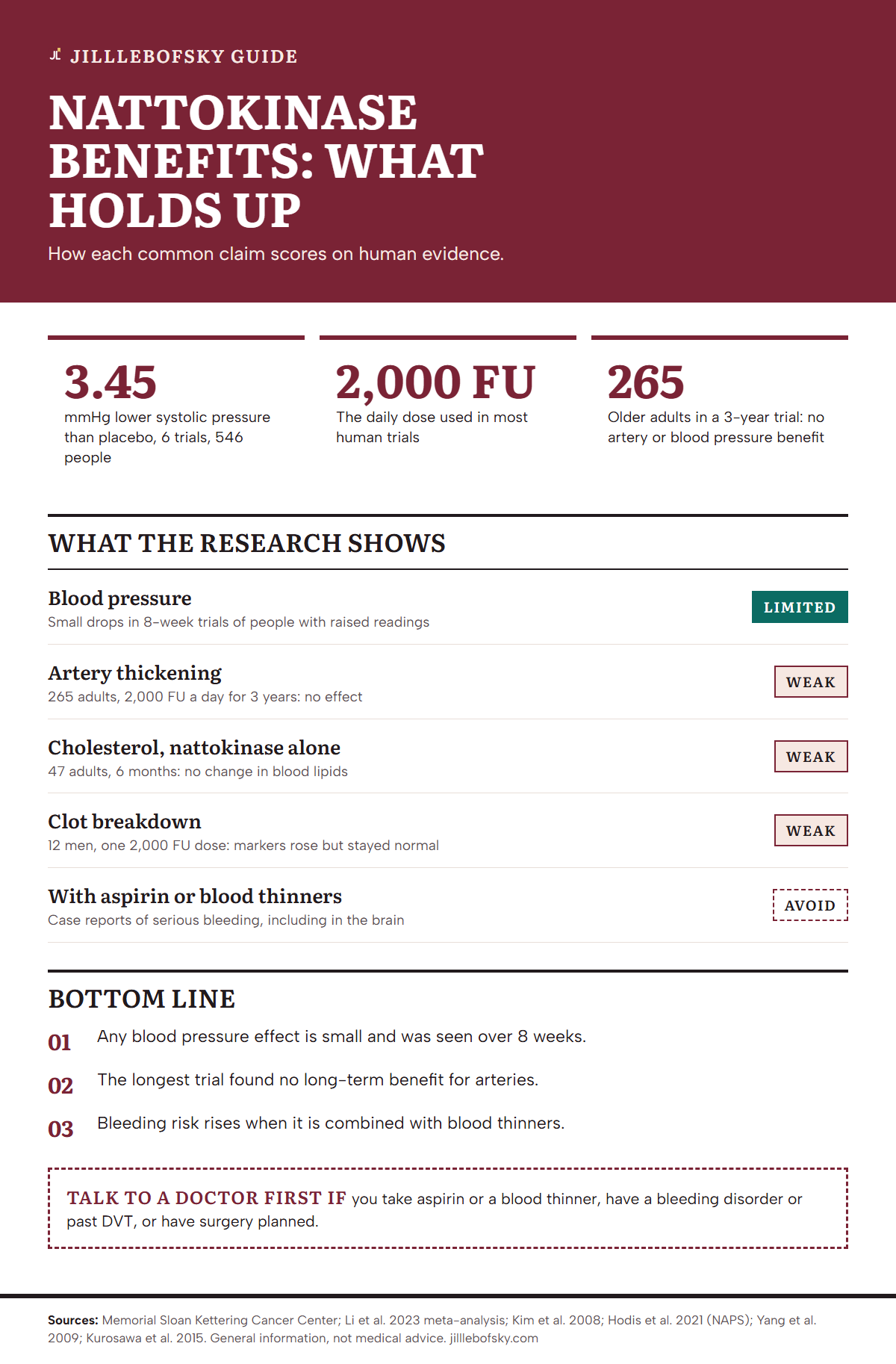
Nattokinase is an enzyme from natto, a fermented soybean food. Its best-supported benefit is a small blood pressure drop: 6 trials with 546 people found systolic pressure about 3.45 mmHg lower than placebo. A 3-year trial in 265 older adults found no effect on arteries or blood pressure. It can raise bleeding risk, so avoid it with aspirin or blood thinners.
Nattokinase benefits are mostly claimed for blood pressure and blood flow, and the research is thinner than most labels suggest. We read the Memorial Sloan Kettering herb monograph, a 2023 meta-analysis of six randomized trials, the main blood pressure trials, a 3-year artery study and the bleeding case reports[1][6][7][9][14].
The short answer: in small 8-week trials, nattokinase lowered systolic blood pressure by about 3 to 6 points, but a 3-year trial of 265 older adults found no effect on blood pressure or artery thickening, and it can raise bleeding risk with blood thinners[1][6][7][9].
| What it is | An enzyme made by Bacillus subtilis bacteria when they ferment soybeans into natto[1] |
|---|---|
| Studied for | Blood pressure, clot breakdown, cholesterol, artery plaque and memory[1][6][10][15] |
| Amounts in trials | 2,000 FU a day in most trials, 100 mg a day in one, and 8,000 to 10,800 FU a day in two Chinese studies[7][8][9][10][15] |
| Best evidence | Blood pressure: 6 trials with 546 people, systolic about 3.45 mmHg lower than placebo[6] |
| Weakest claims | Cancer and Alzheimer's disease, with no human trials[1] |
| Safety | Well tolerated in short trials, but may raise bleeding risk[1][6][13][14] |
| Who should avoid it | People on blood thinners or daily aspirin, with a bleeding disorder, or with a history of deep vein thrombosis[1] |
What is nattokinase and what does it do?
Nattokinase is an enzyme that Bacillus subtilis bacteria make while fermenting soybeans into natto, a traditional Japanese food. It is sold as a circulation supplement because lab work shows it can break down fibrin, the protein mesh that holds a blood clot together[1].
Memorial Sloan Kettering (MSKCC) notes that in lab tests its clot-dissolving activity was estimated at about four times that of plasmin, the body's own clot-breaking enzyme[1]. It also appears to disable PAI, a natural brake on clot breakdown[1].
Those are test-tube and animal findings. Human studies are limited, and MSKCC says they mainly suggest a possible drop in blood pressure[1].
The food and the capsule differ in one way that matters for some readers. Raw natto is high in vitamin K, which can interfere with warfarin, while some branded extracts have the vitamin K2 removed[1][8]. Labels list strength in fibrinolytic units (FU), a measure of enzyme activity, or in milligrams. Most human trials used 2,000 FU[7][9][12].
What are the nattokinase benefits backed by human trials?
The best-supported nattokinase benefit is a small drop in blood pressure seen in short trials. A 2023 meta-analysis pooled 6 randomized trials with 546 people and found systolic pressure about 3.45 mmHg lower than with placebo[6]. Evidence for clots, cholesterol, plaque and memory is weak or mixed[9][11][15].
Our grades: Limited means some trials with small or mixed results, and Weak means lab markers only, no placebo group, or no benefit found. Our review method for supplement evidence explains how we weigh studies.
| Study | Who and how long | Dose | Result |
|---|---|---|---|
| Kim, 2008[7] | 86 adults with raised blood pressure, 8 weeks | 2,000 FU | Systolic down 5.55 and diastolic down 2.84 mmHg vs placebo |
| Jensen, 2016[8] | 74 North American adults with raised blood pressure, 8 weeks | 100 mg a day | Diastolic fell from 87 to 84 mmHg; placebo stayed at 87 |
| Li, 2023 meta-analysis[6] | 6 trials, 546 people | Varied | Systolic down 3.45 and diastolic down 2.32 mmHg |
| Hodis, 2021 (NAPS)[9] | 265 healthy adults, median age 65.3, median 3 years | 2,000 FU a day | No effect on artery thickening, stiffness, blood pressure or lab tests |
| Yang, 2009[11] | 47 adults with high cholesterol, 6 months | Nattokinase alone | No change in blood lipids |
| Zhang, 2026[15] | 120 adults with narrowed neck or brain arteries, 6 months | 8,000 FU a day | No change in overall memory and thinking score |
Does nattokinase lower blood pressure?
Nattokinase may lower blood pressure slightly in people whose readings are already raised, based on two 8-week trials. In a 2008 Korean trial of 86 adults, systolic pressure fell 5.55 mmHg more than with placebo[7]. A 3-year trial in healthy older adults saw no blood pressure change at all[9].
The Korean trial enrolled people aged 20 to 80 with untreated systolic readings of 130 to 159 mmHg. Diastolic pressure fell 2.84 mmHg more than placebo, and 73 of the 86 people finished[7].
A 2016 North American trial tested 100 mg a day of one branded extract, NSK-SD, in 74 people who completed it. Average diastolic pressure went from 87 to 84 mmHg, while the placebo group stayed at 87[8]. The 2023 meta-analysis put the pooled effect at 3.45 mmHg systolic and 2.32 mmHg diastolic[6].
So nattokinase may help a little when pressure is high, but no trial has shown it keeps blood pressure down over years[9]. Our guide on how to lower blood pressure without guesswork covers the steps with stronger evidence.
Can nattokinase dissolve blood clots?
No human trial shows that nattokinase dissolves an existing blood clot or prevents one. A 2015 study gave 12 healthy young men a single 2,000 FU dose and found higher clot-breakdown markers for several hours, but every value stayed within the normal range[12].
A 2019 Korean trial in 100 adults with high cholesterol found that 8 weeks of nattokinase lengthened two clotting tests, the closure time and the aPTT, compared with placebo[13]. In plain terms, blood took longer to clot, and that same property is why it is risky next to aspirin or warfarin[1][13].
MSKCC says preliminary studies suggest it may help prevent deep vein thrombosis. It still advises people with a history of DVT to avoid it, because in theory it could loosen an existing clot that then travels[1].
MedlinePlus notes that even prescription blood thinners do not break up clots you already have. They stop clots from growing and new ones from forming[3], and nattokinase has no trial showing it can do that job in their place.
Does nattokinase help cholesterol, artery plaque or memory?
Nattokinase on its own has not lowered cholesterol in placebo-controlled trials. In a 6-month Taiwanese trial of 47 adults with high cholesterol, the nattokinase-only capsule changed nothing, while a version combined with red yeast rice did lower lipids[11]. The 2023 meta-analysis found no lipid benefit at lower doses either[6].
That combination result belongs to red yeast rice, which has its own risks. Our red yeast rice safety and evidence guide covers them, and our guide on how to lower cholesterol with proven steps starts with diet and medicine.
For artery plaque, the 3-year NAPS trial found no slowing of carotid artery thickening at 2,000 FU a day[9]. A 2022 Chinese report of 1,062 people on 10,800 FU a day for 12 months described smaller carotid plaques. Its own authors call it a retrospective study, not a randomized trial, and five of them worked for Sungen Bioscience[10]. The same report found 3,600 FU a day ineffective[10].
For memory, a 2026 trial gave 120 adults with narrowed arteries 8,000 FU a day for 6 months. Overall cognition scores did not change[15]. MSKCC lists Alzheimer's benefits as animal findings only[1].
How much nattokinase is used in studies?
Most human trials used 2,000 FU of nattokinase a day, and none of the sources we read gives an official recommended dose. One trial used 100 mg a day, and two Chinese studies went higher, to 8,000 and 10,800 FU[7][8][10][15]. No randomized trial has shown that higher doses work better.
The table matches each goal to the dose that was tested and what happened. It is a reading aid for your talk with a doctor, not a dosing plan.
| Goal | Dose and length tested | What happened | Our grade |
|---|---|---|---|
| Blood pressure | 2,000 FU or 100 mg a day, 8 weeks | Small drop in people with raised readings[7][8] | Limited |
| Artery thickening | 2,000 FU a day, about 3 years | No effect[9] | Weak |
| Plaque and lipids | 10,800 FU a day, 12 months | Benefit reported, but not randomized[10] | Weak |
| Cholesterol | Nattokinase alone, 6 months | No change[11] | Weak |
| Memory | 8,000 FU a day, 6 months | No change in overall score[15] | Weak |
What to check on a nattokinase supplement label
The trials tested only a few branded extracts, so there is no best nattokinase supplement in the data[8][9][12]. These label checks matter more than the brand name.
- Look for strength in FU, not just milligrams, and compare it with the 2,000 FU used in most trials[7][9].
- If you eat natto or the label is unclear about vitamin K2, ask your doctor before using it with warfarin[1][8].
- Check for soy and natto allergy warnings, since allergic reactions have been reported[1].
- Read the full ingredient list for red yeast rice or other blood-thinning herbs added to the formula[11].
- Skip any product that says it dissolves clots or replaces medicine; no trial supports that[1][3].
- Bring the bottle to your doctor or pharmacist, especially before surgery[2].
Is nattokinase safe, and who should avoid it?
Nattokinase was well tolerated in short trials, but it can raise bleeding risk, especially with aspirin or blood thinners. The 2023 meta-analysis reported no notable side effects[6]. Case reports describe a brain bleed in a patient on aspirin and a fatal internal bleed in an older woman[1][14].
In the 2008 case, a patient taking aspirin after a stroke had a bleed in the cerebellum after 7 days of nattokinase at 400 mg a day. Brain scans also showed tiny old bleeds[14]. MSKCC also reports a patient who swapped warfarin for nattokinase and later developed a clot on a mechanical heart valve[1].
Avoid nattokinase, or ask your doctor first, if any of these apply[1][2]:
- You take warfarin, heparin, a newer anticoagulant or daily aspirin.
- You have a bleeding or clotting disorder, or a past deep vein thrombosis.
- You have surgery coming up.
- You are pregnant or breastfeeding, since supplements like this are rarely tested in those groups.
- You are allergic to soy or natto.
See a doctor right away if
Call 911 for sudden shortness of breath or pain when you breathe, which can signal a clot in the lungs[5]. Get urgent care for any of these[3][5]:
- A swollen, tender leg that hurts to the touch
- A serious fall or bump on the head while on a blood thinner
- Red or brown urine, or red or black stools
- Gum or nose bleeding that does not stop quickly, or brown or bright red vomit
- A severe headache or stomachache, unusual bruising, dizziness or weakness
What do doctors use first for blood pressure and clots?
For high blood pressure, doctors start with heart-healthy lifestyle changes, alone or with medicine. NHLBI says the DASH eating plan combined with lower salt can be as effective as medicines in lowering blood pressure[4]. For clots, the standard care is prescription blood thinners[3].
Blood thinners need regular follow-up, and your provider should know every supplement you take, because some change how well the medicine works[3]. NCCIH warns that supplements can interact with medicines and pose risks before surgery[2].
Nattokinase has not been tested as a replacement for any of these, so a safer order is to get your numbers checked, follow the plan your doctor sets, and then ask whether a supplement adds anything. If your doctor agrees to a trial, recheck your blood pressure after 8 weeks, the point at which the trials measured results, and stop if the numbers have not moved[7][8]. More guides on leg swelling and blood flow sit in our circulation and swollen legs section, and our editorial policy on medical claims explains how we handle them.
Bottom line
Nattokinase shifts clotting markers in lab work and short human studies, and two short trials found small blood pressure drops in people with raised readings[7][8]. The longest controlled trial, 3 years in 265 older adults, found no benefit for arteries or blood pressure[9].
For most people, the DASH plan, less salt and any medicine your doctor prescribes are the better first step, because their evidence is far stronger[4]. Skip nattokinase entirely if you take aspirin or a blood thinner, have a bleeding disorder, or have had a deep vein thrombosis, since that is where the reported harms cluster[1][14].
Frequently asked questions
Is it safe to take nattokinase every day?
In the NAPS trial, healthy older adults took 2,000 FU daily for a median of 3 years, and no lab measure differed from placebo. Daily use is risky if you take aspirin, warfarin or another blood thinner, or have a bleeding disorder.
Does nattokinase contain vitamin K?
Natto, the food, is high in vitamin K, which can weaken warfarin. Nattokinase supplements are extracts, and some brands remove the vitamin K2. Check the label, and never combine either one with warfarin unless your doctor agrees.
Can I take nattokinase with aspirin?
Memorial Sloan Kettering advises against it, because nattokinase may boost the effect of aspirin and lead to heavy bleeding. One reported patient on aspirin had a bleed in the brain after a week of nattokinase at 400 mg a day.
How long does nattokinase take to work?
Blood pressure trials measured their results after 8 weeks. Clotting markers shifted within hours of a single dose but stayed in the normal range. Over 3 years in healthy older adults, researchers found no measurable benefit at all.
Is nattokinase the same as eating natto?
Natto is a sticky fermented soybean food from Japan, and nattokinase is one enzyme taken from it and sold in capsules. The food also carries vitamin K and soy protein, so warfarin use and soy allergy matter more with natto itself.
Sources
- Nattokinase. Memorial Sloan Kettering Cancer Center, About Herbs
- Using Dietary Supplements Wisely. National Center for Complementary and Integrative Health (NCCIH), NIH
- Blood Thinners. MedlinePlus, National Library of Medicine
- High Blood Pressure: Treatment. National Heart, Lung, and Blood Institute (NHLBI)
- Venous Thromboembolism: Symptoms. National Heart, Lung, and Blood Institute (NHLBI), 2022
- Nattokinase Supplementation and Cardiovascular Risk Factors: A Systematic Review and Meta-Analysis of Randomized Controlled Trials. Li et al., Reviews in Cardiovascular Medicine, 2023
- Effects of nattokinase on blood pressure: a randomized, controlled trial. Kim et al., Hypertension Research, 2008
- Consumption of nattokinase is associated with reduced blood pressure and von Willebrand factor: a randomized, double-blind, placebo-controlled North American trial. Jensen et al., Integrated Blood Pressure Control, 2016
- Nattokinase atherothrombotic prevention study: a randomized controlled trial. Hodis et al., Clinical Hemorheology and Microcirculation, 2021
- Effective management of atherosclerosis progress and hyperlipidemia with nattokinase: a clinical study with 1,062 participants. Chen et al., Frontiers in Cardiovascular Medicine, 2022
- Combined nattokinase with red yeast rice but not nattokinase alone has potent effects on blood lipids in human subjects with hyperlipidemia. Yang et al., Asia Pacific Journal of Clinical Nutrition, 2009
- A single-dose of oral nattokinase potentiates thrombolysis and anti-coagulation profiles. Kurosawa et al., Scientific Reports, 2015
- The effects of nattokinase supplementation on collagen-epinephrine closure time, prothrombin time and activated partial thromboplastin time. Yoo et al., Food and Function, 2019
- Cerebellar hemorrhage provoked by combined use of nattokinase and aspirin in a patient with cerebral microbleeds. Chang et al., Internal Medicine, 2008
- Nattokinase supplementation for cognitive enhancement in asymptomatic intracranial/carotid stenosis: a randomized controlled trial. Zhang et al., Journal of Stroke and Cerebrovascular Diseases, 2026
This page is general information, not medical advice. Talk to your doctor or pharmacist before you start any supplement, especially if you are pregnant, take medicine or have a health condition. Read our medical disclaimer and how we review.