To lower cholesterol, start with a heart-healthy eating plan, add soluble fiber such as 3 g of oat beta-glucan or 7 g of psyllium a day, swap saturated fat for unsaturated fats, and get 150 to 300 minutes of activity a week. A full cholesterol-lowering diet cut LDL by about 17% in trials. People at high risk usually also need a statin.
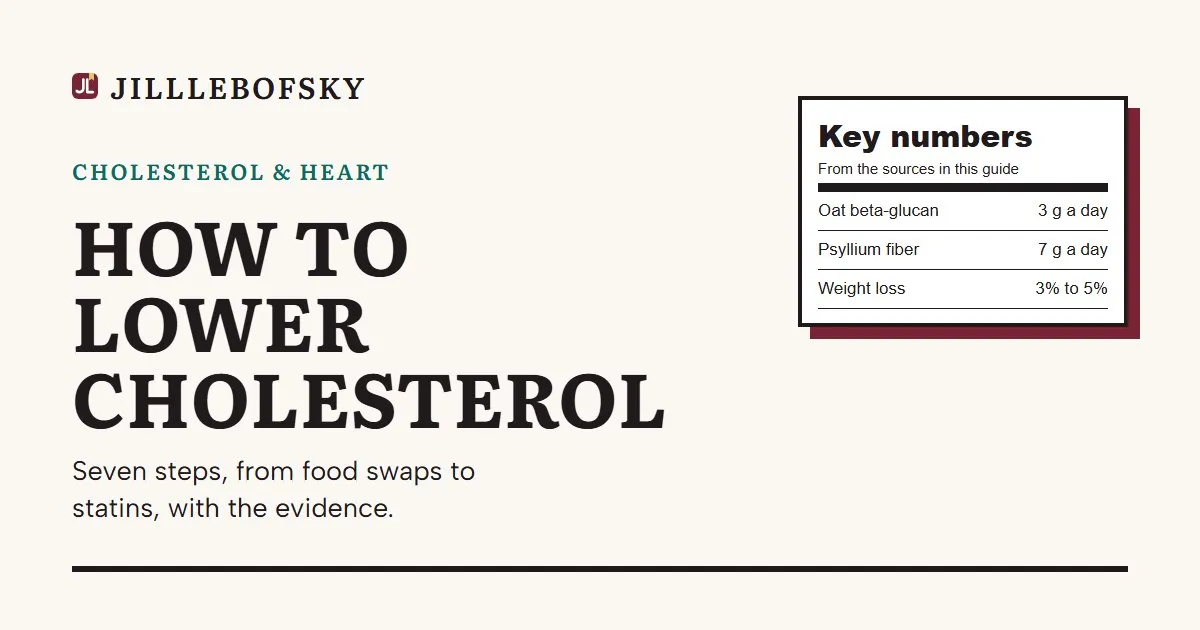
This guide explains how to lower cholesterol in the order most doctors would use: a heart-healthy eating pattern, more soluble fiber, saturated fat swaps, regular activity, modest weight loss, and medicine when your risk is high. We read the NHLBI and MedlinePlus treatment pages, the 2018 AHA/ACC cholesterol guideline, the FDA health-claim rules for fiber and plant sterols, and pooled trials on diet, fiber and saturated fat[1][3][4][5].
The short answer: a full cholesterol-lowering diet cut LDL by about 17% in trials, while statins are dosed to cut it by at least 30% to 50%, so people at high risk usually need both food changes and medicine[10][4].
| What to lower | LDL, the "bad" cholesterol. Under 100 mg/dL is optimal, 160 to 189 is high and 190 or more is very high[2] |
|---|---|
| First step | A heart-healthy eating plan such as TLC or DASH that limits saturated and trans fats[1][3] |
| Soluble fiber | 3 g a day of beta-glucan from oats or barley, or 7 g a day of soluble fiber from psyllium husk[5] |
| Activity | 150 to 300 minutes a week of moderate activity such as brisk walking, plus muscle work 2 days a week[11] |
| Weight | Losing 3% to 5% of body weight lowers LDL in adults with overweight or obesity[1] |
| Medicine | Statins are the most common choice; ezetimibe, bempedoic acid, bile acid sequestrants and PCSK9 inhibitors are other options[1] |
| Use caution | Red yeast rice can contain monacolin K, which is identical to the drug lovastatin, and is not recommended in pregnancy[12] |
How to lower cholesterol: the 7 steps in order
Lowering cholesterol works best as a stack of small changes, because each food step lowers LDL a little and the steps add up. The guideline calls a healthy lifestyle the foundation of heart risk reduction, and medicine is added on top when your risk is high, never in place of it[4]. Here is the order we would follow.
- Know your numbers. Ask for your LDL result and your 10-year heart risk. Men 45 to 65 and women 55 to 65 should be tested every 1 to 2 years[2].
- Pick one eating pattern. The Therapeutic Lifestyle Changes (TLC) diet and the DASH plan both lower cholesterol. They stress whole grains, fruits, vegetables and nuts[1][3].
- Add soluble fiber every day. FDA label rules tie 3 g of oat or barley beta-glucan, or 7 g of psyllium soluble fiber a day, to lower heart risk in a low saturated fat diet[5].
- Swap out saturated fat. Cut back on fatty cuts of meat, full-fat dairy and desserts, the main sources NHLBI names[1]. Use oils, nuts and plant proteins in their place.
- Move most days. Aim for 150 to 300 minutes of moderate activity a week[11]. Ask your provider what level is right for you first[1].
- Lose a little weight if you carry extra. A 3% to 5% loss lowers LDL. For a 200-pound adult, that is 6 to 10 pounds[1]. Sleep 7 to 9 hours, quit smoking and limit alcohol too[1].
- Take medicine when your risk calls for it. Statins are the standard care for high-risk adults, and you keep the lifestyle steps even after you start one[1][4].
Steps 2 to 6 cost little and carry few risks. Step 7 depends on your LDL level, age, diabetes status and heart history, so it is a talk with your doctor.
How do you lower cholesterol naturally with a low cholesterol diet?
To lower cholesterol naturally, eat less saturated and trans fat and more whole grains, fruits, vegetables, nuts and soluble fiber. MedlinePlus says the saturated fat and cholesterol in food make your LDL level rise, which is why diet comes first[2]. A low cholesterol diet is mostly a set of swaps you can keep up for years.
The best long-term data on fat comes from a 2020 Cochrane review. It pooled 15 randomized trials with about 59,000 people. Cutting saturated fat for at least 2 years led to 21% fewer combined heart events, though it had little or no effect on deaths from any cause[7]. The benefit was clearest when saturated fat was replaced with polyunsaturated fat or carbohydrate[7].
Here are simple swaps built from the NHLBI food advice and the foods tested in cholesterol trials.
| Instead of | Try | Why it helps |
|---|---|---|
| Fatty cuts of meat | Beans, soy foods or tofu a few times a week | Plant protein is part of the Portfolio diet; soy foods have a small cholesterol-lowering effect[10][3] |
| Full-fat dairy | Low-fat dairy or soy milk | Dairy is a main saturated fat source[1] |
| Butter | A spread with added plant sterol esters, used at meals | FDA label claims need 0.65 g of sterol esters per serving, eaten twice a day with meals[6] |
| Sugary cereal or white toast | Oatmeal or barley | Oat and barley beta-glucan is a soluble fiber[5] |
| Desserts and sweets | Fruit | NHLBI lists desserts with fatty meats and dairy as foods to limit[1] |
| Chips and crackers | A handful of nuts | Nuts are in both the NHLBI plan and the Portfolio diet[1][10] |
What foods lower cholesterol the most?
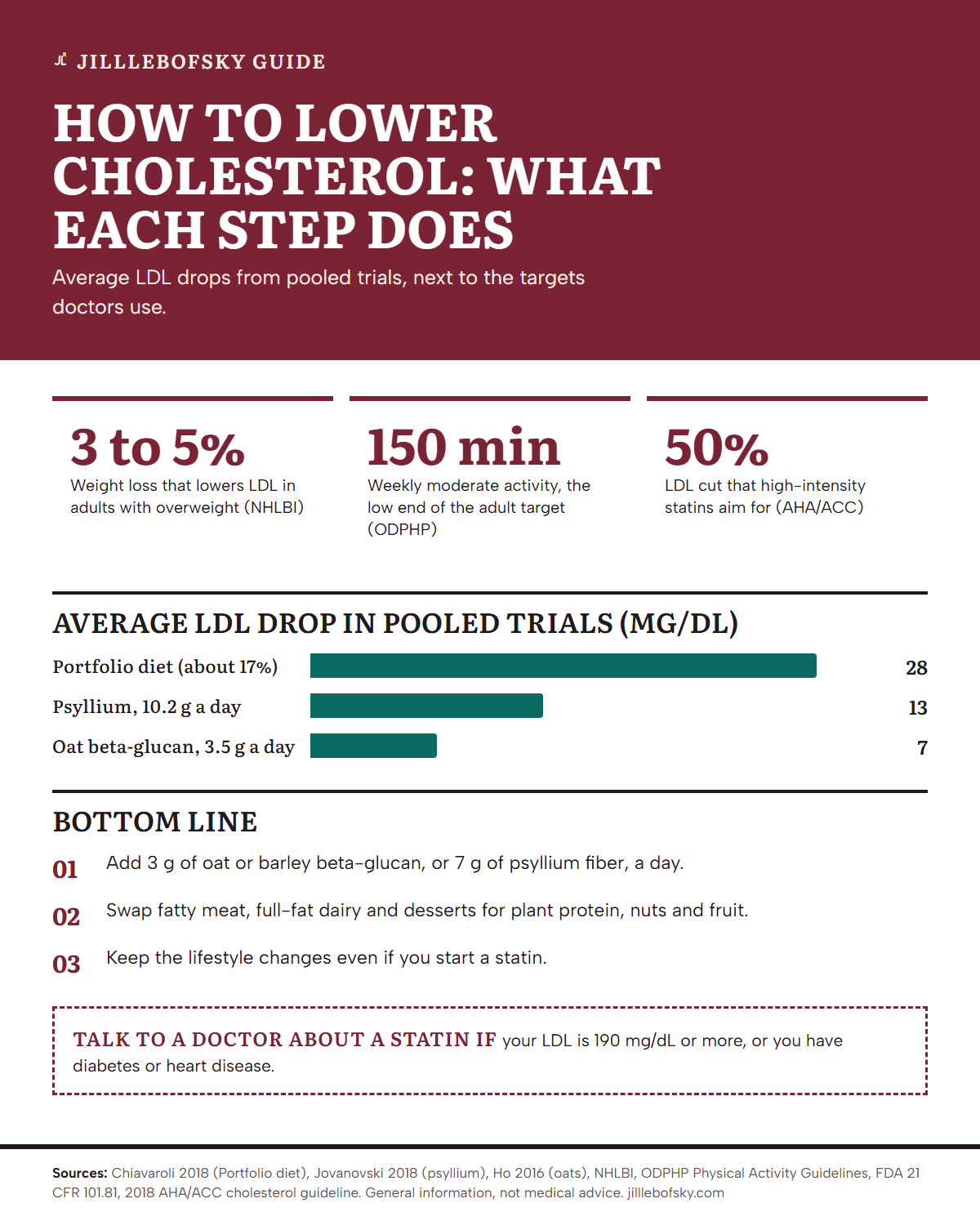
The foods with the best evidence for lowering LDL are oats, barley, psyllium, soy foods, nuts and foods with added plant sterols or stanols. Each one has a modest effect. Eaten together, as in the Portfolio diet, they lowered LDL by about 17% in controlled trials[10]. The table shows the daily amounts that FDA label rules and trials used.
| Food | Daily amount | What the evidence says |
|---|---|---|
| Oats and barley | 3 g beta-glucan (0.75 g per serving)[5] | 58 trials: 3.5 g a day lowered LDL by about 7 mg/dL[9] |
| Psyllium husk | 7 g soluble fiber (1.7 g per serving)[5] | 28 trials: about 10.2 g a day lowered LDL by about 13 mg/dL[8] |
| Plant sterol or stanol esters | 1.3 g sterol esters or 3.4 g stanol esters[6] | Can lower cholesterol when taken with meals[3] |
| Soy foods | Part of meals, not pills | Small effect; foods do better than supplements[3] |
| Nuts | A variety, in place of snacks | Part of the Portfolio diet[10] |
| Whole flaxseed | Ground into food | May help; flaxseed oil does not[3] |
A bowl of oatmeal is one way to start. Psyllium is a fiber supplement, so it fits people who struggle to eat enough fiber from food. Our gut health supplements guide covers how fiber products differ. Add fiber slowly and drink water with it.
How much can you lower LDL cholesterol?
Single food changes lower LDL by about 7 to 13 mg/dL, a full Portfolio diet by about 17%, and statins by at least 30% to 50%. That gap is the reason people with very high LDL rarely reach their goal on diet alone[8][9][10][4]. If you are searching for how to lower LDL cholesterol, start with where your number sits.
- Under 100 mg/dL: optimal[2]
- 100 to 129 mg/dL: near or above optimal[2]
- 130 to 159 mg/dL: borderline high[2]
- 160 to 189 mg/dL: high[2]
- 190 mg/dL or more: very high[2]
People with heart disease or high risk have different goals, so ask what yours is[2]. The studies below show how big each step's effect was.
| Study | Who and how many | What changed | Result |
|---|---|---|---|
| Portfolio diet review, 2018 | 7 trial comparisons, 439 adults with high cholesterol, at least 3 weeks | Nuts, plant protein, soluble fiber and plant sterols added to a low-fat diet | LDL down about 17% (0.73 mmol/L, about 28 mg/dL); high certainty[10] |
| Psyllium review, 2018 | 28 trials, 1,924 people | About 10.2 g psyllium a day | LDL down 0.33 mmol/L (about 13 mg/dL); moderate quality[8] |
| Oat beta-glucan review, 2016 | 58 trials, 3,974 people | About 3.5 g beta-glucan a day | LDL down 0.19 mmol/L (about 7 mg/dL); results varied a lot[9] |
| Cochrane saturated fat review, 2020 | 15 trials, about 59,000 people, at least 2 years | Less saturated fat | 21% fewer combined heart events; little or no change in deaths[7] |
| AHA/ACC guideline, 2018 | Adults who need a statin | Moderate or high-intensity statin | LDL cut targets of at least 30% or at least 50%[4] |
How can you lower cholesterol quickly?
There is no safe shortcut: the fastest large drop comes from prescription medicine, and doctors recheck LDL 4 to 12 weeks after a statin starts. Food changes work too, but more slowly and by less. The Portfolio trials that showed a 17% drop each ran for at least 3 weeks[4][10].
We found no trustworthy source that promises a set drop in a set number of days from diet alone. Be wary of products that do. Red yeast rice is often sold as a fast fix, but NCCIH reports that a review of 28 brands found none listed the amount of monacolin K, its active compound. In 26 brands the amount ranged more than 60-fold, from 0.09 to 5.48 mg per 1,200 mg[12]. With that much spread, a quick drop from one of these products could simply reflect a larger dose of the active compound.
If your LDL is 190 mg/dL or higher, the guideline says to start a high-intensity statin without waiting to calculate risk[4]. For that group, a statin is the faster and stronger option.
Do exercise and weight loss lower cholesterol?
Yes. Regular physical activity can lower LDL and triglycerides and raise HDL, and losing 3% to 5% of body weight lowers LDL in adults with overweight or obesity. Both come from the NHLBI treatment page[1]. Neither source gives a set mg/dL drop for either one, so expect them to add to your diet changes.
The federal activity guidelines ask adults for at least 150 to 300 minutes of moderate aerobic activity each week, such as brisk walking or fast dancing. They also ask for muscle-strengthening work, like lifting weights or push-ups, on at least 2 days a week[11]. A 30-minute walk on 5 days meets the low end.
Other habits help. NHLBI says getting 7 to 9 hours of sleep lowers your risk of high LDL, and it advises limiting alcohol[1]. Quitting smoking can raise your HDL[3]. If you are also watching blood glucose, our blood sugar support guide looks at what the trials show for common ingredients.
When do doctors add a statin or other medicine?
Statins are the most common medicine for high cholesterol, and doctors use them first when LDL is 190 mg/dL or higher, in many adults with diabetes, and after a heart attack or stroke. This is the standard care in the 2018 AHA/ACC guideline, and no supplement replaces it[1][4]. The guideline's main decision points are below.
| If you have | The guideline says |
|---|---|
| Heart disease, a past heart attack or stroke | High-intensity statin, aiming to cut LDL by at least 50%[4] |
| LDL of 190 mg/dL or more | Start a high-intensity statin, with no risk calculation needed[4] |
| Diabetes, age 40 to 75, LDL of 70 mg/dL or more | Moderate-intensity statin[4] |
| Age 40 to 75 with a 10-year risk of 7.5% or more | Moderate-intensity statin if a talk with your doctor favors it; cut LDL by at least 30%[4] |
| Very high risk with LDL still 70 mg/dL or more on a statin | Adding ezetimibe is reasonable[4] |
If statins cause side effects or do not lower LDL enough, ezetimibe or bempedoic acid may be used. Bile acid sequestrants and injected PCSK9 inhibitors are other options[1]. NHLBI notes statins may raise diabetes risk, mainly in people already at high risk, and that actual liver damage is extremely rare[1].
MedlinePlus says that even if you take medicine, you still need to keep up your lifestyle changes[3].
Do cholesterol supplements work, and who should avoid them?
Plant sterols and psyllium have the clearest evidence among cholesterol supplements, while red yeast rice needs the most caution because it can contain the same compound as the drug lovastatin. MedlinePlus says sterol and stanol supplements taken with meals can reduce cholesterol, and that garlic has only a small effect next to medicine[3].
Red yeast rice can carry the same side effects as statins, including muscle, kidney and liver damage, and the same drug interactions[12]. In a 2021 test of 37 products, only one had citrinin, a kidney toxin, below the EU limit. Four products labeled "citrinin-free" were contaminated[12].
Talk to a doctor before any cholesterol supplement if you:
- Are pregnant or breastfeeding; red yeast rice is not recommended[12]
- Already take a statin or other cholesterol medicine; red yeast rice can add the same risks[12]
- Have an LDL of 190 mg/dL or more, which calls for a statin[4]
- Have a family history of very high cholesterol, which can point to familial hypercholesterolemia[2]
Practical checklist: what to check on the label
We use the same label checks described in how we review supplements.
- Fiber products: look for grams of soluble fiber per serving. A psyllium heart claim needs 1.7 g per serving, and an oat claim needs 0.75 g of beta-glucan[5].
- Sterol foods: look for at least 0.65 g of plant sterol esters per serving, and eat them with meals twice a day[6].
- Red yeast rice: if the label does not state the monacolin K amount, you cannot know your dose[12].
- Do not trust "citrinin-free" claims on their own[12].
- Bring every supplement bottle to your next visit, and get your lipids retested after any change[2].
The bottom line
For most people, a daily bowl of oats or a psyllium dose plus fewer fatty meats and full-fat dairy is the better first step than any cholesterol pill, because these changes have FDA-reviewed amounts and pooled trials behind them[5][8][9]. Add walking and a small weight loss, and the effects stack[1][11].
If your LDL is 190 mg/dL or more, or you have diabetes or heart disease, diet alone is rarely enough and a statin is the standard care[4]. You can find more guides in our cholesterol and heart health section, and our editorial policy explains how we choose sources.
Frequently asked questions
What is the best way to lower cholesterol?
For most people, the best way combines a low saturated fat diet, daily soluble fiber, regular activity and weight loss if needed. People with an LDL of 190 mg/dL or more, diabetes or heart disease usually also need a statin, which cuts LDL by at least 30% to 50%.
How can I lower my cholesterol without medication?
Follow an eating plan such as TLC or DASH, add oats, barley, psyllium, nuts and soy foods, cut fatty meats and full-fat dairy, and move 150 to 300 minutes a week. Combined food changes lowered LDL by about 17% in trials. Ask your doctor whether that is enough for you.
How often should I get my cholesterol checked?
MedlinePlus says men 45 to 65 and women 55 to 65 should have their cholesterol checked every 1 to 2 years. People with heart disease, diabetes or a family history may need tests more often. After starting a statin, doctors recheck within 4 to 12 weeks.
Does sleep affect cholesterol?
Yes. NHLBI says getting 7 to 9 hours of sleep a day lowers your risk for high LDL and high total cholesterol. Poor sleep is one of the lifestyle factors it lists alongside diet, activity, weight, smoking and alcohol.
Does quitting smoking lower cholesterol?
Quitting smoking can raise your HDL, the good cholesterol, according to MedlinePlus. It is part of the heart-healthy lifestyle changes NHLBI recommends along with diet, activity, healthy weight, enough sleep and limiting alcohol.
Sources
- Blood Cholesterol: Treatment. National Heart, Lung, and Blood Institute, NIH
- LDL: The "Bad" Cholesterol. MedlinePlus, National Library of Medicine
- How to Lower Cholesterol. MedlinePlus, National Library of Medicine
- 2018 AHA/ACC Guideline on the Management of Blood Cholesterol (Grundy et al.). Circulation, 2019
- 21 CFR 101.81 Health claims: soluble fiber from certain foods and risk of coronary heart disease. US FDA, Electronic Code of Federal Regulations
- 21 CFR 101.83 Health claims: plant sterol/stanol esters and risk of coronary heart disease. US FDA, Electronic Code of Federal Regulations
- Reduction in saturated fat intake for cardiovascular disease (Hooper et al.). Cochrane Database of Systematic Reviews, 2020
- Effect of psyllium fiber on LDL cholesterol and alternative lipid targets (Jovanovski et al.). American Journal of Clinical Nutrition, 2018
- The effect of oat beta-glucan on LDL-cholesterol, non-HDL-cholesterol and apoB (Ho et al.). British Journal of Nutrition, 2016
- Portfolio Dietary Pattern and Cardiovascular Disease: a systematic review and meta-analysis (Chiavaroli et al.). Progress in Cardiovascular Diseases, 2018
- Top 10 Things to Know About the Second Edition of the Physical Activity Guidelines for Americans. Office of Disease Prevention and Health Promotion, HHS
- Red Yeast Rice: What You Need To Know. National Center for Complementary and Integrative Health, NIH
This page is general information, not medical advice. Talk to your doctor or pharmacist before you start any supplement, especially if you are pregnant, take medicine or have a health condition. Read our medical disclaimer and how we review.