High cholesterol means too much cholesterol, mainly LDL, in your blood. For adults, healthy levels are a total under 200 mg/dL, LDL under 100 and non-HDL under 130. It usually causes no symptoms, so a lipid panel is the only way to know. Over years it builds plaque in the arteries and raises the risk of heart attack and stroke.
High cholesterol means there is too much cholesterol in your blood, and this guide explains what counts as high, what it does to your arteries, what causes it and how it is found. We read the NHLBI and MedlinePlus cholesterol pages, CDC data, the 2018 AHA/ACC cholesterol guideline and three large research papers. We checked each number against its source, as our review method for health guides requires.
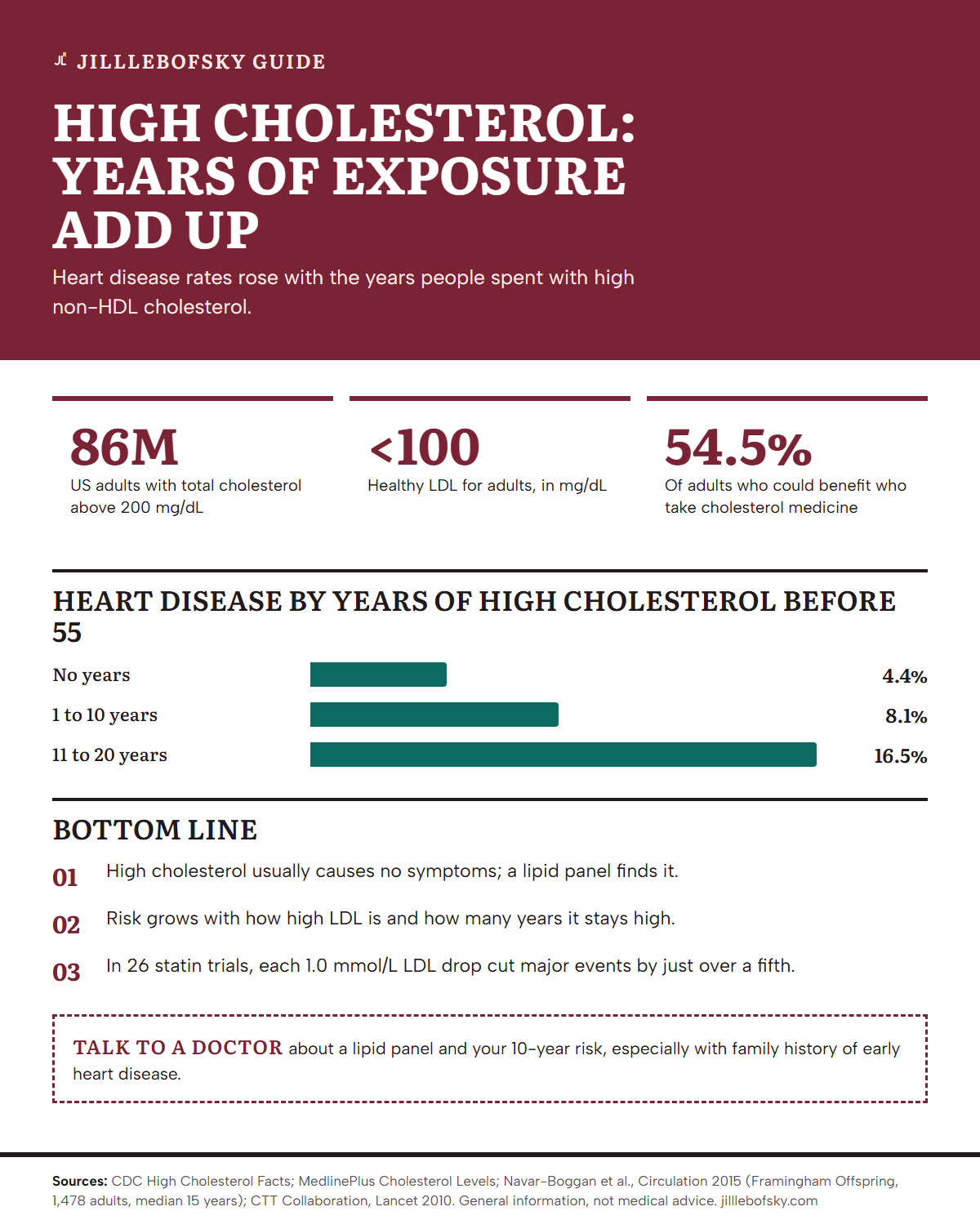
For adults, total cholesterol under 200 mg/dL and LDL under 100 mg/dL are the healthy targets.[9] About 86 million US adults are above 200, and most of them feel nothing at all.[12][2]
| What it is | Too much cholesterol in the blood, also called hypercholesterolemia or hyperlipidemia[7] |
|---|---|
| Healthy adult levels | Total under 200, LDL under 100 and non-HDL under 130 mg/dL[9] |
| How common | About 86 million US adults have total cholesterol above 200 mg/dL[12] |
| Main risk | Plaque in the arteries, which can lead to a heart attack or stroke[1] |
| Symptoms | Usually none; most people learn about it from a blood test[2] |
| Main causes | Lifestyle habits, inherited genes, other conditions and some medicines[3] |
| Standard care | Heart-healthy habits, with statins as the most common medicine[5] |
What is high cholesterol?
High cholesterol is a blood cholesterol level, mainly of LDL, that sits above the healthy range for your age and sex.[9] Cholesterol itself is a waxy, fat-like substance your body needs, and your liver makes all of it you need.[1][11] Problems start when too much LDL stays in the blood for years.[8]
Cholesterol moves through the blood inside particles called lipoproteins. LDL, the "bad" kind, can leave plaque in artery walls. HDL, the "good" kind, carries cholesterol back to the liver so the body can get rid of it.[1]
A third particle, VLDL, mainly carries triglycerides, and it also adds to plaque.[7] Your genes and your daily habits both play a major role in where your numbers land.[1]
What is the medical term for high cholesterol?
The medical term for high cholesterol is hypercholesterolemia. MedlinePlus lists hyperlipidemia and hyperlipoproteinemia as other names for the same problem, and the CDC also uses hyperlipidemia.[7][11]
When the cause is inherited, doctors call it familial hypercholesterolemia, or FH. It affects an estimated 1 in 200 to 1 in 250 people and is thought to be the most common inherited condition of the heart and blood vessels.[10] The 2018 AHA/ACC guideline uses "severe hypercholesterolemia" for an LDL of 190 mg/dL or higher.[13]
What is considered high cholesterol?
For adults 20 and older, a total cholesterol of 200 mg/dL or more, an LDL of 100 or more, or a non-HDL of 130 or more is above the healthy range.[9] The CDC labels a total of 240 mg/dL or more as high.[12] HDL works the other way, so a low number is the problem.[9]
| Measure | Healthy | Of concern |
|---|---|---|
| Total cholesterol | Under 200[9] | 240 or more is high[12] |
| LDL ("bad") | Under 100[8] | 160 to 189 high; 190 or more very high[8] |
| Non-HDL | Under 130[4] | 130 or more[9] |
| HDL ("good") | 60 or more is best[9] | Under 40 for men, under 50 for women[9] |
MedlinePlus splits LDL into five bands: under 100 is optimal, 100 to 129 is near optimal, 130 to 159 is borderline high, 160 to 189 is high and 190 or more is very high.[8] If you have coronary artery disease or a high risk of it, your provider may set a lower LDL goal.[8]
The CDC gives an optimal total of about 150 mg/dL, so a reading of 199 is not a reason to relax.[11]
What are the risks of high cholesterol?
The main risk of high cholesterol is atherosclerosis, a slow buildup of plaque that narrows arteries and can lead to a heart attack or stroke.[6] If a plaque breaks open, a clot can form on it and block blood flow to the heart or brain.[7] Risk climbs the higher LDL goes and the longer it stays up.[15]
Plaque can build up in almost any artery. NHLBI lists heart attack, stroke, vascular dementia, erectile dysfunction, heart failure and limb loss as possible results of blocked arteries.[6] In the legs the problem is called peripheral artery disease; in the neck it is carotid artery disease.[7]
Plaque often starts to form in childhood and gets worse with age.[6] A European Atherosclerosis Society review pooled more than 200 studies with over 2 million people and found that risk rose step by step with LDL and with the years of exposure.[15]
Which factors raise the risk further?
The AHA/ACC guideline lists "risk-enhancing factors" that make doctors more likely to suggest a statin. They matter most for adults 40 to 75 whose 10-year risk falls in the borderline or intermediate range:[13]
- A family history of early heart disease or stroke
- LDL that stays at 160 mg/dL or higher
- Metabolic syndrome or chronic kidney disease
- Preeclampsia in pregnancy, or menopause before age 40
- Rheumatoid arthritis, psoriasis, HIV or another chronic inflammatory disorder
- South Asian ancestry
- Lipoprotein(a) of 50 mg/dL (125 nmol/L) or more
What the research shows
| Study | Who and how many | Length | Result |
|---|---|---|---|
| CTT meta-analysis, 2010[14] | 170,000 people in 26 statin trials | About 5 years median follow-up | Each 1.0 mmol/L (about 39 mg/dL) drop in LDL cut major heart and stroke events by just over a fifth |
| EAS consensus, 2017[15] | More than 200 studies, over 2 million people, over 150,000 events | Over 20 million person-years | Risk rose with LDL level and with years of exposure |
| Framingham Offspring, 2015[16] | 1,478 adults free of heart disease at 55 | Median 15 years after age 55 | Heart disease in 4.4% with no early high non-HDL, 8.1% with 1 to 10 years and 16.5% with 11 to 20 years |
In the CTT data, deaths from any cause also fell 10% for each 1.0 mmol/L drop, and the authors saw no level below which lowering LDL stopped helping.[14] The Framingham study is observational, so it shows a strong link rather than proof on its own, but it fits the trial results.[16]
What causes high cholesterol?
An unhealthy lifestyle is the most common cause of high LDL cholesterol, though inherited genes, other medical conditions and some medicines can raise it too.[3] Eating a lot of saturated fat, sitting most of the day, smoking and carrying extra weight push LDL up or HDL down.[7] Age and menopause matter as well.[3]
- Food: saturated fat from fatty red meat and full-fat dairy raises LDL. NHLBI says it should supply no more than 10% of daily calories.[3]
- Smoking: it lowers HDL, especially in women, and raises LDL.[3]
- Alcohol: more than two drinks a day for men or one for women can raise total cholesterol.[3]
- Stress: it may raise hormones such as corticosteroids that lead the body to make more cholesterol.[3]
- Age: high cholesterol is most often diagnosed between ages 40 and 59, partly because the liver clears LDL less well with age.[3]
- Sex: men aged 20 to 39 have higher risk than women, but after menopause women's LDL usually rises and HDL falls.[3]
For food swaps that cut saturated fat, our heart healthy diet guide with foods to eat and a sample day lays out a full day of meals.
Why is my cholesterol high?
If your cholesterol is high even though you eat reasonably well, the cause is often your genes, another health condition or a medicine you take.[3] Family members tend to have similar levels.[3] When a condition or drug is behind it, your provider may treat that condition or change the medicine or its dose.[5]
Use this table to plan questions for your next visit. It does not replace a diagnosis.
| If this fits you | Ask your doctor about |
|---|---|
| LDL of 190 mg/dL or more, or a parent with early heart disease | Familial hypercholesterolemia and early testing for your children, which can start at age 2[13][4] |
| You have hypothyroidism, diabetes, kidney disease, PCOS, lupus, HIV or sleep apnea | Whether that condition is raising your numbers[3] |
| You take beta-blockers, thiazide diuretics, steroids, acne retinoids, cyclosporine or amiodarone | Whether the medicine or dose can change; never stop it on your own[3][5] |
| You recently went through menopause | How the drop in hormones is shifting your LDL and HDL[3] |
| Your result jumped since your last test | Whether you should have fasted 8 to 12 hours, and repeating the test[4] |
What are the symptoms of high cholesterol?
High cholesterol usually causes no symptoms, so most people only learn about it from a routine blood test.[2] You cannot feel your LDL level. Left undiagnosed or untreated, it can lead to a heart attack or stroke, which is why a test tells you far more than waiting for signs.[2][11]
When levels are very high, a few visible signs can appear. They show up mostly in people with familial hypercholesterolemia:[2][10]
- Fatty bumps on the skin called xanthomas, often on the elbows, knees, hands, ankles or buttocks
- Tendon xanthomas, most often on the Achilles tendons and the tendons of the hands and fingers
- Yellowish deposits on the eyelids, called xanthelasmata
- A grayish-white ring around the cornea of the eye, called corneal arcus
Corneal arcus can also come with normal aging, so on its own it does not prove high cholesterol.[2] Chest pain, by contrast, is a sign that plaque may already be limiting blood flow to the heart.[11] Our guide to heart attack symptoms and when to call 911 lists the warning signs that need emergency care.
How is high cholesterol diagnosed and treated?
High cholesterol is diagnosed with a lipid panel, a blood test that measures total, LDL and HDL cholesterol plus triglycerides.[4] Your provider may ask you to fast for 8 to 12 hours first. Treatment starts with heart-healthy habits, and statins are the medicine doctors use most.[4][5]
NHLBI suggests this testing schedule for healthy people:[4]
- A first check at ages 9 to 11, then every 5 years, or as early as age 2 with a family history
- Every 5 years for younger adults
- Every 1 to 2 years for men aged 45 to 65 and women aged 55 to 65
- Every year after 65
The first treatment step is lifestyle: the TLC or DASH eating plan, regular activity, losing 3% to 5% of body weight if you carry extra, 7 to 9 hours of sleep, quitting smoking and limiting alcohol.[5] Our step-by-step guide on how to lower cholesterol with trial-backed steps covers each one.
The guideline says to start a high-intensity statin at an LDL of 190 mg/dL or more without waiting for a risk score.[13] For adults 40 to 75 with a 10-year risk of 7.5% or more, a moderate-intensity statin is an option after a shared talk.[13] Ezetimibe, bempedoic acid, bile acid sequestrants and PCSK9 inhibitors are added when statins are not enough or not tolerated.[5] Only 54.5% of US adults who could benefit from cholesterol medicine take it.[12]
When should you see a doctor about high cholesterol?
See a doctor if you have never had a lipid panel, if your last result was above the healthy range, or if close relatives had early heart disease.[4] A provider weighs your whole risk, including age, blood pressure, diabetes and family history, before deciding whether you need medicine.[13]
Statins usually do not cause side effects. They may raise the risk of diabetes, mainly in people already at high risk, and real liver damage is extremely rare. Muscle damage is a rare side effect.[5] Report muscle pain or other new symptoms rather than stopping on your own.
No supplement replaces a prescribed statin. If you are weighing one, our red yeast rice guide on LDL results and label risks explains what testing of those products found. More guides sit in our cholesterol and heart health section.
Checklist for your next cholesterol test
- Ask whether you need to fast; some labs want 8 to 12 hours.[4]
- Bring a list of every medicine, including steroids, diuretics, beta-blockers and acne retinoids.[3]
- Write down any family history of early heart attack, stroke or high cholesterol.[4]
- Ask for your LDL and non-HDL numbers, not just the total.[4]
- Ask whether a one-time lipoprotein(a) test fits your history; it is not part of a routine panel.[4]
- Ask for your 10-year risk estimate and what number would change the plan.[13]
- Tell your provider about any supplement before you start it, and keep taking prescribed medicine.[5]
The bottom line on high cholesterol
High cholesterol is common and silent, and a simple blood test finds it. About 25 million US adults have a total above 240 mg/dL.[12] What it means for you depends on your LDL, your family history and your other conditions.[13]
For most people, the better first step is a lipid panel and a talk about 10-year risk, because the trials show that lowering LDL, mostly with statins plus diet and activity, is what cuts heart attacks and strokes.[14][5] Supplements can be discussed after that, as an extra, never as a swap for prescribed medicine.
Frequently asked questions
Is it bad if your good cholesterol is high?
Usually not. MedlinePlus says an HDL of 60 mg/dL or more is best for adults. NHLBI adds that high HDL may not protect as much as once believed, especially if you also have high blood pressure, obesity or diabetes.
Can children have high cholesterol?
Yes. The CDC estimates about 7% of US children and teens aged 6 to 19 have high total cholesterol. NHLBI advises a first test at ages 9 to 11, or as early as age 2 when the family has high cholesterol or early heart disease.
Is high cholesterol genetic?
It can be. Familial hypercholesterolemia is an inherited condition that affects about 1 in 200 to 1 in 250 people and causes very high LDL. Family members usually have similar cholesterol levels, so a parent's history is worth sharing with your doctor.
Do you need to fast before a cholesterol test?
Not always. The 2018 AHA/ACC guideline says screening can use a fasting or nonfasting blood sample. NHLBI notes your provider may still ask you to fast for 8 to 12 hours, so follow the instructions your lab or clinic gives you.
How soon is cholesterol rechecked after starting a statin?
The AHA/ACC guideline advises a repeat lipid test 4 to 12 weeks after starting a statin or changing the dose, then every 3 to 12 months as needed. That shows whether LDL has dropped enough and whether the plan needs changing.
Sources
- What Is Blood Cholesterol?. NHLBI, NIH, 2024
- Blood Cholesterol: Symptoms. NHLBI, NIH, 2024
- Blood Cholesterol: Causes and Risk Factors. NHLBI, NIH, 2024
- Blood Cholesterol: Diagnosis. NHLBI, NIH
- Blood Cholesterol: Treatment. NHLBI, NIH
- What Is Atherosclerosis?. NHLBI, NIH, 2024
- Cholesterol. MedlinePlus, National Library of Medicine
- LDL: The Bad Cholesterol. MedlinePlus, National Library of Medicine
- Cholesterol Levels. MedlinePlus Lab Tests, National Library of Medicine
- Familial hypercholesterolemia. MedlinePlus Genetics
- About Cholesterol. CDC, 2024
- High Cholesterol Facts. CDC, 2024
- 2018 AHA/ACC Guideline on the Management of Blood Cholesterol. Circulation, 2019
- Efficacy and safety of more intensive lowering of LDL cholesterol: a meta-analysis of data from 170,000 participants in 26 randomised trials. Lancet, 2010
- Low-density lipoproteins cause atherosclerotic cardiovascular disease: EAS consensus statement. European Heart Journal, 2017
- Hyperlipidemia in early adulthood increases long-term risk of coronary heart disease. Circulation, 2015
This page is general information, not medical advice. Talk to your doctor or pharmacist before you start any supplement, especially if you are pregnant, take medicine or have a health condition. Read our medical disclaimer and how we review.