CoQ10 is a compound your body makes to help cells produce energy. Its best-studied benefit is in heart failure, where one 420-person trial of 300 mg a day for 2 years found fewer major heart events, though a Cochrane review called the evidence unconvincing. It probably does not lower blood pressure, statin muscle results are mixed, and it may interact with warfarin.
CoQ10 benefits are one of the most searched supplement questions, and the answers online often run ahead of the research. We read the NCCIH page on coenzyme Q10, the NIH Office of Dietary Supplements fact sheet, the National Cancer Institute summary, two Cochrane reviews, two statin meta-analyses and the main trials on heart failure, migraine and IVF[1][2][3][6][7][8].
The short answer: CoQ10 has one encouraging heart failure trial (420 patients, 300 mg a day for 2 years) and a small migraine trial, but federal reviewers call most of the evidence inconclusive or too limited, and it probably does not lower blood pressure[1][5][9][10].
| What it is | A substance your body makes, with the highest levels in the heart, liver, kidneys and pancreas[1] |
|---|---|
| Food sources | Fish, meats and whole grains[2] |
| Studied for | Heart failure, statin muscle symptoms, blood pressure, migraine and fertility[1][5][7][9][10][12] |
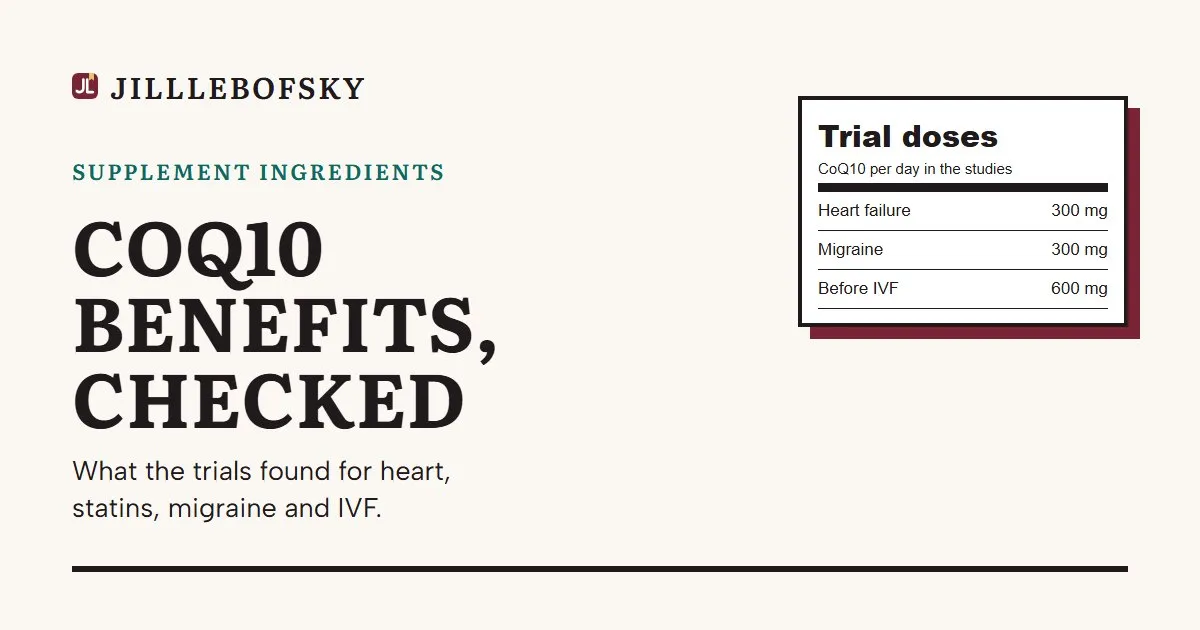
| Doses in key trials | 300 mg a day (heart failure, migraine) to 600 mg a day (IVF)[5][10][12] |
| Best evidence | Heart failure: one 420-person trial looked positive, but a Cochrane review found no convincing evidence overall[5][6] |
| Safety | No serious side effects reported; mild insomnia or stomach upset can occur[1] |
| Check with a doctor first | People on warfarin, insulin or cancer treatment[1][3] |
What is CoQ10 and what does it do?
Coenzyme Q10 (CoQ10) is a fat-soluble compound that helps your cells' mitochondria turn food into energy. Your body makes it on its own, and you also get some from fish, meats and whole grains[2]. The highest levels sit in the heart, liver, kidneys and pancreas[1].
Inside the mitochondria, CoQ10 passes electrons along the chain that makes ATP, the fuel cells run on[2]. In its reduced form, called ubiquinol, it also works as an antioxidant that protects cell membranes and DNA from oxidative damage[2].
Researchers got interested in supplements because people with some diseases have lower CoQ10 levels[1]. Lower levels alone cannot show whether a capsule changes how you feel or how long you live. Only trials can answer that.
CoQ10 is sold in the United States as a dietary supplement[1]. You can browse our other supplement ingredient guides for how we handle evidence for similar products.
What do trials show about CoQ10 benefits for heart failure?
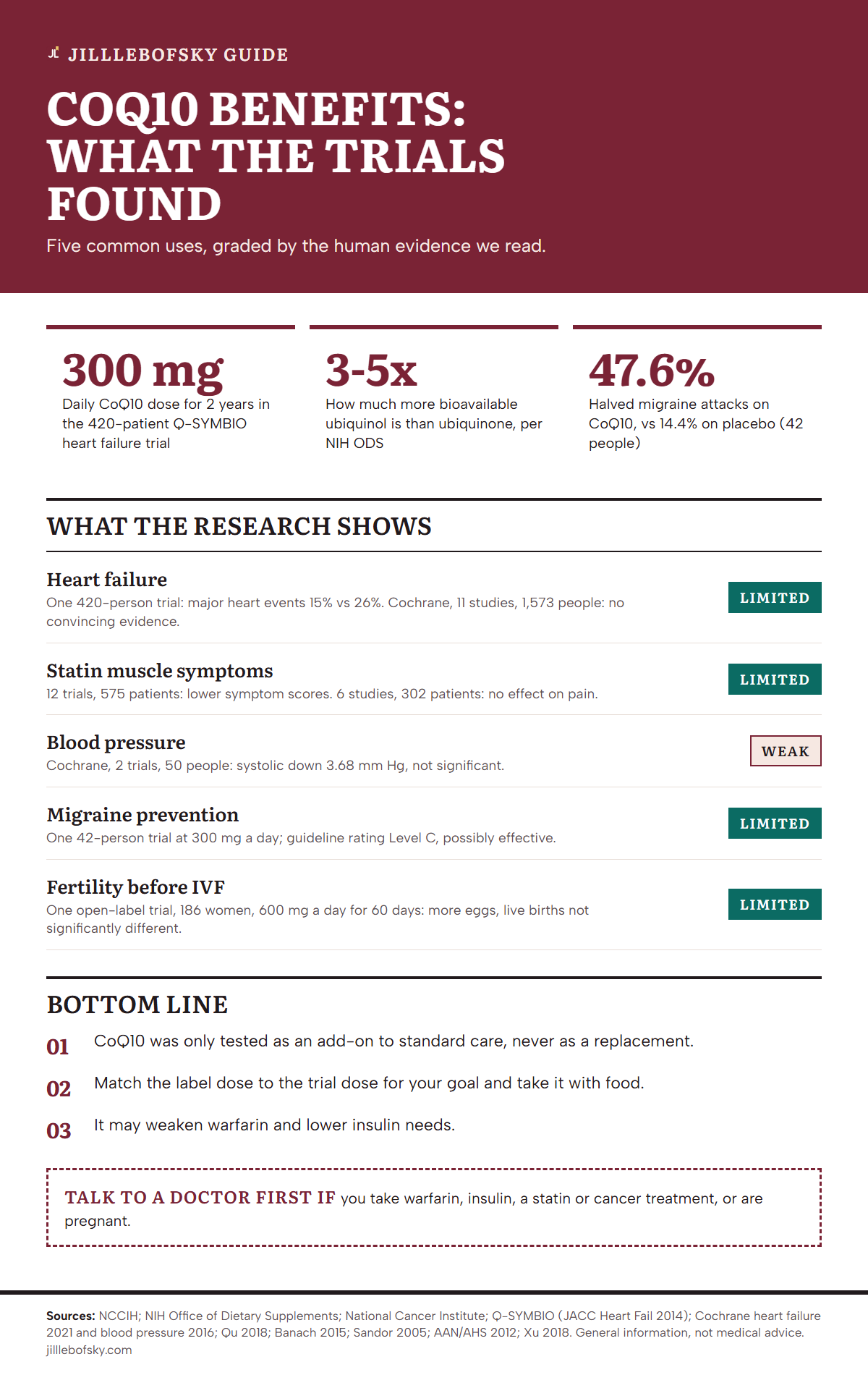
The biggest trial, Q-SYMBIO, found fewer major heart events with CoQ10, but a later Cochrane review still called the overall evidence unconvincing. NCCIH also describes heart failure research as inconclusive[1][5][6].
Q-SYMBIO (2014) enrolled 420 people with moderate to severe heart failure. They took 100 mg of CoQ10 three times a day or a placebo for 2 years, on top of their usual heart medicines[5]. Major adverse heart events happened in 15% of the CoQ10 group and 26% of the placebo group. Deaths from any cause were 10% versus 18%[5].
The trial found no change in its short-term goals at 16 weeks, including walking distance[5]. The positive results also came from a single trial, which is rarely enough to change practice.
The 2021 Cochrane review pooled 11 studies with 1,573 people. Every study had an unclear or high risk of bias. The review concluded there is "no convincing evidence to support or refute" CoQ10 for heart failure[6]. CoQ10 was only ever tested as an add-on to standard care, never as a replacement for it[5].
NCCIH adds two narrower points: CoQ10 may lower the risk of some complications of heart surgery, and it may reduce heart damage caused by one type of chemotherapy drug[1]. Both happen in hospital, under a care team.
Should you take CoQ10 with statins?
Statins lower the body's CoQ10 levels, but research does not clearly show that a CoQ10 supplement eases statin muscle pain. NCCIH says the overall evidence "does not support the idea that CoQ10 can reduce muscle pain" from statins[1][3]. Two meta-analyses reached opposite answers.
The National Cancer Institute summary notes that statins "cause a decrease in serum levels of coenzyme Q10"[3]. That drop is the reason so many people search for CoQ10 and statins together.
A 2015 meta-analysis by Banach and colleagues pooled 6 studies with 302 patients and found no significant effect on muscle pain[8]. A 2018 update by Qu and colleagues pooled 12 trials with 575 patients and reported lower scores for muscle pain, weakness, cramps and tiredness[7]. Neither review found that higher doses worked better, and the 2018 review saw no change in creatine kinase, a blood marker of muscle damage[7][8].
Statins lower the risk of heart attack and stroke in people with high LDL cholesterol[4]. MedlinePlus is clear that you should not stop a statin on your own, and that you should ask which supplements to avoid[4]. If muscle aches start, tell your prescriber first. Muscle damage is an uncommon statin side effect that needs a proper check[4]. Our cholesterol and heart guides cover the wider picture.
Does CoQ10 lower blood pressure?
Probably not by a meaningful amount. A 2016 Cochrane review found "moderate-quality evidence that coenzyme Q10 does not have a clinically significant effect on blood pressure," and NCCIH reached the same view[1][9]. An earlier version of the review had flagged its included trials as possibly unreliable.
The Cochrane team could pool only two trials with 50 people in total. Systolic pressure fell by 3.68 mm Hg and diastolic pressure by 2.03 mm Hg, and neither change was statistically significant[9]. A third trial was left out because of a high risk of bias[9].
So if you have high blood pressure, CoQ10 should not replace the medicine, diet and activity changes your doctor recommends. The reviewers also said more well-run trials are needed, so this answer could change[9].
What is CoQ10 good for besides the heart?
Outside heart conditions, the best data are for migraine prevention and egg quality before IVF, and both rest on single small trials. For Parkinson's disease, a large NIH-funded study and later evaluation found CoQ10 not helpful[1][10][12]. For male fertility, ALS and Huntington's disease, NCCIH says the research is too limited to draw conclusions[1].
Migraine
In a 2005 trial, 42 people with migraine took 100 mg of CoQ10 three times a day or a placebo. About 47.6% of the CoQ10 group cut their attack frequency by at least half, compared with 14.4% on placebo[10]. The benefit showed up in the third month[10]. A 2012 American Academy of Neurology and American Headache Society guideline rated CoQ10 "possibly effective" (Level C) for preventing episodic migraine[11].
Fertility and IVF
A 2018 trial gave 186 women under 35 with low ovarian reserve 200 mg of CoQ10 three times a day for 60 days before IVF-ICSI[12]. The CoQ10 group had more eggs retrieved and more high-quality embryos. Cancelled embryo transfers fell from 22.89% to 8.33%[12]. Pregnancy and live birth rates were not significantly different, and the trial was open label, so both doctors and patients knew who got CoQ10[12].
Energy, skin and memory
We found no trials on these in the federal sources we read. Claims that CoQ10 boosts everyday energy or slows skin aging have no support in the research summarized here.
How much CoQ10 did the studies use?
The main trials used 300 to 600 mg a day, split into two or three doses. That is often more than one capsule of a store-bought product provides, so compare the label dose with the trial dose before you judge any result[5][10][12]. Higher doses were not shown to work better for statin symptoms[7][8].
| Study | Who and how many | Dose and length | Result |
|---|---|---|---|
| Q-SYMBIO, 2014[5] | 420 adults with moderate to severe heart failure | 100 mg 3 times a day, 2 years | Major heart events 15% vs 26% on placebo |
| Cochrane heart failure, 2021[6] | 11 studies, 1,573 people | Varied | No convincing evidence either way |
| Qu et al., 2018[7] | 12 trials, 575 statin users | Varied | Lower muscle symptom scores; no dose effect |
| Banach et al., 2015[8] | 6 studies, 302 statin users | Varied | No significant effect on muscle pain |
| Cochrane blood pressure, 2016[9] | 2 trials, 50 people | At least 3 weeks | Systolic minus 3.68 mm Hg, not significant |
| Sandor et al., 2005[10] | 42 people with migraine | 100 mg 3 times a day, 3 months | 47.6% vs 14.4% halved attacks |
| Xu et al., 2018[12] | 186 women before IVF | 200 mg 3 times a day, 60 days | More eggs; live births not significantly different |
Use the next table as a reading aid when you hold a bottle. It matches each goal people buy CoQ10 for with what the research actually tested. It is not a dosing plan.
| If your goal is | Trial dose | What the evidence says | Sensible next step |
|---|---|---|---|
| Heart failure support | 300 mg a day[5] | One positive trial; Cochrane unconvinced[6] | Only with your cardiologist, as an add-on |
| Statin muscle aches | Varied; no dose effect[7] | Reviews disagree[7][8] | Report aches to your prescriber first[4] |
| Blood pressure | Not applicable | No meaningful effect[9] | Stick with proven treatment |
| Migraine prevention | 300 mg a day[10] | One 42-person trial; Level C[11] | Ask your doctor; allow about 3 months |
| Egg quality before IVF | 600 mg a day[12] | One open-label trial[12] | Ask your fertility clinic |
For context on safety at these amounts, the ODS reports no safety concerns with up to 900 mg a day for 4 weeks in healthy people, and 600 to 3,000 mg a day in people with Huntington's or Parkinson's disease[2]. Tolerated doses are a safety finding only, and the statin reviews found no extra benefit from higher amounts.
Is CoQ10 safe with warfarin and other medicines?
CoQ10 has no serious side effects on record, but it may interact with the blood thinner warfarin and with insulin. NCCIH lists mild insomnia and digestive upset as the usual complaints[1]. The ODS adds rash, nausea and hyperactivity in some people[2].
The warfarin interaction matters most. The NCI summary says CoQ10 "can reduce the body's response to the anticoagulant drug warfarin"[3]. If you take warfarin, starting or stopping CoQ10 without telling your care team could change how well your blood thinner works.
Other points from the federal sources:
- Insulin: CoQ10 can lower insulin needs, so people with diabetes on insulin should only start it with their doctor watching their numbers[1][3].
- Cancer care: NCCIH says CoQ10 may not be compatible with some types of cancer treatment[1]. No randomized trial has tested it as a cancer treatment[3].
- Beta-blockers: some can block CoQ10-dependent enzyme reactions in the body[3].
- Pregnancy and breastfeeding: none of the sources we read give safety data, so ask your doctor or midwife before using it.
What do doctors use first?
For heart failure, high blood pressure and high cholesterol, doctors rely on prescription medicines and lifestyle changes with proven outcomes. Statins, for example, lower the risk of heart attack and stroke in people with high LDL[4]. CoQ10 was studied only as an extra on top of standard care[5]. For migraine, the 2012 guideline placed CoQ10 among options rated "possibly effective," the lowest of the guideline's positive ratings[11].
See a doctor promptly if you have unexplained muscle pain or weakness on a statin, new swelling or breathlessness, or unusual bruising or bleeding while on warfarin.
Ubiquinone or ubiquinol: what should you check on a CoQ10 label?
Ubiquinone is the oxidized form of CoQ10, and ubiquinol is the reduced form, which the ODS says is three to five times more bioavailable. The capsule format and how you take it also change absorption[2].
CoQ10 does not dissolve in water. Powder-filled hard capsules absorb less well than oil suspensions or softgel emulsions, and absorption improves when you take CoQ10 with a meal or some dietary fat[2]. The big trials above mostly reported total daily milligrams, so match milligrams first and form second[5][10][12].
When we look at a CoQ10 bottle for a review, these are the checks we run. Our review method explains the rest of the process.
- Find the milligrams of CoQ10 per serving, and how many capsules make one serving.
- Compare that number with the trial dose for your goal, such as 300 mg a day in the heart failure and migraine trials[5][10].
- Check the form: ubiquinone or ubiquinol[2].
- Check the format: softgel or oil-based products are better absorbed than dry powder capsules[2].
- Read the directions and plan to take it with a meal that contains some fat[2].
- Skip blends that hide the CoQ10 amount inside a "proprietary" total.
- Look for disease claims. A bottle that says it cures heart disease is making a claim the research does not support[1][6].
- Tell your doctor and pharmacist before you start, especially if you take warfarin, insulin or a statin[1][3][4].
We explain how we choose and update sources in our editorial policy.
Bottom line: are CoQ10 benefits worth it?
CoQ10 is a safe-looking supplement with a few promising single trials and a lot of inconclusive reviews[1][6]. The most solid numbers come from the 420-person Q-SYMBIO heart failure trial, and that was an add-on to standard care[5]. Blood pressure benefits look unlikely, and the statin muscle evidence is split[7][8][9].
For most people, the better first step is a talk with the doctor who manages the condition, because CoQ10 was never tested as a replacement for treatment and it can interact with warfarin[3]. If you and your doctor decide to try it, choose a product whose label dose matches the trial dose for your goal and take it with food[2].
Frequently asked questions
What is CoQ10 good for?
CoQ10 has been studied most for heart failure, statin muscle symptoms, migraine and egg quality before IVF. Each area rests on small or mixed evidence, and federal reviewers call most results inconclusive. It probably does not lower blood pressure in a meaningful way.
Can I take CoQ10 and statins together?
NCCIH does not list statins among CoQ10 interactions, and statins do lower CoQ10 levels. Whether CoQ10 eases statin muscle pain is unclear, since two meta-analyses disagree. Tell your prescriber about any muscle aches and never stop a statin on your own.
How long does CoQ10 take to work?
There is no general answer. In the 2005 migraine trial, the benefit showed up in the third month. In the Q-SYMBIO heart failure trial, there was no change at 16 weeks, and the differences appeared over 2 years.
Which is the best CoQ10 form to buy?
The NIH Office of Dietary Supplements says ubiquinol is three to five times more bioavailable than ubiquinone, and oil-based softgels absorb better than powder capsules. Matching the trial dose for your goal and taking it with a meal matter at least as much.
Who should not take CoQ10?
Check with a doctor first if you take warfarin, use insulin, are having cancer treatment, or are pregnant or breastfeeding. CoQ10 may weaken warfarin and lower insulin needs, and our sources had no safety data for pregnancy.
Sources
- Coenzyme Q10. National Center for Complementary and Integrative Health (NCCIH), NIH
- Dietary Supplements for Primary Mitochondrial Disorders: Fact Sheet for Health Professionals. NIH Office of Dietary Supplements
- Coenzyme Q10 (PDQ), Health Professional Version. National Cancer Institute
- Statins. MedlinePlus, National Library of Medicine
- The effect of coenzyme Q10 on morbidity and mortality in chronic heart failure: results from Q-SYMBIO. Mortensen et al., JACC Heart Failure, 2014
- Coenzyme Q10 for heart failure. Al Saadi et al., Cochrane Database of Systematic Reviews, 2021
- Effects of coenzyme Q10 on statin-induced myopathy: an updated meta-analysis of randomized controlled trials. Qu et al., Journal of the American Heart Association, 2018
- Effects of coenzyme Q10 on statin-induced myopathy: a meta-analysis of randomized controlled trials. Banach et al., Mayo Clinic Proceedings, 2015
- Blood pressure lowering efficacy of coenzyme Q10 for primary hypertension. Ho et al., Cochrane Database of Systematic Reviews, 2016
- Efficacy of coenzyme Q10 in migraine prophylaxis: a randomized controlled trial. Sandor et al., Neurology, 2005
- Evidence-based guideline update: NSAIDs and other complementary treatments for episodic migraine prevention in adults. Holland et al., Neurology (AAN and AHS), 2012
- Coenzyme Q10 improves ovarian response and embryo quality in low-prognosis young women with decreased ovarian reserve: a randomized controlled trial. Xu et al., Reproductive Biology and Endocrinology, 2018
This page is general information, not medical advice. Talk to your doctor or pharmacist before you start any supplement, especially if you are pregnant, take medicine or have a health condition. Read our medical disclaimer and how we review.