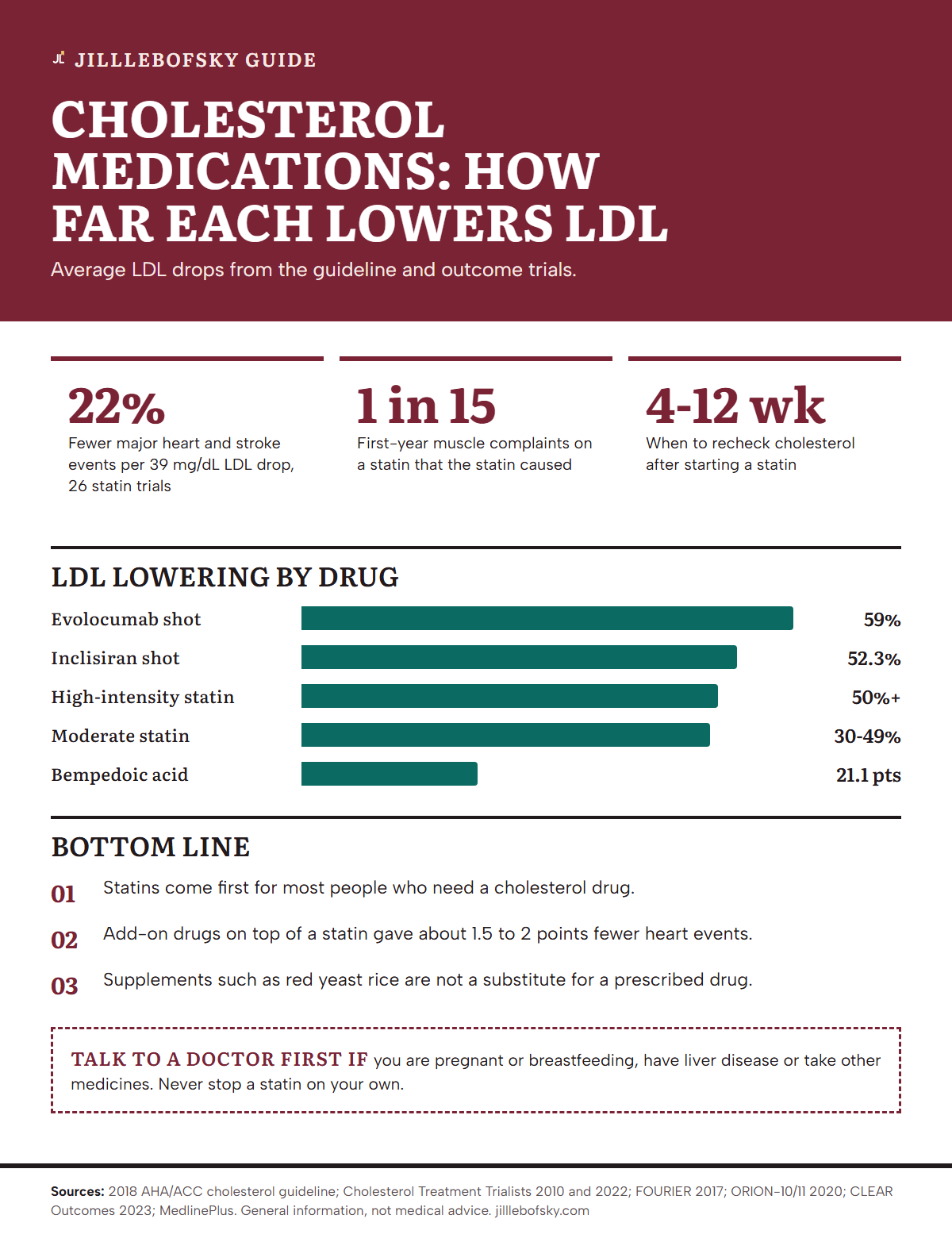
Cholesterol medications lower LDL cholesterol and, in large trials, heart attacks and strokes. Statins come first: moderate doses cut LDL 30% to 49% and high doses 50% or more. Ezetimibe, bempedoic acid and injectable PCSK9 drugs are added when a statin is not enough or not tolerated. Muscle aches are the most reported side effect, but most are not caused by the statin.
Cholesterol medications are prescription drugs that lower LDL cholesterol, and this guide covers each main class, how far it lowers LDL, what it does to heart attack risk and its common side effects. We read the MedlinePlus and NHLBI pages on cholesterol drugs, the 2018 AHA/ACC cholesterol guideline, two large statin analyses and six outcome trials of other drugs.[1][3][4]
Statins come first for most people: a high-intensity statin lowers LDL by 50% or more, and each 39 mg/dL drop in LDL cut major heart and stroke events by about 22% across 26 trials.[4][6]
| What they are | Prescription drugs that lower LDL cholesterol; they control it but do not cure it[1] |
|---|---|
| Main classes | Statins, ezetimibe, bempedoic acid, bile acid sequestrants, PCSK9 inhibitors, fibrates and niacin[1][3] |
| First choice | Statins, the most common cholesterol medicine[2] |
| Typical LDL drop | Statins: 30% to 49% at moderate intensity, 50% or more at high intensity[4] |
| Best evidence | 26 trials, about 170,000 people: 22% fewer major vascular events per 39 mg/dL LDL drop[6] |
| Common side effects | Muscle aches, higher diabetes risk in people already at risk, skin reactions with shots[2][3] |
| Who should not take statins | People who are pregnant or breastfeeding, and people with certain liver diseases[2] |
What are cholesterol medications and how do they work?
Cholesterol medications are prescription drugs that lower the LDL, or bad, cholesterol in your blood, mostly by making the liver produce less cholesterol or clear more of it. Others block cholesterol absorption in the gut or trap bile acids. They control cholesterol but do not cure it, so most people keep taking them.[1][2]
Statins slow how much cholesterol the liver makes and help it pull LDL out of the blood, which slows plaque building in the arteries.[2] Ezetimibe works in the gut and blocks how much cholesterol the body absorbs.[3] Bile acid sequestrants trap bile acids, so the liver breaks down LDL to make more of them.[1]
PCSK9 inhibitors block a liver protein that destroys the parts of liver cells that take up LDL, so more LDL is cleared.[3] Fibrates mainly lower triglycerides and may lower LDL a little.[1] MedlinePlus says lifestyle changes still matter after you start any of these drugs.[1] Our guide on how to lower cholesterol with diet, exercise and weight loss covers those steps.
Who needs high cholesterol medication?
Doctors usually prescribe high cholesterol medication based on your overall heart attack and stroke risk, not on one LDL number. MedlinePlus lists three common reasons: a past heart attack or stroke, age 40 to 75 with diabetes and LDL of 70 mg/dL or higher, or age 40 to 75 with high risk and LDL of 70 or higher.[1]
| If this fits you | What the guideline suggests |
|---|---|
| Past heart attack, stroke or other artery disease | High-intensity or highest tolerated statin, aiming for an LDL drop of 50% or more |
| LDL of 190 mg/dL or higher | High-intensity statin; add ezetimibe if LDL stays at 100 or above |
| Age 40 to 75 with diabetes and LDL of 70 or higher | Moderate-intensity statin |
| Age 40 to 75, LDL of 70 or higher, 10-year risk of 7.5% or more | Moderate-intensity statin if a talk with your clinician favors it, aiming for a 30% LDL drop |
| Very high risk, LDL still 70 or higher on the top statin dose | Add a non-statin drug such as ezetimibe |
For reference, MedlinePlus calls an LDL under 100 mg/dL optimal and 190 or above very high. Men 45 to 65 and women 55 to 65 should be tested every 1 to 2 years.[5]
What are the names of common cholesterol medications?
The most prescribed cholesterol medication names are statins: atorvastatin, rosuvastatin, simvastatin, pravastatin, lovastatin, fluvastatin and pitavastatin. Non-statin names include ezetimibe, bempedoic acid, evolocumab, alirocumab and inclisiran. The table groups statins by how much they lower LDL at each daily dose, from the 2018 AHA/ACC guideline.[3][4][10]
| Intensity | Usual LDL drop | Statin and daily dose |
|---|---|---|
| High | 50% or more | Atorvastatin 40 to 80 mg; rosuvastatin 20 to 40 mg |
| Moderate | 30% to 49% | Atorvastatin 10 to 20 mg; rosuvastatin 5 to 10 mg; simvastatin 20 to 40 mg; pravastatin 40 to 80 mg; lovastatin 40 to 80 mg; fluvastatin XL 80 mg; pitavastatin 1 to 4 mg |
| Low | Under 30% | Simvastatin 10 mg; pravastatin 10 to 20 mg; lovastatin 20 mg; fluvastatin 20 to 40 mg |
The guideline notes that these percentages are averages and that each person responds a little differently.[4] It also says the FDA does not recommend starting simvastatin at 80 mg, or raising it to that dose, because of a higher risk of muscle injury.[4] Some tablets combine two cholesterol drugs, and others pair a cholesterol drug with a blood pressure drug.[1]
How well do cholesterol meds lower LDL and heart risk?
Cholesterol meds lower heart attack and stroke risk roughly in step with how far they drop LDL. In an analysis of 26 statin trials with about 170,000 people, each 1 mmol/L (about 39 mg/dL) drop in LDL cut major vascular events by 22% and deaths from any cause by 10%.[6]
| Trial and drug | Who and how many | Length | Result |
|---|---|---|---|
| CTT 2010, statins | 26 trials, about 170,000 people | About 5 years | 22% fewer major events per 39 mg/dL LDL drop[6] |
| Cochrane 2013, statins, no prior heart disease | 18 trials, 56,934 people | At least 1 year | 14% lower odds of death; 25% fewer heart and stroke events[7] |
| IMPROVE-IT, ezetimibe added to simvastatin | 18,144 after acute coronary syndrome | Median 6 years | LDL 53.7 vs 69.5 mg/dL; events 32.7% vs 34.7% at 7 years[9] |
| FOURIER, evolocumab shots | 27,564 with artery disease on a statin | Median 2.2 years | LDL down 59%; events 9.8% vs 11.3%[10] |
| ODYSSEY OUTCOMES, alirocumab shots | 18,924 after a heart attack or unstable angina | Median 2.8 years | Events 9.5% vs 11.1%; deaths 3.5% vs 4.1%[11] |
| CLEAR Outcomes, bempedoic acid | 13,970 who could not take statins | Median 40.6 months | Events 11.7% vs 13.3%[13] |
| HPS2-THRIVE, niacin | 25,673 with vascular disease | Median 3.9 years | No significant drop in events, 13.2% vs 13.7%[14] |
Second drugs added to a statin gave smaller gains, about 1.5 to 2 percentage points fewer events over 2 to 7 years.[9][10][11]
What can you take if statins cause side effects?
If a statin causes side effects, the usual next steps are a different statin, a lower dose, or a non-statin pill such as ezetimibe or bempedoic acid. The 2018 guideline says most people who have statin side effects can take a statin again when it is switched, lowered or combined with a non-statin drug.[3][4]
Ezetimibe blocks cholesterol absorption and is also added when a statin alone does not lower LDL enough.[1] Bempedoic acid is a daily pill. In CLEAR Outcomes, 13,970 people who could not take statins got 180 mg a day or a placebo. LDL fell 29.2 mg/dL more than with placebo, a gap of 21.1 percentage points, but gout and gallstones were more common.[13]
Bile acid sequestrants are another choice. NHLBI warns they may cause diarrhea, raise triglycerides and make some other medicines less effective.[3] Niacin is sold without a prescription, but MedlinePlus says to talk to your provider first because high doses can cause serious side effects.[1] In HPS2-THRIVE, niacin with laropiprant raised serious diabetes-control problems by 3.7 percentage points.[14]
What injectable cholesterol medication options are there?
The injectable cholesterol medication options are the PCSK9 drugs evolocumab and alirocumab, given every 2 weeks or monthly, and inclisiran, given every 6 months after two starting doses. All go under the skin and are usually added to a statin for people at high risk or with familial hypercholesterolemia.[3][10][11][12]
In FOURIER, evolocumab on top of a statin took median LDL from 92 to 30 mg/dL.[10] In ODYSSEY OUTCOMES, alirocumab helped most in people who started with LDL of 100 mg/dL or more.[11]
NHLBI notes the FDA approved inclisiran in 2021.[3] It is given on day 1, day 90 and then every 6 months. The ORION-10 and ORION-11 trials, with 1,561 and 1,617 patients, found LDL drops of 52.3% and 49.9%. Those trials tracked LDL, not heart attacks.[12]
Skin reactions at the injection spot were the main side effect that differed from placebo: 2.1% vs 1.6% with evolocumab and 3.8% vs 2.1% with alirocumab.[10][11] NHLBI lists itching, pain or swelling at that spot as most common.[3]
What are the side effects of cholesterol medication, and who should avoid it?
The most reported side effect of cholesterol medication is muscle aches with statins, but blinded trials show most of those aches are not caused by the drug. In 19 trials with 123,940 people, 27.1% on a statin and 26.6% on placebo reported muscle pain or weakness.[8]
In the first year, only about 1 in 15 of those reports in the statin group was due to the statin, and there was no clear excess after that.[8] Serious muscle damage is rare.[2] Statins may raise the risk of type 2 diabetes, mainly in people with prediabetes, overweight or metabolic syndrome.[2] Abnormal liver tests can occur, but actual liver damage is very rare.[2]
Who should avoid them or take extra care
- People who are pregnant or breastfeeding should not take statins.[2]
- Statins are not recommended for people with certain types of liver disease.[2]
- Grapefruit, fresh or as juice, affects how the liver breaks down some statins.[2]
- Taking a fibrate with a statin may raise the risk of side effects.[1]
- Bile acid sequestrants can make other medicines less effective.[3]
Tell your doctor about new muscle pain. A blood test can check for muscle damage, and switching statins often helps. Never stop a statin on your own, since MedlinePlus warns this can lead to serious problems.[2]
Can supplements replace cholesterol medications?
No supplement has outcome evidence that matches cholesterol medications, and none should replace a prescribed drug. Doctors start with lifestyle changes and, when needed, statins, which cut heart attacks and strokes in trials of about 170,000 people. Supplements were not tested that way.[3][6]
Red yeast rice, often sold as a natural option, contains monacolin K, which is structurally identical to the drug lovastatin. It can cause statin side effects, including muscle, kidney and liver damage.[15] None of 28 US brands listed monacolin K on the label, and only 1 of 37 products tested in 2021 was under the EU limit for citrinin, a kidney toxin.[15] Taking it with a statin doubles up on the same type of drug. Our red yeast rice LDL results and label risks guide has the details.
Some people on statins ask about CoQ10 for muscle aches; our CoQ10 benefits for statin users review covers those trials. We grade evidence with the method in how we review supplements and studies, and more guides sit in our cholesterol and heart health section.
What should you check before starting a cholesterol medication?
Before starting a cholesterol medication, know your LDL number, your heart risk and every other pill you take. Those facts shape the drug and dose your clinician picks. The 2018 guideline then asks for a repeat cholesterol test 4 to 12 weeks after you start a statin or change the dose.[1][4]
- Get a baseline lipid panel and write down your LDL.[5]
- Ask which statin intensity you are getting and the LDL drop to expect.[4]
- Bring a list of every medicine and supplement, including red yeast rice and niacin.[1][2]
- Ask whether grapefruit affects your statin.[2]
- Book the follow-up test for 4 to 12 weeks after starting, then every 3 to 12 months.[4]
- Report muscle pain early instead of stopping the pill.[2]
- Keep up the diet and exercise changes.[1]
The bottom line
For most people who need one, a statin is the right first cholesterol medication because it has the longest track record: lower LDL, fewer heart attacks and strokes, and side effects that are usually mild.[4][6][8]
Ezetimibe, bempedoic acid and the PCSK9 shots are add-ons or backups with their own outcome trials, while niacin did not cut heart events.[9][13][14] Supplements are not a substitute. If you are unsure whether you need a drug at all, bring the decision table above and your latest LDL result to your next appointment.
Frequently asked questions
Do you have to take cholesterol medication forever?
Usually, yes. MedlinePlus says cholesterol medicines control cholesterol but do not cure it, so you keep taking them and get regular checks. Never stop a statin on your own; talk with your clinician about any change or concern.
How long do cholesterol meds take to work?
The 2018 AHA/ACC guideline advises a repeat cholesterol test 4 to 12 weeks after starting a statin or changing the dose, then every 3 to 12 months. That first recheck shows how far your LDL has fallen.
Can you eat grapefruit while taking cholesterol medication?
Ask first. MedlinePlus says fresh grapefruit and grapefruit juice affect how the liver breaks down some statins, which can cause side effects or change how well the drug works. Your pharmacist can tell you whether your statin is affected.
Is niacin still used to lower cholesterol?
Its case is weak. In HPS2-THRIVE, 25,673 people on a statin took extended-release niacin or placebo for about 3.9 years. Niacin did not reduce heart events and raised serious diabetes problems. Talk to your provider before taking it.
Can you take cholesterol medication while pregnant?
MedlinePlus says you should not take statins if you are pregnant or breastfeeding. If you plan a pregnancy or become pregnant while on a statin, talk with your clinician soon about stopping it safely and what to do instead.
Sources
- Cholesterol Medicines. MedlinePlus, National Library of Medicine
- Statins. MedlinePlus, National Library of Medicine
- Blood Cholesterol: Treatment. NHLBI, NIH, 2024
- 2018 AHA/ACC Guideline on the Management of Blood Cholesterol. Circulation, 2019
- LDL: The Bad Cholesterol. MedlinePlus, National Library of Medicine
- Efficacy and safety of more intensive lowering of LDL cholesterol: a meta-analysis of data from 170,000 participants in 26 randomised trials. Cholesterol Treatment Trialists, Lancet, 2010
- Statins for the primary prevention of cardiovascular disease. Cochrane Database of Systematic Reviews, 2013
- Effect of statin therapy on muscle symptoms: an individual participant data meta-analysis. Cholesterol Treatment Trialists, Lancet, 2022
- Ezetimibe Added to Statin Therapy after Acute Coronary Syndromes (IMPROVE-IT). New England Journal of Medicine, 2015
- Evolocumab and Clinical Outcomes in Patients with Cardiovascular Disease (FOURIER). New England Journal of Medicine, 2017
- Alirocumab and Cardiovascular Outcomes after Acute Coronary Syndrome (ODYSSEY OUTCOMES). New England Journal of Medicine, 2018
- Two Phase 3 Trials of Inclisiran in Patients with Elevated LDL Cholesterol (ORION-10 and ORION-11). New England Journal of Medicine, 2020
- Bempedoic Acid and Cardiovascular Outcomes in Statin-Intolerant Patients (CLEAR Outcomes). New England Journal of Medicine, 2023
- Effects of Extended-Release Niacin with Laropiprant in High-Risk Patients (HPS2-THRIVE). New England Journal of Medicine, 2014
- Red Yeast Rice: What You Need To Know. NCCIH, National Institutes of Health
This page is general information, not medical advice. Talk to your doctor or pharmacist before you start any supplement, especially if you are pregnant, take medicine or have a health condition. Read our medical disclaimer and how we review.