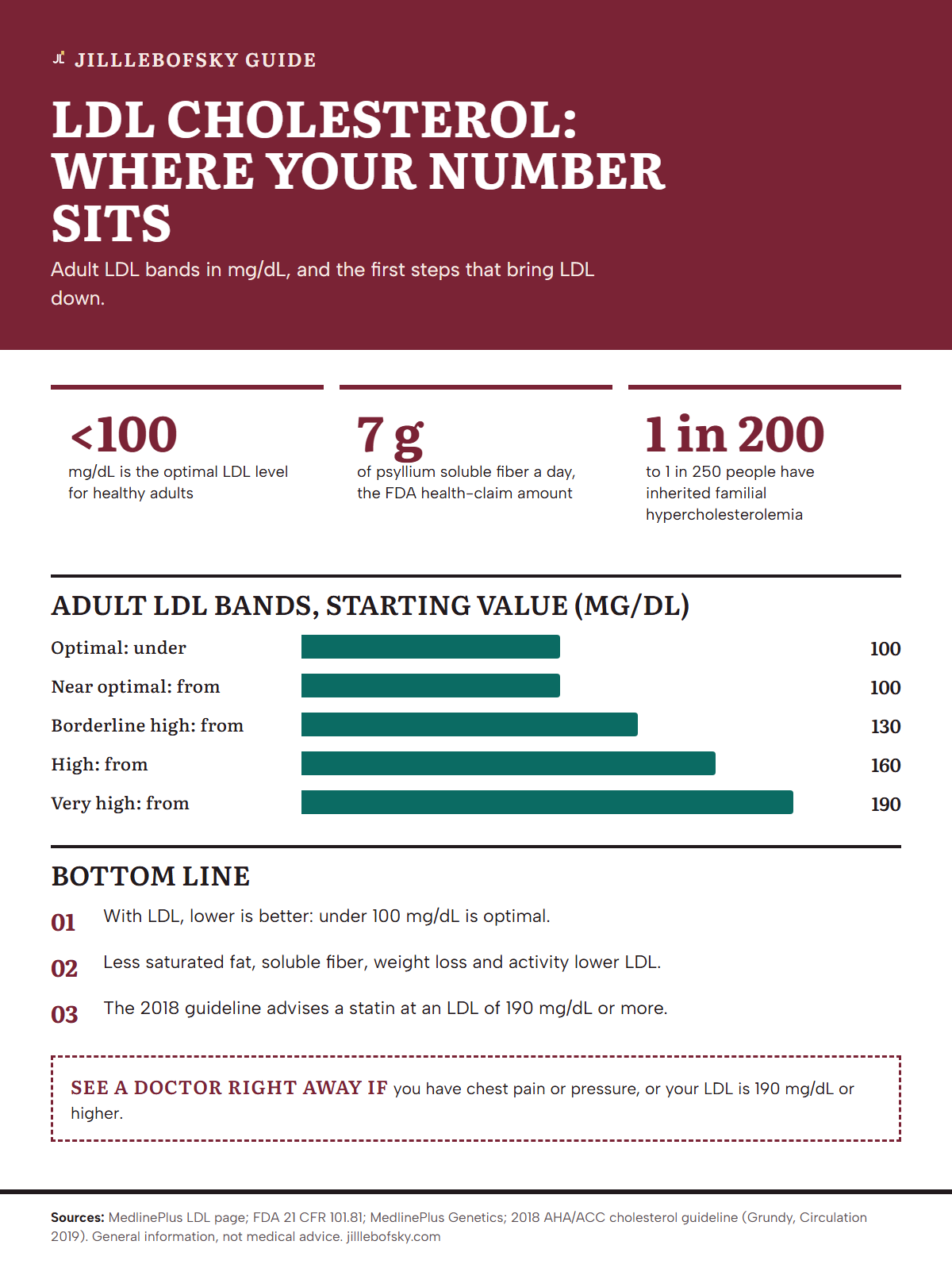
LDL cholesterol is the bad cholesterol that builds plaque in your arteries. For adults, under 100 mg/dL is optimal, 130 to 159 is borderline high, 160 to 189 is high and 190 or more is very high. Less saturated fat, 7 g of psyllium fiber a day, weight loss and activity lower it, and statins are the main medicine.
For this LDL cholesterol guide, we read the MedlinePlus and NHLBI pages on blood cholesterol, the 2018 AHA/ACC cholesterol guideline, two FDA health-claim rules, and pooled studies of statins, saturated fat, psyllium and oats[1][3][8][9][10][12][13][14]. Our supplement review method and editorial policy explain how we choose sources.
The short answer: for adults, an LDL level under 100 mg/dL is optimal, 130 to 159 is borderline high, and 160 or more is high[1]. Lower numbers are better, and diet, weight, activity and, when needed, medicine all bring LDL down[1].
| What it is | Low-density lipoprotein, the bad cholesterol that helps build plaque in arteries[1] |
|---|---|
| Optimal adult level | Under 100 mg/dL; 190 mg/dL or more is very high[1] |
| Age 19 or younger | Under 110 mg/dL[2] |
| How it is measured | A lipid panel blood test; you may be asked to fast 8 to 12 hours[5] |
| First-line care | Heart-healthy eating, weight control and activity, then statins if needed[1][6] |
| Best-studied food steps | 7 g of psyllium soluble fiber or 3 g of oat beta-glucan a day[10] |
| Who should be careful | Red yeast rice acts like lovastatin and is not advised in pregnancy[15] |
What is LDL cholesterol?
LDL cholesterol is the cholesterol carried by low-density lipoproteins, small particles of fat and protein that move cholesterol through your blood. It is called the bad cholesterol because a high LDL level leads to cholesterol building up in the walls of your arteries[1].
Cholesterol itself is a waxy, fat-like substance found in every cell. Your liver makes it, and it also comes from foods such as meat and dairy[1]. Your body needs some, but too much in the blood raises the risk of coronary artery disease[1].
HDL, the high-density lipoprotein, does the opposite job. It carries cholesterol back to the liver, which clears it from the body, so HDL gets the good cholesterol label[1][3]. People sometimes mix the two up online. LDL is the one you want low.
On a lab report, the LDL line may be marked calculated[2].
What is the normal LDL cholesterol range?
For healthy adults, an LDL cholesterol level under 100 mg/dL is optimal, and 190 mg/dL or higher is very high. MedlinePlus sorts the values in between into near optimal, borderline high and high bands. For people aged 19 or younger, a healthy LDL is under 110 mg/dL[1][2].
| LDL level | Category |
|---|---|
| Less than 100 mg/dL | Optimal |
| 100 to 129 mg/dL | Near optimal or above optimal |
| 130 to 159 mg/dL | Borderline high |
| 160 to 189 mg/dL | High |
| 190 mg/dL and above | Very high |
These bands come straight from the MedlinePlus LDL page[1]. They are general ranges for people without heart disease.
If you already have coronary artery disease or are at high risk for it, your clinician may set a different goal[1]. The 2018 guideline, for example, uses 70 mg/dL as the point to add a second medicine for some very high-risk patients who already take a statin[8].
What does high LDL cholesterol mean?
High LDL cholesterol means you have too much LDL in your blood, and the extra LDL helps form plaque inside your arteries. Over time that plaque hardens and narrows the arteries, a condition called atherosclerosis, which slows blood flow and raises the risk of chest pain and heart attack[1].
When the buildup is in the arteries of the heart, it is coronary artery disease. Less oxygen reaches the heart muscle, which can cause angina, and a complete blockage causes a heart attack[1]. Plaque also makes blood clots more likely to form[3].
In the 2018 AHA/ACC guideline, an LDL of 160 mg/dL or more counts as a risk enhancer, and 190 mg/dL or more is treated as severe enough for a high-intensity statin[8].
The Cholesterol Treatment Trialists pooled 26 statin trials with about 170,000 people and found that each 1.0 mmol/L drop in LDL (about 39 mg/dL) cut major vascular events by just over a fifth[9].
What causes high LDL cholesterol?
An unhealthy lifestyle is the most common cause of high LDL cholesterol, according to the NHLBI. A diet high in saturated fat, little physical activity and extra weight push LDL up, but inherited genes, some medical conditions and some medicines can raise it too[4][1].
- Food: saturated fat and cholesterol in what you eat make LDL rise[1].
- Weight: being overweight tends to raise LDL and lower HDL[1].
- Inactivity: a lack of physical activity is linked to unhealthy cholesterol levels[4].
- Smoking: it lowers HDL, which helps remove LDL from the arteries[1].
- Age and sex: levels rise with age, and LDL tends to rise in women after menopause[1].
- Medicines: steroids, some blood pressure medicines and HIV medicines can raise LDL[1].
- Conditions: chronic kidney disease, diabetes, HIV and lupus are linked to higher LDL[1][4].
Genes explain why a lean, active person can still have a very high LDL. Familial hypercholesterolemia, an inherited form of high cholesterol, affects an estimated 1 in 200 to 1 in 250 people[16]. Some people with it need lipoprotein apheresis, a treatment that filters LDL out of the blood[1].
How is LDL cholesterol tested?
LDL cholesterol is measured with a lipid panel, a blood test that also reports total cholesterol, HDL and triglycerides. Your clinician may ask you to fast for 8 to 12 hours beforehand, although expert groups now accept a non-fasting sample for most routine checks[5][17].
MedlinePlus gives this general testing schedule[1]:
- Children: first test between ages 9 and 11, then every 5 years; as early as age 2 with a family history of high cholesterol, heart attack or stroke.
- Younger adults: every 5 years.
- Men aged 45 to 65 and women aged 55 to 65: every 1 to 2 years.
- Adults older than 65: every year.
You may need more frequent tests if you have heart disease, diabetes or a family history of high cholesterol[1].
Eating before the test changes LDL only a little. A 2016 European expert consensus found that normal meals lowered LDL by about 8 mg/dL and raised triglycerides by about 26 mg/dL, and it recommended non-fasting panels for routine use[17]. Your lab or clinician will tell you which they want.
How do you lower LDL cholesterol naturally?
The lifestyle steps that lower LDL are eating less saturated fat, adding soluble fiber, losing some weight if you carry extra, and staying active. MedlinePlus and the NHLBI list these first, and the 2018 guideline calls lifestyle the foundation even for people who need medicine[1][6][8].
- Cut saturated fat from fatty meats, full-fat dairy and desserts[6]. In a 2020 Cochrane review of 15 trials and about 59,000 people, eating less saturated fat for at least 2 years cut combined cardiovascular events by 21%[12].
- Add soluble fiber: 3 g a day of beta-glucan from oats or barley, or 7 g a day of soluble fiber from psyllium husk[10].
- Eat plant sterols or stanols with meals if you use them: 1.3 g of sterol esters or 3.4 g of stanol esters a day, split over two meals[11][7].
- Lose 3% to 5% of your body weight if you are overweight[6].
- Stay physically active, which lowers LDL and triglycerides[6].
- Sleep 7 to 9 hours a night[6].
- Stop smoking, which lowers your protective HDL[1].
- Retest as your clinician advises, and keep these habits even if you start medicine[1][7].
Our seven-step plan to lower cholesterol goes deeper on meals and trials, and our guide on how to lower triglycerides covers the other fat on your lipid panel.
Do supplements lower LDL cholesterol?
A few fiber and plant sterol products lower LDL by a modest amount, and the FDA allows a heart-disease health claim for them at set daily doses. In pooled fiber trials, LDL fell by about 7 to 13 mg/dL, and none of these products replaces a statin your doctor prescribes[10][11][13][14].
| Product | Evidence | Daily amount | LDL result |
|---|---|---|---|
| Psyllium | 28 trials, 1,924 people[13] | About 10.2 g | Down 0.33 mmol/L (about 13 mg/dL) |
| Oat beta-glucan | 58 trials, 3,974 people[14] | About 3.5 g | Down 0.19 mmol/L (about 7 mg/dL) |
| Plant sterols or stanols | FDA health claim; MedlinePlus says they reduce cholesterol taken with meals[11][7] | 1.3 g sterol or 3.4 g stanol esters | No pooled figure in the sources we read |
| Red yeast rice | NCCIH account of a 28-brand label study[15] | 0.09 to 5.48 mg monacolin K per 1,200 mg | Acts like lovastatin; dose unreliable |
MedlinePlus adds that flaxseed may help while flaxseed oil does not, and that garlic has only a small effect[7]. Our psyllium husk guide covers dosing, and our red yeast rice review explains its label risks.
Safety and who should avoid LDL supplements
Red yeast rice contains monacolin K, which is structurally identical to lovastatin, so it carries the same muscle, kidney and liver risks and the same drug interactions as a statin[15]. Do not combine it with a prescribed statin, and skip it if you are pregnant or breastfeeding[15]. In a 2021 analysis, only one of 37 products was below the EU limit for citrinin, a toxin[15].
Tell your doctor about any supplement you take. Get care right away if you have:
- Chest pain or pressure, which can be angina or a heart attack[1].
- An LDL result of 190 mg/dL or more[1][8].
- A child with a family history of very high cholesterol or early heart attack[1][16].
What to check on a cholesterol supplement label
- Grams of soluble fiber per serving, compared with 7 g a day for psyllium or 3 g of beta-glucan[10].
- Sterol or stanol ester grams per serving, with directions to take them at meals[11].
- For red yeast rice, whether monacolin K is listed at all; none of the 28 brands tested listed it[15].
- Citrinin-free claims: four products labeled that way still contained citrinin[15].
- Any promise that a product replaces your statin, which no source we read supports[1][6].
When do doctors prescribe medicine for high LDL cholesterol?
Statins are the most common medicine for high LDL cholesterol, and doctors add one when lifestyle changes are not enough or heart risk is high. The 2018 AHA/ACC guideline starts a high-intensity statin at an LDL of 190 mg/dL or more, whatever a person's other risks[6][8].
| Situation | What the guideline advises |
|---|---|
| LDL of 190 mg/dL or more | High-intensity statin, aiming for an LDL drop of 50% or more |
| Diabetes, age 40 to 75, LDL 70 mg/dL or more | Moderate-intensity statin |
| Age 40 to 75 with a 10-year risk of 7.5% or more | Moderate-intensity statin after a risk talk, aiming for a 30% or greater drop |
| Heart disease, very high risk, LDL still 70 mg/dL or more on a statin | Add ezetimibe |
Lipids are rechecked 4 to 12 weeks after a statin is started[8]. In the CTT analysis, each 1.0 mmol/L drop in LDL also lowered deaths from any cause by 10%[9].
If a statin causes side effects or does not lower LDL enough, options include ezetimibe, bempedoic acid, bile acid sequestrants and injected PCSK9 inhibitors[6]. The NHLBI notes that real liver damage from statins is extremely rare and that lifestyle changes should continue alongside any medicine[6].
The bottom line on LDL cholesterol
LDL cholesterol is the number on your lipid panel that you want low: under 100 mg/dL is optimal for most adults, and 160 or more is high[1]. The causes are mostly diet, weight and activity, with genes playing a big part for some families[4][16].
For most people, the better first step is a food change, such as less saturated fat and a daily dose of psyllium or oat fiber, because those steps have the clearest trial data among non-drug options[12][13][14]. If your LDL is 190 or higher, or you have diabetes or heart disease, a statin has far stronger evidence than any supplement[8][9]. More guides sit in our cholesterol and heart section.
Frequently asked questions
Is LDL the good cholesterol?
No. LDL is called the bad cholesterol because high levels lead to cholesterol building up in artery walls. HDL is the good one, since it carries cholesterol back to the liver for removal. With LDL, lower numbers are better.
Is an LDL cholesterol of 130 high?
MedlinePlus lists 130 to 159 mg/dL as borderline high for healthy adults and 160 to 189 as high. Whether 130 needs treatment depends on your other risks, such as diabetes, age, blood pressure and any heart disease.
How fast can you lower LDL cholesterol?
Statins act quickly enough that the 2018 guideline rechecks lipids 4 to 12 weeks after starting one. The diet and fiber studies we read did not set a firm timeline, so retest when your clinician advises.
Can thin people have high LDL cholesterol?
Yes. Genes partly decide how much cholesterol your body makes. Familial hypercholesterolemia, an inherited form, affects about 1 in 200 to 1 in 250 people and can raise LDL whatever your weight or activity level.
Does red yeast rice lower LDL like a statin?
It can, because its monacolin K is structurally identical to lovastatin. That also brings statin-type side effects and drug interactions, and tested brands varied more than 60-fold in how much monacolin K they held.
Sources
- LDL: The "Bad" Cholesterol. MedlinePlus, National Library of Medicine
- Cholesterol Levels. MedlinePlus, National Library of Medicine
- What Is Blood Cholesterol?. National Heart, Lung, and Blood Institute, NIH, 2024
- Blood Cholesterol: Causes and Risk Factors. National Heart, Lung, and Blood Institute, NIH
- Blood Cholesterol: Diagnosis. National Heart, Lung, and Blood Institute, NIH, 2024
- Blood Cholesterol: Treatment. National Heart, Lung, and Blood Institute, NIH, 2024
- How to Lower Cholesterol. MedlinePlus, National Library of Medicine
- 2018 AHA/ACC Guideline on the Management of Blood Cholesterol. Grundy et al., Circulation, 2019
- Efficacy and safety of more intensive lowering of LDL cholesterol: a meta-analysis of data from 170,000 participants in 26 randomised trials. Cholesterol Treatment Trialists' Collaboration, Lancet, 2010
- 21 CFR 101.81 Health claims: soluble fiber from certain foods and risk of coronary heart disease. US Food and Drug Administration, eCFR
- 21 CFR 101.83 Health claims: plant sterol/stanol esters and risk of coronary heart disease. US Food and Drug Administration, eCFR
- Reduction in saturated fat intake for cardiovascular disease. Hooper et al., Cochrane Database of Systematic Reviews, 2020
- Effect of psyllium fiber on LDL cholesterol and alternative lipid targets, non-HDL cholesterol and apolipoprotein B. Jovanovski et al., American Journal of Clinical Nutrition, 2018
- The effect of oat beta-glucan on LDL-cholesterol, non-HDL-cholesterol and apoB for CVD risk reduction. Ho et al., British Journal of Nutrition, 2016
- Red Yeast Rice: What You Need To Know. National Center for Complementary and Integrative Health, NIH, 2022
- Familial hypercholesterolemia. MedlinePlus Genetics, National Library of Medicine
- Fasting is not routinely required for determination of a lipid profile. Nordestgaard et al., European Heart Journal, 2016
This page is general information, not medical advice. Talk to your doctor or pharmacist before you start any supplement, especially if you are pregnant, take medicine or have a health condition. Read our medical disclaimer and how we review.