Psyllium husk is a soluble fiber from the seed coat of Plantago ovata. It has the best fiber evidence for chronic constipation, a guideline backing for IBS, and modest effects on LDL cholesterol and blood sugar. Trials mostly used about 10 to 12 grams a day. Take every dose with at least 8 ounces of liquid, because dry psyllium can cause choking.
Psyllium husk is the seed coat of the Plantago ovata plant, sold as a powder, capsules and wafers, and it is one of the few fiber supplements with solid trial data behind it. We read the MedlinePlus drug page, two NIDDK pages, two FDA rules, two gastroenterology guidelines and five research reviews and trials before writing this guide.[1][2][4][6]
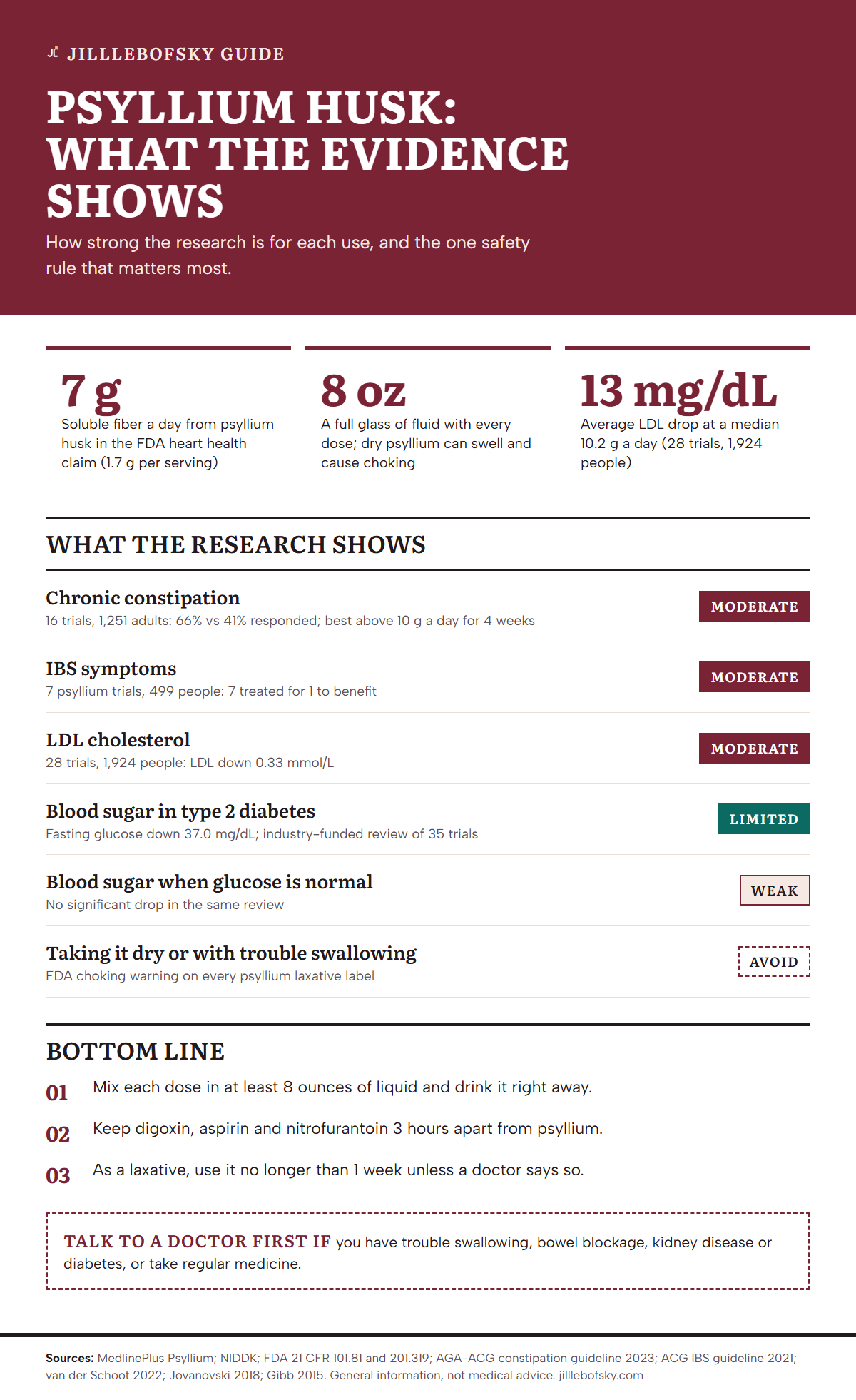
The short answer: psyllium has the best fiber evidence for constipation, a guideline backing for IBS, and an FDA-authorized food label claim for heart health at 7 grams of soluble fiber a day, as long as every dose goes down with a full glass of liquid.[4][5][6][7]
| What it is | The husk (seed coat) of Plantago ovata seed, also called blond or Indian psyllium[4] |
|---|---|
| Main use | Bulk-forming laxative for constipation; also used by doctors for diarrhea and high cholesterol[1] |
| Amounts studied | About 10 to 12 grams a day in most trials; 7 grams of soluble fiber a day for the FDA heart claim[4][9][10] |
| Best evidence | Chronic constipation and IBS symptoms (guidelines); LDL cholesterol (28 trials)[6][7][10] |
| Main safety rule | Take each dose with at least 8 ounces of fluid; dry psyllium can swell and cause choking[5] |
| Who should check first | People with trouble swallowing, bowel blockage, kidney disease, diabetes, or who take digoxin, aspirin or nitrofurantoin[1] |
What is psyllium husk?
Psyllium husk is a soluble, gel-forming fiber made from the outer coat of Plantago ovata seeds. It soaks up water in the gut, swells, and forms a soft, bulky stool that is easier to pass. That is why MedlinePlus lists it as a bulk-forming laxative.[1]
The FDA rule on fiber health claims defines psyllium husk as the dried seed coat of Plantago ovata, known as blond or Indian psyllium. For a product to carry the heart health claim, the husk must be at least 95% pure.[4]
You will see it in several forms. MedlinePlus lists powder, granules, capsules, liquid and wafers, usually taken one to three times a day.[1] Familiar brand names include Metamucil, Konsyl, Fiberall and Reguloid.[1] Plain "psyllium husks" are the whole flakes; psyllium husk powder is the same husk ground finer so it mixes more easily.
Most adults fall short on fiber. NIDDK puts the daily target at 22 to 34 grams, depending on age and sex, and food should still supply most of it.[2] A supplement fills part of that gap. It does not replace fruit, vegetables, beans and whole grains.
Is psyllium husk good for you?
For most healthy adults, psyllium fiber is a low-cost, well-studied way to add soluble fiber, with its clearest benefit for regular bowel movements. The strength of the evidence differs by goal, so it helps to look at each one on its own. The table below sums up the main reviews and trials we read.[6][7][8][10]
| Study | Who and how many | Dose and length | Result |
|---|---|---|---|
| van der Schoot, 2022 meta-analysis[8] | 16 trials, 1,251 adults with chronic constipation | Various fibers; over 10 g a day for at least 4 weeks worked best | 66% responded to fiber vs 41% to control; psyllium had a significant effect |
| AGA-ACG guideline, 2023[6] | 3 psyllium trials, largest with 201 adults | 3.6 g three times a day for 14 days | About 391 more people per 1,000 reported overall relief vs placebo |
| ACG IBS guideline, 2021[7] | 7 psyllium trials, 499 people with IBS | Varied | Fewer stayed symptomatic; 7 people treated for 1 to benefit |
| Jovanovski, 2018 meta-analysis[10] | 28 trials, 1,924 people | Median about 10.2 g a day for 3 weeks or more | LDL cholesterol down 0.33 mmol/L (about 13 mg/dL) |
| Gibb, 2015 meta-analysis (industry-funded)[11] | 35 trials | Taken before meals | In type 2 diabetes, fasting glucose down 37.0 mg/dL and HbA1c down 0.97%; no drop with normal glucose |
Across these reviews, psyllium helped most where there is a real problem to fix, such as hard stools, high LDL or high blood sugar, and did little in people whose numbers are already normal.[10][11]
Does psyllium fiber help constipation?
Yes, psyllium is the fiber supplement with the best support for chronic constipation, although the overall certainty of fiber evidence is rated low. The 2023 AGA and ACG guideline gives fiber a conditional recommendation and says only psyllium appears to be effective, with very limited data for bran and inulin.[6]
In the trial the guideline weighed most, 201 adults took 3.6 grams of psyllium or placebo three times a day for 14 days.[6] Pooled across studies, about 391 more people per 1,000 reported overall relief with psyllium than with placebo.[6]
A 2022 meta-analysis of 16 trials and 1,251 adults found that 66% responded to fiber compared with 41% on control. Doses above 10 grams a day for at least 4 weeks gave the clearest results.[8] In a 2021 US trial, 79 adults took psyllium (12 grams a day), prunes or kiwifruit for 4 weeks; all three raised the number of complete bowel movements, though side effects were most common with psyllium.[9]
NIDDK lists fiber supplements such as Metamucil among the first over-the-counter options and reminds people to drink plenty of water with them.[2] The usual trade-off is gas: the guideline names flatulence as a common side effect of fiber.[6] Our gut health supplements guide grades psyllium against probiotics and other options.
Can psyllium help IBS?
The American College of Gastroenterology suggests soluble fiber such as psyllium for overall IBS symptoms, a strong recommendation based on moderate-quality evidence. Insoluble fiber such as wheat bran is not suggested.[7]
In the guideline's review, 7 trials of psyllium (also called ispaghula) with 499 people showed benefit, with about 7 people needing treatment for 1 to improve. Bran showed no significant benefit.[7] Fibers that ferment in the colon can produce gas and make bloating worse, which is one reason psyllium, a poorly fermented fiber, fits IBS better.[7] NIDDK suggests a fiber supplement when more fiber from food has not helped.[3]
Does psyllium lower cholesterol and blood sugar?
Psyllium lowers LDL cholesterol by a modest amount, and the FDA allows a food label health claim for soluble fiber from psyllium husk. Its effect on blood sugar is clearest in people who already have type 2 diabetes, and it is smaller or absent in people with normal glucose.[4][10][11]
Cholesterol and the FDA health claim
Under 21 CFR 101.81, foods may say that diets low in saturated fat and cholesterol that include 7 grams or more a day of soluble fiber from psyllium seed husk may reduce the risk of heart disease. Each serving must supply at least 1.7 grams of that soluble fiber.[4] By our arithmetic, that is about 4 servings a day to reach 7 grams.
The claim covers food labels and does not mean the FDA has approved any supplement brand. The research behind it is fairly solid. A 2018 review of 28 trials and 1,924 people found a median dose of about 10.2 grams a day lowered LDL by 0.33 mmol/L, about 13 mg/dL, rated moderate quality.[10]
Blood sugar
A 2015 analysis of 35 trials found that in people with type 2 diabetes, psyllium taken before meals lowered fasting glucose by 37.0 mg/dL and HbA1c by 0.97%. It made no significant difference in people with normal blood sugar.[11] That review was written by Procter and Gamble scientists, the maker of Metamucil, so treat the size of the effect with caution.[11]
An independent 2024 review of 19 trials and 962 adults also found lower fasting blood sugar, HbA1c and insulin resistance. For HbA1c, doses under 10 grams a day did not show a significant change.[12] If you take diabetes medicine, ask your doctor before adding psyllium. Our blood sugar support guide compares psyllium with other studied ingredients.
How much psyllium husk powder should you take?
Follow the package directions, which usually mean one dose one to three times a day, each mixed in at least 8 ounces of liquid. Research doses for constipation and cholesterol mostly fall between about 10 and 12 grams a day, split into smaller doses.[1][8][9][10]
| Goal | Amount studied | How long | Source |
|---|---|---|---|
| Chronic constipation | Over 10 g of fiber a day; 3.6 g three times a day in one trial | At least 4 weeks (14 days in the trial) | Meta-analysis and guideline[6][8] |
| Constipation, US trial | 12 g a day | 4 weeks | Chey, 2021[9] |
| LDL cholesterol | Median about 10.2 g a day | 3 weeks or more | Jovanovski, 2018[10] |
| Heart health label claim | 7 g soluble fiber a day, 1.7 g per serving | Daily, with a diet low in saturated fat | FDA rule[4] |
| Blood sugar (HbA1c) | 10 g a day or more showed an effect | Varied | Gholami, 2024[12] |
One caution from MedlinePlus: when you use psyllium as a laxative, do not take it for longer than 1 week unless your doctor tells you to.[1] Longer daily use for cholesterol or IBS is something to set up with your doctor, who can check whether it is working.
How to take psyllium husk with water
- Measure one dose with the scoop or spoon size printed on the label.[1]
- Stir it into at least 8 ounces (240 mL) of water or juice, a full glass.[1][5]
- Drink it right away, before it thickens into a gel.[1]
- Follow it with more fluid during the day. NIDDK advises plenty of water whenever you add fiber.[2]
- Swallow capsules with a full glass of liquid as well, and chew wafers thoroughly.[1][5]
- Mix the powder gently so you do not breathe it in; inhaled psyllium can cause allergic reactions.[1]
- Keep it 3 hours apart from digoxin, aspirin and nitrofurantoin.[1]
Is psyllium husk safe? Choking, side effects and medicines
Psyllium is safe for most adults when taken with enough fluid, but taken dry or with too little liquid it can swell and block the throat or esophagus. The FDA requires a choking warning on every psyllium laxative label for this reason.[5]
Choking risk
The FDA rule says esophageal blockage and asphyxiation have been linked to water-absorbing gums and mucilloids, including psyllium. The required label tells people not to take it if they have difficulty swallowing.[5] Get medical help right away if you have chest pain, vomiting, or trouble swallowing or breathing after a dose.[5]
Side effects
Gas and bloating are the most common complaints.[6][9] MedlinePlus says to call a doctor right away for difficulty breathing, stomach pain, trouble swallowing, rash, itching, nausea or vomiting.[1]
Medicines and who should check first
- Take digoxin, aspirin and other salicylates, and nitrofurantoin at least 3 hours apart from psyllium.[1]
- Tell your doctor if you have diabetes, heart disease, high blood pressure, kidney disease, rectal bleeding, bowel blockage or trouble swallowing.[1]
- Tell your doctor if you are pregnant, planning a pregnancy or breastfeeding.[1]
- Check the label for sugar and sodium if you follow a low-sugar or low-sodium diet.[1]
See a doctor before reaching for fiber if bowel changes come with blood in the stool, black stools, weight loss you cannot explain, or a family history of colon cancer. Gastroenterologists call these alarm features, and they need a proper checkup.[7]
What do doctors try first for constipation and IBS?
For constipation, doctors start with more dietary fiber, fluids and activity, then add over-the-counter laxatives such as fiber or osmotic agents. NIDDK says to use stimulant laxatives only if constipation is severe or other treatments have not worked.[2]
The 2023 guideline gives its strong recommendations to polyethylene glycol (17 grams a day), stimulant laxatives and prescription drugs such as linaclotide and plecanatide. Fiber, including psyllium, gets a conditional one.[6] For IBS, NIDDK lists diet changes such as a low FODMAP plan, then fiber supplements, laxatives and prescription medicines.[3]
For cholesterol and diabetes, psyllium sits beside diet and prescribed medicine. It does not replace a statin or a diabetes drug.[10][11]
How do you choose the best psyllium husk powder?
The best psyllium husk powder is the one with a clear grams-per-serving label, little or no added sugar, and the standard choking warning. We check these points on every fiber product, as explained in how we review supplements.
- Plantago ovata or psyllium husk is named as the ingredient.[4]
- Soluble fiber is listed in grams per serving. A heart claim needs at least 1.7 grams per serving.[4]
- The label carries the FDA choking warning and the full-glass direction.[5]
- Added sugar and sodium are low if you watch either one.[1]
- Capsule products state how many capsules make one serving and how many grams of fiber that serving holds.
- Blends name the amount of psyllium on its own, not only a combined "proprietary blend" total.
- A price per day is easy to work out: divide the price by the number of daily servings in the tub.
For more single-ingredient guides, browse our ingredients section or the wider probiotics and digestion category.
Bottom line
Psyllium husk is a cheap, well-tested fiber with real support for constipation and IBS, a modest effect on LDL cholesterol, and an FDA-authorized food label claim at 7 grams of soluble fiber a day.[4][6][7][10] Each dose needs a full glass of liquid to avoid choking.[5]
For most people with mild constipation, a plain psyllium powder taken with a full glass of water is a sensible first step before stronger laxatives, because the guideline evidence for it is the best among fibers and the risks are low when you follow the label.[6] If you take digoxin, diabetes medicine or have trouble swallowing, talk to your doctor first.[1][5]
Frequently asked questions
Are psyllium husks and psyllium husk powder the same thing?
Both come from the seed coat of Plantago ovata. Whole husks are flakes, and the powder is the same husk ground finer so it mixes more smoothly. Either form needs at least 8 ounces of liquid per dose to work and to avoid choking.
Is Metamucil psyllium fiber?
Yes. MedlinePlus lists Metamucil among the brand names for psyllium, along with Konsyl, Fiberall, Reguloid and others. Some versions add sugar, sweeteners or flavors, so check the label for grams of soluble fiber and added sugar per serving.
Can you take psyllium fiber every day?
Cholesterol and constipation trials gave psyllium daily for 3 to 4 weeks or longer. MedlinePlus says not to use it as a laxative for more than 1 week unless your doctor tells you to, so plan longer daily use with your doctor.
Does psyllium cause gas or bloating?
It can. Guidelines list flatulence as a common side effect of fiber, and a 2021 trial found side effects were more common with psyllium than with prunes or kiwifruit. Tell your doctor if gas, cramps or bloating do not settle.
Can you be allergic to psyllium powder?
Yes. MedlinePlus warns that breathing in psyllium powder while mixing it can cause allergic reactions. Stop and call a doctor right away for trouble breathing, rash, itching or swelling after a dose, and tell your doctor about any known psyllium allergy.
Sources
- Psyllium. MedlinePlus, National Library of Medicine, revised 2024
- Treatment for Constipation. NIDDK, 2018
- Treatment for Irritable Bowel Syndrome. NIDDK, 2017
- 21 CFR 101.81 Health claims: soluble fiber from certain foods and risk of coronary heart disease. FDA, Electronic Code of Federal Regulations
- 21 CFR 201.319 Water-soluble gums, hydrophilic gums and hydrophilic mucilloids: required warnings. FDA, Electronic Code of Federal Regulations
- AGA-ACG Clinical Practice Guideline: Pharmacological Management of Chronic Idiopathic Constipation. Chang L et al, Am J Gastroenterol, 2023
- ACG Clinical Guideline: Management of Irritable Bowel Syndrome. Lacy BE et al, Am J Gastroenterol, 2021
- The Effect of Fiber Supplementation on Chronic Constipation in Adults: Systematic Review and Meta-Analysis. van der Schoot A et al, Am J Clin Nutr, 2022
- Green Kiwifruit, Psyllium, or Prunes in US Patients With Chronic Constipation. Chey SW et al, Am J Gastroenterol, 2021
- Effect of psyllium fiber on LDL cholesterol, non-HDL cholesterol and apolipoprotein B: meta-analysis. Jovanovski E et al, Am J Clin Nutr, 2018
- Psyllium fiber improves glycemic control proportional to loss of glycemic control: a meta-analysis. Gibb RD et al, Am J Clin Nutr, 2015 (Procter and Gamble authors)
- The effect of psyllium on fasting blood sugar, HbA1c, HOMA IR and insulin: GRADE-assessed meta-analysis. Gholami Z et al, BMC Endocr Disord, 2024
This page is general information, not medical advice. Talk to your doctor or pharmacist before you start any supplement, especially if you are pregnant, take medicine or have a health condition. Read our medical disclaimer and how we review.