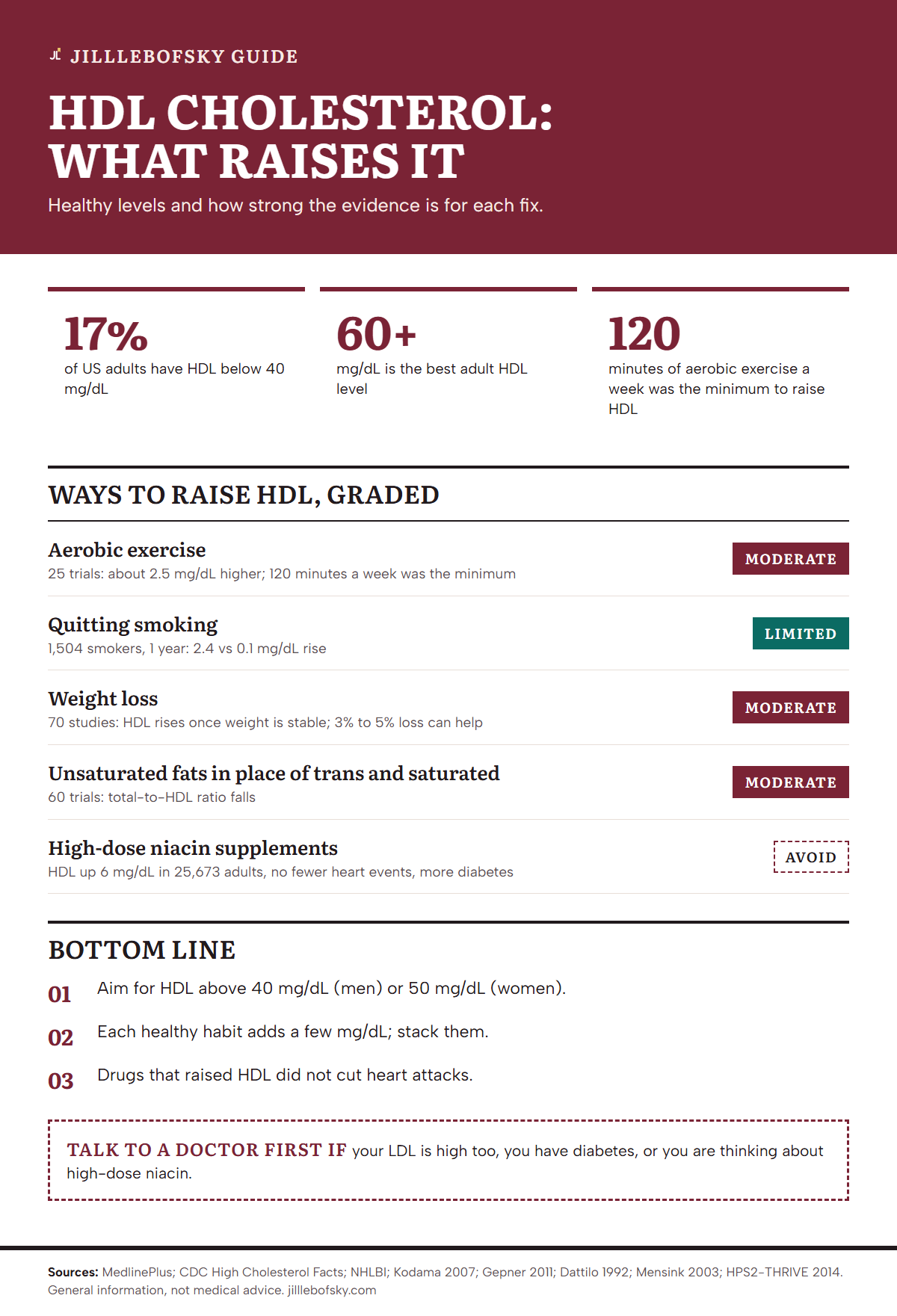
HDL cholesterol carries extra cholesterol back to your liver, so a higher level is usually better. Adults should aim for more than 40 mg/dL (men) or 50 mg/dL (women), and 60 or more is best. Exercise, weight loss, quitting smoking and swapping trans and saturated fats for unsaturated fats raise it a little. Drugs that raised HDL did not cut heart attacks.
HDL cholesterol is the "good" cholesterol on your blood test, and this guide explains what the number means, what a healthy level is, why it drops and what raises it. We read the MedlinePlus and NHLBI pages on HDL, the NIH niacin fact sheet, and the large trials of HDL-raising drugs[1][4][7][13]. Our review method and editorial policy explain how we pick sources.
The short answer: adults should have an HDL of more than 40 mg/dL for men and more than 50 mg/dL for women, and 60 mg/dL or more is best[1][2]. Lifestyle changes raise it by a few points, but raising HDL with drugs has not cut heart attacks in trials[8][13].
| What it is | A lipoprotein that carries cholesterol from the rest of your body back to the liver, which removes it[1] |
|---|---|
| Healthy level | More than 40 mg/dL for men, more than 50 mg/dL for women, more than 45 mg/dL at age 19 or younger[1] |
| Best level | 60 mg/dL or more for adults[2] |
| How common low HDL is | About 17% of US adults have an HDL below 40 mg/dL[6] |
| What raises it | Aerobic exercise, weight loss, quitting smoking and better fats; each adds a few mg/dL[5][8][10] |
| Drugs just for HDL | Not usually prescribed; niacin and CETP inhibitor trials raised HDL without fewer heart events[1][12][15] |
| Main safety point | High-dose niacin supplements can cause flushing, liver damage and blood sugar problems[7] |
What is HDL cholesterol?
HDL cholesterol is the cholesterol carried by high-density lipoproteins, which move cholesterol from other parts of your body back to your liver for removal. That clean-up job is why MedlinePlus calls it the "good" cholesterol. LDL, the "bad" kind, does the opposite and can build up in your arteries[1].
Cholesterol does not dissolve in blood, so it travels inside lipoproteins. HDL and LDL are the two main types. The NHLBI says HDL helps decrease cholesterol blockages in the arteries[3].
A standard lipid panel measures your HDL, your LDL and your triglycerides from one blood draw[3]. Many labs also print non-HDL cholesterol, which is your total cholesterol minus HDL. The LDL number on many reports is "calculated" from total cholesterol, HDL and triglycerides, so your HDL result feeds into that estimate too[2].
For the bigger picture of how LDL and diet fit in, see our guide on how to lower cholesterol with diet, activity and medicine.
What are healthy HDL cholesterol levels?
For HDL, higher numbers are usually better: adult men should be above 40 mg/dL and adult women above 50 mg/dL. MedlinePlus lists 60 mg/dL or more as the best level for adults, and more than 45 mg/dL for anyone 19 or younger[1][2].
| Group | Low | Healthy |
|---|---|---|
| Age 19 or younger | 45 mg/dL or less | More than 45 mg/dL[1] |
| Men 20 and older | Below 40 mg/dL | More than 40; 60 or more is best[1][2] |
| Women 20 and older | Below 50 mg/dL | More than 50; 60 or more is best[1][2] |
The NHLBI frames the goal as a pair: non-HDL cholesterol below 130 mg/dL, with HDL of at least 40 mg/dL for men and 50 mg/dL for women[3]. Reading HDL alone gives you only half the story.
Low HDL is common. CDC data from 2017 to 2020 found that about 17% of US adults had an HDL below 40 mg/dL[6].
What causes low HDL cholesterol?
An unhealthy lifestyle is the most common cause of low HDL, according to the NHLBI. Smoking, extra body weight, inactivity and a diet heavy in trans and saturated fats all pull the number down. Genes, other health conditions and some medicines can lower it as well[4][1].
The common drivers named by MedlinePlus and the NHLBI:
- Smoking and secondhand smoke. Both lower HDL, and the effect is stronger in women[1][4].
- Diabetes. It can lower HDL, which is one more reason to keep blood sugar in range[1].
- Menopause. After menopause, HDL usually goes down while LDL goes up[4].
- Chronic stress. It can sometimes lower HDL[5].
- Medicines. Beta blockers, anabolic steroids including testosterone, progestins and benzodiazepines can lower HDL in some people[1].
Ancestry plays a part too. The NHLBI notes that Hispanic Americans are more likely to have lower HDL, while African Americans are more likely to have high HDL[4]. If you take one of the medicines above and your HDL is very low, ask your prescriber before stopping anything[1].
Is high HDL cholesterol always good?
Not always: very high HDL has been linked with higher death rates in large observational studies. In the Copenhagen studies, the lowest risk of death from any cause came at about 73 mg/dL in men and 93 mg/dL in women, and risk rose again above those ranges[17].
That analysis followed 52,268 men and 64,240 women. Compared with the lowest-risk group, men with HDL of 116 mg/dL or more had a hazard ratio of 2.06 for death, and women with 135 mg/dL or more had 1.68[17]. The authors called the result paradoxical and said it needs confirmation. It shows a link, not proof that high HDL causes harm.
The NHLBI makes a related point. A study found that higher HDL may not be as protective in some Black and White adults as once believed, and other risk factors such as high blood pressure, obesity or diabetes may outweigh any benefit of a high HDL[4].
A high HDL also does not cancel out a high LDL. MedlinePlus says a person with low HDL and high LDL may need medicine, and LDL stays the main treatment target[1].
How to increase HDL cholesterol naturally
The habits that raise HDL in studies are aerobic exercise, weight loss, quitting smoking and swapping trans and saturated fats for unsaturated fats. Each adds only a few mg/dL. The same changes also lower LDL or triglycerides, which matters more for your heart[1][5].
We would take them in this order:
- Stop smoking. In a trial of 1,504 smokers, quitters raised HDL by 2.4 mg/dL over a year, against 0.1 mg/dL in those who kept smoking, despite gaining 4.6 kg[10].
- Do aerobic exercise for at least 120 minutes a week. A meta-analysis of 25 trials found an average rise of about 2.5 mg/dL, and 120 minutes a week looked like the minimum dose[8].
- Make each session longer. Every extra 10 minutes per session was linked with about 1.4 mg/dL more HDL, while frequency and intensity were not[8].
- Lose a little weight if you carry extra. The NHLBI says losing only 3% to 5% of body weight can raise HDL, and waist fat matters most[5][1].
- Replace trans and saturated fats with unsaturated ones. Use olive oil, nuts and avocado instead of butter, fatty meat and fried food[1][11].
- Cut back on sugar and refined carbs, and eat more fiber from oatmeal and beans[1].
- Keep alcohol low. Too much alcohol leads to weight gain, which lowers HDL[1].
Our guide to the best cardio exercises for weight loss grades activities for steps 2 to 4.
How much can lifestyle changes raise HDL?
Expect a few mg/dL from each change, not a jump of 10 or 20 points. The best trial data show rises of roughly 2 to 3 mg/dL from exercise or quitting smoking, so stacking several habits is the realistic path to a higher number[8][10].
| Change | Study | HDL result |
|---|---|---|
| Aerobic exercise | Meta-analysis of 25 randomized trials, 2007 | About 2.5 mg/dL higher on average[8] |
| Quitting smoking | 1,504 smokers followed for 1 year, 2011 | 2.4 vs 0.1 mg/dL rise[10] |
| Weight loss by diet | Meta-analysis of 70 studies, 1992 | Rises once weight is stable; dips slightly while still losing[9] |
| Better fats | Meta-analysis of 60 trials, 2003 | Total-to-HDL ratio falls when unsaturated fats replace saturated and trans fats[11] |
The weight-loss meta-analysis found HDL can dip slightly while you are still actively losing weight, then rise once your weight holds steady[9]. So a test in the middle of a diet may look worse than the end result.
The fat trials also found that replacing trans fats had almost twice the effect on the total-to-HDL ratio as replacing saturated fats[11]. If your triglycerides are high as well, our steps for how to lower triglycerides overlap with these.
Do drugs that raise HDL lower heart risk?
No: large trials of drugs that raised HDL found no drop in heart attacks or strokes. Niacin and a class called CETP inhibitors lifted HDL by up to 72%, but heart events stayed the same or rose. That is why doctors do not usually prescribe medicine only to raise HDL[1][14].
| Trial | Who and how long | HDL change | Heart events |
|---|---|---|---|
| AIM-HIGH, niacin 1,500 to 2,000 mg, 2011 | 3,414 people with heart disease on a statin; stopped at about 3 years | 35 to 42 mg/dL | 16.4% vs 16.2% on placebo[12] |
| HPS2-THRIVE, niacin 2 g, 2014 | 25,673 adults with vascular disease; 3.9 years | 6 mg/dL higher | 13.2% vs 13.7%, not significant[13] |
| ILLUMINATE, torcetrapib, 2007 | 15,067 high-risk patients; stopped early | 72.1% higher | More events and more deaths[14] |
| dal-OUTCOMES, dalcetrapib, 2012 | 15,871 people after a heart event; 31 months | 31% to 40% higher | 8.0% vs 8.3%, stopped for futility[15] |
Genetic research points the same way. A 2012 Lancet study found that people born with gene variants that raise HDL did not have fewer heart attacks, while gene variants that raise LDL did raise risk[16]. So HDL seems to reflect overall health more than it drives heart risk on its own.
Should you take niacin to raise HDL?
For most people, no: niacin raises HDL but did not prevent heart events in modern trials, and high doses carry real risks. The NIH Office of Dietary Supplements says nicotinic acid can raise HDL by 10% to 30%, yet 2017 reviews found little if any protection from heart disease[7].
The doses used for cholesterol are far above the adult upper limit of 35 mg a day, and some niacin-only supplements contain 500 mg or more per serving[7]. Side effects named by the NIH include:
- Skin flushing, which "slow release" forms try to reduce[7]
- Liver damage, more likely with extended-release forms[7]
- Higher blood sugar and insulin resistance; HPS2-THRIVE saw 1.3 percentage points more new diabetes[7][13]
- Low blood pressure, stomach upset and vision problems[7]
Read the form on the label. Nicotinamide, a common form, does not change blood lipids, and "flush free" inositol hexanicotinate is absorbed about 30% less than nicotinic acid[7]. Never start high-dose niacin without a doctor, who would check liver enzymes and blood sugar first[7].
What do doctors focus on when HDL is low?
Doctors look at your whole risk picture, with LDL as the main target, rather than treating a low HDL by itself. MedlinePlus says providers do not usually prescribe medicine only to raise HDL, but someone with low HDL and high LDL may need medicine such as a statin[1].
Standard care starts with the heart-healthy lifestyle the NHLBI recommends: a better eating pattern, regular physical activity, a healthy weight, no smoking and stress management[5]. Some statins raise HDL a little while lowering LDL[1].
Your doctor may also check for the causes listed earlier. That can mean reviewing a beta blocker, a hormone or a sedative, and checking for diabetes[1]. Testing is simple: a lipid panel every 5 years for younger adults, and every 1 to 2 years for men 45 to 65 and women 55 to 65[1].
See a doctor soon if your HDL is low and your LDL is high, if you have diabetes or a family history of early heart disease, or if a test shows a very high HDL alongside other risk factors[1][4]. A supplement is never a replacement for this care.
What to check on your lipid panel and supplement labels
Read HDL next to LDL and non-HDL cholesterol, and read any niacin label for the form and the dose. These checks stop you judging heart risk on HDL alone, or buying a niacin product that does nothing for lipids or far exceeds the upper limit[3][7].
- Compare your HDL with the targets for your sex: above 40 mg/dL for men and above 50 mg/dL for women[1].
- Check non-HDL cholesterol; the NHLBI goal is below 130 mg/dL[3].
- Note whether LDL is "calculated", since it depends on your HDL and triglycerides[2].
- List any beta blocker, steroid, progestin or benzodiazepine for your doctor[1].
- On a niacin label, find the form: nicotinic acid, nicotinamide or inositol hexanicotinate[7].
- Compare the dose per serving with the 35 mg adult upper limit[7].
- Retest after several months of steady habits, once your weight has settled[9].
More guides on lipids and heart health sit in our cholesterol and heart section.
Bottom line on HDL cholesterol
HDL is a useful signal on your lipid panel, and we would not chase it with pills. Aim for more than 40 mg/dL as a man or more than 50 mg/dL as a woman, and treat a low result as a prompt to look at smoking, activity, weight and diet[1].
For most people, the better first step is a longer walk or ride most days and a plan to quit smoking, because those raise HDL and also lower LDL or triglycerides[5][8]. We would skip high-dose niacin supplements: the trials showed a higher HDL number without fewer heart attacks, plus extra diabetes and liver risk[12][13].
Frequently asked questions
What is non-HDL cholesterol?
Non-HDL cholesterol is your total cholesterol minus your HDL. It counts all the cholesterol carried by the harmful particles. The NHLBI goal for a healthy lipid profile is non-HDL below 130 mg/dL, together with a healthy HDL level.
Can you have high HDL and high LDL at the same time?
Yes. The two numbers move fairly independently, and a high HDL does not cancel out a high LDL. MedlinePlus notes that LDL drives the buildup in arteries, so a high LDL still needs attention even when HDL looks good.
Can medicines lower HDL cholesterol?
Yes. MedlinePlus lists beta blockers, anabolic steroids including testosterone, progestins in some birth control and menopause hormone therapy, and benzodiazepines. If you take one and your HDL is very low, ask your prescriber before changing anything.
Does losing weight raise HDL right away?
Not always. A meta-analysis of 70 studies found HDL can dip slightly while you are still actively losing weight, then rise once your weight is stable. Retest after your weight settles for a fairer picture of the change.
Is HDL the good cholesterol?
Yes. HDL is called the good cholesterol because it carries cholesterol from other parts of the body back to the liver, which removes it. Very high levels have been linked with higher death rates in observational studies, though.
Sources
- HDL: The "Good" Cholesterol. MedlinePlus, National Library of Medicine
- Cholesterol Levels. MedlinePlus, National Library of Medicine, 2024
- Blood Cholesterol: Diagnosis. NHLBI, NIH
- Blood Cholesterol: Causes and Risk Factors. NHLBI, NIH
- Blood Cholesterol: Treatment. NHLBI, NIH
- High Cholesterol Facts. CDC
- Niacin: Fact Sheet for Health Professionals. NIH Office of Dietary Supplements, 2022
- Effect of aerobic exercise training on serum levels of HDL cholesterol: a meta-analysis (Kodama et al.). Archives of Internal Medicine, 2007
- Effects of weight reduction on blood lipids and lipoproteins: a meta-analysis (Dattilo and Kris-Etherton). American Journal of Clinical Nutrition, 1992
- Effects of smoking and smoking cessation on lipids and lipoproteins (Gepner et al.). American Heart Journal, 2011
- Effects of dietary fatty acids and carbohydrates on the ratio of serum total to HDL cholesterol: a meta-analysis of 60 controlled trials (Mensink et al.). American Journal of Clinical Nutrition, 2003
- Niacin in patients with low HDL cholesterol levels receiving intensive statin therapy (AIM-HIGH). New England Journal of Medicine, 2011
- Effects of extended-release niacin with laropiprant in high-risk patients (HPS2-THRIVE). New England Journal of Medicine, 2014
- Effects of torcetrapib in patients at high risk for coronary events (ILLUMINATE). New England Journal of Medicine, 2007
- Effects of dalcetrapib in patients with a recent acute coronary syndrome (dal-OUTCOMES). New England Journal of Medicine, 2012
- Plasma HDL cholesterol and risk of myocardial infarction: a mendelian randomisation study (Voight et al.). The Lancet, 2012
- Extreme high HDL cholesterol is paradoxically associated with high mortality in men and women (Madsen et al.). European Heart Journal, 2017
This page is general information, not medical advice. Talk to your doctor or pharmacist before you start any supplement, especially if you are pregnant, take medicine or have a health condition. Read our medical disclaimer and how we review.