The best cardio exercises for weight loss are brisk walking, running and interval training, which have the most trial support, followed by cycling and swimming. The weekly dose matters more than the type: most adults need more than 250 to 300 minutes a week, plus fewer calories, to lose a meaningful amount. Cardio alone usually brings only a few pounds of loss.
We graded the best cardio exercises for weight loss on the human trials behind each one. We read the federal Physical Activity Guidelines, the American College of Sports Medicine (ACSM) position stand, a Cochrane review, four meta-analyses, two randomized trials, an NIDDK treatment page and calorie data from Harvard Health and the 2024 Compendium of Physical Activities.
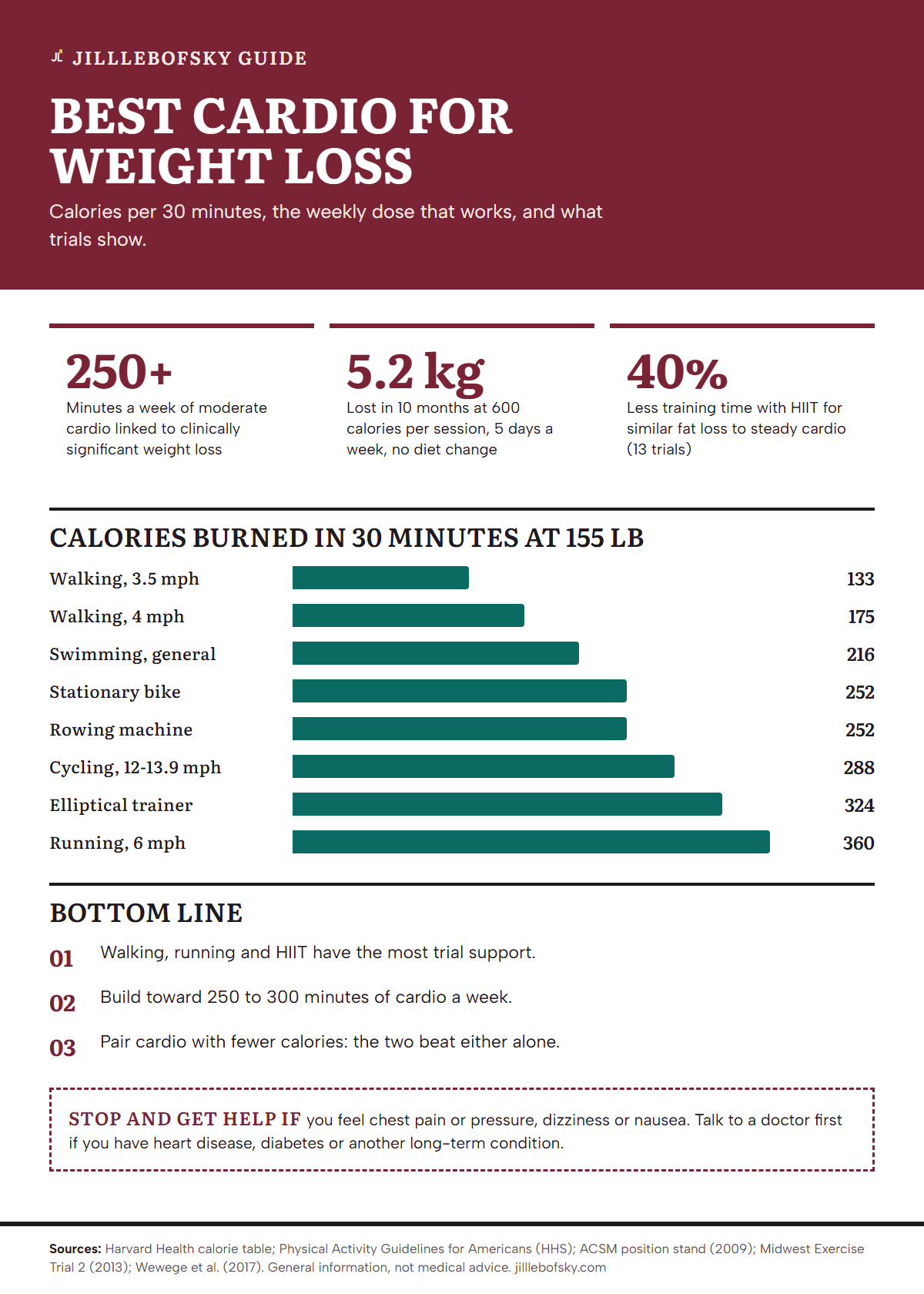
The short answer: brisk walking, running and interval training have the most trial support, but the weekly dose matters more than the type. In a 10-month trial, adults who burned 600 calories per session, 5 days a week, lost 5.2 kg (about 11 pounds) without changing their diet.[7]
| What it is | Aerobic (endurance) activity that raises your breathing and heart rate for a sustained time, such as brisk walking, running, cycling and swimming[15] |
|---|---|
| Weekly amount for health | 150 to 300 minutes of moderate activity, or 75 to 150 minutes of vigorous activity[1] |
| Amount for weight loss | More than 250 minutes a week is linked to clinically significant loss; losing more than 5% of body weight may take over 300 minutes[6][1] |
| Calories in 30 minutes | About 133 for a 3.5 mph walk up to 360 for a 6 mph run, for a 155-pound adult[2] |
| Best evidence | A supervised 10-month trial in 141 adults: 3.9 kg lost at 400 calories per session and 5.2 kg at 600[7] |
| Safety | Cardio should not cause dizziness, chest pain or pressure, or nausea[15] |
| Check with a provider first | People with chronic conditions should be active under the care of a health provider[1] |
What are the best cardio exercises for weight loss?
The best cardio exercises for weight loss are the ones that burn real calories and that you can repeat most days of the week. Brisk walking, running and interval training have the most trial support. Cycling and swimming have less, and we found no adult weight-loss trials for elliptical or rowing machines.[10][12][13]
No trial has ranked every cardio type head to head. So we graded each type on the human studies behind it, then added calorie cost from the Compendium of Physical Activities, which lists energy costs for 1,114 activities.[3] Our full method is on the how we review health guides page.
- Moderate: several pooled trials, small consistent effect
- Limited: some trials, small or low quality
- Weak: pilot studies only, or reviews found no benefit
- Avoid: no evidence plus a safety problem
None of the six types below earned Avoid. Elliptical and rowing machines sit at Weak because nobody has run dedicated weight-loss trials on them.
1. Brisk walking: beginners and sore joints
Brisk walking is the easiest cardio to start and keep, and pooled studies show a small but steady loss. A meta-analysis of 9 pedometer programs with 307 people found an average loss of 1.27 kg over a median of 16 weeks, about 0.05 kg a week, with no diet change.[12]
Walking at 3.5 mph burns about 133 calories in 30 minutes for a 155-pound person, and 4 mph burns about 175.[2] That is less than running, so you need more minutes. The NIDDK names brisk walking as a typical activity in weight-loss programs.[14]
It also suits people with knee trouble. The federal guidelines say walking up to 10,000 steps a day does not appear to worsen knee osteoarthritis.[1] Use the talk test: at a moderate pace you can talk, but not sing.[1] Grade: Moderate.
2. Running and jogging: the most burn per minute
Running burns more calories per minute than walking, and it showed the clearest fat loss in pooled trials. A 6 mph run burns about 360 calories in 30 minutes at 155 pounds.[2] A 2017 meta-analysis found running programs had large effects on whole-body fat mass in adults with overweight or obesity.[10]
Running is vigorous for most people. The federal guidelines count 75 minutes of vigorous activity as roughly equal to 150 minutes of moderate activity, so each running minute does about twice the work of a walking minute.[1]
The trade-off is impact. For people with arthritis, the guidelines favor activities that are low impact and not painful, such as swimming and walking.[1] If you are new, start with walk and jog intervals and add running time slowly, since gradual increases lower the risk of injury.[1] Grade: Moderate.
3. Interval training (HIIT): people short on time
Interval training (HIIT) gives about the same fat loss as steady cardio in less time. A 2017 meta-analysis of 13 trials in adults with overweight or obesity found no significant difference between HIIT and moderate steady cardio on body composition, but HIIT needed about 40% less training time.[10]
A larger 2019 review pooled 36 studies. Both styles cut body fat percentage by similar amounts (1.50 and 1.44 points), while interval training cut total fat mass 28.5% more.[11] The journal later posted an expression of concern on that paper, so treat the 28.5% figure with care.[11]
HIIT is hard work. The Compendium rates vigorous HIIT, such as burpees or Tabata, at 11.0 METs, against 7.0 for moderate HIIT.[4] That intensity is why people with heart disease or other chronic conditions should plan it with their provider.[1] Grade: Moderate.
4. Cycling and stationary bikes: low-impact steady work
Cycling is a solid low-impact choice, but its trial record for fat loss is thinner than running. In the 2017 meta-analysis, cycling programs did not produce significant fat loss, while running programs did.[10] Calories are still respectable: about 252 for a moderate stationary bike and 288 for road cycling at 12 to 13.9 mph.[2]
The NIDDK lists cycling next to brisk walking as a standard activity in weight-loss programs.[14] A vigorous stationary ride burns about 278 calories in 30 minutes at 155 pounds, so effort matters.[2]
Set the resistance so you can still talk but not sing, and you are in the moderate zone the guidelines describe.[1] Grade: Limited.
5. Swimming: arthritis, back pain or a heavier body
Swimming takes weight off the joints and has one randomized trial behind it for weight loss. In the SWEAT 2 trial, 116 women aged 50 to 70 swam or walked 3 times a week. After 12 months, the swimmers had lost 1.1 kg more body weight than the walkers.[13]
General swimming burns about 216 calories in 30 minutes at 155 pounds, and vigorous laps about 360.[2] The federal guidelines list swimming as a low-impact choice for people with osteoarthritis.[1]
One trial in older women is not enough to call swimming the best cardio for everyone, so we graded it Limited. It is still a strong pick if walking or running hurts. Grade: Limited.
6. Elliptical and rowing machines: gym days without impact
Elliptical trainers and rowing machines burn plenty of calories, but we found no weight-loss trials testing them in adults. An elliptical burns about 324 calories in 30 minutes at 155 pounds, and a moderate rowing machine about 252.[2] The Weak grade reflects the missing trials; the machines themselves are hard work.
The Compendium puts a moderate elliptical at 5.0 METs and a vigorous one at 9.0. Light rowing is 5.0 METs and vigorous rowing is 7.3.[4] A MET compares the energy an activity uses with the energy you use at rest, so higher numbers mean more calories per minute.[3]
These machines still count toward your weekly minutes. Use them on days you want a break from impact, and keep the pace in the talk-but-not-sing range.[1] Grade: Weak.
How many calories does each cardio exercise burn in 30 minutes?
A 155-pound adult burns about 133 to 360 calories in 30 minutes of common cardio, depending on the activity and pace. Heavier people burn more and lighter people burn less. A 3.5 mph walk burns about 107 calories at 125 pounds and about 159 at 185 pounds.[2]
| Activity | Calories | Our grade |
|---|---|---|
| Walking, 3.5 mph | 133[2] | Moderate |
| Walking, 4 mph | 175[2] | Moderate |
| Swimming, general | 216[2] | Limited |
| Stationary bike, moderate | 252[2] | Limited |
| Rowing machine, moderate | 252[2] | Weak |
| Cycling, 12 to 13.9 mph | 288[2] | Limited |
| Elliptical trainer | 324[2] | Weak |
| Running, 6 mph | 360[2] | Moderate |
| Swimming laps, vigorous | 360[2] | Limited |
Treat these as rough guides. Your real burn depends on body size and effort, which is why we rank by trial results and by the minutes you can keep up week after week.[2][3]
How much cardio do you need to lose weight?
Most adults need more than 250 to 300 minutes of moderate cardio a week to lose a meaningful amount of weight from exercise. The ACSM position stand found that 150 to 250 minutes a week gives only modest loss, while more than 250 minutes is linked to clinically significant loss.[6]
The federal guidelines agree: people who want to lose more than 5% of body weight may need more than 300 minutes a week.[1] Even a 3% to 5% loss lowers health risk.[6] If heart numbers are your main goal, our guide on how to lower blood pressure covers the other steps.
The Midwest Exercise Trial 2 shows what high volume can do. Adults burned 400 or 600 calories per session, 5 days a week, for 10 months, under supervision.[7] The 400-calorie group lost 3.9 kg (4.3%), the 600-calorie group lost 5.2 kg (5.7%), and the control group gained 0.5 kg.[7] At 155 pounds, 600 calories is roughly 50 minutes of running at 6 mph.[2]
Can cardio alone help you lose weight?
Cardio alone usually brings small weight loss unless the volume is very high. A 2014 review found that public-health amounts of exercise may bring up to about 2 kg of loss, and that people respond very differently.[5] The 2006 Cochrane review of 43 studies with 3,476 people also found only small losses from exercise alone.[9]
| Study | Who and how long | What they did | Result |
|---|---|---|---|
| Midwest Exercise Trial 2 (2013) | 141 adults, 10 months | 400 or 600 calories a session, 5 days a week | 3.9 kg and 5.2 kg lost; controls gained 0.5 kg[7] |
| Cochrane review (2006) | 43 studies, 3,476 people | Exercise alone or with diet | Small loss alone; 1.1 kg more with diet plus exercise than diet alone[9] |
| Johns meta-analysis (2014) | 8 trials, 1,022 people | Diet plus exercise vs exercise only | 6.29 kg more lost at 12 to 18 months with both[8] |
| Wewege meta-analysis (2017) | 13 trials, adults with overweight or obesity | HIIT vs steady cardio | No significant difference; HIIT used 40% less time[10] |
| Richardson meta-analysis (2008) | 307 people, median 16 weeks | Pedometer walking | 1.27 kg lost[12] |
| SWEAT 2 trial (2010) | 116 women aged 50 to 70, 12 months | Swimming vs walking | Swimmers lost 1.1 kg more[13] |
The same Cochrane review found that higher-intensity exercise led to 1.5 kg more loss than lower-intensity exercise.[9] Intensity helps, though adding eating changes brings a bigger gain.
Should you combine cardio with diet and strength training?
Yes. Pairing cardio with fewer calories works better than either one alone, and strength work helps protect muscle. In 8 trials with 1,022 people, diet plus exercise led to 5.33 kg more loss at 3 to 6 months than exercise alone, and 1.72 kg more at 12 months than diet alone.[8]
The federal guidelines say combining calorie cuts with physical activity tends to work best for weight loss.[1] They also advise muscle-strengthening work on 2 or more days a week, which helps you keep lean mass while you lose weight.[1]
If you are also watching blood sugar or cholesterol, our guides to blood sugar support supplements and how to lower cholesterol cover what the evidence shows there.
What does a sample week of cardio for weight loss look like?
A practical plan starts near 150 minutes a week and builds toward 300, mixing easy low-impact days with one or two harder sessions. The table below is our example ramp, built from the federal minute targets and the talk test. Adjust it to your fitness and any advice from your doctor.[1]
| Weeks | Weekly minutes | What a week looks like |
|---|---|---|
| 1 and 2 | 150 | 30 minutes of brisk walking on 5 days |
| 3 and 4 | 200 | 40 minutes of walking or cycling on 5 days |
| 5 and 6 | 250 | 50 minutes on 5 days; one session adds short faster intervals |
| 7 and 8 | 300 | 60 minutes on 5 days mixing walking, cycling and swimming, plus 2 strength days |
Each vigorous minute, such as running or hard intervals, counts about the same as 2 moderate minutes.[1] So 25 minutes of running can stand in for a 50-minute walk on a busy day.
Who should check with a doctor before starting cardio?
Anyone with a chronic condition, such as heart disease, diabetes or arthritis, should start cardio under a health provider's care. The federal guidelines say people with chronic conditions should be under a provider's care and match their activity to their abilities. Pregnant people should also talk with their provider about how much to do.[1]
Warm up before each session, cool down after, and drink water.[15] Build up slowly, because gradual increases in time and effort lower the risk of injury.[1]
Stop exercising and see a doctor right away (call 911 if chest symptoms do not ease when you rest) if you notice:
- Chest pain or pressure[15]
- Dizziness or feeling faint[15]
- Nausea during or after a session[15]
- Joint pain that gets worse with each session; switch to a low-impact activity that is not painful[1]
What do doctors use first for weight loss?
Doctors start with a lifestyle program that combines a lower-calorie eating plan, more physical activity and behavior support. The NIDDK describes programs that include at least 150 minutes a week of moderate activity, such as brisk walking or cycling, and 14 or more counseling sessions over 6 months.[14]
For some adults, doctors add weight-loss medicines or surgery, which the NIDDK covers on the same treatment page.[14] Cardio is one part of that plan, and it works best alongside eating changes.[8]
Practical checklist
Most people do best with a moderate activity they enjoy, a slow build in weekly minutes and a modest calorie cut. Pick the activity first and set the pace with the talk test. Then add time every couple of weeks, expect the scale to move slowly, and judge progress over months of training.
- Pick the cardio you can do on 5 days a week without pain.
- Start near 150 minutes a week and add 30 to 50 minutes every 2 weeks.
- Use the talk test: at a moderate pace you can talk, but not sing.[1]
- Count each vigorous minute as about 2 moderate minutes.[1]
- Add muscle-strengthening work on 2 days a week.[1]
- Pair cardio with a modest calorie cut, since the two together beat either alone.[8]
- Expect slow change: walking alone averaged about 0.05 kg a week.[12]
- Browse our fitness guides and read our editorial policy on sources.
Bottom line
For most people, brisk walking is the better first step because it is easy to repeat, gentle on the joints and backed by pooled studies.[12] Running and HIIT burn more per minute and save time, but only if your joints and heart are ready for them.[10][1]
Whatever you choose, the weekly dose matters more than the type. Build toward 250 to 300 minutes a week and pair it with eating changes, because cardio alone rarely moves the scale far.[6][5]
Frequently asked questions
Is walking or running better for weight loss?
Running burns about 360 calories in 30 minutes at 155 pounds against 133 for a 3.5 mph walk, so it does more per minute. Walking is easier to repeat and gentler on joints. The best choice is the one you can keep up for 250 or more minutes a week.
Can I lose weight doing 30 minutes of cardio a day?
Thirty minutes on 5 days gives 150 minutes a week, which the ACSM says brings only modest loss on its own. Most people need more than 250 minutes a week, or 30 minutes daily paired with a lower-calorie eating plan, to see a clear change.
How long does it take to see weight loss from cardio?
Change is slow. Pedometer walking programs averaged about 0.05 kg a week over a median of 16 weeks. In a 10-month supervised trial, high-volume cardio led to 3.9 to 5.2 kg of loss. Adding diet changes speeds results.
Is HIIT safe for beginners?
HIIT is vigorous, so beginners should first build a base of moderate cardio and increase effort slowly. People with heart disease, diabetes or other chronic conditions should plan it with their provider. Stop if you feel chest pain, dizziness or nausea.
What is the best cardio machine for weight loss?
By calories, an elliptical burns about 324 in 30 minutes at 155 pounds, and a moderate stationary bike or rowing machine about 252. We found no adult weight-loss trials comparing machines, so pick the one you will use most often.
Sources
- Physical Activity Guidelines for Americans, 2nd edition. HHS Office of Disease Prevention and Health Promotion, 2018
- Calories burned in 30 minutes for people of three different weights. Harvard Health Publishing, 2021
- 2024 Adult Compendium of Physical Activities (Herrmann et al.). Journal of Sport and Health Science, 2024
- Conditioning exercise MET values. Compendium of Physical Activities, 2024
- The role of exercise and physical activity in weight loss and maintenance (Swift et al.). Progress in Cardiovascular Diseases, 2014
- ACSM position stand: physical activity strategies for weight loss and prevention of weight regain (Donnelly et al.). Medicine and Science in Sports and Exercise, 2009
- Aerobic exercise alone results in clinically significant weight loss: Midwest Exercise Trial 2 (Donnelly et al.). Obesity, 2013
- Diet or exercise interventions vs combined behavioral weight management programs (Johns et al.). Journal of the Academy of Nutrition and Dietetics, 2014
- Exercise for overweight or obesity (Shaw et al.). Cochrane Database of Systematic Reviews, 2006
- High-intensity interval training vs moderate-intensity continuous training on body composition (Wewege et al.). Obesity Reviews, 2017
- Is interval training the magic bullet for fat loss? (Viana et al.). British Journal of Sports Medicine, 2019
- A meta-analysis of pedometer-based walking interventions and weight loss (Richardson et al.). Annals of Family Medicine, 2008
- Swimming vs walking in older women, the SWEAT 2 trial (Cox et al.). Metabolism, 2010
- Treatment for Adults with Overweight and Obesity. NIDDK, National Institutes of Health
- Four Types of Exercise Can Improve Your Health and Physical Ability. National Institute on Aging
This page is general information, not medical advice. Talk to your doctor or pharmacist before you start any supplement, especially if you are pregnant, take medicine or have a health condition. Read our medical disclaimer and how we review.