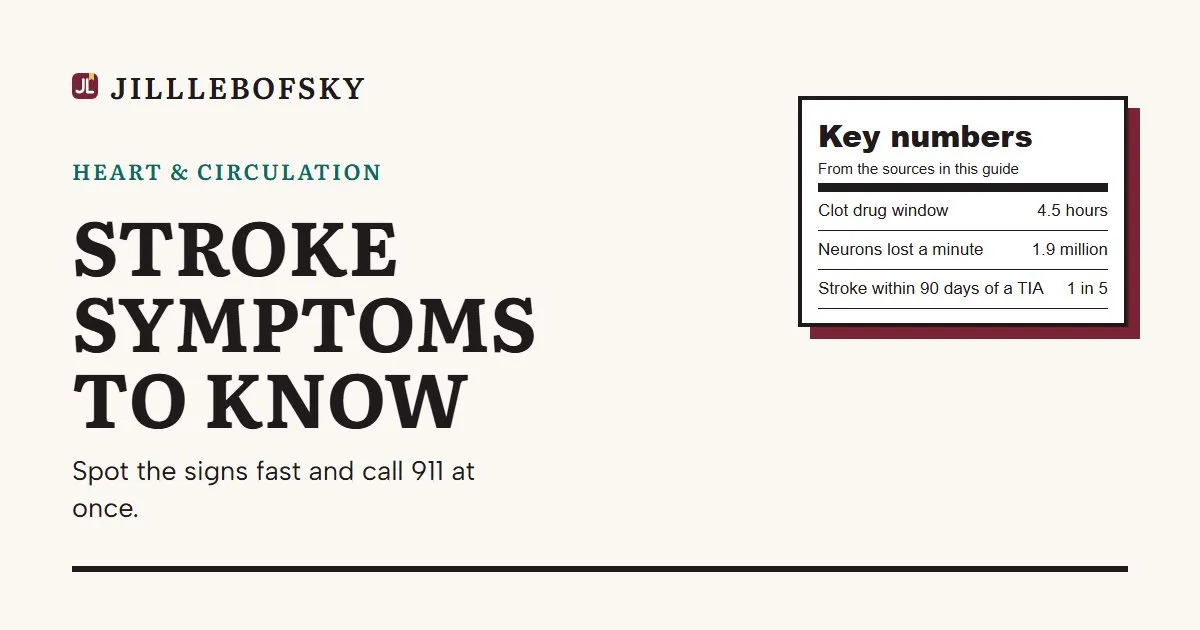
Stroke symptoms start suddenly: a drooping face, weakness or numbness on one side, slurred or confused speech, vision loss, loss of balance, or a severe headache with no known cause. Call 911 at once, even if the signs fade, and note the time they began. The main clot-busting drug works within 4.5 hours, and some clots can be removed up to 24 hours later.
Stroke symptoms start suddenly: a drooping face, a weak arm or leg, slurred or confused speech, lost vision, or a severe headache out of nowhere. We read the stroke pages from NINDS, NHLBI, MedlinePlus, the CDC and the American Stroke Association, plus six published studies, to put the warning signs, causes and hospital care in one place.[1][2][9]
If any of these signs appear, call 911 at once. The main clot-busting drug works only within 4.5 hours, and an untreated stroke destroys about 1.9 million nerve cells every minute.[1][6][12]
| What it is | Blood flow to part of the brain is blocked (ischemic stroke) or a vessel bleeds into the brain (hemorrhagic stroke)[4] |
|---|---|
| Main warning signs | Sudden face droop, weakness or numbness on one side, speech trouble, vision loss, loss of balance, severe headache[1] |
| Most common type | Ischemic, about 87% of strokes[4] |
| Treatment window | Clot-busting drug up to 4.5 hours after symptoms begin; clot removal up to 24 hours for some people[1][6] |
| Biggest risk factor | High blood pressure[7][17] |
| Warning stroke (TIA) | Signs often pass in under 5 minutes, yet nearly 1 in 5 people have a stroke within 90 days[9] |
| What to do | Call 911, note the time, and do not drive to the hospital[2][10] |
What are the most common stroke symptoms?
The main stroke symptoms are sudden numbness or weakness on one side of the body, confusion or trouble speaking, trouble seeing, trouble walking, and a severe headache with no known cause. NINDS says the key to spotting a stroke is that the signs come on suddenly, without warning.[1]
NINDS lists these five signs:[1]
- Numbness or weakness of the face, arm or leg, most often on one side of the body
- Confusion, slurred words, or trouble understanding what other people say
- Trouble seeing in one or both eyes
- Trouble walking, dizziness, or loss of balance and coordination
- A severe headache with no known cause
Less often, a stroke shows up as double vision, drowsiness, nausea, vomiting, memory loss or disorientation.[1] These are easy to blame on something else, so look for them alongside any one-sided weakness or change in speech.
Signs usually arrive within minutes. NHLBI notes they can also build over hours or even days, sometimes when a mini stroke turns into a full stroke.[2] Which signs show up depends on the type of stroke and the part of the brain that is hurt.[2]
Why people miss their own stroke
A stroke can damage the parts of the brain that let a person notice something is wrong. NINDS calls this anosognosia, and it is one reason bystanders often have to make the call.[1] If a family member brushes off a slurred word or a clumsy hand, trust what you see.
Dizziness on its own has many causes, and most of them start in the inner ear. Our guide to the common causes of vertigo and dizziness covers those. Dizziness that arrives with weakness, numbness, speech trouble or vision loss is different, and it belongs on the stroke list.[1]
How do you check for a stroke with the FAST test?
FAST is a short check anyone can run: Face, Arms, Speech, Time. If one side of the face droops, one arm drifts down, or speech sounds slurred or strange, the T means it is time to call 911 right away. NHLBI and NINDS both teach this test to the public.[1][2]
- Face: ask the person to smile. Does one side of the face droop?
- Arms: ask the person to raise both arms. Does one arm drift downward?
- Speech: ask the person to repeat a simple phrase. Is the speech slurred or strange?
- Time: if you see any of these signs, call 911 and note the time.[2]
FAST does not cover every sign. Sudden vision loss, a sudden severe headache or a sudden loss of balance also count as stroke signs, even when the face, arms and speech look normal.[1]
Try to note the clock time when the person was last known to be well. NHLBI explains that the clot-busting drug is given within 4.5 hours of the first symptoms, or within 4.5 hours of waking up with them, so that time shapes what doctors can offer.[6]
What does a mini stroke (TIA) feel like?
A transient ischemic attack (TIA), often called a mini stroke, causes the same sudden symptoms as a stroke, but they fade on their own. The American Stroke Association says they usually last less than five minutes. MedlinePlus says most clear within an hour, though some last up to 24 hours.[8][9]
A TIA happens when a clot blocks blood flow to the brain for a short time and then dissolves or moves on.[9] It leaves no lasting damage, so many people shrug it off.
About 240,000 people in the United States have a TIA each year, and nearly 1 in 5 people with a suspected TIA have a stroke within 90 days.[9] The CDC puts the 90-day risk as high as 17%, with the greatest risk in the first week.[10]
You also cannot tell a TIA from a stroke while it is happening, so MedlinePlus advises going to the hospital right away.[8] The American Stroke Association adds that 2 in 5 people with a suspected TIA learn from the right scan that they actually had a stroke.[9]
What causes a stroke?
A stroke happens when blood stops reaching part of the brain, either because an artery is blocked (ischemic stroke) or because a vessel bursts and bleeds (hemorrhagic stroke). Brain cells cut off from oxygen-rich blood start dying quickly, which is why every stroke is an emergency.[3][4][12]
About 87% of strokes are ischemic, by NHLBI's count.[4] The blockage usually starts with plaque, a buildup of fat, cholesterol and other material inside an artery. Plaque can break open, and platelets then stick to the injury and form a clot.[4]
Sometimes the clot forms somewhere else and travels to the brain, which is called an embolism. It can break off from plaque in a carotid artery in the neck, or form in the heart when it beats out of rhythm.[4][11]
Hemorrhagic stroke: a bleeding vessel
Bleeding strokes are less common. Bleeding inside the skull accounts for about 10% of strokes, and bleeding between the brain and its thin covering, called subarachnoid hemorrhage, for about 3%.[4]
The usual causes are an aneurysm, a weak bulge in an artery that can burst, and an arteriovenous malformation, a tangle of poorly formed vessels. High blood pressure strains artery walls and makes either one more likely to break open. Bleeding can also follow the use of blood thinners.[4]
A sudden, severe headache with no known cause is on the NINDS list of stroke signs, so treat it as an emergency rather than reaching for a painkiller and waiting.[1]
Who is most likely to have a stroke?
High blood pressure is the primary risk factor for stroke, and most strokes trace back to things that can be treated or changed. NHLBI says factors people can control, such as blood pressure, obesity, inactivity, poor diet and smoking, account for 82% to 90% of all strokes.[4][7]
The INTERSTROKE study compared 26,919 people in 32 countries and found that ten modifiable risk factors explained 90.7% of the population risk of stroke. High blood pressure alone explained 47.9%.[17]
| Group | Examples |
|---|---|
| Can be treated or changed | High blood pressure, diabetes, high cholesterol, atrial fibrillation and other heart disease, smoking, obesity, inactivity, heavy drinking, cocaine use[4][7] |
| Cannot be changed | Older age, a parent or sibling who had a stroke, blood type AB; stroke rates double every 10 years after age 55[4][9] |
| Specific to women | Birth control pills, hormone replacement therapy, pregnancy and the weeks after birth, preeclampsia[4] |
| Other conditions | Sleep apnea, kidney disease, migraine, lupus and other inflammatory conditions[4] |
Atrial fibrillation can cause no symptoms at all. The irregular rhythm lets blood pool in the heart, where clots can form and travel to the brain.[11]
If your numbers run high, our plain guides on how to lower blood pressure and how to lower cholesterol walk through the steps doctors start with.
When should you call 911 for stroke symptoms?
Call 911 the moment any stroke sign appears, even if it fades after a few minutes. Do not drive to the hospital or let someone else drive you. An ambulance crew can start treatment on the way, and the CDC notes that the key to recovery is reaching the hospital quickly.[2][10]
Call 911 right away if:
- One side of the face droops or goes numb[1][2]
- An arm or leg turns weak or numb, especially on one side[1]
- Speech is slurred or garbled, or the person suddenly cannot understand you[1]
- Vision fails in one or both eyes, or the person sees double[1]
- Walking, balance or coordination fails without warning[1]
- A sudden, severe headache has no clear cause[1]
- Any of these signs came and went, since a TIA often comes before a stroke[8][9]
What to do while you wait for the ambulance
- Call 911 and tell the dispatcher you think it is a stroke.
- Note the time the symptoms started, or the last time the person was seen well. If they woke up with symptoms, note when they went to sleep.[6]
- Do not drive the person yourself, even if the hospital is close.[2][10]
- Leave all medicine decisions to the care team. Only a brain scan shows whether the stroke is a clot or a bleed, and the treatments are different.[5][6]
- Gather the person's medicine list, and flag any blood thinner for the paramedics.[4][6]
- Stay with the person and watch for changes in speech, alertness or movement until help arrives.
How do doctors diagnose and treat a stroke?
Doctors confirm a stroke with a brain scan, usually a CT done soon after arrival, because treatment depends on whether the stroke is a clot or a bleed. Clots can be dissolved with a drug called tPA or pulled out through a thin tube. Bleeds call for blood pressure control and sometimes surgery.[5][6]
A CT scan shows bleeding or damage to brain cells. An MRI may be used instead of CT or along with it. Blood tests check platelets and blood sugar, and they help show whether a given medicine can be used.[5]
For a hemorrhagic stroke, the care team works to lower blood pressure and stops blood thinners. Surgeons may close an aneurysm with a clip or with coils placed through a catheter.[6]
Why the clock matters
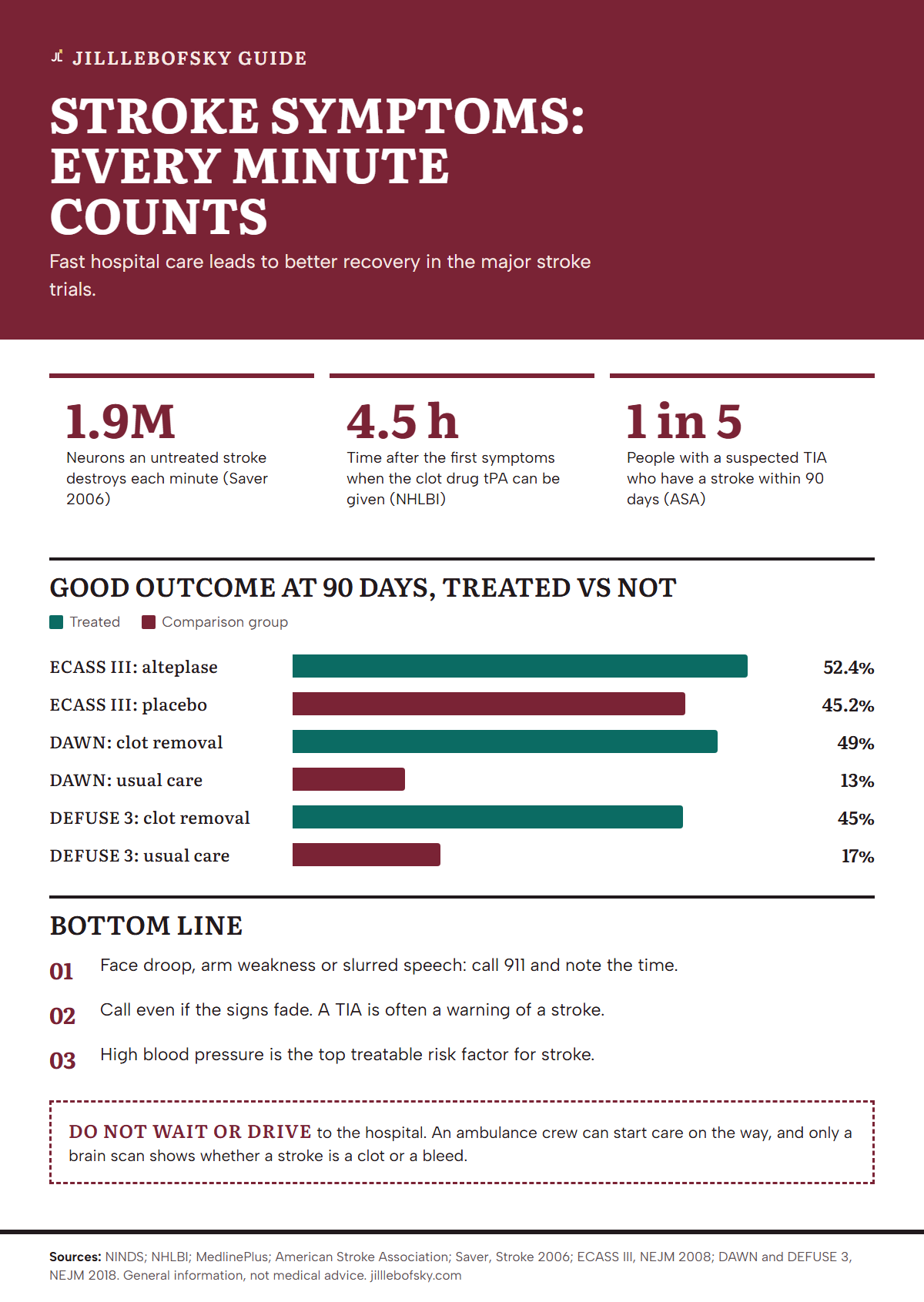
Jeffrey Saver's 2006 analysis in the journal Stroke estimated that an untreated stroke kills about 1.9 million neurons each minute. By his math, the brain ages about 3.6 years for each hour without treatment.[12]
NHLBI says tPA can be given up to 4.5 hours after symptoms begin. NINDS adds that some people benefit from treatment up to 24 hours after a stroke, so waking up with symptoms is still a reason to call.[1][6]
| Trial | Patients and window | Treatment | Result |
|---|---|---|---|
| NINDS t-PA, 1995 | Ischemic stroke, within 3 hours | Clot-busting drug vs placebo | At least 30% more likely to have little or no disability at 3 months; brain bleeding 6.4% vs 0.6%[13] |
| ECASS III, 2008 | 821 patients, 3 to 4.5 hours | Alteplase vs placebo | Good outcome 52.4% vs 45.2%; brain bleeding 2.4% vs 0.2%[14] |
| DAWN, 2018 | 206 patients, 6 to 24 hours | Clot removal vs usual care | Independent at 90 days 49% vs 13%[15] |
| DEFUSE 3, 2018 | 182 patients, 6 to 16 hours | Clot removal vs usual care | Independent 45% vs 17%; deaths 14% vs 26%[16] |
Clot-busting drugs improve recovery, but they carry a real bleeding risk, so doctors weigh timing and scan results first.[13][14] Clot removal in the later window was tested in people whose scans showed brain tissue that could still be saved.[15][16]
What lowers the risk of a stroke or a second stroke?
The steps that lower stroke risk are the ones doctors start with: controlling blood pressure, treating atrial fibrillation, managing diabetes and cholesterol, and quitting smoking. After a stroke or TIA the stakes rise, since about 1 in 4 stroke survivors has another stroke within 5 years.[4][7][10]
After a TIA or stroke, doctors may prescribe blood thinners or other medicines and ask for changes in diet and exercise. Surgery helps in some cases.[8][10]
The NIH and MedlinePlus pages we read list medicines, blood pressure control and lifestyle changes as the tools for stroke prevention. None lists a supplement.[4][7] If you take a blood thinner, check with your doctor before adding any supplement, because blood thinners already raise the risk of bleeding.[4]
Our supplement review method explains how we grade label doses against human trials, and stroke prevention is an area where prescribed care comes first.
Practical checklist
- Learn the FAST check and teach it to the people you live with.[2]
- Know your blood pressure, and ask your doctor what your target should be.[7]
- Mention any fluttering or irregular heartbeat, since atrial fibrillation can lead to stroke.[11]
- Keep a current list of your medicines, including any blood thinner, on your phone or in your wallet.[6]
- Treat any TIA as an emergency, even if you feel fine afterward.[8][9]
- If you smoke, ask about help quitting, since smoking damages blood vessels and raises blood pressure.[7]
Bottom line on stroke symptoms
Stroke symptoms are sudden, and the safe response is the same every time: call 911 and note the time. Face droop, arm weakness, speech trouble, vision loss, loss of balance and a sudden severe headache all count, even when they fade after a few minutes, because a passing episode may be a TIA.[1][9]
For most people the most useful long-term step is getting blood pressure under control, because it is the biggest treatable driver of stroke.[7][17] Our editorial policy explains why we point readers to standard care first, and the heart and circulation guides cover the habits that support it.
Frequently asked questions
Can stroke symptoms come and go?
Yes. Symptoms that appear and then fade may be a TIA, or mini stroke, which often comes before a full stroke. Nearly 1 in 5 people with a suspected TIA have a stroke within 90 days, so call 911 even if the signs pass.
Can someone have a stroke without realizing it?
Yes. A stroke can damage the part of the brain that lets a person notice a problem, a condition called anosognosia. That is why family members and bystanders often need to spot the signs and make the 911 call.
What is the main cause of a stroke?
Most strokes, about 87%, come from a blocked artery to the brain, usually from plaque or a traveling clot. The rest come from a burst blood vessel. High blood pressure is the biggest single risk factor for both types.
How long do you have to get treatment for a stroke?
The main clot-busting drug, tPA, can be given up to 4.5 hours after symptoms start. Some people can have a clot removed through a catheter up to 24 hours later, so go to the hospital even if hours have passed.
Can a young person have a stroke?
Yes. A stroke can happen at any age. NHLBI notes higher risk in babies under 1 and in older adults, and factors such as pregnancy, birth control pills, migraine and cocaine use can affect younger adults too.
Sources
- Stroke Signs and Symptoms. NINDS, NIH
- Stroke Symptoms. NHLBI, NIH, 2023
- What Is a Stroke?. NHLBI, NIH, 2023
- Stroke Causes and Risk Factors. NHLBI, NIH, 2023
- Stroke Diagnosis. NHLBI, NIH, 2023
- Stroke Treatment. NHLBI, NIH, 2023
- Stroke. MedlinePlus, National Library of Medicine
- Transient Ischemic Attack. MedlinePlus, National Library of Medicine
- TIA (Transient Ischemic Attack). American Stroke Association
- Stroke Treatment. CDC, 2024
- Atrial Fibrillation. NHLBI, NIH
- Time is brain, quantified. Saver JL, Stroke, 2006
- Tissue plasminogen activator for acute ischemic stroke. NINDS rt-PA Stroke Study Group, NEJM, 1995
- Thrombolysis with alteplase 3 to 4.5 hours after acute ischemic stroke (ECASS III). Hacke W et al., NEJM, 2008
- Thrombectomy 6 to 24 hours after stroke with a mismatch between deficit and infarct (DAWN). Nogueira RG et al., NEJM, 2018
- Thrombectomy for stroke at 6 to 16 hours with selection by perfusion imaging (DEFUSE 3). Albers GW et al., NEJM, 2018
- Global and regional effects of potentially modifiable risk factors associated with acute stroke (INTERSTROKE). O'Donnell MJ et al., Lancet, 2016
This page is general information, not medical advice. Talk to your doctor or pharmacist before you start any supplement, especially if you are pregnant, take medicine or have a health condition. Read our medical disclaimer and how we review.