The most common causes of vertigo are inner ear problems. BPPV, where loose calcium crystals drift into a balance canal, leads the list, followed by vestibular neuritis, Meniere's disease and vestibular migraine. Some medicines and low blood pressure can also make you dizzy. Sudden vertigo with weakness, slurred speech or vision loss can signal a stroke and needs emergency care.

We wrote this guide to the causes of vertigo after reading the MedlinePlus and NIDCD pages on dizziness, balance disorders and Meniere's disease, the NHLBI and MedlinePlus pages on low blood pressure and stroke, the 2017 BPPV clinical practice guideline, a Cochrane review of the Epley maneuver and five research papers.[1][2][3][6][7]
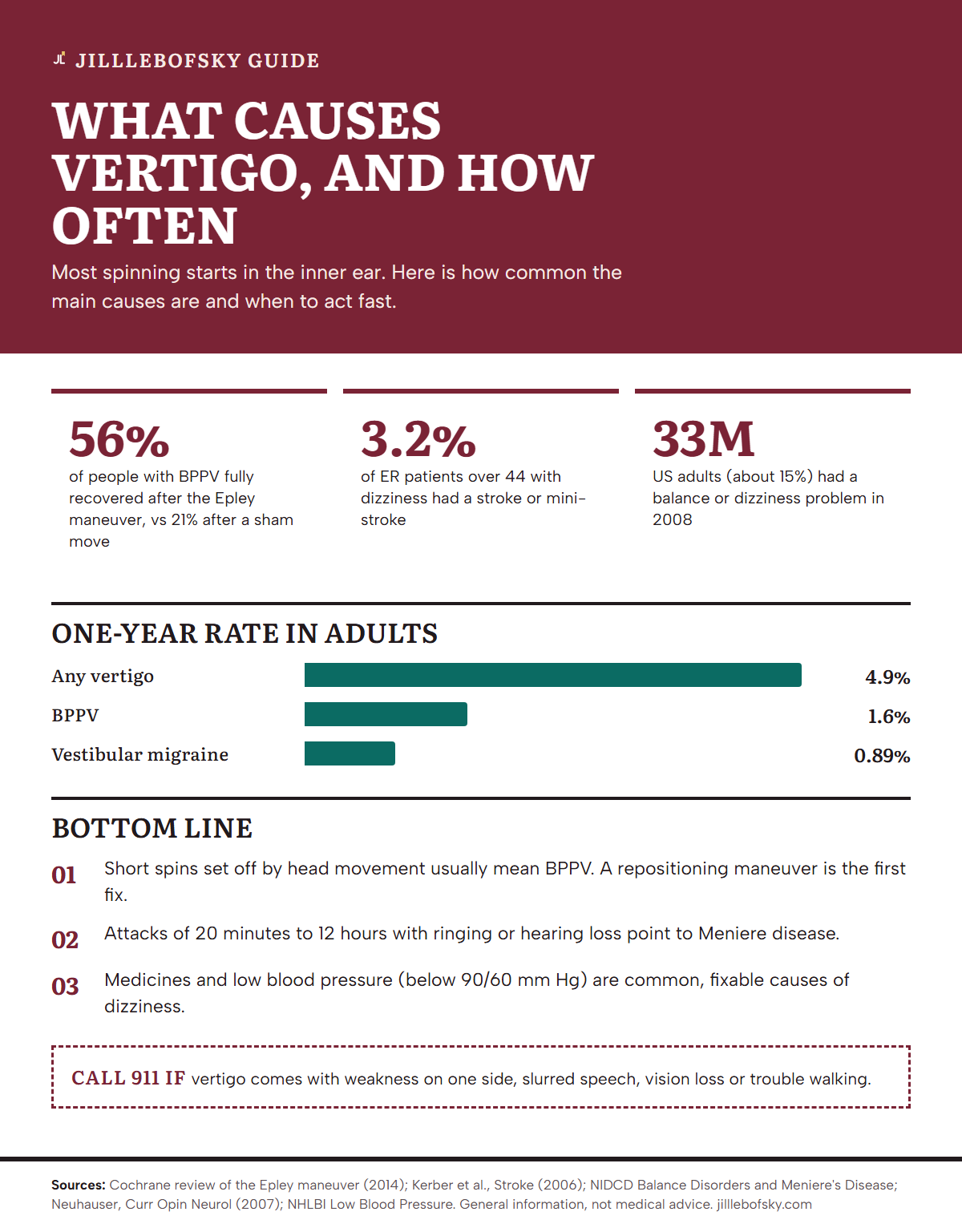
The short answer: most vertigo starts in the inner ear, and benign paroxysmal positional vertigo (BPPV), where loose calcium crystals drift into a balance canal, is the most common cause. About 1.6% of adults have BPPV in a given year.[1][2][8]
| What vertigo is | The feeling that you or the room is spinning even when nothing is moving[1] |
|---|---|
| How common | About 15% of US adults (33 million) had a balance or dizziness problem in 2008; about 4.9% of adults have vertigo in a year[2][8] |
| Most common cause | BPPV: loose ear crystals called otoconia move into a semicircular canal[1][2] |
| Other inner ear causes | Vestibular neuritis, labyrinthitis and Meniere's disease[2][3] |
| Causes outside the ear | Vestibular migraine, certain medicines, low blood pressure, dehydration and head injury[1][4][10] |
| Best-studied fix | The Epley maneuver for BPPV raised full recovery from 21% to 56% in a Cochrane review[7] |
| Emergency signs | Sudden or severe vertigo with vision problems, slurred speech or weakness[1][5] |
What are the most common causes of vertigo?
The most common causes of vertigo are inner ear disorders, and BPPV tops the list. MedlinePlus also names Meniere's disease, migraines, certain medicines, a sudden drop in blood pressure, dehydration, getting up too quickly, motion sickness, and a head injury or ear surgery.[1] NIDCD adds ear infections and anything else that affects the inner ear or brain.[2]
Your sense of balance depends on signals from three places: your eyes, your inner ear, and the muscles and touch sensors in your legs. When one of them sends the wrong message, your brain senses motion that is not happening.[2]
A few rarer inner ear problems also cause vertigo. A perilymph fistula is a leak of inner ear fluid that can follow a head injury, scuba diving or ear surgery. Mal de debarquement syndrome is a rocking feeling that lingers after a cruise.[2]
Risk rises with age, partly because older adults have more health conditions and take more medicines.[1][2] Still, NIDCD notes that many balance disorders start suddenly with no obvious cause.[2] You can find more on each condition in our vertigo and balance guides.
What are vertigo symptoms?
Vertigo is the feeling that you or the room is spinning even when nothing is moving. It can come with nausea, vomiting, sweating, trouble walking or ringing in the ears. It often gets worse when you stand up, walk or turn your head, and it can make you lose your balance.[1]
Dizziness and vertigo are often mixed up. Dizziness is a broader word for feeling lightheaded, woozy or unsteady. Vertigo is the spinning kind.[1] The difference matters, because a faint, lightheaded feeling when you stand points more toward blood pressure, while a true spin points more toward the inner ear.[2][4]
NIDCD lists other balance symptoms too:[2]
- Staggering when you walk, or feeling as if you are about to fall
- Blurred vision
- Confusion or feeling disoriented
- Changes in heart rate and blood pressure
- Fear, anxiety or panic
Symptoms may come and go or last a long time, and they can lead to tiredness and low mood.[2]
What is BPPV, the top cause of vertigo?
BPPV happens when tiny calcium carbonate crystals called otoconia break loose and tumble into one of the inner ear's semicircular canals. That canal then sends the wrong head-position signal to your brain. The result is a brief, intense spin when you roll over in bed, look up or bend down.[2]
BPPV can follow a head injury, or it can develop simply with age.[2] A German population survey summarized in a 2007 review found a one-year BPPV rate of 1.6% in adults. It was more common in women, and it came back in about 50% of people within five years.[8]
The 2017 BPPV clinical practice guideline drew on 2 earlier guidelines, 20 systematic reviews and 27 randomized trials.[6] Its stated goals were more use of repositioning maneuvers and less use of vestibular suppressant drugs and imaging scans that do not help.[6]
Can a virus or inner ear infection cause vertigo?
Yes. Vestibular neuritis is inflammation of the balance nerve, often caused by a virus, and its main symptom is vertigo. Labyrinthitis is an infection or inflammation of the inner ear itself. It often follows a cold or the flu and causes dizziness and loss of balance.[2]
Researchers call vestibular neuritis the second most common cause of vertigo that starts in the inner ear or its nerve. The assumed trigger is a reactivated herpes simplex type 1 virus.[9]
A 2004 trial in the New England Journal of Medicine tested that idea in 141 people. Recovery of balance-nerve function at 12 months was 62.4 points with the steroid methylprednisolone and 39.6 points with placebo. The antiviral valacyclovir did not help, alone or added to the steroid.[9]
Some people feel unsteady long after the nerve heals: almost a third of people still had anxiety-related dizziness one year after vestibular neuritis.[8]
How does Meniere's disease cause vertigo?
Meniere's disease is an inner ear disorder in which extra fluid, called endolymphatic hydrops, builds up in the labyrinth and scrambles balance and hearing signals. Attacks bring severe vertigo, ringing in the ears, hearing loss and a full or blocked feeling in the ear.[3]
A diagnosis of definite Meniere's disease needs two or more spontaneous vertigo spells lasting 20 minutes to 12 hours, plus low- to mid-pitch hearing loss shown on a hearing test.[3] Some people have vertigo so strong they fall, which doctors call drop attacks.[3]
It usually affects one ear, but both ears are involved in 15% to 25% of cases. It is most likely between ages 40 and 60. About 615,000 people in the United States have it, with about 45,500 new diagnoses each year.[3]
The root cause is still unclear. Theories include narrowed blood vessels like those in migraine, viral infections, allergies, autoimmune reactions and genes, since it sometimes runs in families.[3]
Can migraine cause vertigo?
Yes. Vestibular migraine is a recognized diagnosis in which migraine brings repeated spells of vertigo or head-motion dizziness with nausea. The Barany Society and International Headache Society criteria require moderate or severe spells lasting 5 minutes to 72 hours.[10]
Doctors also look for a history of migraine, a link in time between the spells and migraine symptoms, and no better explanation.[10] There is no single test, so the diagnosis rests on your history.
The 2007 population review put the one-year rate of migraine-related vertigo at 0.89% of adults, and like BPPV it was more common in women.[8] MedlinePlus lists migraine among the common causes of dizziness and vertigo.[1]
Can medicines or low blood pressure cause vertigo?
Yes. Certain medicines and a sudden drop in blood pressure are both listed causes of dizziness and vertigo, and both are often fixable.[1] Low blood pressure means a reading below 90/60 mm Hg, and it can make you dizzy when you stand up too quickly.[2][4]
NHLBI names these causes of low blood pressure:[4]
- Medicines for high blood pressure, depression or Parkinson's disease
- Dehydration
- Diabetes and nerve problems such as Parkinson's disease
- Heart rhythm problems
- Pregnancy, or blood loss from an injury
Older adults are more likely to feel dizzy when they stand or after a meal, often as a side effect of blood pressure pills.[4] A blood pressure drop tends to feel lightheaded or faint rather than spinning, and sitting down may relieve it.[4]
Some drugs act on the inner ear directly. The antibiotic gentamicin can damage the inner ear's hair cells, which is why its use in Meniere's disease carries a risk of hearing loss.[3] NIDCD says the first thing an ear specialist checks is whether another condition or a medicine is to blame.[2] Never stop a prescribed medicine on your own. Ask the prescriber.
When is vertigo a sign of a stroke?
Vertigo is rarely a stroke, but sudden or severe vertigo with vision problems, slurred speech or weakness needs emergency care right away.[1] Stroke symptoms come on fast and include numbness or weakness on one side, confusion, trouble seeing, a sudden severe headache, and sudden trouble walking or keeping your balance.[5]
A population study of emergency room patients over age 44 found stroke or mini-stroke in 3.2% of those with dizziness, vertigo or imbalance (53 of 1,666). Among people whose dizziness came with no other stroke sign, the rate was 0.7%.[11]
That study also found that trouble with balance pointed toward stroke more than dizziness alone.[11] If you cannot stand or walk, call 911 rather than waiting it out. Doctors order brain imaging when they suspect a stroke or after a head injury.[1]
How do doctors find the cause of vertigo?
Doctors find the cause of vertigo mainly from your story: what sets off the spin, how long it lasts and what comes with it. They may add a hearing test, blood tests, an eye-movement test called a video nystagmogram, balance platform tests or brain imaging.[1][2] Several tests may be needed.[2]
The table below turns the main patterns from our sources into a quick guide. Use it to describe your symptoms clearly to a doctor; it cannot diagnose you.
| What you notice | Often points to | Next step |
|---|---|---|
| A brief, intense spin when you roll over, look up or bend down[2] | BPPV | Ask about a repositioning maneuver[6] |
| Vertigo that starts after a cold or flu[2] | Vestibular neuritis or labyrinthitis | See a doctor within days; steroids are a prescription decision[9] |
| Attacks of 20 minutes to 12 hours with ringing, muffled hearing or a full ear[3] | Meniere's disease | Ear, nose and throat doctor plus a hearing test[3] |
| Spells of 5 minutes to 72 hours in someone with migraine[10] | Vestibular migraine | Doctor review of your migraine history[10] |
| Lightheaded on standing, after meals or after a new pill[4] | Low blood pressure or a medicine | Blood pressure check and medicine review[4] |
| Rocking or swaying after a cruise[2] | Mal de debarquement syndrome | Usually fades in hours or days; see a doctor if not[2] |
| Vertigo with weakness, slurred speech, vision loss or inability to walk[1][5] | Possible stroke | Call 911 now[5] |
What to write down before your visit
NIDCD suggests answering these questions before your appointment.[2]
- Does the room spin, and if so, which way?
- Does a certain head movement set it off, or does it happen when you are still?
- How long does each spell last: seconds, minutes, hours or days?
- Do you also have hearing loss, ringing, ear pressure or a headache?
- How often does it happen, and have you fallen?
- Every medicine and supplement you take, with the dose and how often
What is the treatment for vertigo?
Treatment for vertigo depends on the cause, and for BPPV the first choice is a repositioning maneuver such as the Epley, not a pill.[6][7] NIDCD says one session often works, though some people need several.[2] For other causes, treatment may include balance exercises and medicines.[1]
Here is what doctors use first, by cause:
- BPPV: the Epley or a similar maneuver. In the Cochrane review, full recovery rose from 21% with a sham move to 56% with the Epley.[7]
- Vestibular neuritis: a doctor may prescribe a steroid, based on the 2004 trial.[9]
- Meniere's disease: salt kept to 1,500 to 2,000 mg a day, a water pill, quitting smoking, and medicines for attacks. Injections or surgery come later.[3]
- Long-term imbalance: vestibular rehabilitation with a trained therapist.[2]
- Low blood pressure: more fluids, a change to the medicine causing it, or a medicine to raise pressure.[4]
Anti-vertigo and anti-nausea drugs can ease an attack, but they can make you drowsy.[2] The BPPV guideline aims to cut their routine use.[6]
| Study | Who and how many | What was tested | Result |
|---|---|---|---|
| Cochrane review, 2014[7] | 11 trials, 745 adults with BPPV | Epley maneuver vs sham or no treatment | Full recovery 56% vs 21%; BPPV returned in 36% |
| NEJM trial, 2004[9] | 141 adults with vestibular neuritis | Steroid, antiviral, both, or placebo | Steroid 62.4 vs placebo 39.6 points of nerve recovery; antiviral no benefit |
| Stroke study, 2006[11] | 1,666 ER patients over 44 with dizziness | How many had a stroke or mini-stroke | 3.2% overall; 0.7% with dizziness alone |
| Meta-analysis, 2022[12] | 5 trials, 1,250 people with BPPV | Vitamin D, with or without calcium | Fewer relapses (risk ratio 0.37); 4 of 5 trials not randomized |
Where supplements fit
NIDCD says there is no evidence that ginkgo biloba, niacin or ginger root help Meniere's disease.[3] A 2022 meta-analysis linked vitamin D to fewer BPPV relapses, but four of its five trials were not randomized and the results varied a lot between studies.[12] That is limited evidence, and vitamin D was studied alongside standard care, never as a replacement for a repositioning maneuver. You can read how we review supplement evidence for the grading we use.
When should you see a doctor for vertigo?
See a doctor about any vertigo that keeps coming back, and get emergency help for vertigo that comes with stroke signs. Dizziness often gets better on its own, but repeat spells need a cause found.[1] NIDCD also advises a visit if you feel unsteady, feel the room spin even briefly, or lose your balance and fall.[2]
Call 911 or go to an emergency room right away if you have:[1][4][5]
- Sudden numbness or weakness of the face, arm or leg, especially on one side
- Slurred speech, confusion or trouble understanding speech
- Sudden trouble seeing in one or both eyes
- A sudden, severe headache with no known cause
- Sudden trouble walking or a loss of coordination
- Signs of shock: cold, sweaty skin, fast breathing, blue-tinged skin or a weak, fast pulse
To lower your risk of falls, NIDCD suggests avoiding walking in the dark, wearing low-heeled shoes, using a cane or walker if needed, adding handrails, and asking your doctor whether it is safe to drive.[2] If you have neck problems, tell the clinician before any repositioning maneuver; some people in the Cochrane trials could not tolerate it, and nausea during the move affected 16.7% to 32%.[7]
The bottom line on causes of vertigo
Most spinning comes from the inner ear. BPPV is the most likely cause when short spins follow head movement, and it often clears with a simple maneuver. Vestibular neuritis, Meniere's disease, vestibular migraine, medicines and low blood pressure explain much of the rest.[1][2][7]
For most people, the better first step is a doctor's exam with a clear symptom diary, because the right treatment depends entirely on the cause. Supplements have little to offer here so far. We follow our editorial policy and will update this page when the evidence changes.
Frequently asked questions
How do you stop vertigo immediately?
No single move stops every type of vertigo. Sit or lie down at once so you do not fall, and keep your head still. If a doctor has confirmed BPPV, a repositioning maneuver such as the Epley is the fastest proven option, and one session often works.
What vertigo treatment can you do at home?
Once a clinician has diagnosed BPPV and shown you the steps, some people repeat the Epley maneuver at home. Balance exercises from a vestibular therapist also help. Try home moves only after a diagnosis, since nausea during them is common and neck problems can rule them out.
Is there a cure for vertigo?
It depends on the cause. BPPV often clears with a repositioning maneuver, though it comes back in about a third of people. Meniere's disease has no cure yet, but salt limits, medicines and other options can control attacks.
Do supplements like vitamin D or ginkgo help vertigo?
The evidence is thin. A 2022 meta-analysis linked vitamin D to fewer BPPV relapses, but four of its five trials were not randomized. NIDCD says there is no evidence that ginkgo, niacin or ginger root help Meniere's disease.
How long does vertigo last?
It varies by cause. BPPV spins are brief and set off by head movement. Meniere's attacks last 20 minutes to 12 hours, and vestibular migraine spells last 5 minutes to 72 hours. Vertigo that does not stop needs a doctor's exam.
Sources
- Dizziness and Vertigo. MedlinePlus, National Library of Medicine
- Balance Disorders. NIDCD, NIH, 2018
- Meniere's Disease. NIDCD, NIH
- Low Blood Pressure. NHLBI, NIH
- Stroke. MedlinePlus, National Library of Medicine
- Clinical Practice Guideline: Benign Paroxysmal Positional Vertigo (Update). Bhattacharyya et al., Otolaryngology Head and Neck Surgery, 2017
- The Epley (canalith repositioning) manoeuvre for benign paroxysmal positional vertigo. Hilton and Pinder, Cochrane Database of Systematic Reviews, 2014
- Epidemiology of vertigo. Neuhauser, Current Opinion in Neurology, 2007
- Methylprednisolone, valacyclovir, or the combination for vestibular neuritis. Strupp et al., New England Journal of Medicine, 2004
- Vestibular migraine: Diagnostic criteria. Lempert et al., Barany Society and International Headache Society, Journal of Vestibular Research, 2022
- Stroke among patients with dizziness, vertigo, and imbalance in the emergency department. Kerber et al., Stroke, 2006
- Prevention of recurrent benign paroxysmal positional vertigo with vitamin D supplementation: a meta-analysis. Jeong et al., Journal of Neurology, 2022
This page is general information, not medical advice. Talk to your doctor or pharmacist before you start any supplement, especially if you are pregnant, take medicine or have a health condition. Read our medical disclaimer and how we review.