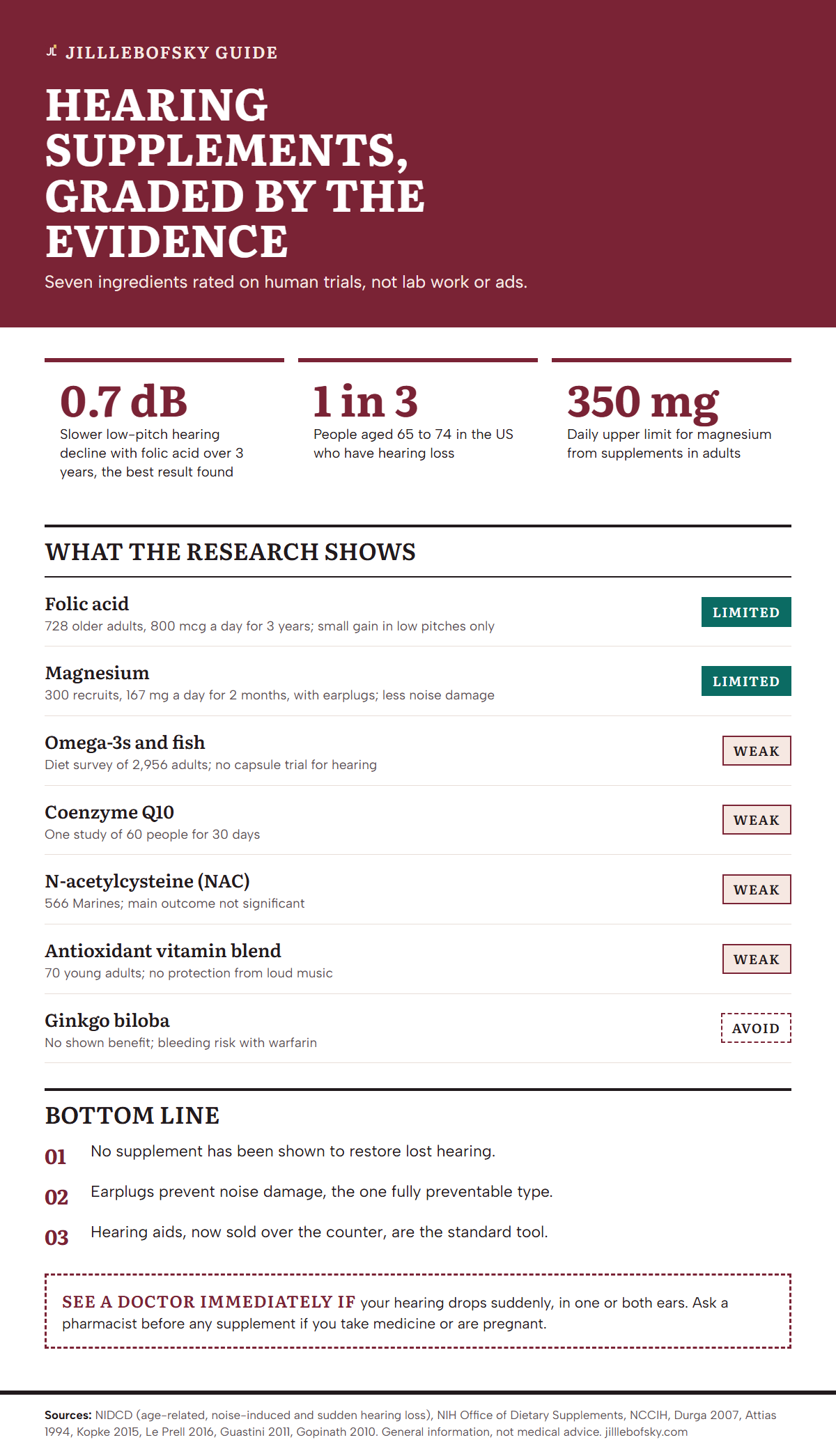
No hearing supplement has been shown to restore lost hearing. Folic acid has the best trial, a 0.7 dB slower decline in low-pitch hearing over 3 years in older adults with low folate. Magnesium cut noise damage in one 1994 trial of recruits who also wore earplugs. NAC and an antioxidant blend failed, and ginkgo is best avoided. Get a hearing test first.
We graded hearing supplements against NIH pages on age-related, noise-induced and sudden hearing loss, the NIH fact sheets on folate and magnesium, the NCCIH ginkgo page, the FDA rules for supplements, and six human studies of folic acid, magnesium, N-acetylcysteine, an antioxidant blend, CoQ10 and fish intake.[1][2][3][6][7][8][9] We ranked ingredient types, not brands.
No supplement has been shown to restore lost hearing. The best result we found was small: folic acid slowed the decline in low-pitch hearing by 0.7 dB over 3 years, in older Dutch adults who started with poor folate status.[10]
| What they are | Pills sold with hearing claims, usually vitamins, minerals, antioxidants or herbs such as ginkgo. The FDA does not approve supplements or their labels.[6][9] |
|---|---|
| Used for | Age-related hearing loss, which affects about 1 in 3 people aged 65 to 74, and hearing damage from noise.[1][2] |
| Best evidence | Folic acid at 800 mcg a day slowed low-frequency hearing decline by 0.7 dB over 3 years in 728 older adults.[10] |
| Clearest failure | A beta-carotene, vitamin C, vitamin E and magnesium blend did not protect 70 young adults from hearing changes after loud music.[13] |
| Safety | Folic acid above 1,000 mcg a day can hide low B12. Magnesium above 350 mg from supplements can cause diarrhea. Ginkgo may raise bleeding risk with warfarin.[6][7][8] |
| What works instead | Hearing protection around loud noise, and hearing aids, which adults with mild to moderate loss can buy over the counter since 2022.[1][2] |
Do hearing supplements work?
No hearing supplement has been shown to restore hearing that is already lost. The NIDCD says scientists do not yet know how to prevent age-related hearing loss, and MedlinePlus notes that inner-ear and nerve damage is usually permanent.[1][5] A few ingredients have one small positive trial each. The rest have weak or negative results.
Some hearing loss can still be avoided or fixed. Noise damage is preventable, and some hearing loss comes from earwax, fluid or a punctured eardrum that treatment can often fix.[2][5]
Under FDA rules, a product sold to treat, prevent or cure a disease counts as a drug, so a supplement may not claim to cure hearing loss.[9] If an ad promises to restore your hearing, treat that as a warning sign. More guides sit in our hearing and tinnitus health section.
How did we grade each ingredient?
Each ingredient got one of four grades, based only on human studies and official NIH or FDA pages. We did not score brands, flavors or price. Lab and animal results counted for nothing, and a study that only tracked what people ate was treated as a clue, never as proof.[15] The four grades are:
- Moderate: several pooled trials with a small but consistent effect.
- Limited: some trials, but small or low quality.
- Weak: pilot studies only, or the trials found no benefit.
- Avoid: no shown benefit plus a safety problem.
No hearing ingredient reached Moderate, and only two reached Limited. The full method is on our how we review supplements page, and our editorial policy explains how we choose sources and correct errors.
1. Folic acid: older adults with low folate status
Folic acid has the best single trial of any hearing ingredient, but the effect was small. In a Dutch trial, 728 older adults took 800 mcg a day or a placebo for 3 years. Low-pitch hearing thresholds worsened by 1.0 dB with folic acid and by 1.7 dB with the placebo.[10]
High-pitch hearing, where age-related loss usually shows first, did not change. Everyone in the trial had high homocysteine, and Dutch food was not fortified with folic acid at the time, so their folate levels were about half those in the US.[10] The authors said the effect needs confirmation.
Adults need 400 mcg DFE of folate a day. The upper limit for folic acid from supplements and fortified foods is 1,000 mcg, and large amounts can hide a vitamin B12 deficiency.[7] Grade: Limited.
2. Magnesium: people exposed to loud noise, on top of earplugs
Magnesium was studied for noise damage, not for age-related hearing loss. In a 1994 trial, 300 young military recruits drank 167 mg of magnesium aspartate or a placebo each day through 2 months of training with gunfire. Permanent hearing damage was more common and more severe in the placebo group.[11]
The recruits also wore earplugs, so magnesium was tested as an add-on to hearing protection. The trial is old and was done in one group of healthy young men and women. A later blend that included magnesium did not stop hearing changes after loud music.[13]
Adults should keep magnesium from supplements and medicines at or below 350 mg a day. More can cause diarrhea, nausea and cramps, and magnesium interacts with some medicines.[8] Grade: Limited.
3. Omega-3s and fish: eat the fish, skip the hearing claim
The omega-3 evidence for hearing comes from diet surveys, not from supplement trials. In the Blue Mountains Hearing Study of 2,956 Australians aged 50 and older, people who ate fish 2 or more times a week had a 42% lower risk of developing age-related hearing loss than those who ate less than 1 serving.[15]
That kind of study cannot prove that fish caused the difference. People who eat fish often may differ in many other ways, and diet was measured by questionnaire.[15] None of our sources tested a fish oil capsule for hearing, so the pill version has no trial behind it. Grade: Weak.
4. Coenzyme Q10: too early to say
CoQ10 for hearing rests on one small Italian study. Sixty people with age-related hearing loss took a water-soluble CoQ10, vitamin E or a placebo for 30 days. The CoQ10 group had better hearing thresholds than the vitamin E group at several pitches, from 1,000 to 8,000 Hz.[14]
The study was short and small, it mainly compared CoQ10 with vitamin E, and the authors asked for a larger trial.[14] We found no larger trial. Grade: Weak. If you take a daily medicine, ask a pharmacist before adding CoQ10 or any other supplement.
5. N-acetylcysteine (NAC): missed its main goal
NAC is an antioxidant that protected hearing in lab work, but its biggest human trial missed its main goal. Among 566 Marines tested after weapons training, 277 took NAC and 289 took a placebo. The rate of hearing threshold shifts did not differ significantly between the two groups.[12]
A secondary result looked better. In the ear on the side of the trigger hand, shifts happened in 27.14% of the NAC group and 34.98% of the placebo group.[12] Secondary results can justify a new trial, but they do not overturn the main result.
Side effects were about equal, at 27.4% with NAC and 26.7% with the placebo.[12] Grade: Weak.
6. Antioxidant vitamin blends: no effect in a direct test
A blend of beta-carotene, vitamin C, vitamin E and magnesium did not protect hearing from loud music. In a 2016 trial, 72 adults aged 18 to 28 were randomized and 70 finished. They took the blend or a placebo for 3 days before 4 hours of loud music through earbuds.[13]
Temporary hearing loss after the music was the same in both groups. Short-lived ringing was more common with the blend, at 54.3% versus 25.7% with the placebo.[13]
The doses were large, including 500 mg of vitamin C and 305 mg of vitamin E a day. Grade: Weak, because the one direct test we read found no benefit.
7. Ginkgo biloba: avoid, especially on a blood thinner
Ginkgo is often sold for ear problems, but NCCIH says it has not been shown to be effective for any condition it has been studied for. NCCIH adds that research suggests it does not relieve tinnitus, one of the uses it is promoted for.[6]
Ginkgo may raise bleeding risk in people taking anticoagulants such as warfarin, and it may be unsafe during pregnancy. The most common side effects are dizziness, stomach upset and headache.[6] With no shown benefit and a known safety issue, ginkgo gets our Avoid grade.
If ringing is your main problem, our guide to tinnitus treatment options with real evidence covers what helps.
What are the best supplements for hearing, according to trials?
The best supplements for hearing have, at most, one small positive trial each. The table puts the human studies side by side. Folic acid and magnesium had positive main results. NAC and the antioxidant blend did not, and the CoQ10 and fish data are too small or too indirect to rely on.[10][11][12][13]
| Ingredient and study | Who and how many | Dose and length | Result |
|---|---|---|---|
| Folic acid, Durga 2007[10] | 728 older Dutch adults with high homocysteine | 800 mcg a day, 3 years | 0.7 dB less low-pitch decline; no change in high pitches |
| Magnesium, Attias 1994[11] | 300 military recruits wearing earplugs | 167 mg a day, 2 months | Less permanent noise damage than placebo |
| NAC, Kopke 2015[12] | 566 Marines in weapons training | NAC vs placebo during training | Main outcome not significant |
| Antioxidant blend, Le Prell 2016[13] | 70 adults aged 18 to 28 | 3 days before 4 hours of music | No protection; more short-lived ringing |
| CoQ10, Guastini 2011[14] | 60 adults with age-related loss | 30 days | Better thresholds than vitamin E; small study |
| Fish intake, Gopinath 2010[15] | 2,956 adults aged 50 and older | Diet survey, no pills | 42% lower risk with 2+ fish meals a week; observational |
Which supplement for hearing should you consider first?
For most people, a hearing test should come before any supplement. Hearing loss has many causes, including genes, infections, injury, some medicines, noise and aging, and some of them can be treated.[5] Use this table to start a talk with your doctor or pharmacist.
| If this describes you | Start with | Why |
|---|---|---|
| Hearing has faded slowly over years | A hearing test; an over-the-counter hearing aid if the loss is mild to moderate | Hearing aids are the standard tool; no pill restores hearing[1] |
| Loud work, shooting or concerts | Earplugs or earmuffs; magnesium only as an add-on | Noise loss can be fully prevented; the magnesium trial used earplugs too[2][11] |
| A blood test shows low folate | Folic acid at label doses, under 1,000 mcg | The only group with positive trial data[7][10] |
| You take a blood thinner or are pregnant | Skip ginkgo | Bleeding risk with warfarin; may be unsafe in pregnancy[6] |
| Hearing dropped suddenly | Same-day medical care, no supplement | Sudden deafness is an emergency[3] |
Are natural hearing supplements safe?
Natural hearing supplements are not automatically safe, and the FDA does not approve them or their labels before sale. The FDA also does not routinely test what is inside them.[9] Most single ingredients are fine at label doses, but these limits and interactions still apply:
- Folic acid: stay at or under 1,000 mcg a day unless a doctor says otherwise. More can hide a B12 deficiency, and people with a history of colorectal adenomas should be careful with high doses.[7]
- Magnesium: the upper limit from supplements is 350 mg for adults. Higher intakes can cause diarrhea, nausea and cramps, and extremely high intakes can cause an irregular heartbeat.[8]
- Ginkgo: may raise bleeding risk with warfarin, may interact with other drugs and may be unsafe in pregnancy.[6]
- Antioxidant blends: short-lived ringing was more common with the blend than with the placebo in the music trial.[13]
Some medicines, including certain chemotherapy drugs, can damage hearing on their own.[1] Show your pharmacist every pill you take, including supplements.
When is hearing loss an emergency?
Sudden hearing loss is a medical emergency, so see a doctor immediately instead of trying a supplement. The NIDCD describes one sign as a loss of at least 30 decibels across three connected pitches within 72 hours. Treatment, most often corticosteroids, works better when it starts early.[3]
Call 911 or go to an emergency room if hearing loss comes on with signs of a stroke or after a head injury. Both stroke and head trauma can affect hearing.[3][4]
See a doctor right away if:
- Hearing drops in one or both ears all at once or over a few days.[3]
- You hear a loud pop just before your hearing fades.[3]
- Hearing loss comes with ear fullness, dizziness or new ringing.[3]
- Sudden loss affects only one ear, since a growth on the hearing nerve has to be ruled out.[3]
- Your hearing changes after you start a new medicine.[4]
About half of people with sudden deafness recover some or all of their hearing on their own, usually within one to two weeks. Waiting can still make treatment less effective.[3]
What do doctors use first for hearing loss?
Hearing aids and other devices are the standard care for hearing loss. Hearing aids make sounds louder, and since 2022 adults with mild to moderate loss can buy them over the counter without an exam. Cochlear implants help people with severe hearing loss or deafness, and assistive listening devices help on phones and in theaters.[1]
A primary care doctor can check for conditions that add to hearing loss and refer you on. An ENT doctor looks for the cause, and an audiologist measures the loss and fits devices.[1] Loss from earwax, fluid or a punctured eardrum can often be reversed with treatment or surgery.[5]
The National Institute on Aging says older adults with hearing loss have a greater risk of dementia, and people who used hearing aids or cochlear implants had a lower risk in one analysis.[4] Our review of memory loss supplements and what their trials found covers the memory side.
What should you check on a hearing supplement label?
Check each ingredient's dose against the trial dose and the NIH upper limits before you pay. If a label does not list the amount of every ingredient, you cannot compare it with any study. Bring the bottle, or a photo of the label, when you ask a pharmacist about it.[7][8]
- Folic acid: the trial used 800 mcg, and your total from pills and fortified food should stay at or under 1,000 mcg.[7][10]
- Magnesium: the noise trial used 167 mg, and the supplement limit is 350 mg a day.[8][11]
- Ginkgo on the label: skip the product if you take a blood thinner or are pregnant.[6]
- Words such as cures, restores hearing or reverses hearing loss are drug claims a supplement may not make.[9]
- "FDA approved" on a supplement is false, because the FDA does not approve supplements.[9]
- Read the refund terms and the auto-ship rules before you order.
- Keep a list of every pill you take to show your doctor or pharmacist.
Are hearing supplements worth buying?
For most people, hearing supplements are not worth buying to protect or restore hearing. The strongest result we found was a 0.7 dB difference over 3 years in one group with low folate, and the most direct test of an antioxidant blend found no benefit.[10][13]
A hearing test is the better first step for most people, because it finds causes that can be fixed and shows whether a hearing aid would help.[1][5] Earplugs around loud noise guard against the one type of hearing loss the NIDCD calls completely preventable.[2] If you still want to try a pill, folic acid at label doses has the best case, mainly for people whose folate runs low.
Frequently asked questions
Can vitamins restore hearing loss?
No vitamin has been shown to restore lost hearing. Inner-ear and nerve damage is usually permanent, according to MedlinePlus. In the best trial we found, folic acid only slowed low-pitch hearing decline by 0.7 dB over 3 years in older adults with low folate.
Is hearing loss linked to memory problems?
Studies link them. The National Institute on Aging says older adults with hearing loss have a greater risk of dementia, and their memory and focus decline faster. In one analysis, people who used hearing aids or cochlear implants had a lower risk.
How long do hearing supplements take to work?
There is no proven timeline, because no supplement has been shown to restore hearing. The folic acid trial ran for 3 years and found a small effect. The CoQ10 study lasted 30 days and was too small to rely on.
Can you get folate and magnesium from food instead?
Yes. Adults need 400 mcg DFE of folate a day. Men need 400 to 420 mg of magnesium and women 310 to 320 mg. Magnesium in food is not harmful; the 350 mg upper limit applies to supplements and medicines.
Do I need a hearing test before taking a supplement?
A test is the better first step. It shows the type and degree of hearing loss, and some causes, such as earwax or fluid, can be treated. Adults with mild to moderate loss can also try over-the-counter hearing aids.
Sources
- Age-Related Hearing Loss (Presbycusis). NIDCD, NIH
- Noise-Induced Hearing Loss. NIDCD, NIH
- Sudden Deafness. NIDCD, NIH
- Hearing Loss: A Common Problem for Older Adults. National Institute on Aging, NIH
- Hearing Disorders and Deafness. MedlinePlus, National Library of Medicine
- Ginkgo. NCCIH, NIH
- Folate: Fact Sheet for Consumers. NIH Office of Dietary Supplements
- Magnesium: Fact Sheet for Consumers. NIH Office of Dietary Supplements
- Questions and Answers on Dietary Supplements. U.S. Food and Drug Administration
- Effects of folic acid supplementation on hearing in older adults: a randomized, controlled trial. Durga et al., Annals of Internal Medicine, 2007
- Oral magnesium intake reduces permanent hearing loss induced by noise exposure. Attias et al., American Journal of Otolaryngology, 1994
- Efficacy and safety of N-acetylcysteine in prevention of noise induced hearing loss: a randomized clinical trial. Kopke et al., Hearing Research, 2015
- Dietary supplement comprised of beta-carotene, vitamin C, vitamin E, and magnesium: failure to prevent music-induced temporary threshold shift. Le Prell et al., Audiology and Neurotology Extra, 2016
- Water-soluble coenzyme Q10 formulation in presbycusis: long-term effects. Guastini et al., Acta Oto-Laryngologica, 2011
- Consumption of omega-3 fatty acids and fish and risk of age-related hearing loss. Gopinath et al., American Journal of Clinical Nutrition, 2010
This page is general information, not medical advice. Talk to your doctor or pharmacist before you start any supplement, especially if you are pregnant, take medicine or have a health condition. Read our medical disclaimer and how we review.