Vertigo exercises work best when matched to the cause. For BPPV, brief spinning when you roll over or look up, the Epley maneuver cleared vertigo in 56% of people versus 21% with sham moves. Brandt-Daroff is a slower backup. For inner ear damage from a virus, gaze and balance exercises for 4 to 6 weeks help. Get a diagnosis first, and call 911 for vertigo with weakness or slurred speech.
Vertigo exercises are head, eye and body movements you repeat to stop the spinning or retrain your balance, and the right one depends on what is causing your vertigo. We read the 2017 clinical practice guideline on benign paroxysmal positional vertigo (BPPV), the Cochrane review of the Epley maneuver, the 2022 physical therapy guideline on vestibular rehabilitation, and the NIDCD and MedlinePlus pages on dizziness.[1][2][3][4][5]
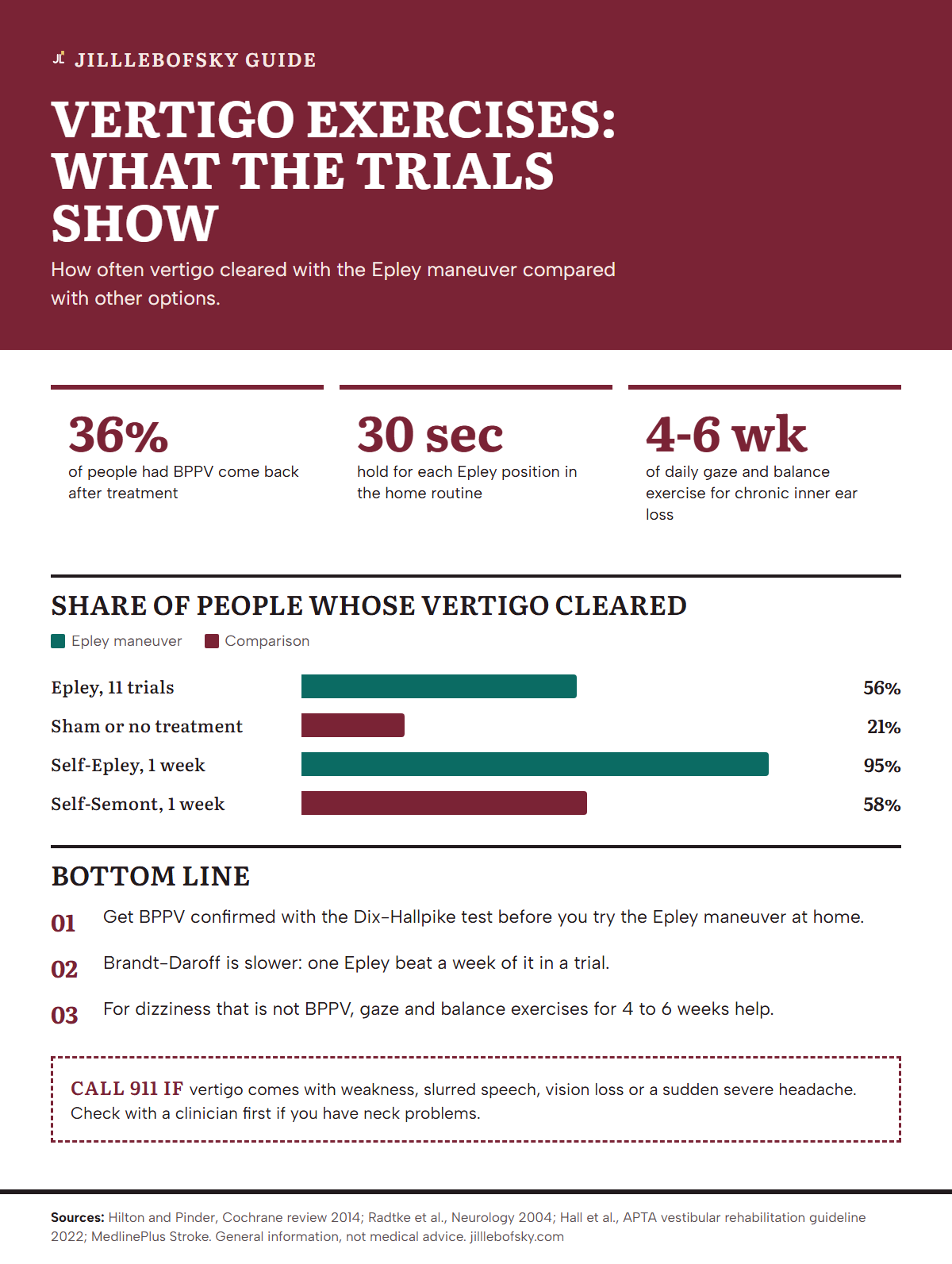
The short answer: for BPPV, the most common cause of vertigo, a repositioning move called the Epley maneuver raised the share of people whose vertigo cleared from 21% to 56% in pooled trials.[5][2] For other inner ear problems, gaze and balance exercises done daily for 4 to 6 weeks made dizziness less frequent than no treatment.[3][6]
| What they are | Repositioning moves (Epley, Brandt-Daroff) for BPPV, plus gaze stabilization and balance exercises from vestibular rehabilitation[2][3] |
|---|---|
| Main use | BPPV: brief spinning when you roll over, look up or bend down, caused by loose crystals in an inner ear canal[4] |
| Typical home routine | Self-Epley: 3 cycles each night for 2 weeks, 30 seconds per position. Brandt-Daroff: 5 repetitions, 3 times a day[8] |
| Rehab dose | Gaze exercises at least 12 minutes a day early on; gaze and balance work at least 20 minutes a day for 4 to 6 weeks in chronic cases[3] |
| Best evidence | Cochrane review of 11 trials and 745 patients: the Epley maneuver is safe and effective for posterior canal BPPV[2] |
| Common side effects | Nausea during the moves in 16.7% to 32% of patients; brief dizziness[2][8] |
| Get checked first if | You have neck problems, hearing loss, weakness, slurred speech or vision changes[2][5] |
Vertigo exercises at home: which one fits your dizziness?
The right exercise depends on the cause: repositioning moves treat BPPV, while gaze and balance exercises help an inner ear that has been weakened by inflammation or injury. BPPV spins for a short time after a specific head movement. Constant dizziness, or spinning with hearing loss, points to something else.[4][10]
The guideline asks clinicians to confirm BPPV with the Dix-Hallpike test before treating it, because the Epley maneuver only fits posterior canal BPPV.[1] Use this table as a starting point, then confirm with a clinician.
| If your vertigo... | Likely cause | Exercise that fits |
|---|---|---|
| Lasts seconds and starts when you roll over, look up or bend down | BPPV[4] | Epley maneuver, with Brandt-Daroff as a backup[2] |
| Started with a cold or flu and does not depend on head position | Vestibular neuronitis or labyrinthitis[4] | Gaze stabilization and balance exercises[3] |
| Comes in attacks with ringing, hearing loss or a full ear | Possible Meniere's disease[10] | See an ear specialist first[10] |
| Comes on suddenly with weakness, slurred speech or vision loss | Possible stroke[5][11] | No exercises. Call 911[11] |
How do you do the Epley maneuver at home?
The Epley maneuver is a set of four head and body positions, from sitting to lying, rolling over and back to sitting, that moves loose crystals out of the problem canal. You need to know which ear is affected, so have a clinician confirm that first. These steps follow the self-Epley used in a 2026 trial.[2][8]
- Sit on your bed with your legs out in front of you. Place a pillow so it will sit under your shoulders when you lie back.[8]
- Turn your head 45 degrees toward the affected ear.[8]
- Keep your head turned and lie back quickly, with the pillow under your shoulders so your head tips slightly back. Hold for 30 seconds.[8][1]
- Turn your head 90 degrees to the other side without lifting it. Hold for 30 seconds.[8]
- Roll your body onto that same side, keeping your head where it is. Hold for 30 seconds.[8]
- Sit up slowly on the edge of the bed and stay seated until you feel steady.[8]
- Repeat for 3 cycles just before bed. The trial used this routine every night for 2 weeks.[8]
Expect brief spinning during step 3. Lying back with the head turned is the position that sets off BPPV vertigo.[2] In a 2004 study of 70 patients, 95% of those who did a self-Epley were free of positional vertigo after 1 week.[7]
How do you do Brandt-Daroff exercises?
Brandt-Daroff exercises are a habituation routine: you move quickly from sitting to lying on each side, over and over, until the brain and inner ear stop reacting. They are easier to learn than the Epley maneuver but slower to work. In one trial, a single Epley beat a full week of Brandt-Daroff done 3 times a day.[8][2]
- Sit on the edge of your bed.[8]
- Turn your head 45 degrees to one side.[8]
- Lie down quickly on your side, keeping your head in the same turned position. Hold for at least 30 seconds.[8]
- Sit back up. Wait until any dizziness settles.[8]
- Turn your head the other way and repeat on the other side.[8]
- Do 5 repetitions per session, 3 times a day. The trial ran for 2 weeks.[8]
Patients in that trial had one supervised session with a physician or physiotherapist before going home, plus written steps with pictures.[8] Copy that approach and have a clinician show you which way to point your head before you try this alone.
What exercises help dizziness that is not BPPV?
Vestibular rehabilitation is an exercise program that trains the brain to rely on the eyes, the body and the healthy ear when one inner ear is damaged. The 2022 physical therapy guideline gives it a strong recommendation for people with weakened inner ear function on one or both sides.[3]
A 2015 Cochrane review of 39 studies and 2,441 people found it made dizziness less frequent than no treatment.[6] The program has two main parts: gaze work and balance work.
Gaze stabilization exercises
These exercises involve moving your head while keeping your eyes focused on a target. The target can be still or moving.[3]
- Pick a target at eye level, such as a letter on a card or a mark on the wall.[3]
- Keep your eyes on it while you turn your head slowly side to side.[3]
- Then nod up and down, still keeping the target in focus.[3]
- Build up to at least 12 minutes a day, split into 3 sessions, in the first weeks after onset.[3]
The guideline advises against eye-only drills, such as following a moving finger with your head still. They do not help gaze stability on their own.[3]
Balance and walking exercises
Balance work makes standing harder in small steps. The guideline lists standing with feet together, heel to toe or on one leg, then adding foam, closed eyes or head movement. Walking drills add head turns or a mental task such as counting backwards.[3]
Do these next to a kitchen counter or in a corner, with someone nearby. An exercise bike alone, with no balance challenge, has not been shown to help.[3]
Do vertigo exercises really work?
Yes for BPPV, where repositioning moves have strong trial support, and yes for one-sided inner ear damage, where vestibular rehabilitation has moderate to strong support. The evidence is weaker for comparisons between the different exercises, and many trials were small.[2][6][9]
| Study | Who and how many | Compared | Result |
|---|---|---|---|
| Cochrane review, 2014[2] | 11 trials, 745 adults with posterior canal BPPV | Epley vs sham or no treatment | Vertigo cleared in 56% vs 21% |
| Radtke trial, 2004[7] | 70 patients with BPPV | Self-Epley vs self-Semont | Clear at 1 week: 95% vs 58% |
| Hanapi trial, 2026[8] | 50 outpatients, 2 weeks at home | Self-Epley vs Brandt-Daroff | Vertigo gone in 40% of both groups at 1 month and 48% at 6 months; test turned negative in 92% vs 84% |
| Meta-analysis, 2026[9] | 13 studies, 911 people | Epley-type vs Brandt-Daroff | Epley about twice as likely to succeed short term (risk ratio 2.10); low certainty; no clear difference in relapse |
| Cochrane review, 2015[6] | 39 studies, 2,441 people with one-sided inner ear loss | Vestibular rehab vs control | Less frequent dizziness (odds ratio 2.67) |
The same 2015 review found that for BPPV, repositioning moves beat general exercise in the short term. A mix of both helped longer-term recovery.[6]
How often should you do vertigo exercises, and how long until they help?
For BPPV, a single in-office Epley often works, and home routines in trials ran for 2 weeks; for vestibular rehab, plan on daily work for 4 to 6 weeks. NIDCD notes that some people need the maneuver several times before the dizziness clears.[4][8][3]
| Exercise | How often | How long |
|---|---|---|
| Self-Epley[8] | 3 cycles each night | 2 weeks |
| Brandt-Daroff[8] | 5 repetitions, 3 times a day | 2 weeks |
| Gaze exercises, recent onset[3] | 3 times a day, at least 12 minutes total | Until goals are met |
| Gaze exercises, chronic[3] | 3 to 5 times a day, at least 20 minutes total | 4 to 6 weeks |
| Balance exercises, chronic[3] | At least 20 minutes a day | At least 4 to 6 weeks |
The BPPV guideline asks clinicians to recheck you within 1 month to see whether symptoms have gone.[1] If you still spin after that, ask for a second look. The crystals may be in a different canal, which needs a different test and move.[1]
Is it safe to do vertigo exercises at home?
Home exercises are generally safe once a clinician has confirmed the diagnosis; the Cochrane review found no serious side effects from the Epley maneuver. The main risks are nausea, a short burst of spinning, and falling while you are dizzy.[2][3]
- Have someone with you the first few times, especially if you are older, unsteady or live alone. The guideline flags poor mobility, a lack of home support and fall risk as reasons to adjust care.[1]
- Stop if your symptoms get worse instead of fading, and call your clinician. The guideline asks clinicians to re-examine anyone whose symptoms persist.[1]
- Skip the repositioning moves until you are cleared if you have neck or back problems. Some trial patients could not tolerate them for this reason.[2]
- Sit for a while before you stand up after each set. Standing up too quickly can cause dizziness on its own.[4]
- Clear the floor, use night lights and wear low-heeled shoes. NIDCD also suggests a cane or handrails if needed.[4]
When vertigo is not BPPV
Repositioning moves will not help Meniere's disease, which brings attacks of vertigo with ringing, hearing loss and a full feeling in one ear.[10] They will not help vestibular neuronitis or labyrinthitis, inflammation that often follows a virus, or dizziness from low blood pressure when you stand.[4] Medicines, migraine and head injury can also cause vertigo.[5]
Call 911 right away if vertigo comes with
- Sudden numbness or weakness of the face, arm or leg, especially on one side[11]
- Slurred speech, confusion or trouble understanding speech[5][11]
- Sudden trouble seeing in one or both eyes[11]
- Sudden trouble walking or loss of coordination[11]
- A sudden, severe headache with no known cause[11]
MedlinePlus lists sudden dizziness and loss of balance among stroke symptoms. If you suspect a stroke, skip the exercises and get help.[11]
What do doctors use first for vertigo?
For BPPV, doctors use a canalith repositioning procedure such as the Epley maneuver, done in the office, as the first treatment. The 2017 guideline makes this a strong recommendation, after a Dix-Hallpike test with the head turned 45 degrees and the neck extended 20 degrees.[1]
The same guideline advises against brain scans and routine vertigo pills, such as antihistamines or benzodiazepines, for typical BPPV. It also advises against sleeping upright or limiting movement after the maneuver.[1]
For other inner ear problems, the first step is to rule out a medicine or another condition as the cause.[4] The physical therapy guideline then recommends supervised vestibular rehab, with a home program between visits.[3] None of the guidelines we read recommends a supplement for vertigo, so this guide does not cover any. Read how we review health claims and our editorial policy for how we pick sources.
Your checklist before you start
- Get a diagnosis first, and ask which ear and which canal is involved.[1]
- Ask your clinician to show you the moves once, the way the 2026 trial did.[8]
- Write down how long each spell lasts and what sets it off. NIDCD suggests bringing this to your visit.[4]
- Bring a list of every medicine and supplement you take.[4]
- Line up a helper for the first sessions and clear a space next to your bed.[1][4]
- Book a recheck within 1 month if the spinning has not stopped.[1]
More guides on dizziness and balance are in our vertigo and balance section.
Bottom line
If your vertigo lasts seconds and starts when you roll over or look up, the Epley maneuver is the exercise with the best evidence. A clinician should confirm the diagnosis and show you the moves first. BPPV comes back in about 36% of people, so the routine is worth learning well.[2]
For most people with constant dizziness after an inner ear infection, daily gaze and balance exercises for 4 to 6 weeks are the better first step, because the physical therapy guideline rates the evidence as strong and the 2015 Cochrane review reported no side effects.[3][6] Any vertigo with weakness, slurred speech or vision loss needs 911, not exercises.[5]
Frequently asked questions
How do I know which ear is causing my vertigo?
A clinician finds out with the Dix-Hallpike test. You lie back quickly with your head turned 45 degrees to one side, and the ear that brings on spinning and jerking eye movements is the affected one. Get this done before you try the Epley maneuver.
Can vertigo go away on its own?
Often, yes. MedlinePlus says dizziness often gets better on its own, and the BPPV guideline lists watching and waiting with follow-up as an option. A repositioning maneuver usually clears BPPV faster, and the guideline asks for a recheck within 1 month.
Do vertigo pills help with BPPV?
The 2017 BPPV guideline advises against routinely treating BPPV with vestibular suppressant medicines such as antihistamines or benzodiazepines. Repositioning moves are the first treatment. NIDCD notes these medicines can make you drowsy, so ask your doctor about other causes.
Do I need to sleep sitting up after the Epley maneuver?
No. The 2017 guideline makes a strong recommendation against movement or sleeping restrictions after a repositioning procedure for posterior canal BPPV. You can go back to your normal sleeping and daily positions.
Can BPPV come back after the Epley maneuver?
Yes. The Cochrane review reported that BPPV came back in 36% of people after treatment. The guideline asks clinicians to warn patients about this and to follow up, so book a visit if the same spinning returns.
Sources
- Clinical Practice Guideline: Benign Paroxysmal Positional Vertigo (Update). American Academy of Otolaryngology-Head and Neck Surgery Foundation, Otolaryngology-Head and Neck Surgery, 2017
- The Epley (canalith repositioning) manoeuvre for benign paroxysmal positional vertigo. Cochrane Database of Systematic Reviews, 2014
- Vestibular Rehabilitation for Peripheral Vestibular Hypofunction: An Updated Clinical Practice Guideline. Academy of Neurologic Physical Therapy, APTA, Journal of Neurologic Physical Therapy, 2022
- Balance Disorders. National Institute on Deafness and Other Communication Disorders (NIDCD), 2018
- Dizziness and Vertigo. MedlinePlus, National Library of Medicine, 2026
- Vestibular rehabilitation for unilateral peripheral vestibular dysfunction. Cochrane Database of Systematic Reviews, 2015
- Self-treatment of benign paroxysmal positional vertigo: Semont maneuver vs Epley procedure. Neurology, 2004
- A randomized controlled trial comparing home-based modified Epley maneuver and Brandt-Daroff exercise for posterior canal BPPV symptoms. Korean Journal of Family Medicine, 2026
- Epley-Type Maneuvers Versus Brandt-Daroff Exercises for Posterior-Canal BPPV: A Systematic Review and Meta-Analysis. Cureus, 2026
- Meniere's Disease. National Institute on Deafness and Other Communication Disorders (NIDCD)
- Stroke. MedlinePlus, National Library of Medicine, 2026
This page is general information, not medical advice. Talk to your doctor or pharmacist before you start any supplement, especially if you are pregnant, take medicine or have a health condition. Read our medical disclaimer and how we review.