The best-supported tinnitus treatment is cognitive behavioral therapy, which lowered tinnitus impact by about 11 points on a 100-point scale across Cochrane-reviewed trials. Add a hearing aid if a hearing test shows loss, and use soft background sound at night. There is no cure for most people, supplements are not recommended, and sudden hearing loss or a pulsing sound needs prompt medical care.
This tinnitus treatment guide is built from the NIDCD tinnitus page, the 2014 US clinical practice guideline, four Cochrane reviews and a 151-person trial of tinnitus retraining therapy[1][2][3][4][5]. We read each one and kept only what they actually report. Our method is set out on our how we review page.
The short answer: no treatment switches tinnitus off for most people, but CBT lowered tinnitus impact by about 11 points on a 100-point scale in pooled trials, and hearing aids help when hearing loss is part of the picture[1][3].
| What it is | Hearing a sound with no outside source; chronic once it lasts 3 months or longer[1] |
|---|---|
| How common | Surveys estimate 10 to 25% of adults[1] |
| Is there a cure? | No cure, but there are ways to reduce symptoms[1] |
| Best evidence | CBT: 28 studies, 2,733 people[3] |
| Main options | Hearing aids, sound therapy, CBT, tinnitus retraining therapy, treating a cause such as earwax[1][2] |
| Supplements | The guideline recommends against ginkgo, melatonin, zinc and other supplements[2] |
| See a doctor fast if | Sudden hearing loss, tinnitus in one ear, or a pulsing sound[2][7][8] |
What is the best tinnitus treatment?
The best-supported tinnitus treatment is cognitive behavioral therapy (CBT), with a hearing aid evaluation for anyone who also has hearing loss. Those are the two steps the 2014 US guideline recommends for tinnitus that is bothersome and has lasted 6 months or longer[2]. Sound therapy is listed as an option[2].
The guideline also says what not to use routinely. It recommends against antidepressants, anticonvulsants, anti-anxiety drugs and ear injections as routine tinnitus treatment. It recommends against dietary supplements and against transcranial magnetic stimulation as routine care[2]. It made no recommendation either way on acupuncture[2].
NIDCD describes the same toolkit in plainer terms: sound therapy devices (including hearing aids), behavioral therapies and, in some cases, medicines for mood or sleep[1]. There are no FDA-approved medicines for tinnitus itself[1].
Here is how the main options look in the research we read.
| Treatment | Who and how many | Length | Result |
|---|---|---|---|
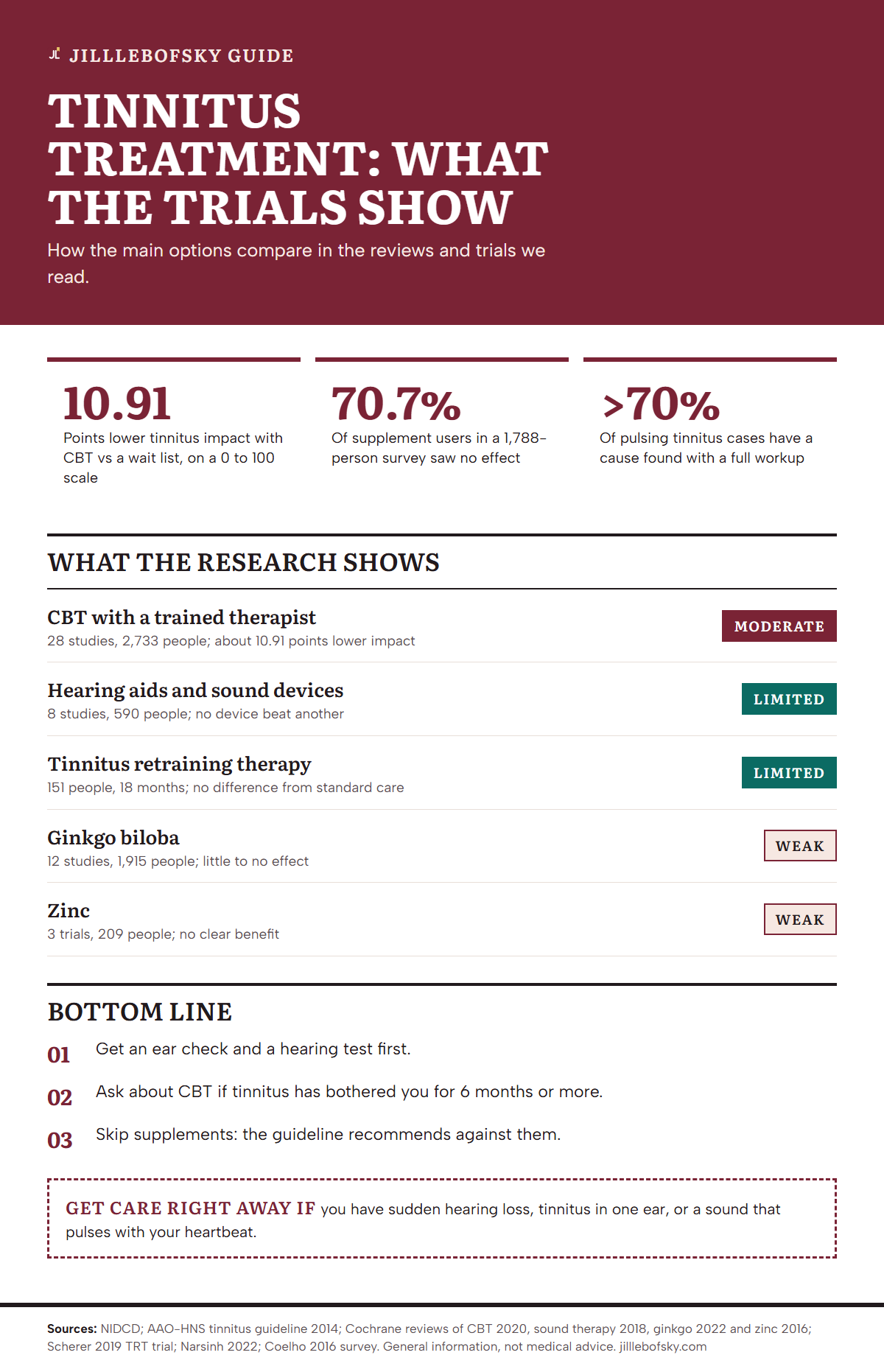
| CBT vs wait list | Cochrane review, 28 studies, 2,733 people overall | End of treatment | About 10.91 points lower on the 0 to 100 Tinnitus Handicap Inventory; 7 points is the smallest change people notice[3] |
| CBT vs usual audiology care | 3 studies, 444 people | End of treatment | About 5.65 points lower, moderate certainty[3] |
| Hearing aids, sound generators, combination devices | Cochrane review, 8 studies, 590 people | Up to 12 months | No device beat another; no trial compared them with no device[4] |
| Tinnitus retraining therapy | 151 people at US military hospitals | 18 months | No difference from standard care; 56.8% in all groups improved by 7 points or more[5] |
| Ginkgo biloba | Cochrane review, 12 studies, 1,915 people | Varied | Little to no effect, very low certainty[9] |
| Zinc | Cochrane review, 3 trials, 209 people | Varied | No clear benefit, very low quality evidence[11] |
Is there a cure for tinnitus?
For most people there is no cure for tinnitus, but there are ways to make it quieter in your mind and less disruptive. NIDCD says this plainly: "there is no cure for tinnitus, but there are ways to reduce symptoms"[1]. The exception is tinnitus with a fixable physical cause, such as earwax or a jaw joint problem[1].
When a cause like that is found, NIDCD says treating it "can eliminate or greatly reduce symptoms"[1]. For many others, symptoms can last months or years[1]. That is why most treatment aims to make the sound less bothersome.
Tinnitus can also fade on its own. NIDCD notes it may improve or go away over time in children and adults, though in some people it gets worse[1].
Be wary of any product sold as a tinnitus cure. NIDCD says vitamins, herbal extracts and supplements are often advertised that way, and "none of these has been proven to be effective"[1].
How do you stop tinnitus immediately?
No method we found stops tinnitus immediately, but adding soft background sound can make it less noticeable right away. NIDCD explains that sound therapy may work by masking the tinnitus, helping you get used to it, or distracting you[1]. That is the closest thing to quick relief the evidence supports.
Simple options NIDCD lists include a tabletop sound machine, a smartphone app playing rain or waves, a radio, or a household fan[1]. For mild tinnitus, NIDCD says a bedside sound generator "might be all that you need to help you fall asleep"[1].
Keep the sound soft and pleasant, the way NIDCD describes wearable generators[1]. NIDCD also lists limiting exposure to loud noise as a way to avoid making symptoms worse[1].
If the ringing started suddenly along with hearing loss in one ear, skip home remedies. That is a medical emergency, covered below[7].
Do hearing aids and sound therapy help tinnitus relief?
Hearing aids are a main tinnitus option for people who also have hearing loss, because they bring in outside sound and make the ringing less noticeable. NIDCD calls hearing aids "one of the main treatment options" for people with tinnitus and hearing loss[1]. The guideline recommends a hearing aid evaluation when hearing loss is documented[2].
Hearing aids and combination devices
Combination devices fit in the ear like hearing aids and add a built-in sound generator[1]. A 2018 Cochrane review of 8 studies and 590 people found no difference between combination devices and plain hearing aids (3 studies, 114 people)[4]. People in both groups improved by a clinically meaningful amount[4].
Sound generators and apps
Wearable sound generators sit in the ear and play soft sound all day[1]. In the one trial that compared them with hearing aids, results were similar[4]. However, the Cochrane authors found no trials comparing any of these devices with no device or a placebo, and they rated the evidence as low quality[4]. So sound therapy is a reasonable option, as the guideline says, but it is not proven better than education and time[2][4].
If a hearing test shows loss, we think a hearing aid is the first device to try, since it also helps you hear people and the world around you[1].
Does CBT help tinnitus?
Yes. Cognitive behavioral therapy has the strongest evidence of any tinnitus treatment for reducing how much tinnitus affects daily life. A 2020 Cochrane review pooled 28 studies with 2,733 people[3]. Compared with a wait list, CBT lowered tinnitus impact by about 10.91 points on a 100-point scale. The smallest change people notice is about 7 points[3].
CBT also did better than usual audiology care, by about 5.65 points, in 3 studies with 444 people[3]. Side effects were rare or absent[3].
CBT does not make the sound go away. NIDCD describes it as learning to spot the negative thoughts that cause distress and to change how you respond to them[1]. That matters because the distress, poor sleep and poor focus are what make tinnitus hard to live with[1]. The guideline recommends CBT for anyone with persistent, bothersome tinnitus[2].
Ask your doctor or audiologist for a referral to a psychologist or counselor who has worked with tinnitus.
Does tinnitus retraining therapy work?
Tinnitus retraining therapy (TRT) pairs counseling with low-level sound from an ear-worn device, but the largest trial found it did no better than standard care. NIDCD describes TRT as a way to "retrain" the brain so the sound becomes neutral and fades into the background[1].
The Tinnitus Retraining Therapy Trial, published in 2019, followed 151 military members and family for 18 months[5]. People got full TRT, TRT with placebo sound generators, or standard care. The authors found no difference between the groups[5]. Everyone tended to improve, and about half reached a clinically meaningful change[5].
An older Cochrane review found only 1 trial of 123 people that met its standards. That single low-quality trial favored TRT over tinnitus masking[6].
TRT is still a fair choice, and its counseling piece overlaps with CBT. The evidence just does not show it beats good standard care, so let cost and time guide the choice[5].
Can treating the cause stop tinnitus?
Sometimes. When tinnitus comes from a physical cause such as earwax, an ear infection or a jaw joint problem, treating that cause can remove or greatly reduce it. NIDCD says this directly for earwax and jaw joint problems[1]. This is why the first visit is usually a basic ear check.
NIDCD advises seeing your primary care doctor first. They check for earwax or fluid from an ear infection and ask about your health history and medicines[1]. Several medicines are linked to tinnitus, especially at high doses: NSAIDs such as ibuprofen, naproxen and aspirin, certain antibiotics, anti-cancer drugs, anti-malaria drugs and antidepressants[1]. Never stop a prescribed medicine on your own. Ask whether a change is possible.
Other linked conditions include Ménière's disease, tumors on the hearing nerve, blood vessel problems such as high blood pressure, and long-term conditions like diabetes, thyroid disorders and anemia[1]. A pulsing tinnitus often has a cause that can be found and treated[1][8].
For people with severe to profound hearing loss, cochlear implants have been shown to suppress tinnitus, but they do not suit most people with tinnitus[1].
Do supplements help tinnitus?
The research we read does not show that any supplement reliably helps tinnitus, and the US guideline recommends against using them. The guideline names ginkgo biloba, melatonin, zinc and "other dietary supplements"[2]. NIDCD says none has been proven to be effective[1].
Trial data point the same way. A 2022 Cochrane review of 12 studies and 1,915 people found ginkgo had little to no effect, with very low certainty[9]. NCCIH says ginkgo is not helpful for tinnitus symptoms[10]. A Cochrane review of zinc found 3 trials with 209 people and no clear benefit[11].
A 2016 survey of 1,788 people with tinnitus found 23.1% had tried supplements. Of those, 70.7% reported no effect, 19.0% felt better and 10.3% felt worse[12]. About 6% reported side effects such as bleeding, diarrhea and headache[12]. The authors concluded supplements should not be recommended for tinnitus[12].
If you still want to try one, check the label dose against the trial dose, look for a refund window, and tell your doctor first. Our editorial policy explains why we do not rank tinnitus pills.
When should you see a doctor for tinnitus?
See a doctor for any tinnitus that lasts, and get prompt care if it is in one ear, pulses with your heartbeat, or comes with sudden hearing loss. The guideline calls for a prompt hearing exam when tinnitus is one-sided, has lasted 6 months or more, or comes with hearing trouble[2]. NIDCD says an ENT may order imaging, especially for pulsing tinnitus[1].
See a doctor right away if:
- You suddenly lose hearing in one ear, with or without ringing. NIDCD calls sudden deafness a medical emergency. About half of people recover some or all hearing within 1 to 2 weeks, but delay can make treatment less effective[7].
- You hear a pulsing or whooshing sound in time with your heartbeat. A cause is found in more than 70% of people with a full workup, and it can be a warning sign of stroke[8].
- Tinnitus is in one ear only, or your hearing is worse on one side[2].
- Tinnitus comes with new nerve symptoms, such as weakness or numbness on one side[2].
- Tinnitus started after a head or neck injury[1].
- The sound is affecting your mood or sleep, or you feel anxious or depressed. NIDCD notes severe tinnitus can lead to anxiety or depression[1].
For tinnitus in both ears with no pulsing and no other warning signs, the guideline recommends against routine head and neck imaging[2].
Which tinnitus treatment should you try first?
Start with a hearing test and an ear check, then match the treatment to what is found and to how much the sound bothers you. This decision table pulls together the guideline and NIDCD advice above[1][2].
| If this fits you | Try first | Why |
|---|---|---|
| Earwax, ear infection or jaw pain found | Treat that cause | Can remove or greatly reduce symptoms[1] |
| Hearing test shows hearing loss | Hearing aid evaluation | Recommended by the guideline[2] |
| Bothersome for 6 months or more | CBT with a trained therapist | Best pooled evidence[3] |
| Mild, mostly noticed at bedtime | Low bedside sound or a fan | May be all you need to fall asleep[1] |
| Wants a structured sound and counseling program | TRT or sound therapy | An option, but not shown better than standard care[4][5] |
| Sudden hearing loss or pulsing sound | Urgent medical visit | Time-sensitive or possibly serious[7][8] |
Your tinnitus relief checklist
- Book a primary care visit for an ear check and a medicine review[1].
- Ask for a full hearing test from an audiologist[2].
- Bring a list of every medicine and supplement you take, with doses[1].
- Write down when the sound started, which ear, and whether it pulses[1][2].
- Ask about a CBT referral if the sound affects sleep, mood or focus[3].
- Use soft background sound at night instead of silence[1].
- Protect your ears from loud noise so symptoms do not get worse[1].
- If you take a blood thinner, skip ginkgo unless your doctor agrees[10].
More guides on ringing in the ears are in our tinnitus relief section.
Bottom line on tinnitus treatment
Tinnitus treatment works best when it starts with finding out why the sound is there. An ear check and a hearing test can turn up earwax, hearing loss or a medicine link, and those are the cases where the sound can fade or ease the most[1][2].
For most people with lasting tinnitus, CBT is a better first step than any device or pill, because it has the most trial data and few side effects[3]. Add a hearing aid if you have hearing loss, use soft sound at night, and save your money on supplements, which the guideline advises against[2].
Frequently asked questions
How to treat tinnitus at home?
Use soft background sound such as a fan, a sound machine or a phone app, especially at night. Protect your ears from loud noise. Home steps ease the contrast with silence; they do not replace an ear check and hearing test from a doctor.
Is there a tinnitus cure coming soon?
NIDCD reports research on electric and magnetic brain stimulation, bimodal stimulation and new drugs, but no medicine is FDA approved for tinnitus. Early results are mixed, so no date can be given for a cure.
How to reduce tinnitus at night?
A bedside sound generator, a fan or an app playing rain or waves can make tinnitus less noticeable when the room is quiet. NIDCD says this may be all that people with mild tinnitus need to fall asleep.
Can medicines cause tinnitus?
Yes, some can, especially at high doses. NIDCD lists NSAIDs such as ibuprofen, naproxen and aspirin, certain antibiotics, anti-cancer drugs, anti-malaria drugs and antidepressants. Ask your doctor before changing any prescribed medicine.
Does tinnitus go away on its own?
It can. NIDCD says tinnitus may improve or go away over time, though in some people it gets worse. It is called chronic once it lasts 3 months or longer, and that is a good point to seek a hearing test.
Sources
- Tinnitus. NIDCD, National Institutes of Health, 2023
- Clinical practice guideline: tinnitus (Tunkel et al.). AAO-HNS Foundation, Otolaryngology Head and Neck Surgery, 2014
- Cognitive behavioural therapy for tinnitus (Fuller et al.). Cochrane Database of Systematic Reviews, 2020
- Sound therapy (using amplification devices and/or sound generators) for tinnitus (Sereda et al.). Cochrane Database of Systematic Reviews, 2018
- Effect of tinnitus retraining therapy vs standard of care on tinnitus-related quality of life (Scherer, Formby). JAMA Otolaryngology Head and Neck Surgery, 2019
- Tinnitus Retraining Therapy (TRT) for tinnitus (Phillips, McFerran). Cochrane Database of Systematic Reviews, 2010
- Sudden Sensorineural Hearing Loss. NIDCD, National Institutes of Health
- Diagnostic approach to pulsatile tinnitus: a narrative review (Narsinh et al.). JAMA Otolaryngology Head and Neck Surgery, 2022
- Ginkgo biloba for tinnitus (Sereda et al.). Cochrane Database of Systematic Reviews, 2022
- Ginkgo. NCCIH, National Institutes of Health
- Zinc supplementation for tinnitus (Person et al.). Cochrane Database of Systematic Reviews, 2016
- Survey on the effectiveness of dietary supplements to treat tinnitus (Coelho et al.). American Journal of Audiology, 2016
This page is general information, not medical advice. Talk to your doctor or pharmacist before you start any supplement, especially if you are pregnant, take medicine or have a health condition. Read our medical disclaimer and how we review.