Sensorineural hearing loss comes from damage to the inner ear or the hearing nerve. It is the most common type of permanent hearing loss and usually cannot be fixed with medicine or surgery. Hearing aids are the main help, with trials showing better listening and quality of life. Hearing that drops over hours or days is an emergency that needs a doctor quickly.
Sensorineural hearing loss is the most common type of permanent hearing loss, and it starts with damage deep inside the ear.[1] To write it, we read the NIDCD and National Institute on Aging pages on age-related, noise-induced and sudden hearing loss, the 2019 US guideline on sudden hearing loss, a Cochrane review of hearing aids and four trials.[2][4][5][7][11]
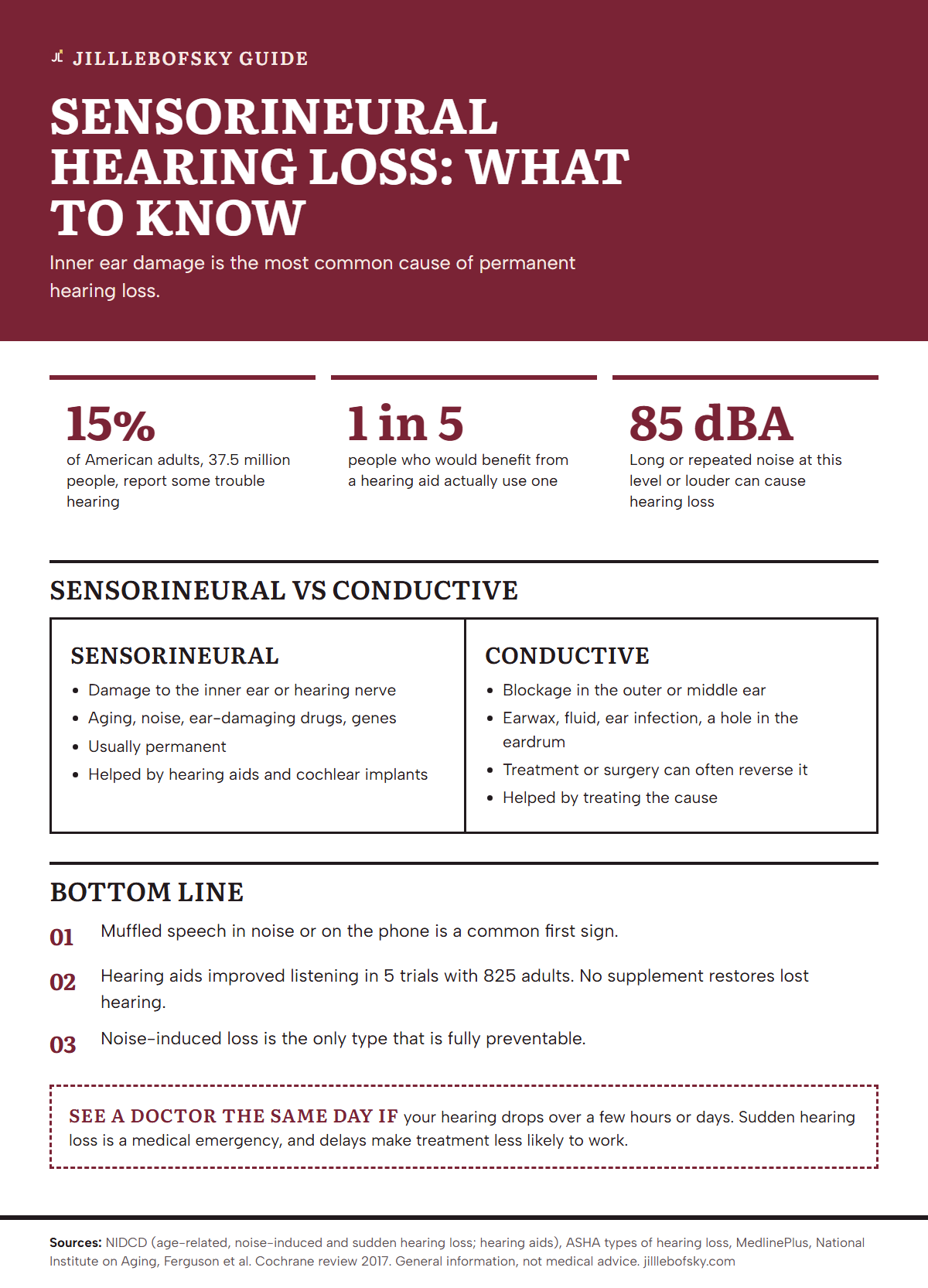
The damage sits in the inner ear or the hearing nerve, it usually cannot be fixed with medicine or surgery, and hearing aids are the main help. About 15% of American adults, or 37.5 million people, report some trouble hearing.[1][2][9]
| What it is | Damage to the inner ear or the nerve pathways from the inner ear to the brain[1] |
|---|---|
| How common | About 1 in 3 people aged 65 to 74 have hearing loss, and nearly half of those over 75 have trouble hearing[2] |
| Main causes | Aging, loud noise, medicines that harm the ear, illness, genes and head injury[1] |
| Typical signs | Speech sounds muffled, trouble in noisy rooms and on the phone, often asking people to repeat[3][7] |
| Best evidence for help | Hearing aids improved daily listening and quality of life in 5 trials with 825 adults[11] |
| Supplements | None restores lost hearing; folic acid slowed low-pitch decline by 0.7 dB over 3 years in one Dutch trial[13] |
| Emergency sign | Hearing that drops over a few hours or days needs a doctor right away[4] |
What is sensorineural hearing loss?
Sensorineural hearing loss (SNHL) is hearing loss caused by damage to the inner ear or to the nerve pathways that carry sound from the ear to the brain.[1] It is the most common kind of permanent hearing loss. It usually cannot be corrected with medicine or surgery, so care centers on hearing aids and other devices.[1]
Inside the inner ear, tiny sensory hair cells turn sound vibrations into electrical signals. The hearing nerve carries those signals to the brain.[3] Most noise damage comes from the death of these hair cells, and human hair cells do not grow back.[3]
Age-related loss usually affects both ears about equally.[7] Loss in one ear only, or loss that comes on fast, needs a closer look from a doctor.[4]
Sensorineural vs conductive hearing loss
Conductive hearing loss happens when sound cannot travel through the outer or middle ear to reach the inner ear. Mixed hearing loss means both problems at once.[1]
| Feature | Sensorineural | Conductive |
|---|---|---|
| Where the problem is | Inner ear or hearing nerve | Outer or middle ear[1] |
| Common causes | Aging, noise, ear-damaging drugs, genes, illness | Earwax, fluid, ear infection, a hole in the eardrum[1] |
| Can it be reversed? | Usually permanent | Treatment or surgery can often reverse it[8] |
| Main help | Hearing aids, cochlear implants | Treating the blockage or infection[1][9] |
What does sensorineural hearing loss feel like?
Most people first notice that speech sounds muffled, especially in a noisy room or on the phone.[3] Because age-related and noise-related loss come on slowly, many people do not realize how much they have lost. Family members often notice first, when the TV gets louder or answers stop matching questions.[2][3]
The National Institute on Aging lists these signs as reasons to see a doctor:[7]
- Trouble understanding people on the telephone
- Finding it hard to follow a conversation when two or more people talk
- Often asking people to repeat themselves
- Turning the TV up so loud that others complain
- Losing speech in background noise
- Feeling that other people mumble
- Trouble hearing children and other higher-pitched voices
Ringing, buzzing or roaring in the ears, called tinnitus, often comes along and can be the first sign of hearing loss in older adults.[7] Our guide to tinnitus treatment options covers that symptom in depth.
NIDCD also offers a 10-question self-check. Answering yes to two or more questions, or sometimes to three or more, means you should consider a hearing test.[2]
What causes sensorineural hearing loss?
The most common causes are aging and years of exposure to loud noise.[2][7] Other causes include medicines that damage the inner ear, illnesses, inherited genes, head injury and problems with how the inner ear formed. In sudden cases, only about 10% of people have a cause doctors can identify.[1][4]
- Age-related loss, called presbycusis, comes on gradually and may run in families. It reflects changes in the inner ear and the hearing nerve.[2][7]
- Long or repeated noise at or above 85 dBA can cause hearing loss, while sounds at or below 70 dBA are unlikely to. Music through headphones at maximum volume reaches 94 to 110 dBA.[3]
- Some chemotherapy drugs, some antibiotics, some heart medicines and even aspirin at some doses can harm the inner ear.[2][7]
- Diabetes and high blood pressure are linked with hearing loss. Stroke, brain injury and tumors can also affect hearing.[2][7]
- About 2 to 3 of every 1,000 US children are born with detectable hearing loss, and some inherited forms appear later in life.[6][7]
- Infections, head trauma, autoimmune disease, circulation problems and Meniere's disease can all cause sudden loss.[4]
Among US adults aged 20 to 69 with 5 or more years of very loud noise at work, about 18% have speech-frequency hearing loss in both ears. That compares with 5.5% of adults with no noise at work.[6]
How is sensorineural hearing loss diagnosed?
The core test is pure tone audiometry, a hearing test done by an audiologist.[4] A doctor first looks in the ear for wax, fluid or other blockages that cause conductive loss. The hearing test then shows how much hearing is gone, at which pitches and in which ear.[4][5]
A primary care doctor can refer you and check for related conditions. An ear, nose and throat doctor (otolaryngologist) looks for a medical cause, and an audiologist measures the loss and fits hearing aids.[2]
For sudden loss, the 2019 US guideline asks for audiometry as soon as possible, within 14 days of onset.[5] It advises against routine head CT scans and routine lab tests. It recommends an MRI or an auditory brainstem response test to look for problems behind the ear, such as a tumor on the hearing nerve.[5]
Doctors define sudden sensorineural loss as a drop of at least 30 decibels in three connected frequencies within 72 hours. At that level, normal speech can sound like a whisper.[4]
Tell the doctor if you also feel dizzy. Inner ear disease often affects balance, and our guide to the common causes of vertigo explains how the two connect.
Can sensorineural hearing loss be reversed?
Gradual sensorineural loss is usually permanent, because damaged hair cells do not grow back.[3][8] Sudden loss is different. About half of people with sudden loss recover some or all of their hearing on their own, usually within one to two weeks, and doctors usually start steroids quickly.[4]
Care therefore aims to catch sudden loss early enough to treat it and to fit devices that make the most of the hearing that remains. The 2019 guideline also asks doctors to counsel patients on hearing rehabilitation.[5]
What doctors use first
For lasting loss, hearing aids come first. NIDCD says they are mainly useful for sensorineural loss, because the surviving hair cells pick up the louder vibrations an aid sends in.[9] An aid will not restore normal hearing, but with practice it raises awareness of sounds.[9]
Since 2022, adults with perceived mild to moderate loss can buy over-the-counter hearing aids without an exam.[2] If an OTC aid does not help, or loud sounds are also hard to hear, see a hearing professional, because the loss may be more severe.[2]
For severe or profound loss, a cochlear implant bypasses the damaged part of the ear and stimulates the hearing nerve directly. It does not restore normal hearing either, but it can help people understand speech.[10]
Treatment for sudden loss
Corticosteroids are the most common treatment for sudden sensorineural loss, started as soon as possible.[4] The guideline lists steroids within 2 weeks of onset as an option. Doctors can offer steroid injections through the eardrum when recovery is still incomplete 2 to 6 weeks after onset.[5]
In a 2011 NIDCD-funded trial of 250 patients, injections through the eardrum worked as well as oral prednisone, with average gains of 28.7 and 30.7 decibels.[15] Treatment delayed more than 2 to 4 weeks is less likely to help.[4]
Do supplements help sensorineural hearing loss?
No supplement has been shown to restore hearing lost to inner ear damage. A few trials found small effects on how fast hearing worsens, mostly in narrow groups such as Dutch adults with low folate or people exposed to loud noise. Hearing aids have far stronger evidence.[11][13][14]
We use the same check described in how we review supplements: compare the dose on the label with the trial dose, and ask who was studied. The table puts the main studies side by side.
What the trials found
| Study | Who and how many | What was tested | Result |
|---|---|---|---|
| Ferguson, Cochrane review, 2017[11] | 5 trials, 825 adults with average ages of 69 to 83 | Hearing aids for 6 weeks to 6 months | Large gains in hearing-related quality of life and listening ability |
| ACHIEVE trial, 2023[12] | 977 adults aged 70 to 84 with untreated loss | Hearing aids plus counseling for 3 years | No overall slowing of mental decline; possible benefit in a higher-risk group |
| Durga trial, 2007[13] | 728 Dutch older adults | Folic acid 800 mcg a day for 3 years | Low-pitch hearing worsened 1.0 dB vs 1.7 dB on placebo; no change at high pitches |
| Souza review, 2018[14] | 10 trial reports | Antioxidants such as NAC, ginseng and vitamin E | Less worsening at 4 kHz with NAC and ginseng after noise; none at 6 kHz; vitamin E did not help |
| Rauch trial, 2011[15] | 250 adults with sudden loss | Prednisone 60 mg a day vs eardrum steroid injections | Similar gains, 30.7 vs 28.7 dB |
The folic acid result is the strongest supplement signal, and it is small: 0.7 decibels over 3 years.[13] The trial ran in a country that did not add folic acid to food, so baseline folate was about half the US level, and the authors said the effect needs confirmation.[13]
A product that promises to restore hearing claims more than any study here shows. Spend on a hearing test first.
When should you see a doctor right away?
Sudden hearing loss in one or both ears is a medical emergency.[4] See a doctor the same day if hearing drops over a few hours or days, even if you suspect earwax, allergies or a sinus infection. Delays make treatment less likely to work, and people often put it off for these reasons.[4]
Call 911 if hearing loss comes with new weakness, numbness, trouble speaking or other signs of a stroke or nerve problem. The guideline tells doctors to check for these focal neurologic signs, and stroke can affect hearing.[5][7]
See a doctor right away if you have:
- Hearing loss that came on over hours or up to 3 days[4]
- Loss in one ear only, or a pop just before the loss[4]
- Hearing loss with dizziness or new ringing in the ear[4]
- Loss in both ears at once, or loss that keeps coming back[5]
- Ear pain or fluid draining from the ear[7]
Quick decision table
| If you notice | What to do |
|---|---|
| Hearing dropped over hours or a few days | Same-day doctor visit; ask for a hearing test within days[4][5] |
| Hearing loss with weakness, numbness or trouble speaking | Call 911[5] |
| Slow decline over years in both ears | Book a hearing test; OTC aids are an option for mild to moderate loss[2] |
| One ear clearly worse than the other | See an ear specialist; an MRI may be needed[5] |
| New hearing trouble after starting a medicine | Call your doctor before changing the dose[7] |
| Muffled hearing after a loud concert | It often fades in 16 to 48 hours; get checked if it lasts[3] |
How can you protect the hearing you have?
Noise-induced hearing loss is the only type of hearing loss that is completely preventable.[3] Scientists do not yet know how to prevent age-related loss. You can still limit noise, protect your ears and get tested early so a device can help sooner.[2]
- Wear earplugs or earmuffs for lawn mowers, leaf blowers, power tools, concerts and shooting.[3]
- Keep headphones well below maximum volume.[3]
- Move away from noise you cannot turn down.[3]
- Ask your doctor or pharmacist whether any of your medicines can affect hearing.[7]
- Keep blood pressure and blood sugar in range, since both conditions are linked with hearing loss.[2]
- Before buying hearing aids, ask about the trial period. Most makers allow 30 to 60 days to return them for a refund.[9]
- Ask what the warranty covers, since prices range from hundreds to several thousand dollars.[9]
Only about 1 in 5 people who would benefit from a hearing aid uses one.[9] Untreated hearing problems can get worse, and older adults with hearing loss have a higher risk of dementia than peers with normal hearing.[7][8] That last link is an association, and the ACHIEVE trial did not show hearing aids slowed mental decline overall.[12]
More guides on ears and balance sit in our hearing and tinnitus section.
Bottom line on sensorineural hearing loss
This type of hearing loss means the inner ear or hearing nerve is damaged, and the loss is usually permanent.[1] It is common, especially after 65. The tools that help most are a proper hearing test, hearing aids and, for severe loss, cochlear implants.[2][9][10]
For most people, a hearing test and a well-fitted hearing aid are a better first step than any supplement, because hearing aids have controlled trials showing real gains in daily listening.[11] Sudden loss is the one case that cannot wait, so see a doctor within days.[4] Our editorial policy explains how we pick sources.
Frequently asked questions
Can sensorineural hearing loss affect only one ear?
Yes. Age-related loss usually affects both ears, but noise, infections, Meniere's disease and sudden loss can hit one ear. Loss in one ear deserves a doctor visit, because doctors may order an MRI to rule out a tumor on the hearing nerve.
Does sensorineural hearing loss get worse over time?
It often does. Age-related loss builds slowly in both ears, and more noise exposure adds damage. Untreated hearing problems can get worse, so a baseline hearing test helps you and an audiologist track changes and adjust hearing aids as needed.
Can earwax cause sensorineural hearing loss?
No. Earwax blocks sound in the ear canal, which causes conductive hearing loss, not inner ear damage. That kind of loss can often be fixed by removing the wax. A doctor checks for wax first before testing for sensorineural loss.
Do OTC hearing aids work for sensorineural hearing loss?
They can for adults with perceived mild to moderate loss, the group the 2022 FDA category was built for. If an over-the-counter aid does not help, or loud sounds are also hard to hear, see a hearing professional for a full test.
Who is most likely to get sensorineural hearing loss?
Age is the strongest predictor, with the most loss among adults in their 60s and beyond. Among US adults aged 20 to 69, men are almost twice as likely as women to have hearing loss, and years of loud work noise raise the risk.
Sources
- Types of Hearing Loss. American Speech-Language-Hearing Association, 2026
- Age-Related Hearing Loss (Presbycusis). NIDCD, National Institutes of Health
- Noise-Induced Hearing Loss. NIDCD, National Institutes of Health
- Sudden Deafness. NIDCD, National Institutes of Health, 2018
- Clinical Practice Guideline: Sudden Hearing Loss (Update). Chandrasekhar et al., Otolaryngology Head and Neck Surgery, 2019
- Quick Statistics About Hearing, Balance, and Dizziness. NIDCD, National Institutes of Health
- Hearing Loss: A Common Problem for Older Adults. National Institute on Aging
- Hearing Disorders and Deafness. MedlinePlus, National Library of Medicine
- Hearing Aids. NIDCD, National Institutes of Health
- Cochlear Implants. NIDCD, National Institutes of Health
- Hearing aids for mild to moderate hearing loss in adults. Ferguson et al., Cochrane Database of Systematic Reviews, 2017
- Hearing intervention versus health education control to reduce cognitive decline (ACHIEVE). Lin et al., The Lancet, 2023
- Effects of folic acid supplementation on hearing in older adults: a randomized, controlled trial. Durga et al., Annals of Internal Medicine, 2007
- Effect of antioxidant supplementation on the auditory threshold in sensorineural hearing loss: a meta-analysis. Souza et al., Brazilian Journal of Otorhinolaryngology, 2018
- Oral vs intratympanic corticosteroid therapy for idiopathic sudden sensorineural hearing loss: a randomized trial. Rauch et al., JAMA, 2011
This page is general information, not medical advice. Talk to your doctor or pharmacist before you start any supplement, especially if you are pregnant, take medicine or have a health condition. Read our medical disclaimer and how we review.