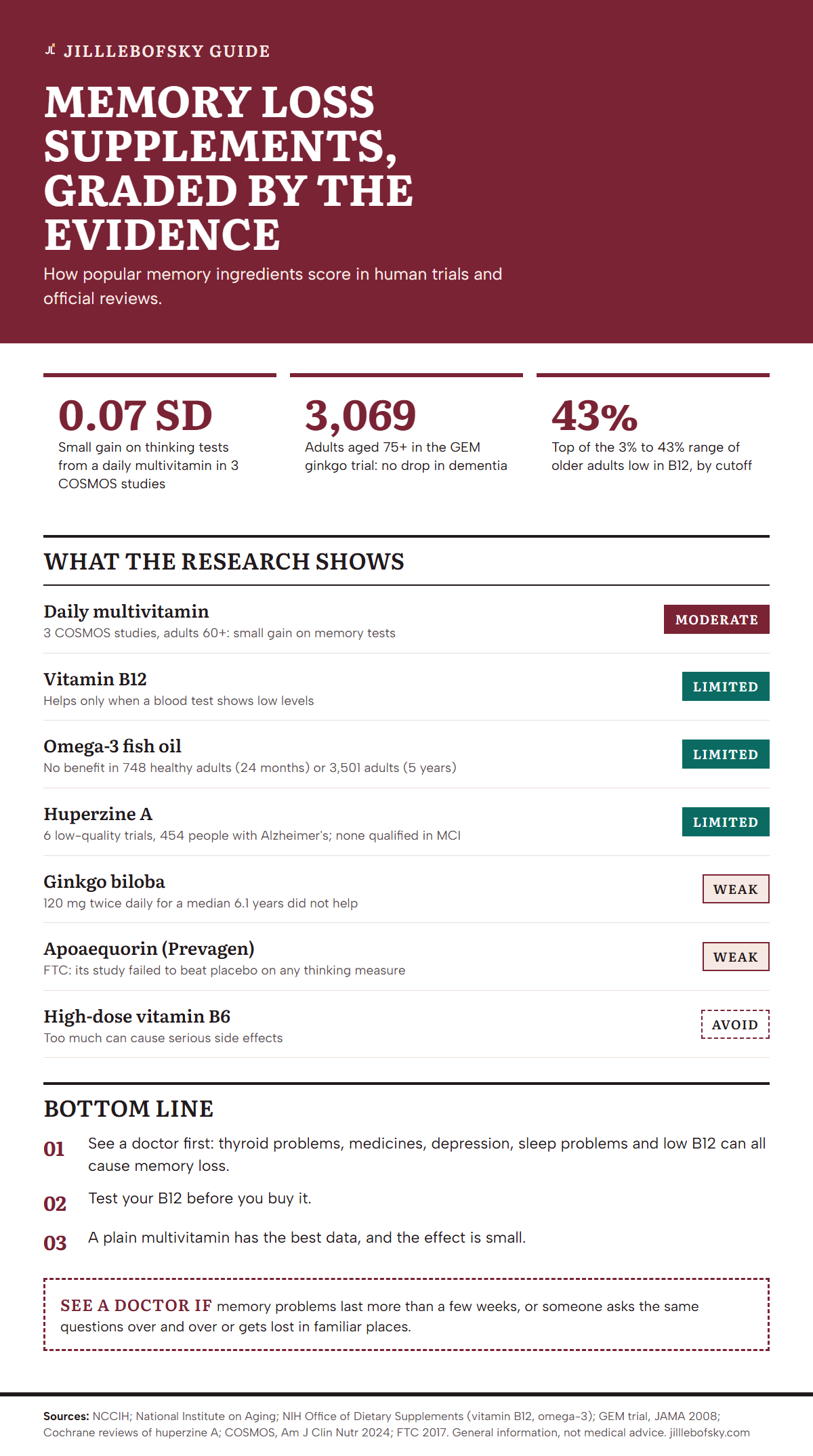
No memory loss supplement has been shown to stop memory decline. A plain daily multivitamin has the best trial data, a small gain on memory tests in adults 60 and older. B12 helps only if a blood test shows you are low. Ginkgo, vitamin E and Prevagen's jellyfish protein did not deliver, and high-dose B6 carries risk. See a doctor first.

We graded memory loss supplements against the NCCIH evidence summaries, the NIH fact sheets on vitamin B12 and omega-3s, two Cochrane reviews of huperzine A, a Cochrane review of vitamin E, the GEM ginkgo trial, the COSMOS multivitamin studies and the FTC case against Prevagen.[1][4][5][6][7][8][10][11] We ranked ingredient types, not brands.
No pill has been shown to stop memory loss. The best result we found was small: a 0.07 standard deviation gain on memory and thinking tests from a daily multivitamin in COSMOS.[10] Finding the cause of the memory problem matters more than any capsule.[3]
| What they are | Pills sold with claims that they boost memory or brain health, usually vitamins, fish oil, herbs or proteins.[1] |
|---|---|
| Used for | Forgetfulness, age-related memory changes and worry about dementia.[1][3] |
| Best evidence | A daily multivitamin: small gains on memory tests pooled across 3 COSMOS studies in adults 60 and older.[10] |
| Clearest failure | Ginkgo at 120 mg twice daily did not lower dementia rates in 3,069 adults aged 75 and older over a median 6.1 years.[6] |
| Safety | Too much vitamin B6 can cause serious side effects. Fish oil at 4 g a day slightly raised atrial fibrillation risk in people with heart disease or high heart risk.[2][5] |
| Check first | New or worsening memory loss. Thyroid problems, medicines, depression, sleep problems and low B12 can all cause it.[3] |
Do memory loss supplements work?
For most people, memory loss supplements have not been shown to stop or slow memory decline. NCCIH says a few trials of natural products found "modest effects," but direct evidence that supplements can head off dementia is lacking.[1][2] The National Institute on Aging warns that memory pills might be unsafe, a waste of money, or both.[3]
The ingredients still differ a lot. Some have large, well-run trials behind them, while others rest on one company study or on lab work. The grades below sort them by the quality of the human evidence, using the method on our how we review supplements page.
How did we grade each supplement?
Each ingredient got one of four grades based only on human trials and official reviews. We did not score brands, taste or price.[1] The grades are:
- Moderate: several pooled trials with a small but consistent effect.
- Limited: some trials, but small, short or low quality.
- Weak: pilot studies only, or reviews that found no benefit.
- Avoid: no useful evidence plus a known safety problem.
No ingredient earned a higher grade. Our editorial policy explains how we pick and update sources.
1. Daily multivitamin: older adults who want the best-tested option
Grade: Moderate. COSMOS gave a standard daily multivitamin or a placebo to adults aged 60 and older, and three separate memory studies inside it pooled their results.[10] The studies had 573, 2,158 and 2,472 people.[10]
Together they found a gain of 0.07 standard deviations in overall thinking and 0.06 in episodic memory, the kind you use to recall a list or a recent event.[10] The authors said the effect on overall thinking matched about 2 years less cognitive aging.[10]
These were test scores, and all three studies came from one parent trial, so they say nothing yet about dementia rates. NCCIH has not changed its view that direct evidence is lacking.[2] A plain store-brand multivitamin is the version that was tested, so a pricey "brain" blend adds nothing proven.[10]
2. Vitamin B12: people with a blood test showing low levels
Grade: Limited, and only useful when you are actually low. Low vitamin B12 is one of the causes of memory problems the NIA lists, and the NIH fact sheet names dementia and numbness or tingling among deficiency symptoms.[3][4] These nerve symptoms can appear without anemia.[4]
Depending on the cutoff used, 3% to 43% of older adults living at home are low in B12.[4] Risk goes up with pernicious anemia, stomach surgery, vegetarian diets and long-term use of metformin or acid-reducing drugs called proton pump inhibitors.[4]
If your level is normal, extra B12 has not helped. Randomized trials found no improvement in thinking among older adults with or without dementia who took B12 alone or with folic acid and B6.[4] Ask for the blood test before you buy.
3. Omega-3 fish oil: people with mild memory loss who eat little fish
Grade: Limited. People who eat more fish show the most consistent links to slower memory decline, but fish oil pills have not matched that in trials of healthy adults or people with Alzheimer's.[1][5]
In a UK trial, 748 healthy adults aged 70 to 79 took 500 mg DHA and 200 mg EPA or a placebo for 24 months, with no difference in thinking.[5] In AREDS2, 3,501 older adults took 350 mg DHA and 650 mg EPA for 5 years, again with no effect.[5] In 295 people with Alzheimer's, 2 g of DHA a day for 18 months did not slow decline.[5]
For mild cognitive impairment, reviews suggest omega-3s may help attention, processing speed and immediate recall, but NIH says this still needs confirming.[5] Eating fish twice a week is the lower-risk way to test the idea.
4. Huperzine A: only under a doctor's eye, if at all
Grade: Limited, with a caution. Huperzine A comes from Chinese club moss and blocks the enzyme that breaks down acetylcholine, the same action as some prescription Alzheimer's drugs.[8] That makes it act more like a medicine than a vitamin.
A Cochrane review found 6 trials with 454 people with Alzheimer's. Results looked positive on some scales, but only one study was of adequate quality and size, and the authors found the evidence too thin to recommend it.[8] A second Cochrane review looked for trials in mild cognitive impairment and found none that qualified.[9]
Side effects in those trials were mild, but the drugs that share its action "have numerous side effects."[8][9] If you already take an Alzheimer's medicine, do not add huperzine A on your own.
5. Ginkgo biloba: not recommended for memory loss
Grade: Weak. Ginkgo has the largest failed trial in this list. The GEM study gave 120 mg of ginkgo extract twice a day or a placebo to 3,069 adults aged 75 and older and followed them for a median of 6.1 years.[6]
Dementia showed up in 277 people on ginkgo and 246 on placebo, a difference that was not significant.[6] Among the 482 people who already had mild cognitive impairment, ginkgo did not slow the move to dementia either.[6] NCCIH concludes there is no conclusive evidence that ginkgo slows dementia or memory decline.[1]
6. Vitamin E: not useful for mild memory loss
Grade: Weak. The 2017 Cochrane review found that vitamin E did not change the odds of moving from mild cognitive impairment to Alzheimer's over 36 months in a trial of 516 people.[7]
It also did not improve thinking in people with Alzheimer's. One trial of 304 people with Alzheimer's found slower loss of daily living skills, which is the only positive signal.[7] Serious side effects were no more common than with placebo in these trials.[7] NCCIH reads the evidence the same way and adds that the few results on curcumin, from turmeric, are too inconsistent to judge.[1]
7. Apoaequorin (Prevagen): skip the jellyfish protein
Grade: Weak. Prevagen's main ingredient is a protein from jellyfish. In 2017 the FTC and New York State sued its maker, saying the company relied on a study that failed to show the product beat a placebo on any measure of thinking.[11]
Bottles of 30 pills cost $24 to $68, and sales topped $165 million, according to the complaint.[11] After 7 years of litigation that included a jury trial, a federal court in December 2024 ordered the company to stop making the challenged claims.[12] The FTC added that health claims need reliable scientific support.[12]
8. High-dose vitamin B6: avoid
Grade: Avoid. B6 shows up in many "brain" blends, often next to B12 and folic acid. Short-term trials of these three B vitamins did not improve thinking in adults 50 and older, with or without dementia.[1][2]
NCCIH also warns that too much vitamin B6 can cause serious side effects, so a big dose brings risk with no proven gain.[2] Some longer studies hint that B vitamins might slow decline, but that is not enough to justify mega-doses.[2]
What did the biggest trials find?
In most large trials, memory loss supplements did not change memory or dementia rates. The multivitamin result is the main exception, and its effect was small.[5][6][7][10]
| Trial | Who and how long | Daily dose | Result |
|---|---|---|---|
| COSMOS, 3 studies[10] | 573, 2,158 and 2,472 adults aged 60+, about 2 years | Standard multivitamin | Small gain: 0.07 SD overall, 0.06 SD memory |
| GEM[6] | 3,069 adults aged 75+, median 6.1 years | Ginkgo 120 mg twice | No drop in dementia (277 vs 246 cases) |
| UK omega-3 trial[5] | 748 healthy adults aged 70 to 79, 24 months | 500 mg DHA, 200 mg EPA | No difference |
| AREDS2[5] | 3,501 older adults, 5 years | 350 mg DHA, 650 mg EPA | No effect on thinking |
| DHA in Alzheimer's[5] | 295 people, 18 months | 2 g DHA | Did not slow decline |
| Vitamin E in MCI[7] | 516 people, 36 months | Vitamin E | No change in progression |
What causes memory loss that a doctor can treat?
Many causes of memory loss are medical problems that improve once they are found and treated. The NIA lists head injury, blood clots, tumors or infections in the brain, thyroid, kidney or liver problems, medication side effects, depression and anxiety, alcohol or drug misuse, sleep problems and low vitamin B12.[3]
NCCIH makes the same point and adds bad reactions to medicines to the list.[2] This is why a supplement should never replace a checkup. A memory pill cannot fix an underactive thyroid or a drug side effect, and taking one can delay the visit that would.[2]
Can stress cause memory loss and confusion?
Yes, stress and strong emotions can leave people confused or forgetful for a while. The NIA names major life events such as retiring or losing a spouse as common triggers.[3] These problems are usually temporary and improve as the stress fades.[3]
Staying active, seeing people and learning new skills can help both memory and mood.[3] If memory problems last more than a few weeks, the NIA advises talking with your doctor, because it may be a sign of something more serious.[3]
Which memory supplement should you consider first?
Pick the next step from your situation before you look at any product. The table matches common cases to the step the evidence supports. It summarizes the sources above and is general information.[2][3][4][10]
| If | Then |
|---|---|
| Memory loss is new, getting worse or worries family | See a doctor before any supplement[2][3] |
| You take metformin or an acid reducer, eat no animal foods, or had stomach surgery | Ask for a B12 blood test[4] |
| You are 60 or older and want one low-cost option | A plain daily multivitamin has the best trial data[10] |
| You rarely eat fish | Add fish to meals before buying fish oil[1][5] |
| You are under heavy stress or grieving | Expect improvement as stress eases; see a doctor if it lasts weeks[3] |
| A label promises it is "clinically shown" to restore memory | Treat that claim with caution[11][12] |
Are memory loss supplements safe?
Most common memory ingredients are low risk at label doses, but a few carry real cautions. Too much vitamin B6 can cause serious side effects.[2] Fish oil can cause a fishy taste, heartburn, nausea, diarrhea and headache, and 4 g a day for several years slightly raised atrial fibrillation risk in people with or at high risk of heart disease.[5]
Vitamin B12 has no upper limit because of its low risk of toxicity.[4] Huperzine A acts like a prescription drug and should not be started alone.[8] The NIA notes that memory products might interfere with other medical treatments, so tell your doctor and pharmacist about every pill you take, especially if you are pregnant or take daily medicines.[3]
Talk with a doctor soon if you or a loved one:[3]
- Asks the same questions over and over
- Gets lost in places you used to know well
- Has trouble following recipes or directions
- Becomes more confused about time, people and places
- Stops eating well, bathing or acting safely
What do doctors do first for memory loss?
Doctors first look for the cause, using tests and memory assessments, and may refer you to a neurologist.[3] Once the cause is known, the treatment plan follows from it, and the NIA suggests a follow-up memory check every 6 to 12 months.[3]
To stay sharp, the NIA suggests you sleep seven to eight hours, exercise, eat well, control blood pressure, limit alcohol and get help for depression that lasts weeks.[3] It also says no drug or lifestyle approach has been shown to stop Alzheimer's, though a healthy lifestyle may lower the risk.[3] You can read more of our brain guides in the memory and focus supplement guides.
What should you check on a memory supplement label?
Check that the dose matches what was tested and that the claims stay modest. Use this list before you buy:
- Does it say it improves memory or is "clinically shown"? The FTC challenged exactly those claims for Prevagen.[11]
- For a multivitamin, is it a standard daily formula like the one tested in COSMOS?[10]
- For fish oil, add up EPA plus DHA per serving and stay well under 5 g a day, the amount the FDA considers safe.[5]
- Is vitamin B6 far above the amount in a basic multivitamin? Skip high-dose B6.[2]
- Does it list huperzine A? Talk to your doctor first.[8]
- Is ginkgo the main ingredient? GEM found 120 mg twice a day did not help.[6]
- Have you had a B12 blood test? Only buy B12 for memory if you are low.[4]
Are memory supplements worth buying?
We would not spend much on memory loss supplements. The best-tested option, a plain multivitamin, gave a small test-score gain, and ginkgo, vitamin E, apoaequorin and high-dose B vitamins did not deliver.[6][7][10][11]
For most people, a doctor's visit is the better first step, because a fixable cause such as low B12, a thyroid problem or a medicine side effect is far more likely to change your memory than any pill.[3][4]
Frequently asked questions
Does suppressing emotions cause memory loss?
We found no NIH source on suppressing emotions as such. The NIA does say stress and negative emotions can leave people confused or forgetful, and that these problems usually fade as the stress eases. If memory trouble lasts more than a few weeks, see a doctor.
What is the elephant trick or honey trick for memory loss?
These are marketing phrases, not medical treatments. We found no clinical trial or NIH page that supports either one. The NIA warns that products promising sharper memory might be unsafe, a waste of money, or both, so ask your doctor first.
Can vitamin B12 help memory loss if my levels are normal?
Probably not. Randomized trials reviewed by the NIH found no improvement in thinking when older adults took B12, alone or with folic acid and B6. B12 matters for memory when you are deficient, which a simple blood test can show.
Is eating fish better than taking fish oil for memory?
The evidence leans that way. NCCIH says the most consistent positive findings for omega-3s come from how much fish people eat, while fish oil pills have not helped people with Alzheimer's and showed no benefit in healthy older adults in trials.
How long should you take a memory supplement to see results?
The trials ran for years, not weeks. COSMOS measured multivitamin effects over about 2 years, and the GEM ginkgo trial followed people for a median of 6.1 years without benefit. A product promising quick memory gains is out of line with that research.
Sources
- Dietary Supplements and Cognitive Function, Dementia, and Alzheimer's Disease. NCCIH Clinical Digest, 2022
- 7 Things To Know About Dietary Supplements for Cognitive Function, Dementia, and Alzheimer's Disease. NCCIH
- Memory Problems, Forgetfulness, and Aging. National Institute on Aging
- Vitamin B12 Fact Sheet for Health Professionals. NIH Office of Dietary Supplements, 2025
- Omega-3 Fatty Acids Fact Sheet for Health Professionals. NIH Office of Dietary Supplements
- Ginkgo biloba for prevention of dementia: a randomized controlled trial (GEM). JAMA, 2008
- Vitamin E for Alzheimer's dementia and mild cognitive impairment. Cochrane Database of Systematic Reviews, 2017
- Huperzine A for Alzheimer's disease. Cochrane Database of Systematic Reviews, 2008
- Huperzine A for mild cognitive impairment. Cochrane Database of Systematic Reviews, 2012
- Effect of multivitamin-mineral supplementation versus placebo on cognitive function: COSMOS. American Journal of Clinical Nutrition, 2024
- FTC, New York State Charge the Marketers of Prevagen With Making Deceptive Memory, Cognitive Improvement Claims. Federal Trade Commission, 2017
- Statement on FTC's Win in Lawsuit Against the Makers of Dietary Supplement Prevagen. Federal Trade Commission, 2024
This page is general information, not medical advice. Talk to your doctor or pharmacist before you start any supplement, especially if you are pregnant, take medicine or have a health condition. Read our medical disclaimer and how we review.