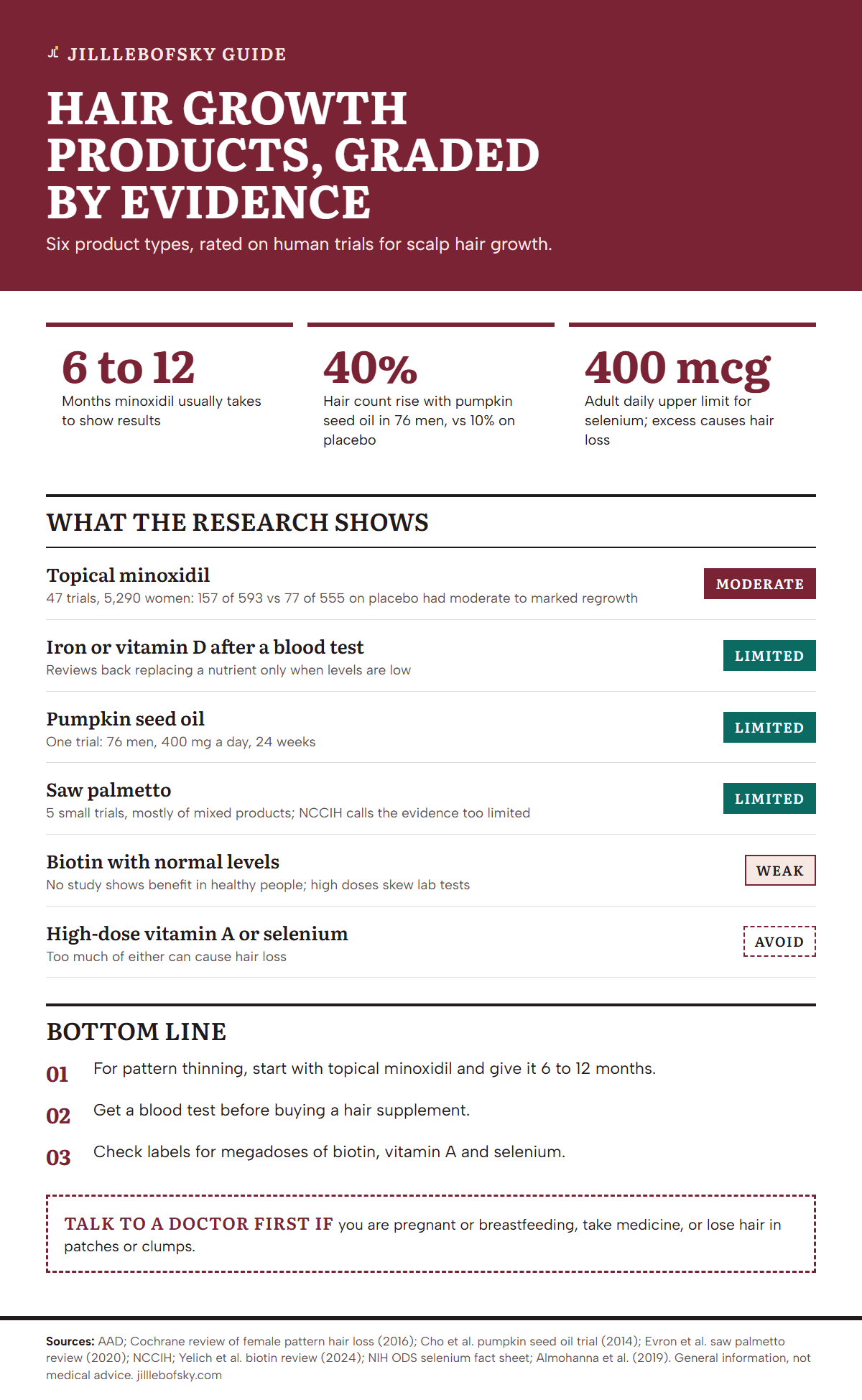
Topical minoxidil is the best-supported hair growth product: in a Cochrane review of 47 trials, women on minoxidil were about twice as likely to see moderate to marked regrowth. Supplements help mainly when a blood test shows low iron or vitamin D. Pumpkin seed oil, saw palmetto and blends rest on small trials, and biotin shows no benefit in healthy people.
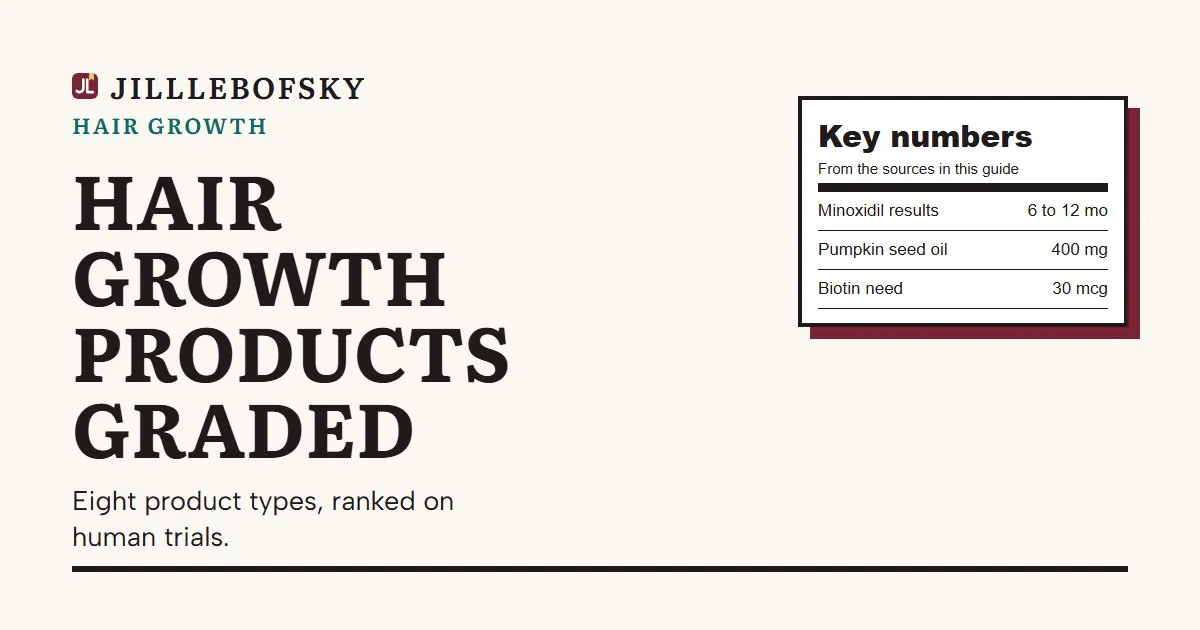
We graded hair growth products by type, not by brand, using human trials. We read the American Academy of Dermatology (AAD) treatment pages, a Cochrane review of 47 trials in women, a 2023 and a 2026 review of hair supplements, NIH fact sheets on biotin, selenium, vitamin A and saw palmetto, and single trials of pumpkin seed oil and rosemary oil.[5][7][8]
The short answer: topical minoxidil is the only product here with pooled trial support. In women it roughly doubled the share with moderate to marked regrowth, 157 of 593 versus 77 of 555 on placebo, while supplements help mainly when a blood test shows a deficiency.[5][1]
| What they are | Over-the-counter drugs such as minoxidil, oral supplements, scalp oils and devices sold to thicken or regrow scalp hair[1][19] |
|---|---|
| Main target | Hereditary pattern hair loss, the most common cause of hair loss worldwide[3] |
| Normal shedding | Up to 100 hairs a day from the scalp[4] |
| Best evidence | Topical minoxidil, 2% or 5%, with results in about 6 to 12 months[1][2] |
| Regulation | Supplements are not approved by FDA before sale; a product that claims to restore hair growth is legally a drug[14][19] |
| Who should be careful | Pregnant or breastfeeding people (minoxidil, saw palmetto) and anyone due for blood tests (biotin)[2][14][10] |
How did we grade these hair growth products?
Each product type got one of four grades based on human trials for scalp hair growth. We did not test or score brands. The grade reflects how much controlled human research backs a type, and a single small trial cannot earn more than Limited, however good its numbers look.[7][8]
- Moderate: several pooled trials, small but consistent effect.
- Limited: some trials, small or low quality.
- Weak: pilot studies only, or reviews found no benefit.
- Avoid: no evidence of benefit plus a safety problem.
Most supplement trials enrolled people with pattern hair loss or chronic shedding and lasted 6 months or less. A 2026 network meta-analysis of 19 trials with 1,658 patients rated its hair density results as moderate certainty and its doctor-rated results as low certainty.[8] Our full method is on the how we review supplements page.
What is the best hair growth product?
For pattern thinning, the best-supported hair growth product you can buy without a prescription is topical minoxidil. A review of 13 controlled trials of non-prescription products found none that beat topical minoxidil or oral finasteride. Supplements come second, and they mostly matter when a blood test finds a gap.[18][1]
| Product type | Study | Size and length | Result |
|---|---|---|---|
| Topical minoxidil (women) | Cochrane review, 2016 | 47 trials, 5,290 women | 157 of 593 vs 77 of 555 on placebo had moderate to marked regrowth[5] |
| Pumpkin seed oil, 400 mg | Cho trial, 2014 | 76 men, 24 weeks | Hair count up 40% vs 10% on placebo[12] |
| Saw palmetto, 100 to 320 mg | Evron review, 2020 | 5 trials, 2 cohort studies | Positive but mostly mixed products; data not robust[13] |
| Rosemary oil vs 2% minoxidil | Panahi trial, 2015 | 100 men, 6 months | Both gained hair; no difference between groups[15] |
| Mixed supplements | Zhou meta-analysis, 2026 | 19 trials, 1,658 patients | Some raised hair density; many small studies[8] |
| Biotin | Yelich review, 2024 | 3 studies | No benefit shown in healthy people[10] |
Finasteride, a prescription pill for men, also has pooled support: 12 trials of 3,927 men found a 24.3% higher hair count than placebo over the long term.[6]
1. Topical minoxidil: pattern thinning in men and women
Topical minoxidil is an over-the-counter drug applied to the scalp, and it has the strongest evidence of any product here. The AAD says it can help early hair loss but cannot regrow a full head of hair, and results usually take about 6 to 12 months.[1]
In the Cochrane review, women using minoxidil were about twice as likely as those on placebo to see moderate to marked regrowth, with 13.18 more hairs per square centimeter. The 2% and 5% strengths did not differ in women.[5]
Expect extra shedding in the first 2 to 8 weeks. If you stop, the regrown hair is lost again, and the AAD advises avoiding minoxidil during pregnancy and breastfeeding.[2][1] Our guide to minoxidil for women, its doses and trial timeline goes deeper. Grade: Moderate.
2. Iron, zinc or vitamin D after a blood test: people with a proven deficiency
Replacing a nutrient you lack is the one solid reason to take a hair supplement. The AAD says too little biotin, iron, protein or zinc can cause noticeable hair loss, and it advises taking biotin, iron or zinc only when a blood test shows a deficiency.[3][1]
Iron deficiency is the most common nutritional deficiency in the world, and most authors in a 2019 review agreed on iron for people with low iron or ferritin and hair loss. The same review said vitamin D should be supplemented if levels are low, but it found too little data to back zinc, folic acid or B12 pills for hair.[9]
Too much iron can cause iron poisoning, so do not take it on a guess.[1] Grade: Limited.
3. Pumpkin seed oil capsules: men with mild pattern thinning
Pumpkin seed oil was studied in one placebo-controlled trial of 76 men with mild to moderate pattern hair loss. Men taking 400 mg a day for 24 weeks had a 40% rise in mean hair count, compared with 10% on placebo, and side effects did not differ between the groups.[12]
One trial is a thin base. The 2026 network meta-analysis counted pumpkin seed oil among supplements that raised hair density, but it noted that some supplements rested on only one or two small studies.[8] No trial we read tested it in women. Grade: Limited.
4. Saw palmetto: men who want to try a plant extract
Saw palmetto is a berry extract sold for prostate symptoms and male pattern baldness, and its hair evidence is small and mixed. NCCIH says a few small studies tested it for male-pattern hair loss and that the evidence is too limited to allow conclusions.[14]
A 2020 systematic review found 5 randomized trials and 2 cohort studies, mostly of products that mixed saw palmetto (100 to 320 mg) with other ingredients. The authors said robust high-quality data are lacking.[13]
It is well tolerated, with mild stomach upset, dizziness or headache, but it may be unsafe in pregnancy or breastfeeding.[14] Grade: Limited.
5. Multi-ingredient hair supplements: adults who accept modest, uncertain gains
Blended hair supplements combine plant extracts, marine protein, vitamins and minerals in one pill, and a few small trials show modest gains. A 2023 JAMA Dermatology review of 30 studies, 17 of them randomized, found potential benefit for several formulas, with rare and mild side effects.[7]
The review's authors asked for larger trials against active treatments, since most compared a blend with placebo.[7] In the 2026 meta-analysis, terminal hair and doctor-rated results reached only low certainty.[8] A Canadian panel of 11 physicians reviewed 45 hair loss options and voted against one marine protein formula.[16]
Check that a blend does not stack high doses of biotin, vitamin A or selenium, which bring their own risks. Grade: Limited.
6. Rosemary oil: people who want a topical option and can wait
Rosemary oil has one randomized trial for pattern hair loss, and it was compared with the weaker 2% minoxidil. In 100 men over 6 months, neither group improved at 3 months, both gained hair by 6 months, and the two groups did not differ.[15]
That trial did not report the size of the scalp area it counted.[18] The Canadian consensus panel put rosemary oil and topical herbal formulas on its not-recommended list.[16] Under FDA rules, any oil or serum that claims to restore hair growth is legally a drug, so most oil labels avoid that claim.[19] Grade: Limited.
7. Biotin and general hair vitamins: almost nobody with normal levels
Biotin is a B vitamin that adults need only 30 mcg of a day, and deficiency is rare. A 2024 review found no studies showing that biotin supplements help hair growth in healthy people, yet many hair vitamins hold 5 to 10 mg.[11][10]
Those doses can distort lab results. Even a single 10 mg dose has interfered with thyroid tests given within 24 hours.[11] A 2019 review found neither biotin nor vitamin E supported for pattern hair loss or shedding.[9]
Read what biotin does and its lab test risk before you buy a biotin-heavy formula. Grade: Weak.
8. High-dose vitamin A or selenium: no one
Too much vitamin A or selenium can itself cause hair loss, so megadose products can make thinning worse. A 2019 review linked excess vitamin A and excess selenium to hair loss, and NIH lists hair loss and brittle nails as the most common signs of selenium overload.[9][17]
The adult upper limit for selenium is 400 mcg a day, against a need of 55 mcg. In 2008, 201 people had severe reactions to a liquid supplement holding 200 times its labeled selenium.[17]
Adults need 900 mcg RAE (men) or 700 mcg RAE (women) of vitamin A, yet 3,000 mcg RAE pills are common, and pregnant women are told not to go above that amount.[20] Grade: Avoid.
Are there proven hair growth supplements?
No hair supplement has the pooled trial support that topical minoxidil has. The best supplement trials are small, short and mostly compared with placebo, and reviewers rate much of the evidence as low certainty. For people without a deficiency, any gain is modest and uncertain.[7][8]
The 2026 meta-analysis pooled 19 trials of 16 different supplements. Some products had only one or two small studies behind them, and most trials tracked safety only while the study ran.[8] No diet-based study met the inclusion rules of the 2023 review.[7]
Supplements are not approved by FDA before they are sold, so a label claim is not proof.[14]
What is good for hair growth if you want results fast?
No product grows hair fast, and the quickest treatments still take months. Finasteride takes about 4 months to show improvement in men, and minoxidil usually takes 6 to 12 months. Shedding after stress, illness or childbirth often settles on its own, with fullness back in 6 to 9 months.[1][3]
| If this fits you | Start with |
|---|---|
| A widening part or thinning crown over years | Topical minoxidil, and ask a dermatologist about prescription options[1][2] |
| Heavy shedding after illness, childbirth or major stress | Time and a check-up; fullness often returns in 6 to 9 months[3] |
| A blood test showing low iron or vitamin D | Replacing that nutrient under a doctor's care[1][9] |
| Patchy bald spots | A dermatologist; steroid injections are a common option[1] |
| Taking biotin and due for blood work | Telling your doctor, since biotin can skew results[10] |
Our plan on how to stop hair loss, from finding the cause to minoxidil walks through each branch.
Who should avoid hair growth products?
Pregnant or breastfeeding people should avoid minoxidil and saw palmetto, and women who may become pregnant should not take prescription hair-loss pills. Anyone due for blood tests should mention biotin, and people on medicines should ask before adding an herb.[2][14][10]
- Minoxidil: extra shedding for 2 to 8 weeks is expected, and scalp itching was more common with minoxidil than rosemary oil in one trial.[2][15]
- Iron: too much can cause iron poisoning.[1]
- Biotin: doses of 5 to 10 mg can interfere with lab tests.[10]
- Herbs: if you take any medicine, talk with your doctor first, because some herbs and medicines interact.[14]
See a doctor if hair falls out in patches or clumps, or if shedding comes with other symptoms, because thyroid problems, medicines and other conditions can cause it. Do not stop a prescribed medicine on your own.[4][3]
What do dermatologists use first for hair growth?
Dermatologists start by finding the cause, because treatment for hair loss depends on it. They may order a blood test or a scalp biopsy, then match minoxidil, prescription pills, injections or procedures to the diagnosis. A supplement is not a replacement for that work-up.[4][1]
For men, finasteride takes about 4 months to show improvement, and hair loss resumes if it stops. For women, spironolactone gave 42% of 166 women mild improvement in one study, but it can cause birth defects.[1]
Pattern hair loss affects 40% to 50% of men and women by age 50 in Canada. The Canadian panel recommended 7 of 45 options, including topical minoxidil, oral finasteride, platelet-rich plasma and microneedling, with laser therapy close behind.[16] In a laser device study of more than 200 people, not everyone saw regrowth.[1] If flaking or itch is the issue, see our guide on how to get rid of dandruff.
What should you check on a hair vitamins label?
Compare each ingredient dose with the amounts used in trials and with NIH upper limits. A hair vitamin that lists 5 to 10 mg of biotin, more than 400 mcg of selenium, or 3,000 mcg RAE of vitamin A deserves a second look before you buy it.[10][17][20]
- Biotin listed in mg rather than mcg, when adults need 30 mcg a day.[11]
- Selenium at or below 400 mcg, counting every product you take.[17]
- Preformed vitamin A under 3,000 mcg RAE, especially if you could become pregnant.[20]
- Iron only if a blood test shows you need it.[1]
- Saw palmetto near the 100 to 320 mg range and pumpkin seed oil near the 400 mg used in studies.[13][12]
- Claims to restore hair growth, which FDA treats as drug claims.[19]
More reviews sit in our hair growth guides, and the best-of supplement guides use the same grades.
So which hair growth product should you try first?
For most adults with gradual thinning, topical minoxidil is the better first step because it has pooled trial support and a known timeline. Give it about 6 to 12 months before judging it, and expect some early shedding in the first weeks.[1][2]
Get a blood test before buying a hair vitamin. If it shows low iron or vitamin D, fixing that makes sense; if it does not, pumpkin seed oil, saw palmetto and blends rest on small trials, and biotin rests on none in healthy people.[9][12][13][10] Skip any product with megadoses of vitamin A or selenium.[17]
Frequently asked questions
Do hair vitamins work?
Only for some people. If a blood test shows low iron or vitamin D, correcting it can help hair. In people with normal levels, reviews found little support for biotin or vitamin E, and blended supplements show only modest gains in small trials.
How long do hair growth supplements take to work?
Trials of pumpkin seed oil and blended supplements ran about 24 weeks, so plan on at least 6 months. Minoxidil, the better-supported option, usually takes 6 to 12 months. Photos taken in the same light each month make progress easier to judge.
Are natural hair growth products safe?
Most plant supplements caused only mild side effects in trials, such as stomach upset. Saw palmetto may be unsafe in pregnancy or breastfeeding, and some herbs interact with medicines, so ask your doctor first if you take any prescription drug.
Is biotin or minoxidil better for hair growth?
Minoxidil. A Cochrane review pooled 47 trials in women and found more regrowth than placebo, while a 2024 review found no study showing that biotin helps hair in healthy people. Biotin helps only with a true deficiency, which is rare.
Can men and women use the same hair growth products?
Partly. Topical minoxidil comes in 2% or 5% strengths for women and is used by men too. Finasteride pills are for men, and women who may become pregnant should avoid prescription hair-loss medicines. Pumpkin seed oil was tested only in men.
Sources
- Hair loss: Diagnosis and treatment. American Academy of Dermatology, current
- Female pattern hair loss. American Academy of Dermatology, current
- Hair loss: Who gets and causes. American Academy of Dermatology, current
- Hair Loss. MedlinePlus, National Library of Medicine, current
- Interventions for female pattern hair loss (van Zuuren et al.). Cochrane Database of Systematic Reviews, 2016
- Efficacy and safety of finasteride therapy for androgenetic alopecia (Mella et al.). Archives of Dermatology, 2010
- Evaluation of the Safety and Effectiveness of Nutritional Supplements for Treating Hair Loss (Drake et al.). JAMA Dermatology, 2023
- Effects of dietary supplements on androgenetic alopecia: a network meta-analysis (Zhou et al.). Frontiers in Nutrition, 2026
- The Role of Vitamins and Minerals in Hair Loss: A Review (Almohanna et al.). Dermatology and Therapy, 2019
- Biotin for Hair Loss: Teasing Out the Evidence (Yelich et al.). Journal of Clinical and Aesthetic Dermatology, 2024
- Biotin: Fact Sheet for Health Professionals. NIH Office of Dietary Supplements, current
- Effect of pumpkin seed oil on hair growth in men with androgenetic alopecia (Cho et al.). Evidence-Based Complementary and Alternative Medicine, 2014
- Natural Hair Supplement: Friend or Foe? Saw Palmetto, a Systematic Review in Alopecia (Evron et al.). Skin Appendage Disorders, 2020
- Saw Palmetto: Usefulness and Safety. NCCIH, current
- Rosemary oil vs minoxidil 2% for the treatment of androgenetic alopecia (Panahi et al.). Skinmed, 2015
- A Canadian Consensus on Androgenetic Alopecia: Approach and Management (Landells et al.). Journal of Cutaneous Medicine and Surgery, 2025
- Selenium: Fact Sheet for Health Professionals. NIH Office of Dietary Supplements, current
- Do Non-Prescription Products Help in Managing Androgenic Alopecia? (Gupta et al.). Skin Appendage Disorders, 2025
- Is It a Cosmetic, a Drug, or Both? (Or Is It Soap?). U.S. Food and Drug Administration (archived copy), current
- Vitamin A and Carotenoids: Fact Sheet for Health Professionals. NIH Office of Dietary Supplements, current
This page is general information, not medical advice. Talk to your doctor or pharmacist before you start any supplement, especially if you are pregnant, take medicine or have a health condition. Read our medical disclaimer and how we review.