To get rid of dandruff, use a medicated shampoo with zinc pyrithione, selenium sulfide, ketoconazole, salicylic acid, sulfur or coal tar. Massage it into the scalp, leave it on for 5 to 10 minutes and use it two or three times a week. Judge it after 4 weeks, then keep a weekly wash. See a dermatologist if a rash, bald patches or thick plaques appear.
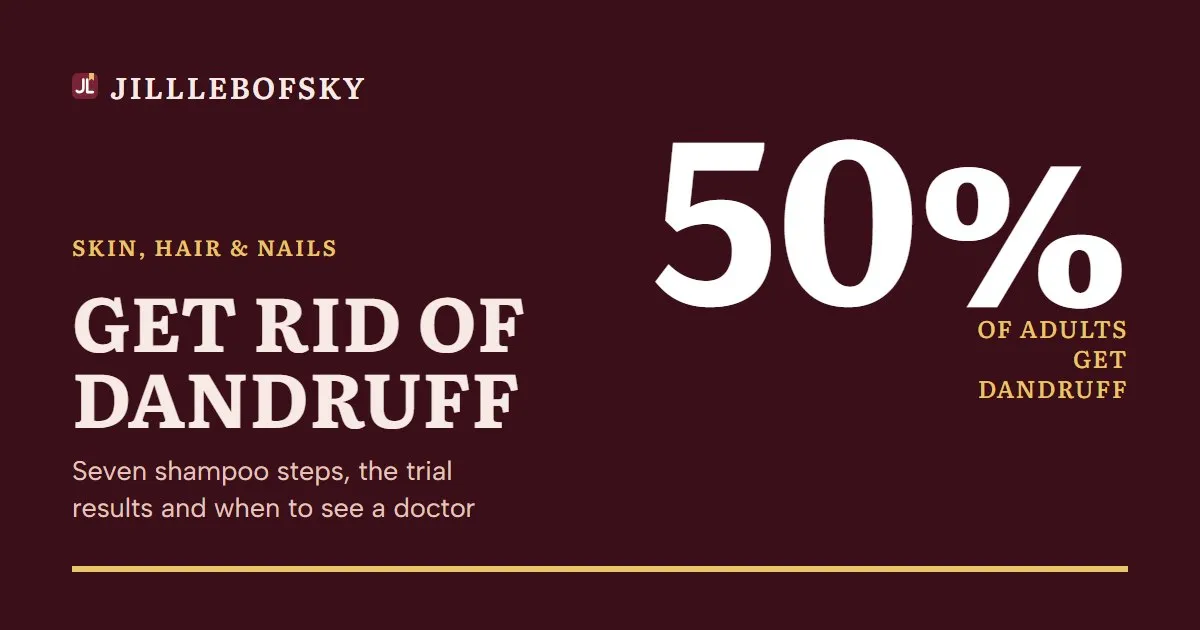
How to get rid of dandruff mostly comes down to picking the right medicated shampoo and using it the right way. Following our editorial policy on medical sources, we read the American Academy of Dermatology (AAD) pages on dandruff and seborrheic dermatitis, MedlinePlus, the NCCIH tea tree oil page, the FDA rule on dandruff ingredients, a Cochrane review and three shampoo trials.
For most people, a drugstore dandruff shampoo left on the scalp for 5 to 10 minutes, two or three times a week, brings the flakes under control in about 4 weeks.[1][2][9]
| What it is | White or yellow flakes of skin shed from the scalp, often with an itch[1][6] |
|---|---|
| How common | About 50% of adults; it usually starts after puberty and is more common in men[13][6] |
| Main cause | A reaction to a yeast that lives on everyone's skin and feeds on scalp oil; it is not caused by unclean skin[4] |
| First step | A shampoo with zinc pyrithione, selenium sulfide, ketoconazole, salicylic acid, sulfur or coal tar[1][8] |
| Best evidence | Ketoconazole 2%: 31% lower risk of failed clearance than placebo at 4 weeks, low-quality evidence from 51 studies[9] |
| Safety | Coal tar can make the scalp sun-sensitive and stain light hair; tea tree oil must never be swallowed[1][3][7] |
| Do not self-treat | Babies with cradle cap, and anyone with bald patches, thick silvery plaques or oozing skin[2][5][6] |
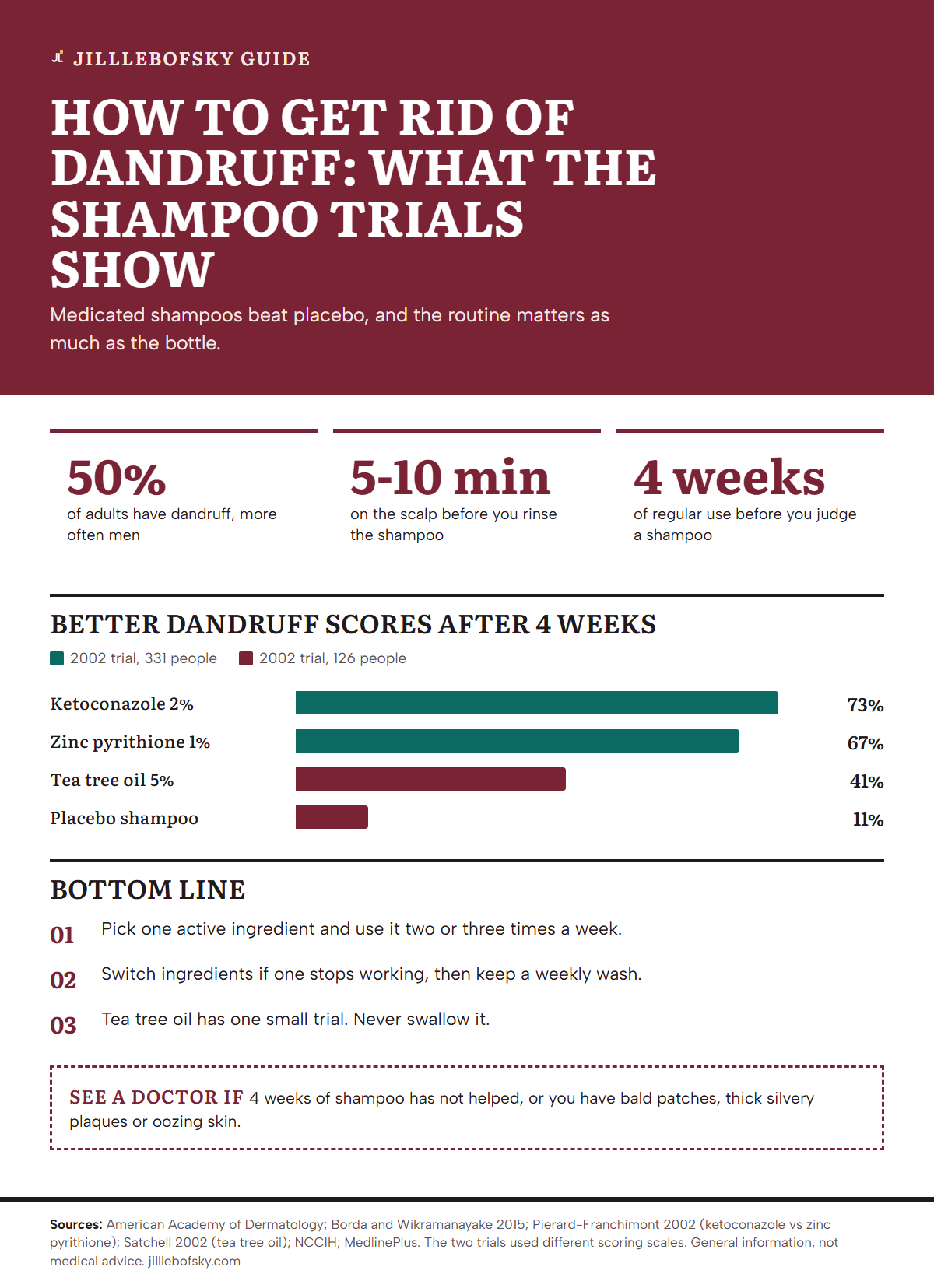
How to get rid of dandruff in 7 steps
The quickest route is a medicated dandruff shampoo, lathered into the scalp and left on for 5 to 10 minutes before you rinse.[1] Use it two or three times a week until the flakes settle, then once a week to keep them away. Most people never need a prescription for this.[1][2]
- Pick one active ingredient. Look under Active ingredient on the Drug Facts panel for zinc pyrithione, selenium sulfide, ketoconazole, salicylic acid, sulfur or coal tar.[1][8]
- Wet your hair and massage the shampoo into the scalp itself, not just the lengths of your hair.[1]
- Leave it on for 5 to 10 minutes, or as long as the label says.[1]
- Rinse well. Product left on the skin can irritate a scalp prone to seborrheic dermatitis.[3]
- Match how often you use it to your hair. Straight or wavy hair: two or three times a week. Curly or coily hair: about once a week.[1][2]
- Give it 4 weeks before you judge it. That is when most trials measured results.[9][11]
- If it stops working, switch to a different active ingredient. Once the flakes clear, drop to one wash a week.[1][2]
With curly or coily hair, apply the medicated shampoo to the scalp only, because the actives can dry the hair shaft. You can follow with your usual shampoo and conditioner.[1]
What causes dandruff?
Dandruff seems to come from a reaction to Malassezia, a yeast that lives on everyone's skin and feeds on scalp oil.[4][13] Where the yeast thrives, the scalp sheds skin cells faster and in visible clumps. The AAD says the condition is not caused by unclean skin and is not an allergy.[4]
Dandruff and seborrheic dermatitis sit on one spectrum. Dandruff stays on the scalp with little or no redness. Seborrheic dermatitis adds a red or discolored rash and can spread to the eyebrows, ears, sides of the nose and chest.[13][5]
Cold, dry weather tends to bring flares, and warm, humid weather often calms them.[4] A 2015 review also links flares to stress and lack of sleep.[13]
Some health conditions raise the risk sharply. More than half of people with Parkinson's disease develop seborrheic dermatitis, and HIV, depression and heavy drinking also raise the odds. Some medicines, including lithium and haloperidol, are linked to flares too.[4] Dandruff usually peaks around age 20 and becomes less common after 50.[13]
Which dandruff shampoo ingredient works best?
Ketoconazole has the strongest trial record, but zinc pyrithione and selenium sulfide also beat placebo in head-to-head studies.[9][11][12] The FDA rule for over-the-counter dandruff products sets a strength for each listed active ingredient. If one shampoo stops working, the AAD suggests trying one with a different active ingredient.[8][1]
| Ingredient | Strength on the label | Watch for |
|---|---|---|
| Zinc pyrithione | 0.3% to 2% in rinse-off shampoo[8] | Well tolerated in a 331-person trial[11] |
| Selenium sulfide | 1%, or 0.6% micronized[8] | All 9 side-effect reports in one trial came from the 2.5% version[12] |
| Ketoconazole | 2% in most trials; the AAD names a 1% shampoo for beards[9][3] | Burning, stinging or irritation[2] |
| Salicylic acid | 1.8% to 3%[8] | Used to reduce scale more than yeast[2] |
| Sulfur | 2% to 5%[8] | Listed by the AAD as a dandruff option[1] |
| Coal tar | 0.5% to 5%[8] | Sun sensitivity; can discolor light, bleached or tinted hair[1][3] |
What the shampoo trials found
Few trials compare dandruff shampoos directly, and most are small or short. We read these four.
| Study | Who and how long | Compared | Result |
|---|---|---|---|
| Danby, 1993[12] | 246 people with moderate to severe dandruff | Ketoconazole 2%, selenium sulfide 2.5%, placebo | Both shampoos beat placebo; ketoconazole was ahead only at day 8 |
| Pierard-Franchimont, 2002[11] | 331 people with severe dandruff, 4 weeks | Ketoconazole 2% vs zinc pyrithione 1% | 73% vs 67% better severity scores; fewer relapses with ketoconazole |
| Satchell, 2002[10] | 126 people aged 14 and up, daily for 4 weeks | 5% tea tree oil shampoo vs placebo | 41% vs 11% better severity scores |
| Cochrane review, 2015[9] | 51 trials, 9,052 people | Topical antifungals vs placebo or steroids | Ketoconazole cut the risk of failed clearance by 31% |
The ketoconazole versus zinc trial was open-label, and the Cochrane team judged 24 of its 51 trials to have a conflict of interest, such as drug-company funding.[11][9] The 2.5% selenium sulfide in the 1993 trial is also stronger than the 1% sold over the counter.[12][8]
How long does it take to get rid of dandruff?
Plan on about 4 weeks of regular use before you judge a dandruff shampoo.[9] That is the point most trials measured. It is also when the AAD tells people on prescription ciclopirox to report back if nothing has changed. Flakes tend to return after you stop, so plan on a weekly maintenance wash.[2]
Some change can show up sooner. In the 1993 trial, both medicated shampoos already beat placebo at the day 8 check, and the gap held at every later visit.[12]
Flakes usually come back. The AAD explains that antifungals cut back the yeast, and when the yeast grows back, the flaking returns.[4] In the 2002 trial, people were followed for 4 more weeks without treatment, and fewer relapsed after ketoconazole than after zinc pyrithione.[11]
If your scalp flares each winter, restart the twice-weekly routine when the weather turns cold and dry.[4]
Do tea tree oil and other home remedies help dandruff?
Tea tree oil has one small trial for dandruff, and that was the only home-remedy evidence we found.[10] In that 2002 study, a 5% tea tree oil shampoo improved severity scores by 41%, against 11% for placebo. NCCIH says the evidence for most tea tree oil uses is too thin to judge.[7][10]
That trial was single-blind, ran 4 weeks with 126 people, and the patients' own scaliness scores did not improve by a significant margin.[10] It also tested a 5% shampoo, which is not the same as neat oil rubbed on the scalp.
Tea tree oil is for the skin only. Swallowed, it can cause confusion, unsteadiness and coma. Some people get red, irritated skin, which is more likely with old oil or oil exposed to heat, light or air.[7]
Because this site checks supplements for a living, we also looked for pills. We found no AAD, MedlinePlus or NIH advice that recommends zinc, biotin, fish oil or any other supplement for dandruff. We left vinegar, coconut oil and baking soda out for the same reason: we read no reliable source on them. Our supplement review method explains how we grade evidence like this.
Is it dandruff or something else?
Plain dandruff means loose white or yellow flakes with little or no redness, and it usually responds to medicated shampoo.[6][13] Thick silvery plaques, bald patches, a spreading rash or oozing point to another problem, such as scalp psoriasis, scalp ringworm or eczema, which needs a different plan.[1][6]
| What you see | Likely cause | What to do |
|---|---|---|
| Loose white or yellow flakes, mild itch, no rash | Dandruff[6][13] | Over-the-counter dandruff shampoo |
| Greasy scale with a red or discolored rash, also on the face, ears or chest | Seborrheic dermatitis[5] | Dandruff shampoo; see a dermatologist if it spreads[2] |
| Thick red patches with silvery scales | Scalp psoriasis[6] | See a doctor; coal tar and salicylic acid are approved for psoriasis[8] |
| Itchy red patches with bald spots, often in a child | Scalp ringworm[6] | See a doctor; it is a fungal infection[6] |
| Scaly, greasy patches on a baby's scalp | Cradle cap[2] | Baby shampoo and gentle scale removal, not dandruff shampoo[2] |
About half of people with psoriasis have it on the scalp.[6] Some people have psoriasis and seborrheic dermatitis together. When the signs overlap, a dermatologist may take a small skin sample to tell them apart.[2]
When should you see a doctor about dandruff?
See a doctor or dermatologist if 4 weeks of medicated shampoo has not helped, or if the flakes come with a rash, hair loss or pain.[1][2][6] Most people with dandruff never need medical care. A dermatologist can rule out psoriasis, ringworm or eczema and prescribe something stronger.[1]
At the visit, a dermatologist asks about your symptoms and medical history and looks closely at your scalp. That is often all it takes to make the diagnosis, so bring a list of the shampoos you have tried and how long you used each one.[2]
Call 911 or see a doctor right away if
- Someone has swallowed tea tree oil. It can cause confusion, trouble walking and coma, so call 911 or Poison Control.[7]
- You have bald patches with itchy, red, scaly skin, especially in a child.[6]
- You see oozing, crusting or cracked skin in or around the ear.[5]
- A rash in skin folds starts to split or looks infected.[5]
- Your scalp becomes irritated on a prescription shampoo such as ciclopirox. Stop it and tell your dermatologist.[2]
Also talk to a doctor if you have HIV, Parkinson's disease or an organ transplant, since each raises the risk of seborrheic dermatitis.[4]
What dermatologists use first
Doctors start where you do, with an over-the-counter dandruff shampoo. A 2015 review in American Family Physician lists antifungal shampoos for long-term use and corticosteroids for short courses as the next step.[14]
Ciclopirox shampoo is a prescription option for people 16 and older, used twice a week for 4 weeks with at least 3 days between washes. In two trials, 58% and 26% of patients had little or no seborrheic dermatitis after 4 weeks.[2]
Prescription ketoconazole foam or gel is approved for seborrheic dermatitis in people 12 and older.[2] In the Cochrane review, ketoconazole cleared rashes about as well as steroids, with 44% fewer side effects.[9]
Dandruff shampoo label checklist
Before you buy, turn the bottle over and read the Drug Facts panel rather than the front label. A true dandruff shampoo names its active ingredient and its percentage, the way any over-the-counter drug does.[8] Use this list in the store and again at home.
- An active ingredient with a strength inside the FDA range, such as zinc pyrithione 0.3% to 2%, selenium sulfide 1% or salicylic acid 1.8% to 3%.[8]
- Directions that say how long to leave it on. Plan on 5 to 10 minutes.[1]
- A fragrance-free formula if your skin flares easily.[3]
- For coal tar: a hat or SPF 30 sunscreen on thin hair, and a different product if your hair is light, bleached or tinted.[1][3]
- A different active ingredient from the last shampoo, if that one stopped working.[1]
- For tea tree products, the percentage. The trial used a 5% shampoo.[10]
- No dandruff shampoo for babies with cradle cap.[2]
For related reading, see our skin, hair and nail guides.
Bottom line
Dandruff is common, affecting about half of adults, and for most people a shampoo is the answer.[13][1] Pick one active ingredient, leave it on for 5 to 10 minutes, use it two or three times a week and judge it at 4 weeks.
For most people, a zinc pyrithione or selenium sulfide shampoo is a sensible first buy, since both beat placebo and are sold over the counter, with ketoconazole as the step up if flakes return fast.[11][12] Skip supplements for dandruff, and see a dermatologist when a rash, bald patches or thick plaques show up.[1]
Frequently asked questions
Is dandruff contagious?
No. The yeast linked to dandruff lives on everyone's skin, and dermatologists say the condition is not caused by poor hygiene or an allergy. Scalp ringworm can look similar and is a fungal infection, so get patchy bald spots checked.
Does washing your hair more often help dandruff?
Often, yes. Dermatologists say regular washing can control mild dandruff, and people with fine, straight or oily hair may need to shampoo daily. Keep the medicated shampoo to about twice a week and use a regular shampoo on other days.
Can you use dandruff shampoo every day?
Most people do not need to. Dermatologists suggest a medicated shampoo two or three times a week for straight or wavy hair and about once a week for curly or coily hair, because the actives can dry the hair.
Can children use dandruff shampoo?
Not babies. Dermatologists do not recommend dandruff shampoo for cradle cap, which usually clears in weeks to months with baby shampoo. The tea tree trial enrolled people 14 and older, and prescription ciclopirox is approved from age 16.
Does stress make dandruff worse?
It may. A 2015 dermatology review links seborrheic dermatitis flares with stress and lack of sleep, and flares are also more common in cold, dry weather. Keep using your shampoo during stressful stretches rather than waiting for flakes to return.
Sources
- How to treat dandruff. American Academy of Dermatology, 2023
- Seborrheic dermatitis: Diagnosis and treatment. American Academy of Dermatology
- Seborrheic dermatitis: Self-care. American Academy of Dermatology
- Seborrheic dermatitis: Causes. American Academy of Dermatology
- Seborrheic dermatitis: Signs and symptoms. American Academy of Dermatology, 2022
- Dandruff, Cradle Cap, and Other Scalp Conditions. MedlinePlus, National Library of Medicine
- Tea Tree Oil: Usefulness and Safety. NCCIH, National Institutes of Health
- 21 CFR 358.710: Active ingredients for the control of dandruff, seborrheic dermatitis, or psoriasis. FDA, Code of Federal Regulations, 1991, amended 1994
- Topical antifungals for seborrhoeic dermatitis. Okokon et al., Cochrane Database of Systematic Reviews, 2015
- Treatment of dandruff with 5% tea tree oil shampoo. Satchell et al., Journal of the American Academy of Dermatology, 2002
- A multicenter randomized trial of ketoconazole 2% and zinc pyrithione 1% shampoos in severe dandruff and seborrheic dermatitis. Pierard-Franchimont et al., Skin Pharmacology and Applied Skin Physiology, 2002
- Ketoconazole 2% shampoo versus selenium sulfide 2.5% shampoo in moderate to severe dandruff. Danby et al., Journal of the American Academy of Dermatology, 1993
- Seborrheic Dermatitis and Dandruff: A Comprehensive Review. Borda and Wikramanayake, Journal of Clinical and Investigative Dermatology, 2015
- Diagnosis and treatment of seborrheic dermatitis. Clark et al., American Family Physician, 2015
This page is general information, not medical advice. Talk to your doctor or pharmacist before you start any supplement, especially if you are pregnant, take medicine or have a health condition. Read our medical disclaimer and how we review.