To stop hair loss, first find the cause: pattern hair loss, stress shedding, alopecia areata, low iron or vitamin D, or thyroid disease. For pattern loss, minoxidil in a 2% or 5% strength helps women and men and takes 6 to 12 months to judge; men can add finasteride. Take biotin, iron or vitamin D only when a blood test shows you are low.
How to stop hair loss depends first on what kind of hair loss you have. We read the American Academy of Dermatology (AAD) pages on hair loss causes, shedding and treatment[1][2][3], the NIH pages on alopecia areata and thyroid disease[5][9], a Cochrane review of 47 trials in women[11] and two reviews of treatment trials in men[10][12]. Our editorial policy explains how we pick sources.
The short answer: treat the cause, and for pattern hair loss start minoxidil early and give it 6 to 12 months, while men can also ask about finasteride[3]. Biotin, iron and zinc pills help only when a blood test shows you are low[3].
| Most common cause | Hereditary (pattern) hair loss, in both men and women[1] |
|---|---|
| Normal shedding | 50 to 100 hairs a day[2] |
| First treatment for pattern loss | Minoxidil 2% or 5% on the scalp for women and men[4][10]; finasteride pill for men[3] |
| Time to judge results | Minoxidil about 6 to 12 months; finasteride about 4 months to notice a change[3] |
| Supplements | Biotin, iron or zinc only when a blood test shows a deficiency[3] |
| Who should avoid | Pregnant or breastfeeding women should avoid minoxidil; prescription hair-loss pills may cause birth defects[4] |
| See a dermatologist for | Round bald patches, or hair loss that came on quickly[3][5] |
How to stop hair loss: 8 steps in order
The way to stop hair loss is to find its cause, fix that cause, and start a proven treatment early, because the AAD says treatment works better the earlier it starts.[1] Without treatment, hereditary hair loss keeps going[1]. Most of these steps take months to judge, so start them in this order.
- Check how much and where. Losing 50 to 100 hairs a day is normal[2]. A widening part or overall thinning in women, or a receding hairline or bald spot on top in men, points to hereditary hair loss[1].
- Look back a few months for a trigger. Giving birth, a high fever, an operation, heavy stress or losing 20 pounds or more can set off heavy shedding[2]. After childbirth, shedding often starts about two months later and peaks at about four months[2].
- Ask for blood tests. Thyroid disease cannot be diagnosed from symptoms alone; it takes a blood test[9]. A dermatologist may also order tests for a vitamin shortfall or hormone imbalance[3].
- Tell the lab about biotin. High-dose biotin can make some lab results wrong without anyone noticing[14].
- Loosen tight hairstyles. Wear braids for no longer than 6 to 8 weeks, and take out a weave that hurts[7].
- Start minoxidil for pattern hair loss. Women and men apply it to the scalp once or twice a day[3].
- Men: ask about finasteride. It is a prescription pill the FDA approved for male pattern hair loss[3].
- Stay with it, then reassess. Minoxidil needs about 6 to 12 months, and if you stop it you lose the benefit[3].
Steps 6 and 7 are for pattern hair loss. Patchy loss, scarring and scalp infections need a diagnosis first, because the AAD warns that without one, treatment is often ineffective[1].
What type of hair loss do you have?
Hair loss has many causes, and the right treatment depends on the cause.[8] Hereditary pattern loss is the most common cause worldwide[1]. The other common types are stress shedding, alopecia areata, low nutrients, thyroid disease and damage from tight hairstyles.
| Type | What you notice | What usually helps |
|---|---|---|
| Pattern hair loss | Widening part or thinning on top in women; receding hairline or crown bald spot in men[1] | Minoxidil, plus finasteride for men; earlier is better[1][3] |
| Telogen effluvium (shedding) | Heavy shedding after childbirth, fever, surgery, stress or losing 20 pounds or more[2] | Often settles alone; fullness returns in 6 to 9 months[2] |
| Alopecia areata | Round patches about the size of a quarter[5] | Steroid injections and newer treatments from a dermatologist[3][6] |
| Low nutrients | Thinning when you get too little protein, iron, zinc or biotin[1][8] | Fixing the shortage a blood test finds[3] |
| Thyroid disease | Dry, thinning hair along with other symptoms[9] | Treating the thyroid disease[1] |
| Traction alopecia | Thinning where tight braids, buns, ponytails or weaves pull[7] | Looser styles early; late damage can be permanent[7] |
Alopecia areata happens when the immune system attacks hair follicles[5]. There is no cure, but treatments can help hair grow back more quickly[5]. Some people see regrowth in 6 weeks with treatment, yet many relapse within a year, and most relapses happen within 5 years[6].
Shedding and true hair loss also differ. Shedding stops once the trigger passes, while constant stress can keep shedding going for a long time[2]. With anagen effluvium, hair does not grow until the cause stops[2]. With thyroid disease, the AAD notes that treating the thyroid can bring the hair back[1].
Does minoxidil for women work?
Yes, minoxidil is the most-recommended treatment for female pattern hair loss, and the FDA approved it for women without a prescription in 2% and 5% strengths.[4] In a Cochrane review, women on minoxidil were about twice as likely as women on placebo to see moderate to marked regrowth[11].
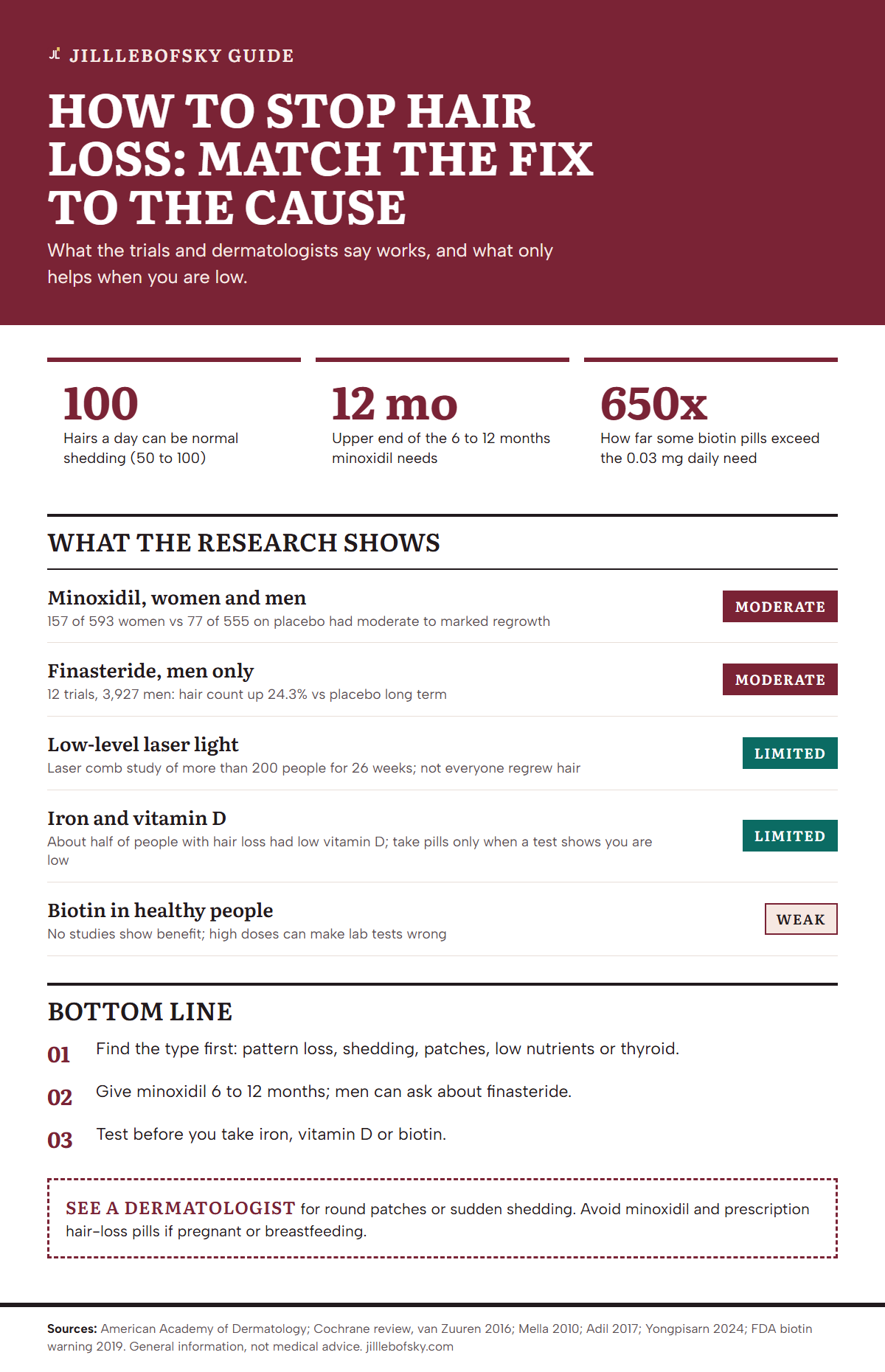
That review pooled 47 trials with 5,290 women[11]. In the minoxidil trials, 157 of 593 women had moderate to marked regrowth, compared with 77 of 555 on placebo[11]. Hair counts rose by 13.18 hairs per square centimeter, though the reviewers rated that result low quality[11]. The 2% and 5% strengths did not differ[11]. A separate 2017 meta-analysis also found 2% minoxidil beat placebo in women[10].
Shedding often gets worse before it gets better: for the first two to eight weeks, hair loss can rise, then it stops as new hair grows[4]. The most common side effect is an itchy, dry or red scalp, and some women grow fine hair on the cheeks or forehead[4]. Applying it only to the scalp and washing your face afterward helps[4].
You need about six to 12 months of daily use before you know whether it works, and stopping it loses the gain[4]. If minoxidil is not enough, a dermatologist may add a pill. In one study of spironolactone in 166 women, 42% saw mild improvement and 31% had thicker hair[3]. Finasteride 1 mg, by contrast, did no better than placebo in women in the Cochrane review[11].
What is the best hair loss treatment for men?
For male pattern hair loss, the treatments with the strongest trial support are minoxidil on the scalp and finasteride 1 mg as a daily pill.[10] A 2017 meta-analysis found that 5% minoxidil, 2% minoxidil, 1 mg finasteride and low-level laser light all beat placebo in men, though results varied widely between trials[10].
Finasteride is FDA approved for male pattern hair loss, and it takes about 4 months to notice a change[3]. A review of 12 trials with 3,927 men found that hair counts rose 24.3% more than with placebo after two years or more[12]. For every 3.4 men treated long term, one more saw his hair as improved[12]. The same review found a higher risk of erectile dysfunction, with about one extra case for every 82.1 men treated[12]. If you stop the pill, the hair loss returns[3].
Does low-level laser light help hair grow?
The AAD describes a study of more than 200 people who used a laser comb 3 times a week for 26 weeks, and not everyone who used it saw regrowth[3]. Pooled trials in men favored laser light over sham devices[10]. In women, laser comb results were inconsistent[11]. Microneedling plus 5% minoxidil also gave more growth than minoxidil alone in men aged 20 to 35 over 12 weeks[3].
| Review or study | Who and how many | Treatment | Result |
|---|---|---|---|
| Cochrane review, 2016 | 47 trials, 5,290 women | Minoxidil vs placebo | 157 of 593 vs 77 of 555 had moderate to marked regrowth[11] |
| Cochrane review, 2016 | Women in finasteride trials | Finasteride 1 mg | No better than placebo: 30 of 67 vs 33 of 70[11] |
| Mella review, 2010 | 12 trials, 3,927 men | Finasteride daily | Hair count up 24.3% vs placebo long term[12] |
| Adil meta-analysis, 2017 | Good or fair quality trials, men and women | Minoxidil, finasteride, laser light | All 5 pooled analyses beat placebo[10] |
| Study cited by AAD | 166 women | Spironolactone | 42% mild improvement; 31% thicker hair[3] |
| Study cited by AAD | 127 people with patchy alopecia areata | Steroid injections | More than 80% regrew at least half their hair within 12 weeks[3] |
Do hair growth products and supplements work?
Most hair growth supplements have no good evidence in people who are not deficient. The AAD says to take biotin, iron or zinc only when a blood test shows a deficiency, and many dermatologists suggest a plain multivitamin instead of single-nutrient hair pills[3]. Drug products such as minoxidil are a different matter, since they have placebo-controlled trials[11].
Biotin: little evidence and a lab-test warning
A 2024 review found no studies showing that biotin helps hair grow in healthy people[13]. In a 1966 trial, 10 mg of biotin did not help women with diffuse hair loss[13].
Biotin also carries a testing risk. The FDA warned that biotin can interfere with certain lab tests and cause wrong results that may go undetected[14]. One concern is a falsely low result for troponin, a marker used to diagnose heart attacks[14]. Many supplements contain 20 mg of biotin and some contain up to 100 mg per pill, up to 650 times the daily need of 0.03 mg[14]. Only 6.6% of biotin users in one survey knew about the warning, and the authors suggest stopping biotin two days before lab work[13]. Ask your doctor before you stop or restart anything.
Iron and vitamin D: only when a test shows you are low
Too little iron can cause noticeable hair loss, and hair can grow back once the shortage is fixed[1]. Too much iron causes iron poisoning, with stomach pain and vomiting, so take it only after a blood test[3]. Too much vitamin A or selenium can also cause hair loss[1].
Low vitamin D is common in people with hair loss. A 2024 meta-analysis found it in about half of people with each type it studied, from 47.38% to 53.51%[15]. The link was clear only for alopecia areata and female pattern hair loss, and no supplement trial has shown vitamin D regrows hair[15]. A blood test of 25-hydroxyvitamin D tells you if you are low, and adults should stay under 4,000 IU a day unless a doctor prescribes more[16].
What to check on a hair product label
- Biotin in mg. Compare it with the daily need of 0.03 mg[14].
- Iron. Take it only if a blood test showed low iron[3].
- Vitamin D. Keep your total under 4,000 IU a day unless prescribed[16].
- Vitamin A and selenium. High amounts can cause hair loss[1].
- Minoxidil strength. Look for 2% or 5% on the Drug Facts label[4].
- Refund terms. Results take 6 to 12 months, so a short refund window closes long before you can judge a product[3]. Our review method explains how we check label doses and refund terms.
Are there natural ways to stop hair loss?
Natural steps help most when the cause is shedding, tight hairstyles or a diet low in protein.[1][8] They do little for hereditary pattern loss, which keeps going without treatment[1]. So the first natural step is still finding out which type you have.
Stress shedding usually fixes itself. After childbirth, an illness or an operation, hair tends to regain its normal fullness within six to nine months[2]. Constant stress, though, can keep shedding going[2].
For traction alopecia, the fix is in how you style your hair. Wear braids for no longer than 6 to 8 weeks, choose sewn-in extensions over bonding glue, and use a silk or satin covering[7]. Once the scalp turns to shiny, bald skin, hair cannot grow back there[7].
Diet can play a part, since MedlinePlus lists a low-protein diet and poor nutrition among the causes of hair loss[8]. If a medicine seems to be thinning your hair, do not stop it before talking with your doctor[1].
When should you see a dermatologist?
See a dermatologist when hair loss is sudden, patchy, painful or still getting worse, because some types cause permanent loss if treated late.[1] Once a hair follicle is destroyed, it cannot regrow a hair, and catching scarring hair loss early can limit further loss[1]. Earlier care also helps pattern loss[1].
At the visit, a dermatologist asks how long you have had hair loss and whether it came on quickly, examines your scalp and nails, and may do a gentle pull test[3]. A blood test or scalp biopsy may follow[3]. Standard care includes minoxidil, finasteride for men, spironolactone for women, steroid injections every 4 to 8 weeks for patchy alopecia areata, and platelet-rich plasma once a month for 3 months, then every 3 to 6 months[3]. Newer treatments now help some people with alopecia areata who were not helped before[6]. A supplement is never a replacement for this care.
Book a visit soon if you notice any of these:
- Round bald patches, or tiny pits in your nails[5]
- A bald spot with black dots, which can signal a scalp infection[1]
- Shiny, bald skin where hair was pulled tight[7]
- Thinning along with other signs of an underactive thyroid[9]
- Thinning with polycystic ovary syndrome (PCOS), a hormone imbalance[1]
- Hair loss that started after a new medicine[1]
Who should avoid these hair loss treatments?
Women who are pregnant, may become pregnant or are breastfeeding should avoid minoxidil, and should not take prescription hair-loss pills, which may cause birth defects.[4] Dermatologists recommend that premenopausal women use birth control while taking one of these prescriptions[4].
Before starting spironolactone, tell your dermatologist about any kidney or adrenal gland problems and every medicine and supplement you take[4]. Men should weigh the small rise in erectile dysfunction with finasteride[12]. Iron pills can cause iron poisoning when you do not need them[3]. Biotin can skew lab tests, including hormone tests[14]. And once you stop a prescription hair-loss pill, the regrown hair falls out again in about three to four months[4].
Bottom line
To stop hair loss, find the type first, then match the treatment to it. Shedding after stress or childbirth often returns to normal in 6 to 9 months, while pattern loss keeps going until you treat it[1][2].
For most people with slow thinning, minoxidil is a better first step than any hair supplement, because it has placebo-controlled trials in women and men, while biotin has none in healthy people[11][13]. Give it 6 to 12 months and see a dermatologist for anything sudden or patchy[3]. You can find more in our hair growth guides.
Frequently asked questions
How do you reverse hair loss?
It depends on the cause. Shedding after stress or childbirth usually regains normal fullness in 6 to 9 months. Pattern hair loss can partly regrow with minoxidil or finasteride, but a follicle destroyed by scarring cannot grow hair again.
What is the best hair growth product?
For pattern hair loss, minoxidil has the best evidence of any product you can buy without a prescription. Both 2% and 5% strengths are approved for women, and men can use them too. Plan on 6 to 12 months of daily use.
How can I reduce hair loss fast?
There is no fast fix. Finasteride takes about 4 months to show a change, and minoxidil takes 6 to 12 months. Minoxidil can even raise shedding for the first 2 to 8 weeks before new hair grows in.
Are natural hair growth products worth buying?
Usually not, unless a blood test shows a shortage. A 2024 review found no studies showing biotin helps hair in healthy people, and high-dose biotin can make lab tests wrong. Iron and vitamin D help only when you are low.
Can hair loss from stress grow back?
Yes, in most cases. Shedding after stress, illness, surgery or childbirth usually stops on its own, and hair tends to regain its normal fullness within six to nine months. Constant stress can keep the shedding going longer.
Sources
- Hair loss: Who gets and causes. American Academy of Dermatology, current
- Do you have hair loss or hair shedding?. American Academy of Dermatology, current
- Hair loss: Diagnosis and treatment. American Academy of Dermatology, 2022
- Female pattern hair loss. American Academy of Dermatology, current
- Alopecia Areata. NIAMS, National Institutes of Health, 2024
- Alopecia areata: Overview. American Academy of Dermatology, current
- Hairstyles that pull can cause hair loss. American Academy of Dermatology, current
- Hair Loss. MedlinePlus, National Library of Medicine, current
- Hypothyroidism (Underactive Thyroid). NIDDK, National Institutes of Health, current
- The effectiveness of treatments for androgenetic alopecia: a systematic review and meta-analysis (Adil and Godwin). Journal of the American Academy of Dermatology, 2017
- Interventions for female pattern hair loss (van Zuuren et al.). Cochrane Database of Systematic Reviews, 2016
- Efficacy and safety of finasteride therapy for androgenetic alopecia: a systematic review (Mella et al.). Archives of Dermatology, 2010
- Biotin for Hair Loss: Teasing Out the Evidence (Yelich et al.). Journal of Clinical and Aesthetic Dermatology, 2024
- UPDATE: The FDA Warns that Biotin May Interfere with Lab Tests (archived copy). US Food and Drug Administration, 2019
- Vitamin D deficiency in non-scarring and scarring alopecias: a systematic review and meta-analysis (Yongpisarn et al.). Frontiers in Nutrition, 2024
- Vitamin D: Fact Sheet for Consumers. NIH Office of Dietary Supplements, current
This page is general information, not medical advice. Talk to your doctor or pharmacist before you start any supplement, especially if you are pregnant, take medicine or have a health condition. Read our medical disclaimer and how we review.