Biotin is a water-soluble B vitamin that helps enzymes break down fats, sugars and amino acids. Adults need about 30 mcg a day, and most diets supply 35 to 70 mcg, so deficiency is rare. Hair growth claims lack trials in healthy people. High-dose pills of 5 to 20 mg can cause false thyroid and heart test results, so tell your doctor before blood work.
What is biotin, and is it worth taking as a supplement? We read the NIH Office of Dietary Supplements fact sheet, the FDA's 2019 lab test warning, a 2024 review of biotin for hair, a 2022 meta-analysis on blood sugar and a 642-person trial in multiple sclerosis to answer that.[1][2][4][7][8] We used our usual supplement review method, which compares label doses with the doses tested in people.
Biotin is a B vitamin that helps enzymes turn food into energy, adults need about 30 mcg a day, and most diets already supply 35 to 70 mcg, so high-dose pills add little for most people and can throw off lab tests.[1][2]
| What it is | A water-soluble B vitamin and an essential nutrient found in many foods.[1] |
|---|---|
| What it does | Helps five carboxylase enzymes process fatty acids, glucose and amino acids.[1] |
| How much adults need | 30 mcg a day, or 35 mcg while breastfeeding. The Daily Value on labels is also 30 mcg.[1] |
| Best evidence | Correcting a true deficiency, including the inherited disorder biotinidase deficiency. Hair, nail, blood sugar and MS uses are weak or unproven.[1][4][7][8][10] |
| Safety | No known toxic dose, but 10 mg or more can cause false thyroid, hormone and troponin (heart) test results.[1][2][3] |
| Who should be careful | Anyone due for blood tests, people on certain seizure medicines, and pregnant or breastfeeding people.[1][2] |
What is biotin?
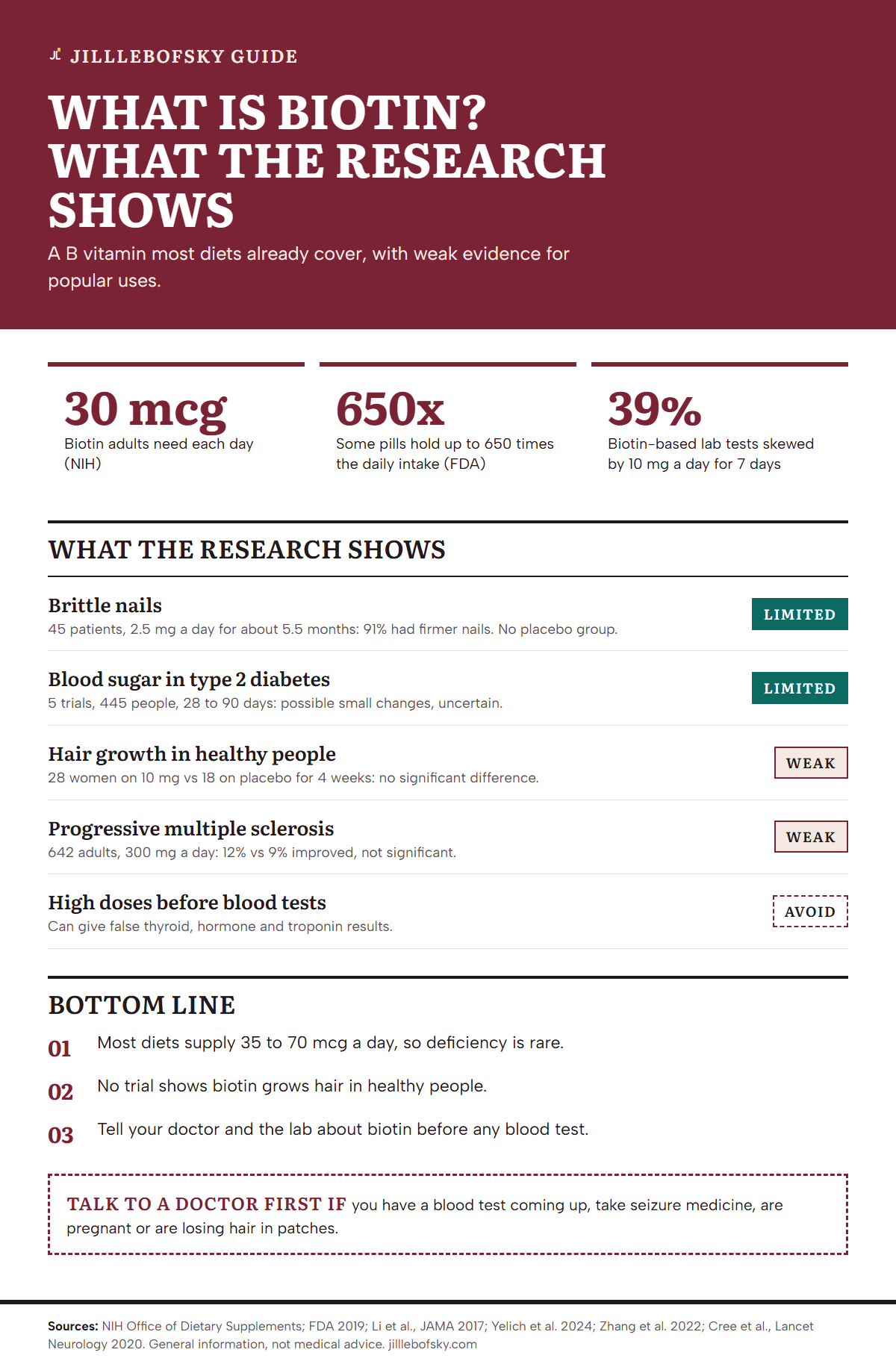
Biotin is a water-soluble B vitamin and an essential nutrient, which means your diet has to supply it. It occurs naturally in eggs, liver, fish, meat, seeds, nuts and some vegetables. It is also sold on its own, in B-complex pills and in many multivitamins and hair, skin and nail blends.[1]
Most biotin in food is bound to protein. Enzymes in the gut, including one called biotinidase, break that bond and free the vitamin so it can be absorbed.[1] Free biotin from a pill is absorbed very well. The NIH fact sheet puts the absorption rate at 100%, even at doses up to 20 mg a day.[1]
Experts did not have enough data to set a full Recommended Dietary Allowance for biotin. So the Food and Nutrition Board set an Adequate Intake instead, based on how much biotin babies get from breast milk.[1]
No national survey tracks biotin intake in the United States. In other western countries, people get about 35 to 70 mcg a day from food, which is more than the 30 mcg adults need.[1]
What does biotin do in the body?
Biotin acts as a helper, or cofactor, for five carboxylase enzymes. These enzymes run key steps in breaking down fatty acids, glucose and amino acids. In plain terms, biotin is one of the tools your cells use to turn food into energy and building blocks.[1]
Taking more than you need has not been shown to speed up metabolism. We found no human trial showing more energy or weight loss from biotin in people who already get enough. We saw a similar gap between marketing and trial results in our NAD supplement guide.
The enzyme biotinidase also matters for recycling. It frees biotin from proteins so the body can reuse it. People born with biotinidase deficiency cannot do this, so they run low on biotin even with a normal diet.[1][10]
That inherited disorder affects about 1 in 60,000 newborns. Without treatment, the severe form can cause seizures, weak muscle tone, hearing and vision loss, skin rashes and hair loss. Lifelong biotin treatment can prevent these problems, which is why all US newborns are screened for it.[1][10]
What is biotin good for, according to research?
The use with solid backing is correcting a biotin deficiency, including biotinidase deficiency. For the popular uses, such as hair, nails, blood sugar and multiple sclerosis, the human evidence runs from small studies without a placebo group to a large trial that found no clear benefit.[1][8][10]
| Use studied | Who was studied | Dose and length | Result |
|---|---|---|---|
| Hair growth | 28 women on biotin vs 18 on placebo (1966) | 10 mg a day for 4 weeks | No significant difference in hair growth[4] |
| Brittle nails | 45 patients, no placebo group | 2.5 mg a day for about 5.5 months | 41 (91%) had firmer, harder nails[1] |
| Brittle nails | 35 patients, records reviewed afterward | 2.5 mg a day for 6 to 15 months | 22 (63%) improved[1] |
| Type 2 diabetes | 5 randomized trials, 445 people in total | Various doses for 28 to 90 days | Possible small drops in fasting glucose and blood fats; no change in insulin[7] |
| Progressive MS | 642 adults in the SPI2 trial | 300 mg a day for at least 12 months | 12% improved vs 9% on placebo, not a significant difference[8] |
The diabetes review pooled only five small trials, and its fasting glucose result had a margin of error that included no effect.[7] Our blood sugar support guide covers the supplements with stronger glucose data.
The MS trial was funded by the maker of the high-dose product, yet its authors concluded it could not be recommended.[8]
What are the benefits of biotin for hair, skin and nails?
No trial has shown that biotin helps hair grow in healthy people. A 2024 review in the Journal of Clinical and Aesthetic Dermatology found only three studies that met its standards. The single placebo-controlled one, from 1966, found no difference after 4 weeks of 10 mg a day.[4]
A 2017 review gathered 18 reported cases in which biotin seemed to help hair or nails. In every case, the person had an underlying condition, such as a genetic disorder or a true deficiency.[5] The NIH fact sheet adds that the hair case reports were all in children with uncombable hair syndrome, a rare hair shaft disorder. They improved after 3 to 4 months on 3 to 5 mg a day.[1]
One clinic study found low biotin in 38% of women who came in with hair loss. It had no control group, and its author still advised against giving biotin unless a test shows a deficiency.[6] The American Academy of Dermatology gives the same advice.[11] Our hair growth guides cover the causes that are far more common.
Nails and skin
Brittle nails have the most data, but all three nail studies lacked a placebo group and did not check biotin levels at the start.[1] For skin, the evidence is limited to case reports in infants with rashes, who improved on 100 mcg to 10 mg a day.[1] None of those reports tested biotin on normal, healthy skin.
The 45-patient study is the source of the 91% figure often quoted on nail product pages. Without a comparison group, we cannot tell how much of that change would have happened anyway as nails grew out.[1]
Who might need a biotin supplement?
Most people do not need a biotin supplement, because a normal mixed diet supplies more than the 30 mcg adults need. The NIH fact sheet says severe deficiency has never been reported in healthy people eating a normal diet. A few groups do have a higher risk of low biotin.[1]
| Group | Biotin per day |
|---|---|
| Children 1 to 3 years | 8 mcg[1] |
| Children 4 to 8 years | 12 mcg[1] |
| Children 9 to 13 years | 20 mcg[1] |
| Teens 14 to 18 years | 25 mcg[1] |
| Adults 19 and older, and pregnancy | 30 mcg[1] |
| Breastfeeding | 35 mcg[1] |
Groups at higher risk of low biotin
- People with biotinidase deficiency, who need lifelong biotin from their doctor.[10]
- People with long-term heavy drinking. Alcohol blocks biotin absorption, and blood levels are low in 15% of people with chronic alcoholism.[1]
- Pregnant women. At least a third develop marginal deficiency despite normal intake, though what that means for health is unclear.[1]
- People on certain seizure medicines. In a study of 264 people with epilepsy, a year or more of carbamazepine, primidone, phenytoin or phenobarbital was linked to lower biotin levels.[1]
Signs of deficiency come on slowly. They include thinning hair, a scaly red rash around the eyes, nose and mouth, pink eye, brittle nails, depression, tiredness and tingling in the hands and feet.[1]
Foods with the most biotin
| Food | Serving | Biotin |
|---|---|---|
| Beef liver, cooked | 3 ounces | 30.8 mcg[1] |
| Egg, whole, cooked | 1 egg | 10.0 mcg[1] |
| Pink salmon, canned | 3 ounces | 5.0 mcg[1] |
| Pork chop, cooked | 3 ounces | 3.8 mcg[1] |
| Sunflower seeds, roasted | 1/4 cup | 2.6 mcg[1] |
| Sweet potato, cooked | 1/2 cup | 2.4 mcg[1] |
| Almonds, roasted | 1/4 cup | 1.5 mcg[1] |
A sample day shows how quickly food adds up. One cooked egg at breakfast, 3 ounces of canned salmon at lunch and a 1/4 cup of sunflower seeds as a snack add up to about 17.6 mcg. Add a 1/2 cup of sweet potato and a second egg and you pass 30 mcg.[1]
Raw egg whites contain avidin, a protein that binds biotin and blocks its absorption. Cooking breaks down avidin, so cooked eggs are fine.[1]
Is biotin good for you, or can it cause problems?
Biotin has no known toxic dose, but high doses can make lab tests wrong. Several studies saw no side effects at 10 to 50 mg a day. The bigger risk is that biotin can skew blood tests for thyroid hormones, other hormones and troponin, the test used to spot a heart attack.[1][2]
In 2019 the FDA warned that biotin can cause incorrect results that may go undetected. It noted that many supplements contain 20 mg of biotin and some up to 100 mg per pill, up to 650 times the recommended daily intake.[2] The NIH reports that one person taking high-dose biotin died after a troponin test gave a falsely low result.[1]
In a 2017 JAMA study, 6 healthy adults took 10 mg a day for 7 days. Biotin affected 9 of 23 (39%) biotin-based lab tests and none of the 14 other tests.[3] Even a single 10 mg dose has interfered with thyroid tests taken within 24 hours.[1]
Doses of 5 to 20 mg a day can give falsely high thyroid hormone and falsely low TSH results, a pattern that can look like an overactive thyroid.[9] Case reports describe people wrongly diagnosed with Graves' disease while taking 10 to 300 mg a day.[1]
Who should talk to a doctor first
Biotin itself is not known to cause side effects at studied doses, so the cautions below are mostly about lab test results and medicines.[1]
- Anyone with a blood test coming up, including thyroid, hormone, vitamin D or heart tests.[1][3]
- People taking carbamazepine, primidone, phenytoin or phenobarbital.[1]
- Pregnant or breastfeeding people, since prenatal vitamins already contain biotin.[2]
- Parents thinking of giving biotin to a child, since children need only 8 to 20 mcg a day.[1]
Call 911 or see a doctor right away if
- You have chest pain or pressure, trouble breathing or fainting. Call 911 and tell the care team you take biotin, because it can cause a falsely low troponin result.[2]
- Your lab results do not match how you feel, especially thyroid results.[1]
- Your hair falls out in patches or clumps, or you shed far more than the normal 100 hairs a day.[12]
- A baby or child has seizures, weak muscle tone, a rash or hair loss.[10]
- You notice a scaly rash around your eyes, nose and mouth along with thinning hair or tingling.[1]
What do doctors check before suggesting biotin?
Doctors look for the cause first, because hair loss and brittle nails have many causes and low biotin is a rare one. For hair loss, the American Academy of Dermatology says a dermatologist may order blood tests or a scalp biopsy. It advises taking biotin only when a blood test shows a deficiency.[11]
Hereditary hair loss is the most common cause of hair loss worldwide.[13] MedlinePlus lists other causes, including thyroid problems, diabetes, lupus, some medicines, stress and a low-protein diet. It notes that treatment depends on the cause.[12] Low levels of iron, protein or zinc can also cause noticeable shedding.[13]
When hereditary hair loss is the cause, standard care includes minoxidil. The AAD says results usually take about 6 to 12 months to show.[11] For diabetes or MS, care stays with the medicines a doctor prescribes. Biotin is never a stand-in for them, which our editorial policy spells out for every guide.[7][8]
What should you check on a biotin supplement label?
Check the amount per serving first, because many biotin pills hold 5 to 20 mg, far above the 30 mcg adults need. Then look for biotin hidden in multivitamins, B-complex pills, prenatal vitamins and hair, skin and nail blends, since doses add up across products.[1][2][4]
- Convert the units. 1 mg equals 1,000 mcg, so a 10 mg pill is 10,000 mcg, about 333 times the 30 mcg Daily Value.[1]
- Add up biotin from every product you take, including gummies and prenatal vitamins.[2]
- If you only want to cover the daily need, note that typical multivitamin amounts of 30 to 60 mcg are not thought to affect lab tests.[4]
- Before any blood test, tell the doctor and the lab. A 2024 review advised stopping about 2 days ahead, and up to a week after high doses.[4]
- Read hair growth claims with care. No trial supports them in healthy people.[4]
- Do not stop a prescribed seizure, thyroid or diabetes medicine to try biotin instead.[1][7]
Many users have never heard of the lab risk. In one survey cited by the 2024 review, only 6.6% of biotin users knew about the FDA warning, and 54.6% took it without a doctor's advice.[4]
Is biotin worth taking?
For most people, no extra biotin is needed, because food already covers the small daily need. Biotin is a real and essential B vitamin. It earns its place in people with a diagnosed deficiency or biotinidase deficiency, where doctors guide the dose.[1][10]
For hair, nails or energy, the evidence is thin, and high doses carry a real risk of wrong lab results. If you worry about hair loss, we think a doctor's visit and a blood test are a better first step than a 10,000 mcg pill, because they can find the cause that biotin will not fix.[3][11]
Frequently asked questions
How long does biotin take to work?
No trial gives a timeline for hair in healthy people. In one nail study, people took 2.5 mg a day for about 5.5 months on average. Children with a rare hair shaft disorder improved after 3 to 4 months.
Can you get enough biotin from food?
Yes, for most people. Diets in western countries supply about 35 to 70 mcg a day, above the 30 mcg adults need. One cooked egg has 10 mcg, and 3 ounces of cooked beef liver has 30.8 mcg.
Should I stop taking biotin before a blood test?
Tell your doctor and the lab first. A 2024 review advised stopping about two days before testing, or up to a week after high doses. The FDA says it is not known whether stopping always prevents wrong results.
Is 10,000 mcg of biotin too much?
No toxic dose is known, and studies saw no side effects at 10 to 50 mg a day. But 10,000 mcg is about 333 times the adult need, and a single 10 mg dose can skew thyroid tests for 24 hours.
Do raw eggs block biotin absorption?
Raw egg whites contain avidin, a protein that binds biotin and stops your gut from absorbing it. Cooking breaks down avidin, so cooked eggs are a good source, with about 10 mcg of biotin in one whole egg.
Sources
- Biotin: Fact Sheet for Health Professionals. NIH Office of Dietary Supplements, 2022
- UPDATE: The FDA Warns that Biotin May Interfere with Lab Tests: FDA Safety Communication. U.S. Food and Drug Administration, 2019 (archived copy)
- Association of Biotin Ingestion With Performance of Hormone and Nonhormone Assays in Healthy Adults. Li et al., JAMA, 2017
- Biotin for Hair Loss: Teasing Out the Evidence. Yelich et al., Journal of Clinical and Aesthetic Dermatology, 2024
- A Review of the Use of Biotin for Hair Loss. Patel et al., Skin Appendage Disorders, 2017
- Serum Biotin Levels in Women Complaining of Hair Loss. Trueb, International Journal of Trichology, 2016 (single clinic, no control group)
- Influence of biotin intervention on glycemic control and lipid profile in patients with type 2 diabetes mellitus: a systematic review and meta-analysis. Zhang et al., Frontiers in Nutrition, 2022
- Safety and efficacy of MD1003 (high-dose biotin) in patients with progressive multiple sclerosis (SPI2): a randomised, double-blind, placebo-controlled, phase 3 trial. Cree et al., Lancet Neurology, 2020 (product maker funded)
- The implications of biotin supplementation on multiple sclerosis, hair loss conditions, and thyroid disorders. Bhimireddy et al., Multiple Sclerosis and Related Disorders, 2026
- Biotinidase deficiency. MedlinePlus Genetics, National Library of Medicine
- Hair loss: Diagnosis and treatment. American Academy of Dermatology
- Hair Loss. MedlinePlus, National Library of Medicine
- Hair loss: Who gets and causes. American Academy of Dermatology
This page is general information, not medical advice. Talk to your doctor or pharmacist before you start any supplement, especially if you are pregnant, take medicine or have a health condition. Read our medical disclaimer and how we review.