An NAD supplement, usually nicotinamide riboside (NR) or nicotinamide mononucleotide (NMN), reliably raises NAD in the blood. One trial saw rises of 22% to 142% in 8 weeks. Trials of energy, blood sugar, muscle and aging found small or no effects. NMN is legal as a supplement under the FDA's 2025 position, and IV NAD+ drips lack outcome trials.
We read the NIH fact sheet on niacin, the FDA's 2025 letter on NMN, two 2026 research reviews and seven human trials of NR, NMN and IV NAD+ to answer one question: does an NAD supplement change anything you can measure or feel?[1][2][10] We followed our usual review method for supplement guides, which compares label doses with trial doses.
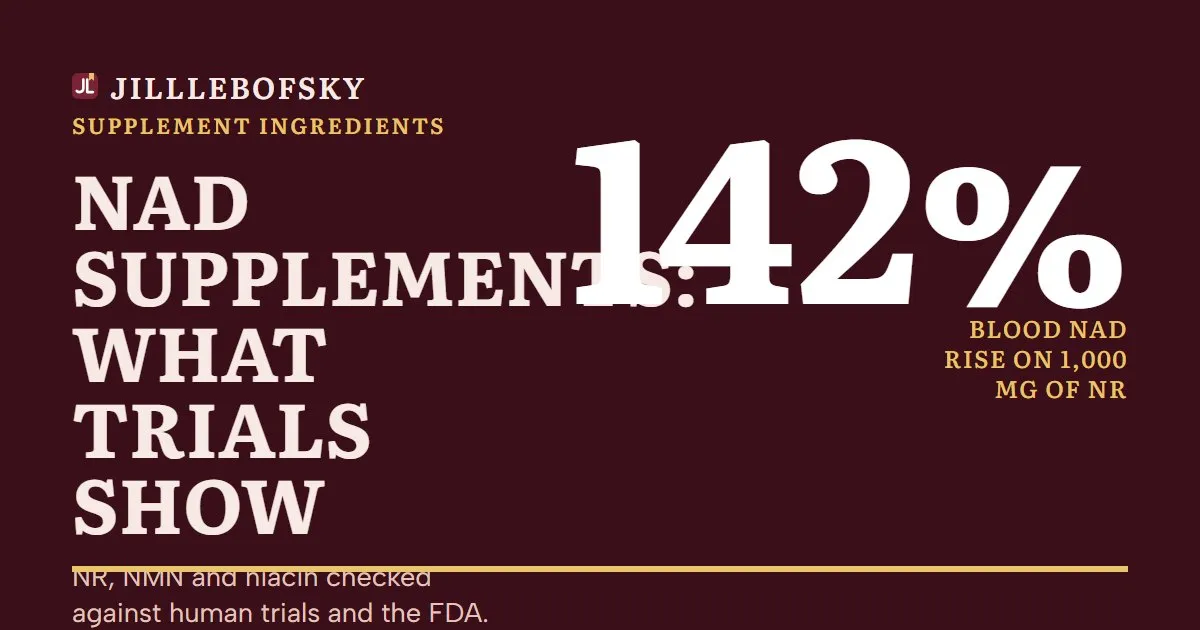
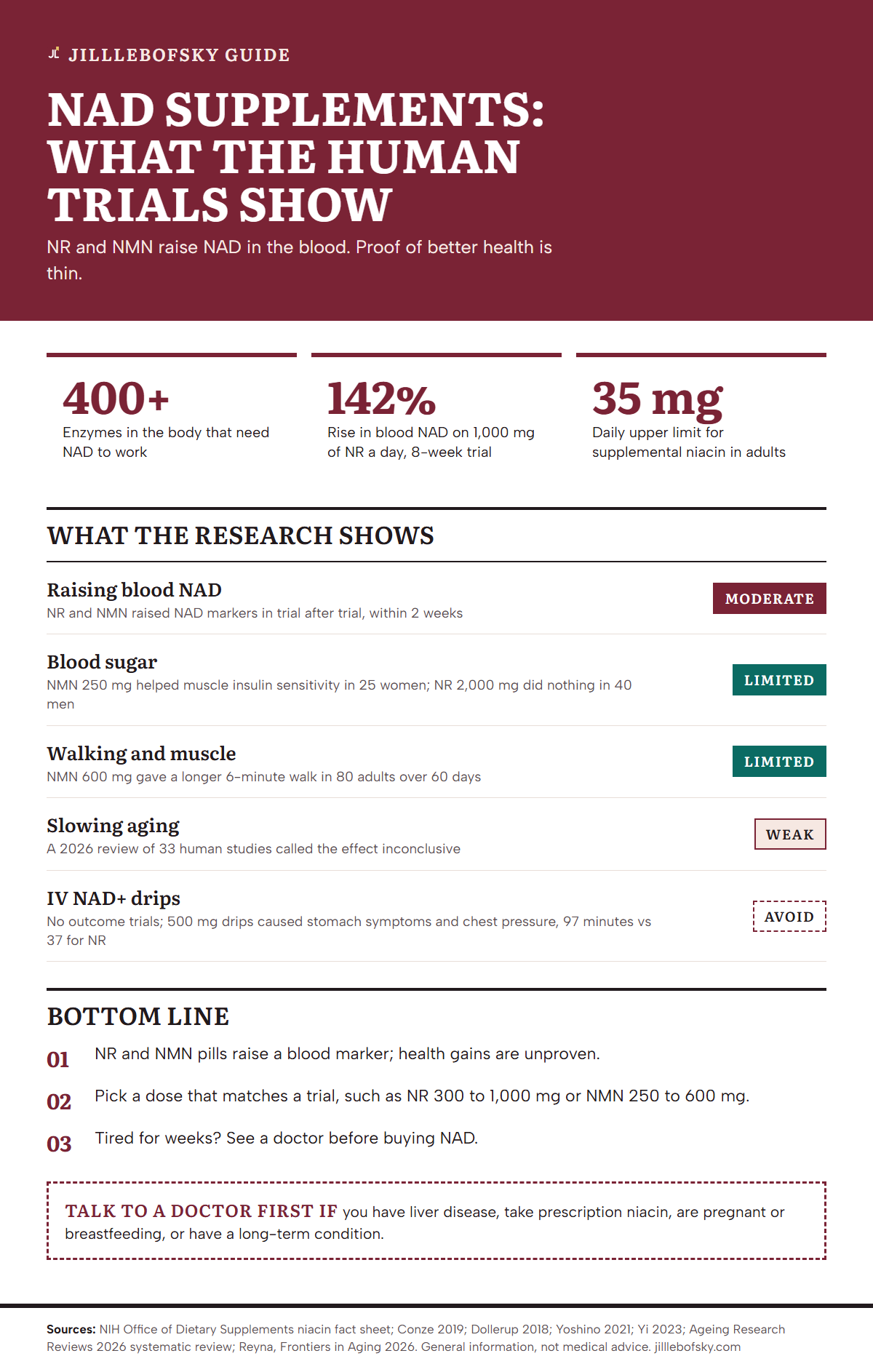
The short answer is that NR and NMN pills reliably raise NAD in the blood, by 22% to 142% in one 8-week trial, but trials on energy, blood sugar, muscle and aging found small or no effects.[5][10]
| What it is | NAD (nicotinamide adenine dinucleotide) is a coenzyme the body makes from vitamin B3. More than 400 enzymes need it.[1] |
|---|---|
| Main forms sold | Nicotinamide riboside (NR), nicotinamide mononucleotide (NMN), niacin (nicotinic acid) and nicotinamide.[1][10] |
| Amounts studied | NR at 100 to 2,000 mg a day; NMN at 250 to 2,000 mg a day.[5][6][11] |
| Best evidence | Raises NAD in blood within 2 weeks. Effects on health outcomes are mixed and often null.[5][10] |
| Safety | NR and NMN were well tolerated in trials of up to 24 weeks. Nicotinic acid causes flushing from 30 to 50 mg.[1][11] |
| Ask a doctor first | Liver disease, prescription niacin, pregnancy or breastfeeding (not studied in the trials we read).[1] |
What is NAD and what does it do?
NAD, short for nicotinamide adenine dinucleotide, is a coenzyme that every tissue makes from vitamin B3, and more than 400 enzymes depend on it.[1] Its main job is helping cells turn the energy in carbohydrates, fats and protein into ATP, the fuel that cells run on.[1]
NAD also works with enzymes that keep DNA intact, control which genes switch on and let cells signal each other.[1] The body turns some of it into a related form, NADP, which helps build cholesterol and fatty acids and supports antioxidant defenses.[1]
You get the raw material from food. Poultry, beef and fish supply about 5 to 10 mg of niacin per serving, much of it as NAD and NADP, and the body can also build NAD from tryptophan, an amino acid in protein.[1] Adults need 16 mg (men) or 14 mg (women) of niacin equivalents a day.[1]
NAD levels fall with age, mostly shown in animal studies, and that decline is the whole sales pitch behind "NAD boosters."[10]
What is an NAD supplement?
An NAD supplement is a pill or powder meant to raise NAD inside your cells, usually by supplying a precursor that the body converts into NAD. The two big sellers are nicotinamide riboside (NR) and nicotinamide mononucleotide (NMN).[1][10] The NIH notes that both are sold as supplements but are not labeled as sources of niacin.[1]
Plain vitamin B3 feeds the same pathway. It comes as nicotinic acid, which can make your skin flush, and nicotinamide, which does not.[1] Some brands sell NAD+ itself in capsules. When you eat NAD in food, your gut breaks it down to nicotinamide before absorbing it, so swallowed NAD+ mostly arrives as an ordinary form of vitamin B3.[1]
Wellness clinics also sell NAD+ by IV drip or injection. That route skips the gut, and it has its own problems, covered further down.[10][12] You will find NAD supplements filed under energy and longevity supplements on most store shelves.
What are the benefits of NAD supplements in human trials?
The one benefit human trials show again and again is a higher NAD level in the blood; better energy, health or slower aging has not been shown. A 2026 review of 33 human studies (28 of them randomized) found that oral NR and NMN consistently raised NAD markers, while effects on function, metabolism and blood vessels were mixed and "often null."[10]
| Study | Who and how long | Daily dose | Result |
|---|---|---|---|
| Martens, 2018[4] | 24 healthy middle-aged and older adults, 6 weeks | NR 1,000 mg | NAD in blood cells up about 60%; well tolerated |
| Conze, 2019[5] | Overweight adults, 8 weeks | NR 100, 300 or 1,000 mg | Blood NAD up 22%, 51% and 142%; no flushing |
| Dollerup, 2018[6] | 40 men with obesity, 12 weeks | NR 2,000 mg | No change in insulin sensitivity, energy use or body fat |
| Yoshino, 2021[7] | 25 women with prediabetes, 10 weeks | NMN 250 mg | Muscle insulin sensitivity improved |
| Yi, 2023[8] | 80 healthy middle-aged adults, 60 days | NMN 300, 600 or 900 mg | Longer 6-minute walk; no change in insulin resistance score |
| NADPARK, 2022[9] | 30 people with new Parkinson's disease, 30 days | NR 1,000 mg | Brain NAD rose by varying amounts; early safety trial |
| NMN meta-analysis, 2026[11] | 15 trials, 14 days to 24 weeks | NMN 250 to 2,000 mg | No effect on weight, glucose, HbA1c or cholesterol; small dip in diastolic blood pressure |
Blood sugar results conflict. One 10-week trial in 25 women found better muscle insulin sensitivity on 250 mg of NMN, but 2,000 mg of NR did nothing for insulin sensitivity in 40 men, and the 2026 meta-analysis found no effect on fasting glucose or HbA1c.[6][7][11] Our blood sugar support supplement guide covers options with more data.
For the brain, the NADPARK trial found that 1,000 mg of NR raised brain NAD in people with early Parkinson's disease. It was a 30-person safety study, and only those whose brain NAD rose showed mild clinical changes.[9] If memory is your concern, see our memory loss supplements graded by evidence before you spend money here.
Which NAD supplement is best: NR, NMN or niacin?
We found no trial that compared NR and NMN head to head, so the best NAD supplement is the form that has human data at the dose printed on your label. NR has the older safety record at up to 2,000 mg a day, NMN has newer trials from 250 to 2,000 mg, and plain niacin causes flushing at 30 to 50 mg.[1][6][11]
| Form | Doses in human studies | What it did | Watch for |
|---|---|---|---|
| Nicotinamide riboside (NR) | 100 to 2,000 mg a day, up to 12 weeks[5][6] | Raised blood NAD up to 142%; no insulin benefit in men with obesity[5][6] | No flushing reported at 1,000 mg[5] |
| Nicotinamide mononucleotide (NMN) | 250 to 2,000 mg a day, up to 24 weeks[11] | Raised blood NAD; mostly no metabolic change[8][11] | FDA status changed in 2025[2] |
| Nicotinic acid (niacin) | Drug doses of 1,000 to 3,000 mg a day[1] | A vitamin B3 source that feeds NAD[1] | Flushing from 30 to 50 mg; liver harm at high doses[1] |
| Nicotinamide | No NAD trial in our table[1] | A vitamin B3 source with no flushing[1] | Nausea and liver signs at 3,000 mg a day[1] |
Which form fits your situation?
| If you | Then |
|---|---|
| Feel tired most days | See your doctor first; fatigue can come from anemia, thyroid disease, sleep apnea or depression, and no trial we read showed NAD relieves fatigue.[10][13] |
| Have prediabetes | Stick with your care plan. One 25-person NMN trial is not enough to lean on.[7][11] |
| Are healthy and curious | Pick a dose that matches a trial, such as NR at 300 to 1,000 mg or NMN at 250 to 600 mg.[5][8] |
| Take prescription niacin or have liver disease | Ask your doctor before adding any B3 product.[1] |
| Are thinking about an IV drip | Try nothing or try pills first; no outcome trials back IV NAD+.[10][12] |
What dose of NAD supplement did the studies use?
Human trials used 100 to 2,000 mg a day of NR and 250 to 2,000 mg a day of NMN, for periods from 14 days to 24 weeks.[5][6][11] The open question is what the extra NAD does for you.
A higher dose raised blood NAD further, up to a point. In the Conze trial, 100 mg of NR lifted whole-blood NAD by 22%, 300 mg by 51% and 1,000 mg by 142%, all within 2 weeks.[5] In the Yi trial, blood NAD and walking distance peaked at 600 mg of NMN, and 900 mg added nothing.[8]
A bigger number in the blood does not mean a bigger health effect. Dollerup's men took 2,000 mg of NR a day, the highest dose in our table, and their insulin sensitivity did not improve.[6]
| Dose on the label | Closest trial | What that trial found |
|---|---|---|
| NR 300 mg | Conze, 8 weeks[5] | Blood NAD up 51% |
| NR 1,000 mg | Martens, 6 weeks[4] | NAD in blood cells up about 60% |
| NMN 250 mg | Yoshino, 10 weeks[7] | Better muscle insulin sensitivity in 25 women |
| NMN 600 mg | Yi, 60 days[8] | Highest blood NAD and longest walk in that trial |
Is NMN legal, and is any NAD supplement FDA approved?
As of October 29, 2026, the FDA's latest public position is that NMN can be sold as a dietary supplement, set out in a letter dated September 29, 2025.[2] The agency said it had evidence that NMN was marketed as a supplement in the United States as early as 2017, before it was cleared for study as a drug, so NMN is "not excluded" from the supplement definition.[2]
That letter reversed the FDA's earlier finding that NMN was excluded from supplements.[2] The rules could change again, so a seller's claim that NMN is "FDA compliant" is worth little on its own.
The FDA does not approve any NAD supplement for safety or for any health use. Makers are responsible for checking safety and labels before they sell, and the FDA can act only after a product is on the market.[3] The same FDA letter notes that when the agency does not respond to a new dietary ingredient filing, that silence "does not constitute a finding" that the ingredient is safe.[2]
Are NAD injections and IV drips worth it?
No outcome trial has tested IV or injected NAD+ for aging, energy or wellness, and IV NAD+ often causes side effects while it drips. A 2026 systematic review of studies through October 2025 found no eligible outcome trials of intravenous or intramuscular NAD+ for these uses.[10]
The best look at safety so far is a 2026 review of clinic records. People got 500 mg of NAD+ or NR by IV on 4 days in a row. The NAD+ group had moderate to severe stomach symptoms, a faster heart rate and chest pressure, which stretched each drip to 97 minutes on average, against 37 minutes for NR.[12]
Symptoms stopped when the drips ended, and liver, kidney and thyroid markers did not change over 30 days.[12] Still, this was a small look back at clinic records with no placebo group. Oral NR and NMN raise blood NAD in trials without a needle.[5][8]
Is an NAD supplement safe, and who should avoid it?
In trials lasting up to 24 weeks, NMN caused no more side effects than placebo, and NR at up to 2,000 mg a day caused no serious adverse events.[6][11] The 2026 NMN meta-analysis also found no rise in the liver enzymes ALT and AST.[11] Nobody in the trials we read was followed for years.
Plain niacin carries its own risks. Nicotinic acid at 30 to 50 mg or more often causes flushing, with burning, tingling and itching. At 1,000 to 3,000 mg a day it can cause more serious effects, and high doses taken for months can harm the liver.[1] The upper limit for supplemental niacin in adults is 35 mg a day.[1]
Talk to your doctor before you start if you:
- Have liver disease or take prescription niacin.[1]
- Are pregnant or breastfeeding, since the trials we read did not include you.[4][7][8]
- Have Parkinson's disease, diabetes or another long-term condition; NAD supplements were studied there only in small trials.[7][9]
- Get flushing, nausea or stomach pain after starting a B3 product.[1]
What doctors check first
Most people buy an NAD supplement because they feel tired or older. MedlinePlus advises seeing your provider if tiredness lasts several weeks. They ask about sleep, activity, appetite and exercise, do an exam and order lab tests, because fatigue can come from anemia, thyroid disease, sleep apnea, depression and other causes.[13]
The same page lists the first steps doctors suggest: regular activity, better sleep, managing stress, not smoking, a healthy diet and less alcohol.[13]
Should you take an NAD supplement?
For most healthy adults an NAD supplement is optional, because it reliably raises a blood marker without a proven health payoff.[10] If you try one, buy a form and dose that match a published trial, and judge it after 8 to 12 weeks.[5][6]
What to check on the label
- The form: NR (often listed as nicotinamide riboside chloride) or NMN (beta-nicotinamide mononucleotide).[5][2]
- The dose per serving in mg, compared with the trial table above.[5][8]
- Any niacin as nicotinic acid, which can make you flush from 30 mg.[1]
- Total niacin from all your products, against the 35 mg upper limit.[1]
- Claims like "reverses aging" or "FDA approved"; the FDA does not approve supplements.[3]
- Capsules of NAD+ itself, which your gut breaks down to nicotinamide.[1]
Our supplement ingredient guides use the same label checks for other popular compounds.
Bottom line
NR and NMN do what their labels say at the most basic level: they raise NAD in your blood. Trials have not shown that this makes people more energetic, healthier or younger, and the best reviews call the clinical effect inconclusive.[10][11]
If tiredness is the reason you are shopping, a doctor visit and lab work is the better first step, because the cause is often something treatable that NAD will not touch.[13] If you still want to try one, skip IV drips and pick a trial-matched oral dose.[10][12]
Frequently asked questions
What is NAD good for?
NAD helps your cells turn food into usable energy and supports enzymes that repair DNA and control genes. More than 400 enzymes need it. Supplements raise NAD levels in blood, but trials have not shown clear health gains from doing so.
What is the best natural NAD supplement?
Food is the most natural source. Poultry, beef and fish give about 5 to 10 mg of niacin per serving, and your body also makes NAD from tryptophan in protein. A label that says natural tells you nothing about the dose or the evidence.
How long does an NAD supplement take to work?
Blood NAD rose within 2 weeks of starting NR in an 8-week trial and stayed up. Feeling a difference is less certain, since most trials of function and metabolism found little or no change over 6 to 24 weeks.
Does NAD help with energy or tiredness?
No trial we read showed that NR or NMN relieves fatigue. One NMN trial found a longer 6-minute walk at 600 mg. Tiredness that lasts weeks is worth a doctor visit, since anemia, thyroid problems and sleep apnea are common causes.
Does an NAD supplement slow aging?
There is no proof in humans. A 2026 review of 33 human studies found that NR and NMN raised NAD markers, but called their effect on aging and wellness outcomes inconclusive. Most of the promising data come from rodent studies.
Sources
- Niacin: Fact Sheet for Health Professionals. NIH Office of Dietary Supplements, 2022
- Response to Citizen Petition on the Regulatory Status of Beta-Nicotinamide Mononucleotide (Docket FDA-2023-P-0872). U.S. Food and Drug Administration, 2025
- Dietary Supplements. U.S. Food and Drug Administration, 2026
- Chronic nicotinamide riboside supplementation is well-tolerated and elevates NAD+ in healthy middle-aged and older adults. Martens et al., Nature Communications, 2018
- Safety and Metabolism of Long-term Administration of NIAGEN (Nicotinamide Riboside Chloride) in Healthy Overweight Adults. Conze et al., Scientific Reports, 2019 (product maker funded)
- A randomized placebo-controlled clinical trial of nicotinamide riboside in obese men. Dollerup et al., American Journal of Clinical Nutrition, 2018
- Nicotinamide mononucleotide increases muscle insulin sensitivity in prediabetic women. Yoshino et al., Science, 2021
- The efficacy and safety of beta-nicotinamide mononucleotide (NMN) supplementation in healthy middle-aged adults. Yi et al., GeroScience, 2023
- The NADPARK study: A randomized phase I trial of nicotinamide riboside supplementation in Parkinson's disease. Brakedal et al., Cell Metabolism, 2022
- NAD+ supplementation for anti-aging and wellness: A PRISMA-guided systematic review of preclinical and clinical evidence. Ageing Research Reviews, 2026
- Safety and Metabolism-Related Outcomes of Oral Nicotinamide Mononucleotide Supplementation in Adults: A Systematic Review and Meta-Analysis. Nutrients, 2026
- Intravenous infusion of NAD+ versus nicotinamide riboside: a retrospective tolerability pilot study. Reyna et al., Frontiers in Aging, 2026
- Fatigue. MedlinePlus, National Library of Medicine, 2026
This page is general information, not medical advice. Talk to your doctor or pharmacist before you start any supplement, especially if you are pregnant, take medicine or have a health condition. Read our medical disclaimer and how we review.