Minoxidil for women is an FDA-approved, non-prescription scalp treatment for female pattern hair loss, sold as a 2% solution used twice a day or a 5% foam used once a day. In trials, about 26% of women saw moderate or better regrowth against 14% on placebo. Expect extra shedding early, judge it at 4 to 6 months, and keep using it to keep the gains.
Minoxidil for women is a non-prescription scalp treatment that the FDA has approved for female pattern hair loss [1]. We read the American Academy of Dermatology (AAD) pages, the Drug Facts labels for the 2% solution and the 5% foam, a Cochrane review of 47 trials, and three studies on low-dose oral minoxidil [1][2][3][4][12][13][14].
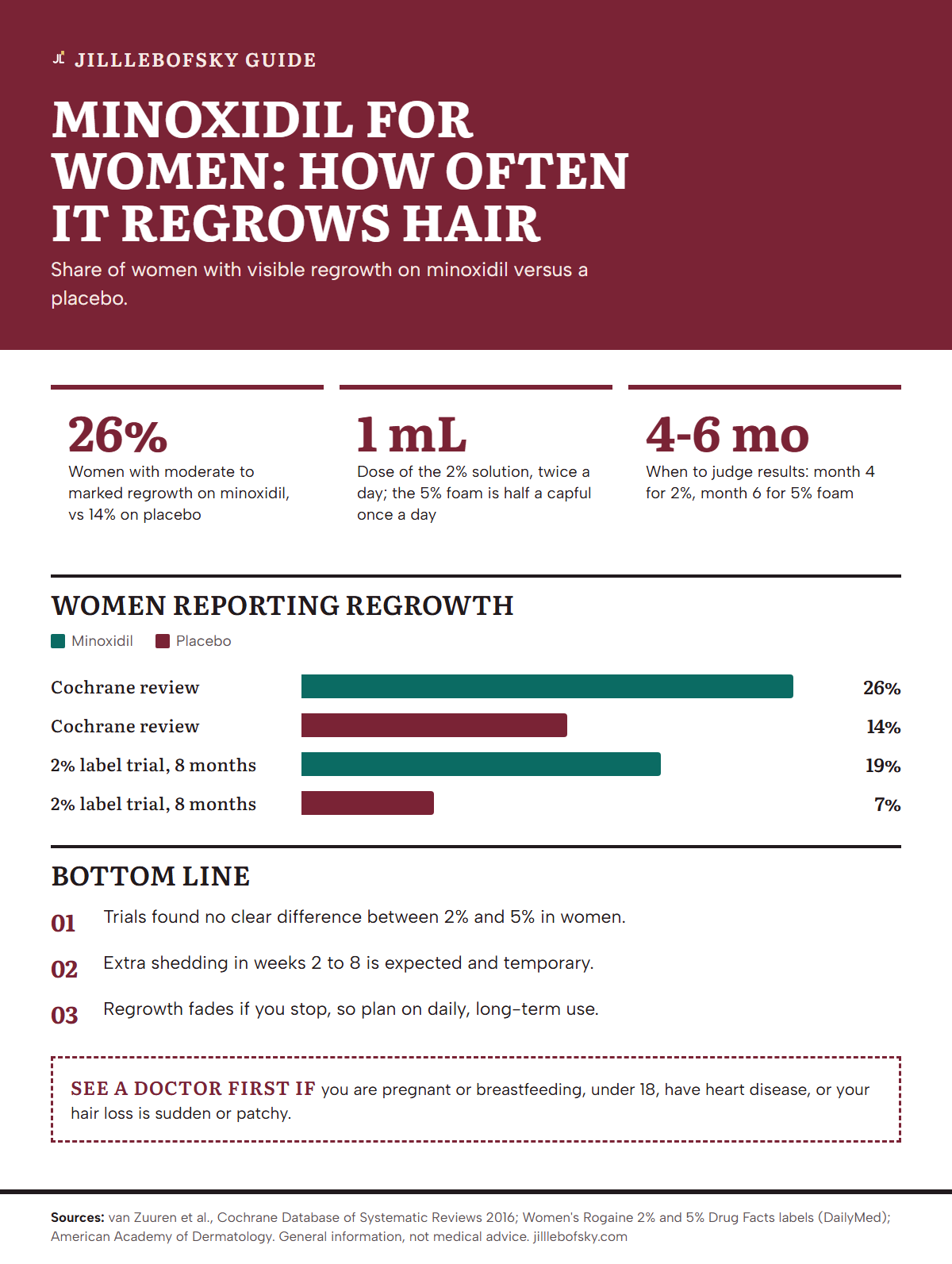
The short answer: in pooled trials, about 26% of women on minoxidil saw moderate to marked regrowth, against about 14% on a placebo, and it takes 4 to 6 months of daily use to judge [2][3][4].
| What it is | A topical drug sold without a prescription as a 2% solution or a 5% foam for women [1][2][3] |
|---|---|
| Used for | Female pattern hair loss, the most common cause of hair loss in women [1] |
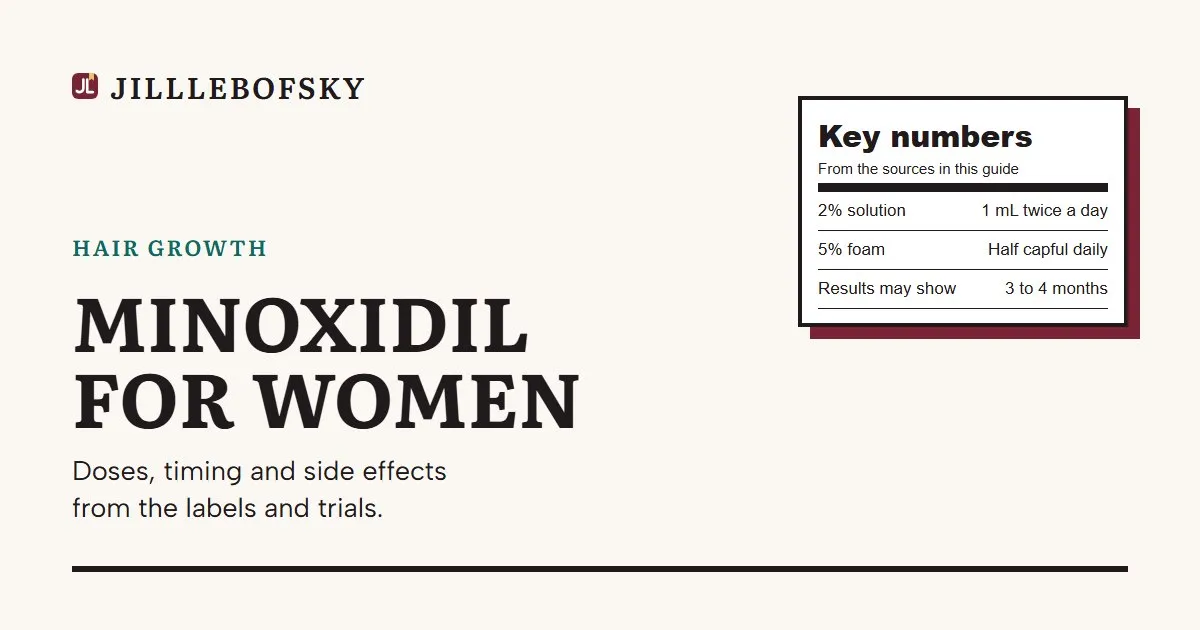
| How much | 2% solution: 1 mL twice a day. 5% foam: half a capful once a day [2][3] |
| Best evidence | Cochrane review of 47 trials with 5,290 participants, 17 of them on minoxidil [4] |
| Time to judge | Results may show at 3 to 4 months; stop if nothing grows by month 4 (2%) or month 6 (5% foam) [2][3] |
| Main side effects | Itchy, dry or red scalp, and unwanted hair on the cheeks or forehead [1] |
| Who should avoid | Pregnant or breastfeeding women, anyone under 18, and sudden or patchy hair loss [1][2] |
What is minoxidil for women, and who is it for?
Minoxidil is a non-prescription scalp medicine, sold as a 2% solution or a 5% foam, for female pattern hair loss. The AAD calls it the most-recommended treatment for this condition [1]. It suits women with slow thinning on the top of the head and a widening part, not sudden or patchy loss [1][2].
Female pattern hair loss is the most common cause of hair loss in women and affects millions of them [1]. It usually starts in a woman's 40s, 50s or 60s, it runs in families, and it gets more common after menopause [1]. A part that looks wider than it used to is often the first sign [1].
The labels are strict about who should use it. The 5% foam label says not to use it if you have no family history of hair loss, if the loss is sudden or patchy, if it came after childbirth, or if you do not know the reason [2]. Those patterns point to other causes that minoxidil will not fix.
Shedding is a separate issue. Losing 50 to 100 hairs a day is normal [7]. Heavy shedding after losing 20 pounds or more, a high fever, an operation or giving birth is usually telogen effluvium, and hair tends to look full again within six to nine months [7].
Does minoxidil work for women?
For many women it regrows some hair, though not a full head. In the Cochrane review, 157 of 593 women on minoxidil (about 26%) had moderate to marked regrowth, against 77 of 555 on placebo (about 14%) [4]. The AAD says it helps early hair loss but cannot regrow a whole head [6].
Cochrane rated that result moderate-quality evidence. Minoxidil also added about 13 hairs per square centimeter over placebo in eight studies, a low-quality finding [4]. A 2017 meta-analysis found 2% minoxidil beat placebo in women [5].
| Study | Who and how many | Dose and length | Result |
|---|---|---|---|
| Cochrane review, 2016 [4] | 47 trials, 5,290 people; 17 trials tested minoxidil | 2% or 5% topical | 26% vs 14% moderate to marked regrowth |
| Adil and Godwin, 2017 [5] | Women in good or fair quality randomized trials | 2% topical | Better than placebo |
| 2% Drug Facts trials [3] | Mostly white women aged 18 to 45, mild to moderate loss | 1 mL twice a day, 8 months | 19% moderate regrowth vs 7% on placebo |
| Asilian trial, 2024 [14] | 65 patients with pattern hair loss | 5% topical vs 1 mg oral, 6 months | No significant difference between groups |
| Vano-Galvan study, 2021 [13] | 1,404 patients, 943 of them women | Low-dose oral, no control group | No life-threatening side effects; 1.7% stopped |
Most label-trial volunteers were white women aged 18 to 45, so results in older women are less certain [3].
Is 2% or 5% minoxidil better for women?
Trials have not shown that 5% regrows more hair than 2% in women. In the Cochrane review, 25 of 57 women on 2% and 22 of 56 on 5% had moderate regrowth, and four trials with 1,006 participants found no real difference [4]. The practical gap is the routine: foam once a day, solution twice.
| Feature | 2% solution | 5% foam |
|---|---|---|
| How to use | 1 mL with the dropper, twice a day [3] | Half a capful, once a day [2] |
| When results may show | After at least 4 months [3] | At 3 months; some need 6 [2] |
| Stop if no regrowth by | Month 4 [3] | Month 6 [2] |
Pick the version you will actually use every day. The AAD says either strength may be used, once or twice a day depending on the product [1][6].
What to check on the label before you buy
- The Drug Facts box lists minoxidil as the active ingredient, with its strength of 2% or 5% [2][3].
- The directions fit your day: once daily for the foam, twice daily for the 2% solution [2][3].
- The warnings name who should not use it and the signs that mean you should stop [2].
- A 60 g can of 5% foam is about a two-month supply, so plan for at least three cans before you judge it [2].
- A "hair growth serum" without minoxidil in a Drug Facts box is not the drug these trials tested.
How do you apply minoxidil?
Apply it to a dry scalp only, at the dose on the label, and wash your hands afterward. The foam is half a capful once a day, and the 2% solution is 1 mL twice a day [2][3]. The label is clear that using more, or using it more often, will not improve results [2].
- Confirm the pattern. Slow thinning on top with a family history fits; sudden, patchy or post-childbirth loss needs a doctor first [2].
- Take a photo of your part in the same spot and light, so you can compare at month 4 and month 6.
- Part dry hair and put the dose on the thinning scalp, not on the lengths of your hair [2][3].
- Spread it with your fingertips, then wash your hands. Keep it off your face, because stray product can grow hair on the cheeks and forehead [1].
- Let it dry fully before you lie down, so it does not rub onto the pillow and your face [1].
- If you miss a dose, carry on with the next one and do not double up [2].
- Judge it at the label checkpoint: month 4 for the 2% solution, month 6 for the 5% foam [2][3].
If it works, keep going. The label says continued use is needed to keep the regrowth, or hair loss will begin again [2].
How long does minoxidil take to work for women?
Expect 3 to 6 months before you see a change, and up to a year for the full effect. The foam label says results may show at 3 months, the 2% label says at least 4, and the AAD says it is usually used for about 6 to 12 months before results are clear [1][2][3].
| When | What usually happens |
|---|---|
| Weeks 2 to 8 | A temporary rise in shedding for some women [1] |
| Months 3 to 4 | First visible regrowth is possible [2][3] |
| Month 4 | Stop the 2% solution if nothing has grown [3] |
| Month 6 | Stop the 5% foam if nothing has grown [2] |
| Months 6 to 12 | The usual window to judge full results [1][6] |
Early shedding worries many women, but the AAD describes it as temporary and expected in the first two to eight weeks [1]. Stopping in that window means you never reach the point where regrowth can show.
The AAD also says people who stop using minoxidil lose the hair they gained [6].
What are the side effects of minoxidil?
The common side effects stay on the skin: an itchy, dry, scaly or red scalp, and unwanted hair on the cheeks or forehead. Keeping the product on the scalp and washing your face after use lowers the facial hair risk [1]. Hair color or texture can also change [2].
In the Cochrane review, side effects were about as common with minoxidil as with placebo: 40 of 407 women versus 28 of 320 [4]. If your scalp stays irritated, the foam label says to stop and ask a doctor [2].
Skip it, or check with a doctor first, if any of these apply:
- Women who are pregnant, planning a pregnancy or breastfeeding. The AAD notes traces of minoxidil may pass into breast milk [1][2].
- Anyone under 18 [2].
- Anyone whose scalp is red, inflamed, infected, irritated or painful [2].
- Women with heart disease, unless a doctor says it is fine [2].
Stop and get medical help right away if
Call 911 if chest pain is severe or you faint. For any of these signs, stop minoxidil and call your doctor the same day [2]:
- Chest pain or a rapid heartbeat [2]
- Faintness or dizziness [2]
- Sudden, unexplained weight gain [2]
- Swollen hands or feet [2]
- Scalp irritation that does not settle, or unwanted facial hair [2]
Bring the box to the visit so the doctor can see the strength and how long you have used it. Women on oral minoxidil should watch for the same signs, since fluid retention and a fast heartbeat were reported in the 2021 safety study [13].
Is oral minoxidil safe for women?
Low-dose oral minoxidil is an off-label prescription option, not an FDA-approved hair treatment. In a 2021 study of 1,404 patients, 943 of them women, there were no life-threatening side effects, and 1.7% stopped because of side effects [13]. It belongs under a doctor's care only.
The most common problem in that study was extra body or facial hair, in 15.1% of patients. Lightheadedness affected 1.7%, fluid retention 1.3% and a fast heartbeat 0.9% [13]. The study looked back at records and had no comparison group, so it cannot rule out rarer harms [13].
A 2021 review found 17 studies with 634 patients and called oral minoxidil an effective, well-tolerated option for healthy people who struggle with topical forms. The authors still asked for larger randomized trials [12]. A 2024 trial of 65 patients found 1 mg a day by mouth did about as well as 5% topical over 6 months [14].
The tablets are a blood pressure drug, made as 2.5 mg or 10 mg. Their label carries a boxed warning about fluid around the heart and worse angina, and about 80% of people on blood pressure doses grow extra body hair [15]. The label also says the tablets should not be given to a nursing woman [15]. If you already take medicine for blood pressure, our guide on how to lower blood pressure covers the basics, and your prescriber needs to know before oral minoxidil is added.
What do doctors check before minoxidil?
A dermatologist first confirms the cause, because treatment for hair loss depends on it. Thyroid disease, low iron and other conditions can thin hair, and treating the thyroid problem can reverse that hair loss [8][11]. A blood test or scalp biopsy may be ordered when a medical cause seems likely [6].
Dry, thinning hair can be a sign of an underactive thyroid. That condition affects nearly 5 in 100 Americans aged 12 and older and is much more common in women [9]. Heavy periods are a common cause of iron-deficiency anemia, which blood tests including ferritin can find [10]. MedlinePlus also lists diabetes and lupus among diseases linked to hair loss [11].
Too little biotin, iron, protein or zinc can play a part [8]. A supplement makes sense only when a test shows you are low.
For confirmed pattern hair loss, minoxidil is the usual first step. A dermatologist may add spironolactone, a prescription pill, and you should mention any kidney or adrenal problems first [1]. In one Cochrane-pooled trial, finasteride 1 mg did no better than placebo in women [4].
The AAD says the earlier treatment starts, the better it works, and that without an accurate diagnosis, treatment often fails [8].
Is minoxidil worth trying for thinning hair?
For slow thinning with a family history, topical minoxidil is a reasonable first step if you can use it every day. About one in four women in trials saw moderate or better regrowth, against about one in seven on placebo [4]. It works best as a long-term habit, since gains fade when you stop [2][6].
Our view: start with the 2% solution or the 5% foam, whichever you will actually use daily, since trials found no clear gap between them [4]. Give it 4 to 6 months before you decide [2][3]. If the loss is sudden or patchy, see a doctor before you buy anything, and treat oral minoxidil as a dermatologist's decision rather than a home experiment [2][13][15].
We built this guide from the sources listed below, following our review process for health guides and our editorial policy. More reading on regrowth and thinning sits in our hair growth guides.
Frequently asked questions
What happens if I stop using minoxidil?
The hair you regrew will gradually be lost. The Drug Facts label says continued use is needed to keep regrowth, or hair loss will begin again, and the AAD says people who stop lose the benefits. Plan on it as a long-term routine.
Does using more minoxidil make it work faster?
No. The 5% foam label states that using more, or using it more often, will not improve results. Extra product raises the chance of scalp irritation and of stray hair growth on the face, so stick to the dose on the label.
Can minoxidil cause facial hair in women?
Yes. Unwanted hair on the cheeks or forehead is a known side effect. The AAD advises applying it only to the scalp and washing your face afterward. The foam label says to stop and ask a doctor if unwanted facial hair appears.
Can I use minoxidil while pregnant or breastfeeding?
The labels say it may be harmful during pregnancy or breastfeeding, and the AAD advises women who are pregnant, planning a pregnancy or nursing to avoid it, noting traces may pass into breast milk. Ask your doctor about other options.
Can minoxidil change my hair color or texture?
It can. The women's 5% foam label lists changes in hair color and texture as possible effects. These are not usually dangerous, but if a change bothers you, stop using it and talk with a dermatologist about other treatments.
Sources
- Thinning hair and hair loss: Could it be female pattern hair loss?. American Academy of Dermatology
- Women's Rogaine Unscented 5% minoxidil topical foam, Drug Facts label. DailyMed, National Library of Medicine
- Women's Rogaine 2% minoxidil topical solution, Drug Facts label. DailyMed, National Library of Medicine, 2024
- Interventions for female pattern hair loss (van Zuuren et al.). Cochrane Database of Systematic Reviews, 2016
- The effectiveness of treatments for androgenetic alopecia: a systematic review and meta-analysis (Adil, Godwin). Journal of the American Academy of Dermatology, 2017
- Hair loss: Diagnosis and treatment. American Academy of Dermatology
- Do you have hair loss or hair shedding?. American Academy of Dermatology
- Hair loss: Who gets and causes. American Academy of Dermatology
- Hypothyroidism (Underactive Thyroid). NIDDK, National Institutes of Health
- Iron-Deficiency Anemia. NHLBI, National Institutes of Health
- Hair Loss. MedlinePlus, National Library of Medicine
- Oral minoxidil treatment for hair loss: a review of efficacy and safety (Randolph, Tosti). Journal of the American Academy of Dermatology, 2021
- Safety of low-dose oral minoxidil for hair loss: a multicenter study of 1404 patients (Vano-Galvan et al.). Journal of the American Academy of Dermatology, 2021
- Low-dose oral minoxidil versus topical solution in androgenetic alopecia: a randomized controlled trial (Asilian et al.). Journal of Cosmetic Dermatology, 2024
- Minoxidil tablets, prescribing information. DailyMed, National Library of Medicine
This page is general information, not medical advice. Talk to your doctor or pharmacist before you start any supplement, especially if you are pregnant, take medicine or have a health condition. Read our medical disclaimer and how we review.