Conductive hearing loss happens when earwax, middle ear fluid, an infection, a hole in the eardrum or a stiff middle ear bone stops sound from reaching the inner ear. Sounds turn quiet and muffled. In many cases medicine, wax removal, ear tubes or surgery can correct it. Sudden loss, ear drainage, vertigo or loss in one ear needs a doctor promptly.
Conductive hearing loss happens when sound cannot pass through the outer or middle ear to reach the inner ear, so everything sounds quieter and muffled. To explain it, we read the ASHA pages on hearing loss types and hearing tests, the NIDCD pages on ear infections, otosclerosis and hearing aids, three clinical practice guidelines from otolaryngology journals and three 2023 Cochrane reviews. Our source review method explains how we pick and check sources.
This type of hearing loss usually comes from by earwax, fluid, infection or a stiff middle ear bone, and in many cases medicine or surgery can correct it, unlike most inner ear damage.[1]
| What it is | Sound is blocked in the outer or middle ear before it reaches the inner ear[1] |
|---|---|
| Common causes | Earwax, middle ear fluid, ear infections, a hole in the eardrum, swimmer's ear, an object in the ear[1] |
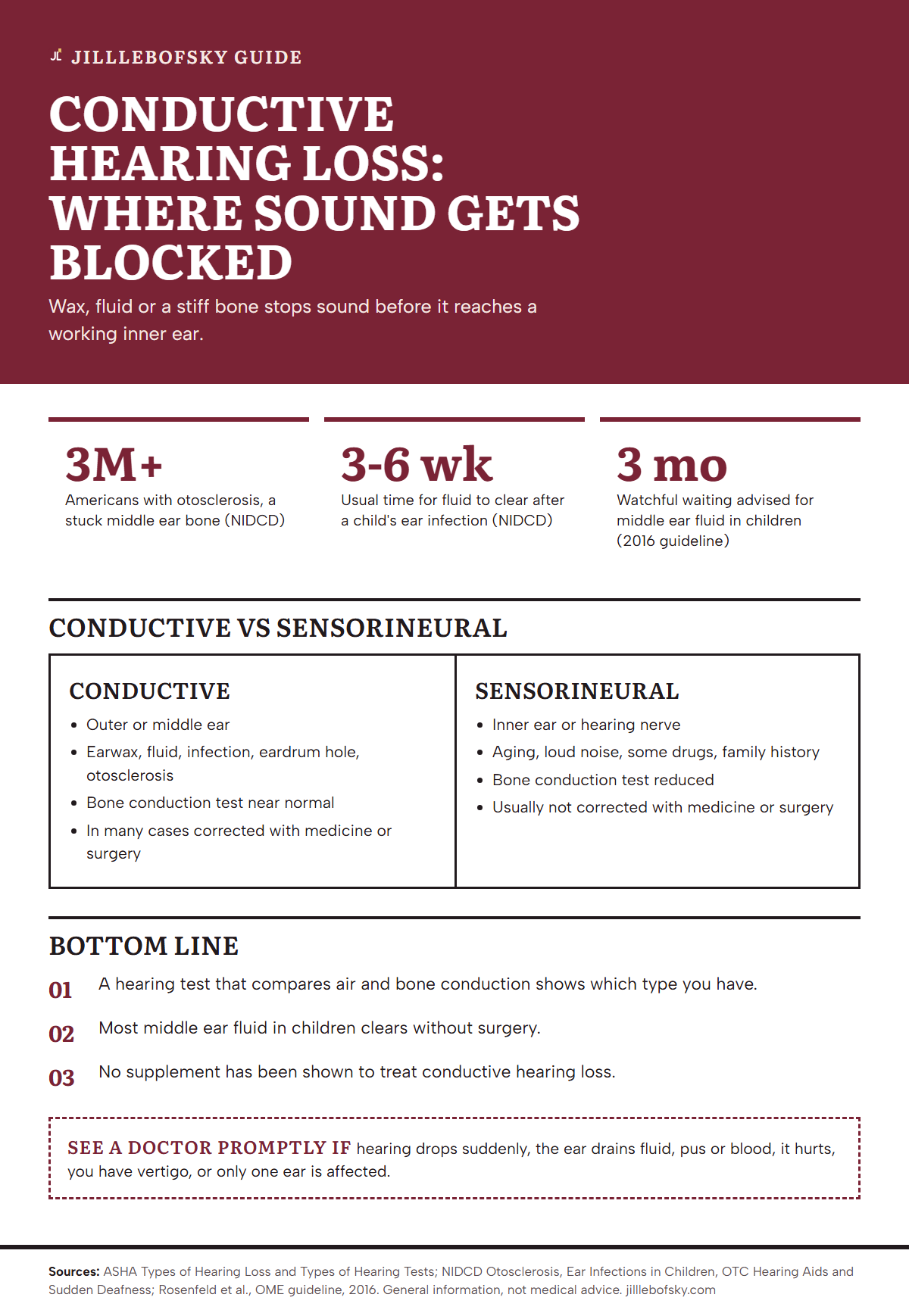
| Bone problem | Otosclerosis, a stuck middle ear bone, affects more than 3 million Americans[4] |
| Key test | Air and bone conduction hearing tests plus tympanometry[7] |
| Usual outlook | In many cases medicine or surgery can correct it[1] |
| Fluid in children | Usually watched for 3 months before surgery is considered[5] |
| Get help fast | Sudden loss, ear drainage, ear pain, vertigo, or loss in one ear only[13][14] |
What is conductive hearing loss?
Conductive hearing loss is a blockage or fault in the outer or middle ear that stops sound from moving through to the inner ear. The inner ear and hearing nerve usually still work. The problem sits in the path the sound takes, so the sound arrives too weak.[1]
Normal hearing is a chain. Sound travels down the ear canal and makes the eardrum vibrate. Three tiny bones in the middle ear, the malleus, incus and stapes, pass those vibrations on to the cochlea in the inner ear.[4]
Break any link in that chain and you get this kind of loss. A plug of wax stops sound in the canal. Fluid behind the eardrum dampens its movement. A stapes bone that has hardened in place cannot pass vibrations on.[1][4]
ASHA names two other types for comparison. Sensorineural loss comes from damage to the inner ear or nerve and is the most common type of permanent hearing loss. Mixed loss is a combination of the two.[1] Our guide to sensorineural hearing loss signs and causes covers the inner ear side.
What does conductive hearing loss feel like?
Most people describe a muffled, plugged or underwater feeling, as if someone turned the volume down. Quiet sounds and soft voices fade first. It often affects one ear, and it may come with ear pain, fullness or fluid draining, depending on the cause.[1][2]
Common signs include:
- Sounds seem quieter but not garbled, and turning up the volume helps
- A blocked or full feeling in the ear
- Ear pain or fever with an ear infection[2]
- Fluid draining from the ear[2]
- Trouble telling where a sound comes from when only one ear is affected[1]
- Difficulty hearing low-pitched sounds or a whisper, an early sign of otosclerosis[4]
Young children often cannot say their ear hurts. NIDCD lists tugging at the ear, fussiness, trouble sleeping, fever, clumsiness and trouble responding to quiet sounds as clues.[2] Fluid that stays behind the eardrum after an infection may cause no symptoms at all.[2]
What causes conductive hearing loss?
The most common causes are earwax, fluid in the middle ear and ear infections. ASHA also lists a hole in the eardrum, swimmer's ear, an object stuck in the ear, masses that block the ear and problems with how the outer or middle ear formed.[1]
The causes split by where the block sits. Outer ear causes plug the ear canal before sound reaches the eardrum. Middle ear causes sit behind the eardrum, where fluid, infection or a stiff bone stops the eardrum and the three small bones from passing sound along. Some people have two causes at once, such as wax on top of fluid after a cold. The exam and tests below are how a clinician tells these apart.[1][4]
Outer ear causes
Earwax counts as a problem only when it causes symptoms or stops a clinician from seeing the eardrum, according to the 2017 earwax guideline.[6] Swimmer's ear (otitis externa) and small objects in the canal can also block sound.[1]
Wax is easy to miss in people who cannot describe symptoms. The guideline asks clinicians to check young children, people with cognitive impairment and hearing aid users, because a blocked canal can go unnoticed in these groups.[6]
Middle ear causes
Middle ear fluid often follows a cold, allergies or an ear infection.[1] Children are more prone because their eustachian tubes are smaller and more level, so fluid drains poorly.[2] MedlinePlus explains that fluid can affect hearing because sound cannot get through it.[3]
Otosclerosis is a bone problem. Abnormal bone remodeling makes the stapes stick in place. NIDCD says it affects more than 3 million Americans, often runs in families and is most common in white, middle-aged women.[4]
Is being hard of hearing the same as conductive hearing loss?
No. Hard of hearing is a general term for any degree of hearing loss, while conductive is one specific type. Someone who is hard of hearing may have conductive, sensorineural or mixed loss, and only a hearing test that compares air and bone conduction shows which one.[1][7]
The type decides the fix. Conductive problems can often be corrected with medicine or surgery. Sensorineural loss usually cannot, and hearing aids are the usual help.[1][12]
| Feature | Conductive | Sensorineural |
|---|---|---|
| Where the problem is | Outer or middle ear[1] | Inner ear or hearing nerve[1] |
| Typical causes | Wax, fluid, infection, eardrum hole, otosclerosis[1][4] | Aging, loud noise, some drugs, family history[1] |
| Can it be corrected? | In many cases, with medicine or surgery[1] | Usually not with medicine or surgery[1] |
| Bone conduction test | Near normal, because the inner ear works[7] | Reduced, like the air conduction result[7] |
Mixed loss happens when both are present, for example a noise-exposed worker who also has fluid in the middle ear.[1]
How do doctors diagnose conductive hearing loss?
Diagnosis starts with a look in the ear with an otoscope, then hearing tests that compare air conduction with bone conduction. If you hear well through bone but poorly through earphones, the inner ear works and the block sits in the outer or middle ear.[2][7]
The usual steps, from the NIDCD and ASHA pages and the guidelines, are:
- History: recent colds, ear pain, drainage, swimming, wax problems and family history.[2][4]
- Otoscopy to see the canal and eardrum; a red, bulging eardrum points to infection.[2]
- Pneumatic otoscopy, a puff of air that shows whether the eardrum moves; the OME guideline makes it a strong recommendation in children.[5]
- Tympanometry, which shows whether the eardrum is too stiff, too floppy, has a hole or has fluid behind it.[7]
- Pure-tone testing from low (250 Hz) to high (8,000 Hz) pitches through earphones, then the same tones by bone conduction.[7]
- A CT scan in some cases, for example when otosclerosis is suspected.[4]
For sudden hearing loss, NIDCD says doctors first rule out conductive causes such as wax or fluid before treating it as inner ear loss.[14]
Can conductive hearing loss be fixed?
Often, yes. ASHA says that in many cases medicine or surgery can correct conductive hearing loss, because the inner ear is usually healthy. The fix depends on the cause: wax removal, time for fluid to clear, treatment of infection, tubes, eardrum repair or bone surgery.[1]
Some cases are not fully reversible. NIDCD notes that some hearing loss may persist after otosclerosis surgery, and in rare cases surgery makes hearing worse.[4] When surgery is not an option, hearing aids or a bone-anchored device can help. The table below matches common patterns with the step clinicians usually take first.[12]
Decision table: likely cause and usual first step
| If you notice | Possible cause | Usual first step |
|---|---|---|
| Plugged ear, no pain, history of wax | Earwax impaction[6] | Softening drops, irrigation or removal by a clinician[6] |
| Muffled hearing after a cold, child with no pain | Middle ear fluid (OME)[5] | Watchful waiting for 3 months, hearing test if it lasts[5] |
| Ear pain and fever | Acute ear infection[2] | Exam; antibiotics if needed, often 7 to 10 days[2] |
| Slow loss in one ear, then both, family history | Otosclerosis[4] | Audiogram and tympanogram; hearing aid or stapedectomy[4] |
| Drainage, blood or sudden loss | Needs a medical exam[13] | See a physician promptly[13] |
When should you see a doctor right away?
Sudden hearing loss is a medical emergency, and NIDCD says to see a doctor immediately. Waiting more than 2 to 4 weeks makes treatment less likely to help if the cause turns out to be in the inner ear, so do not assume it is just wax.[14]
Seek same-day or emergency care if hearing drops all at once or over a few days, especially in one ear.[14] NIDCD also tells adults to see a physician promptly, and not to start with over-the-counter hearing aids, if they have:[13]
- Fluid, pus or blood coming from the ear within the past 6 months
- Pain or discomfort in the ear
- A history of heavy earwax or a feeling that something is in the ear canal
- Episodes of vertigo (severe dizziness) with hearing loss
- Sudden or quickly worsening hearing loss
- Hearing that got worse and then better within 6 months
- Hearing loss or ringing in only one ear, or a clear difference between ears
Call your child's doctor for fever with ear pain, fluid draining from the ear, or a child who still seems sick several days after starting an antibiotic.[2]
How is fluid behind the eardrum treated in children?
Most middle ear fluid clears on its own, so the 2016 guideline advises 3 months of watchful waiting for children who are not at higher risk. After an infection, fluid usually disappears within 3 to 6 weeks, according to NIDCD.[2][5]
The same guideline recommends against steroids, oral antibiotics, antihistamines and decongestants for this fluid. It calls for a hearing test if fluid lasts 3 months or longer and a recheck every 3 to 6 months while it persists.[5]
Ear tubes are the most common outpatient surgery in US children. The 2022 tube guideline says to offer tubes in both ears when fluid in both ears has lasted 3 months or more and there are documented hearing problems.[8] MedlinePlus says tubes relieve pressure so the child can hear again.[3]
What the research shows
| Treatment | Studies and children | Main result | Certainty |
|---|---|---|---|
| Ear tubes (2023) | 19 trials, 2,888 children[9] | Fluid at 6 months 20.4% vs 68.0% in one trial; small hearing gains that may not last; 93% vs 95% normal hearing 8 to 10 years later[9] | Low to very low[9] |
| Autoinflation (2023) | 11 studies, 1,036 children[10] | May slightly cut fluid at 3 months; ear pain 4.4% vs 1.3%[10] | Low to very low[10] |
| Antibiotics (2023) | 19 studies, 2,581 children[11] | Effect on hearing very uncertain; long-term effects unclear[11] | Low to very low[11] |
Autoinflation means blowing up a special balloon through the nose, usually 2 to 3 times a day for 2 to 12 weeks in the trials.[10]
What do doctors use first for adults?
For adults, doctors treat the cause they find: wax is removed, infections are treated, eardrum holes may be repaired and otosclerosis is managed with a hearing aid or surgery. Hearing devices come in when the cause cannot be corrected or surgery is not wanted.[1][4][6]
For earwax, the guideline lists softening drops (water or saline count), irrigation and manual removal by a clinician. It recommends against ear candling. People on blood thinners, with diabetes, a weak immune system or a hole in the eardrum need extra care before removal.[6]
For otosclerosis there is no effective drug. In a stapedectomy, a surgeon inserts a small prosthesis that lets sound bypass the stuck bone.[4]
A bone-anchored hearing aid attaches to the bone behind the ear and sends vibrations through the skull to the inner ear, bypassing the middle ear. NIDCD notes it needs surgery, and some specialists feel the benefits may not outweigh the risks.[12] Standard hearing aids cost from hundreds to several thousand dollars and do not restore normal hearing.[12]
Can supplements help conductive hearing loss?
We found no trial showing that any supplement treats conductive hearing loss. The cause is mechanical, such as wax, fluid or a stuck bone, so the fixes in the guidelines are removal, time, tubes or surgery. None of the guidelines we read lists a vitamin, herb or mineral as a treatment.[4][5][6]
The guidelines even advise against several common medicines for middle ear fluid, including decongestants and antihistamines.[5] Be wary of any product that promises to clear blocked ears or restore hearing; the evidence does not back that claim.
Supplements marketed for hearing are mostly studied for inner ear problems, and the results are small or mixed. Our review of hearing supplement ingredients graded by the evidence covers what those trials found. If ringing is your main problem, see our guide to tinnitus treatments that work and when to get help.
How can you prevent conductive hearing loss?
You cannot prevent every case, since otosclerosis often runs in families, but you can lower the risk of wax blockage and repeated ear infections. The earwax guideline asks clinicians to teach proper ear hygiene, and NIDCD lists smoke exposure and bedtime bottles as infection risks for children.[2][4][6]
Wax does not need routine removal when it causes no symptoms.[6] Pushing swabs into the canal is not on the guideline's list of treatments, and candling is advised against.[6] Keeping children away from people who smoke may cut the number of ear infections.[2]
Practical checklist
- Note which ear is affected, when it started and whether it came on suddenly.
- Get sudden loss in one ear seen the same day.[14]
- Ask for a hearing test that includes bone conduction and tympanometry.[7]
- Tell the clinician if you take blood thinners or have diabetes before wax removal.[6]
- Skip ear candles and do not put anything in an ear that is draining.[6][13]
- For a child with fluid, ask about a hearing test if it lasts 3 months.[5]
- Before buying an over-the-counter hearing aid, rule out the red flags above.[13]
Bottom line
Conductive hearing loss means sound is blocked before it reaches a working inner ear. Wax, fluid, infection and a stuck middle ear bone are the usual causes, and in many cases the hearing comes back once the cause is treated.[1]
For most people, a clinic visit with an ear exam and a proper hearing test is the better first step than drops, devices or supplements, because the right fix depends on which part of the ear is blocked. Treat sudden loss as urgent. You can read more in our hearing and tinnitus guides, and our editorial policy explains how we write them.[14]
Frequently asked questions
Is conductive hearing loss permanent?
Often it is not. ASHA says medicine or surgery can correct it in many cases, because the inner ear usually works. Some causes, such as otosclerosis, can leave some loss even after surgery, so a full hearing test guides the plan.
Can earwax cause hearing loss?
Yes. Earwax that blocks the canal is a common cause of muffled hearing. The 2017 guideline lists softening drops, irrigation and removal by a clinician as treatments, and it advises against ear candling for removing or preventing wax.
Do ear tubes improve hearing in children?
Ear tubes can drain middle ear fluid and may give small hearing gains in the short and medium term. A 2023 Cochrane review of 19 trials found it unclear whether those gains last, since many children recover on their own.
Can adults get fluid behind the eardrum?
Yes. ASHA lists middle ear fluid from colds or allergies as a cause of conductive loss at any age. Adults with fluid, ear pain, drainage or hearing loss in one ear should see a physician promptly.
Can OTC hearing aids help conductive hearing loss?
OTC hearing aids are for adults with perceived mild to moderate loss. NIDCD says ear pain, drainage, wax buildup or loss in one ear need a physician first, and these are common with conductive causes.
Sources
- Types of Hearing Loss. American Speech-Language-Hearing Association (ASHA), reviewed 2026
- Ear Infections in Children. NIDCD, National Institutes of Health
- Ear Infections. MedlinePlus, National Library of Medicine
- Otosclerosis. NIDCD, National Institutes of Health
- Clinical Practice Guideline: Otitis Media with Effusion (Update), Rosenfeld et al.. Otolaryngology-Head and Neck Surgery, 2016
- Clinical Practice Guideline (Update): Earwax (Cerumen Impaction), Schwartz et al.. Otolaryngology-Head and Neck Surgery, 2017
- Types of Hearing Tests. American Speech-Language-Hearing Association (ASHA), reviewed 2026
- Clinical Practice Guideline: Tympanostomy Tubes in Children (Update), Rosenfeld et al.. Otolaryngology-Head and Neck Surgery, 2022
- Ventilation tubes (grommets) for otitis media with effusion (OME) in children. Cochrane Database of Systematic Reviews, 2023
- Autoinflation for otitis media with effusion (OME) in children. Cochrane Database of Systematic Reviews, 2023
- Antibiotics for otitis media with effusion (OME) in children. Cochrane Database of Systematic Reviews, 2023
- Hearing Aids. NIDCD, National Institutes of Health
- Over-the-Counter Hearing Aids. NIDCD, National Institutes of Health
- Sudden Deafness. NIDCD, National Institutes of Health, 2018
This page is general information, not medical advice. Talk to your doctor or pharmacist before you start any supplement, especially if you are pregnant, take medicine or have a health condition. Read our medical disclaimer and how we review.