The main tinnitus symptom is hearing a sound with no outside source, most often ringing, but also buzzing, roaring, hissing or clicking, in one or both ears. It affects about 10 to 25% of adults and is usually tied to hearing loss. Ringing in one ear, a sound that pulses with your heartbeat or sudden hearing loss needs a doctor quickly.
Tinnitus symptoms are sounds you hear that have no outside source, most often a ringing in the ears. To explain them, we read the NIDCD tinnitus page, the MedlinePlus summary, the 2014 tinnitus guideline from the American Academy of Otolaryngology, two national survey studies, a Cochrane review and the NIDCD pages on the ear problems that cause ringing. Our source review method explains how we pick and check sources.
The short answer: tinnitus can ring, buzz, roar, hiss or click in one or both ears, it affects about 10 to 25% of adults, and most cases are not dangerous, though ringing in one ear, a pulsing sound or sudden hearing loss needs a doctor fast.[1][9][10]
| What it is | The perception of sound without an outside source[3] |
|---|---|
| Common sounds | Ringing, buzzing, roaring, whistling, humming, clicking, hissing or squealing[1] |
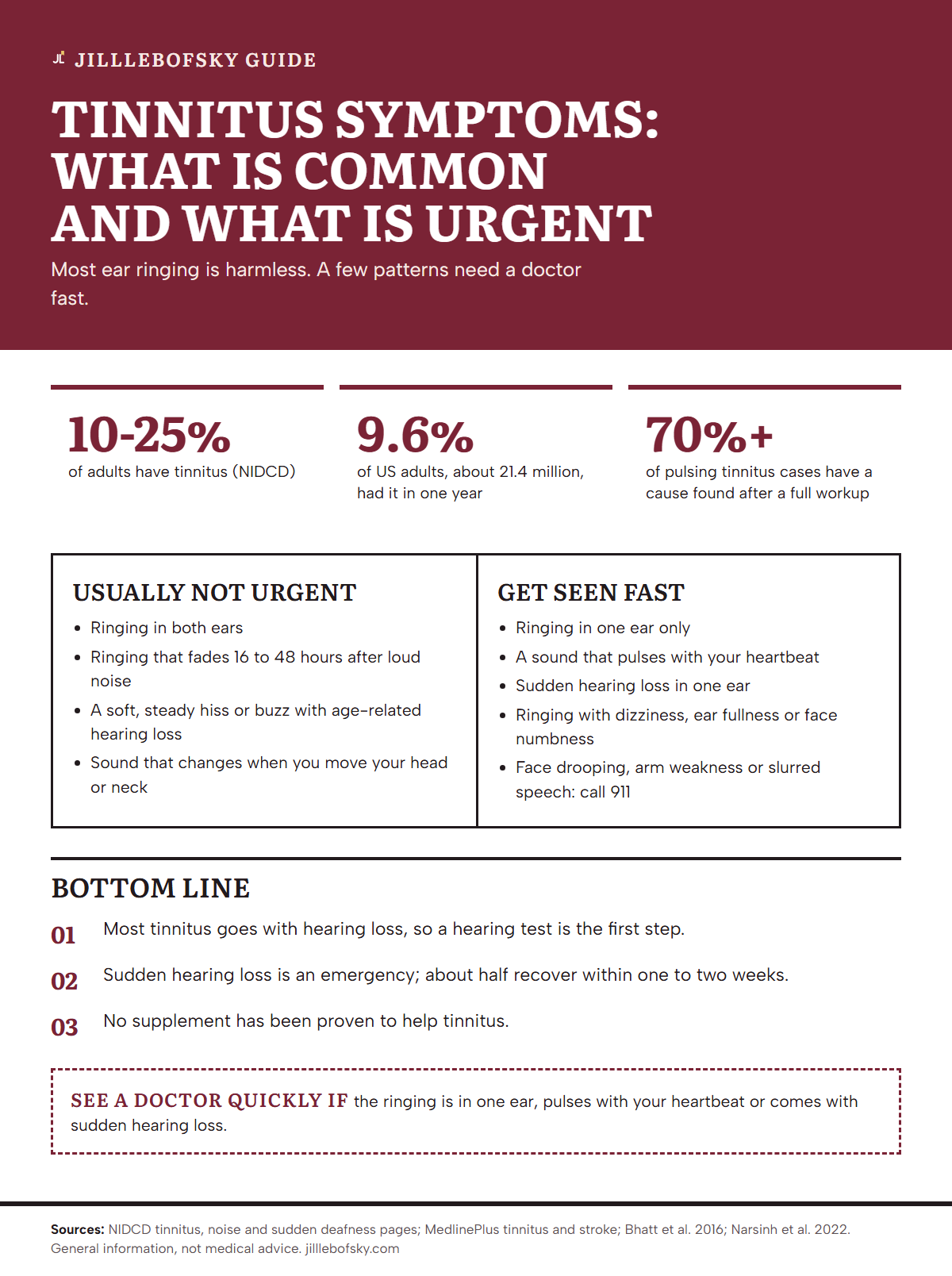
| How common | 10 to 25% of adults; 9.6% of US adults, about 21.4 million, in one year[1][4] |
| When it counts as chronic | Three months or longer; the guideline calls six months or longer persistent[1][3] |
| Red flags | Sound in one ear only, pulsing in time with your heartbeat, sudden hearing loss, dizziness or face weakness[3][8][9][10] |
| Usual first step | A primary care visit to check earwax, infection and medicines, then an ENT and a hearing test[1] |
| Supplements | None has been proven to work for tinnitus[1] |
What are tinnitus symptoms?
The main tinnitus symptom is hearing a sound that no one else can hear, most often a ringing, buzzing or roaring. The sound may be soft or loud, high or low pitched, and you may hear it in one ear, both ears or inside your head. It can come and go or stay all the time.[1][2]
NIDCD lists eight ways people describe the sound: ring, buzz, roar, whistle, hum, click, hiss or squeal.[1] The pattern differs a lot from person to person.
Some people notice that moving the head, neck or eyes, or touching certain parts of the body, changes the sound for a short time. Doctors call this somatosensory tinnitus.[1]
In rare cases the sound pulses in rhythm, often in time with your heartbeat. A doctor may be able to hear it with a stethoscope. That kind, called objective tinnitus, often has a cause that can be found and treated.[1]
Tinnitus also brings symptoms beyond the sound. NIDCD notes it can affect mood and the ability to sleep or concentrate, and MedlinePlus adds that severe cases can make hearing and working hard.[1][2] In a 2016 US survey, 36% of people with tinnitus heard it nearly all the time, and 27% had lived with it for more than 15 years.[4]
What is tinnitus, and what does ringing in the ears mean?
Tinnitus is the medical name for hearing sound without an outside source, and ringing in the ears is its most common form. It is a symptom, not a disease. Most people who have it have some degree of hearing loss, and it is rarely linked to a serious medical problem.[1][3]
Scientists think the sound is made by the brain, in an area called the auditory cortex, after the inner ear sends it less input. That helps explain why hearing loss and tinnitus so often travel together.[1]
Ringing after a loud concert is a short-term version. Loud noise can cause a temporary hearing loss that fades 16 to 48 hours later, though NIDCD warns some lasting damage may remain.[5]
When the sound lasts three months or longer, NIDCD calls it chronic.[1] The 2014 guideline focuses on tinnitus that is bothersome and lasts six months or longer.[3] Children can have tinnitus too.[1]
What large studies show
Survey and review data give a sense of how often tinnitus happens, how much it bothers people and what helps.
| Study | Who and how many | Design | Main finding |
|---|---|---|---|
| Bhatt et al., 2016[4] | 75,764 US adults | National health survey | 9.6% had tinnitus in the past year; 7.2% of them called it a big or very big problem; 49.4% had talked to a doctor |
| Bhatt et al., 2017[11] | US adults in the same national survey | Cross-sectional survey | Anxiety in 26.1% with tinnitus vs 9.2% without; depression 25.6% vs 9.1% |
| Narsinh et al., 2022[10] | People with pulsing tinnitus | Narrative review | A cause was found in more than 70% after a full workup |
| Fuller et al., 2020[12] | 28 studies, 2,733 people | Cochrane review | CBT lowered tinnitus impact by about 11 points on the Tinnitus Handicap Inventory vs wait list (low certainty) |
What causes tinnitus?
The most common causes of tinnitus are hearing loss from aging and damage from loud noise. Other causes include earwax, ear and sinus infections, some medicines at high doses, head or neck injury, Ménière's disease, blood vessel problems and, rarely, tumors. Some people develop it for no known reason.[1][2]
Here is how the main causes line up:
- Age-related hearing loss. About 1 in 3 people in the US aged 65 to 74 has hearing loss, and nearly half of those older than 75 do. It usually affects both ears.[6] You can read more in our guide to sensorineural hearing loss signs and causes.
- Loud noise. Long or repeated exposure at or above 85 dBA can cause hearing loss, and noise-linked tinnitus can show up in one or both ears.[5] In the 2016 survey, work noise and leisure noise were both tied to higher odds of tinnitus.[4]
- Earwax and ear infections. Fluid and mucus from a middle ear infection can clog the ear and affect hearing.[14] When earwax is the cause, removing it can end or greatly reduce the ringing.[1]
- Medicines. NSAIDs such as ibuprofen, naproxen and aspirin, and some antibiotics, cancer, malaria and antidepressant drugs, are linked to tinnitus, especially at high doses.[1]
- Other health conditions. MedlinePlus lists heart or blood vessel problems, thyroid problems and hormonal changes in women.[2]
Why are my ears ringing in only one ear?
Ringing in one ear is more likely than ringing in both to have a specific cause that a doctor should look for. Earwax or an infection on one side is common. Less often, one-sided ringing comes from Ménière's disease, sudden hearing loss or a slow-growing nerve tumor. The guideline calls for a prompt hearing exam in these cases.[3]
Ménière's disease is an inner ear disorder that causes vertigo, ringing, hearing loss and a feeling of fullness in the ear. It usually affects one ear, though both are involved in 15% to 25% of people. Spinning attacks last from 20 minutes to 12 hours, and it is most likely between ages 40 and 60.[7]
A vestibular schwannoma, also called an acoustic neuroma, is a benign tumor on the hearing and balance nerves. NIDCD says one-sided or uneven hearing loss, ringing and dizziness are its early signs, and that one-sided symptoms are the worrisome ones. A larger tumor can cause facial numbness or weakness.[8]
One-sided ringing is seldom a tumor, but the cause is worth finding, usually with a hearing test and sometimes an MRI.[3][8]
When is ear ringing a medical emergency?
Ear ringing is an emergency when it comes with sudden hearing loss, stroke signs or a new pulsing sound with other nerve symptoms. NIDCD says sudden deafness should be treated as a medical emergency, and a 2022 review notes that pulsing tinnitus can, rarely, signal a stroke. Most ringing is not urgent, but these patterns are.[9][10]
Call 911 right away if ringing or ear symptoms come with:
- Sudden numbness or weakness of the face, arm or leg, especially on one side[15]
- Sudden confusion, trouble speaking or trouble understanding speech[15]
- Sudden trouble seeing, trouble walking or loss of balance[15]
- A sudden severe headache with no known cause[15]
See a doctor the same day, or go to urgent care, if:
- You lose hearing in one ear, all at once or over a few days, sometimes after a loud pop, with fullness, dizziness or ringing[9]
- A new sound pulses in time with your heartbeat[1][10]
- Ringing in one ear comes with dizziness or face numbness[8]
Speed matters for sudden hearing loss. About half of people recover some or all hearing on their own within one to two weeks, but putting off care can make treatment work less well.[9]
A quick decision table
| If your ringing | Then |
|---|---|
| Started after a concert or loud event and fades in a day or two | Protect your ears next time; see a doctor if it does not fade[5] |
| Is in both ears, mild, and you are over 60 | Book a routine visit and a hearing test[1][6] |
| Is in one ear only, or comes with hearing trouble | Ask for a prompt hearing exam[3] |
| Pulses with your heartbeat | See a doctor soon; imaging is often used[1][10] |
| Comes with sudden hearing loss in one ear | Treat it as an emergency and be seen right away[9] |
| Comes with face drooping, weakness or slurred speech | Call 911[15] |
How is tinnitus diagnosed?
Tinnitus is diagnosed from your description, an ear exam and a hearing test. A primary care doctor checks for earwax, infection and medicines first. You may then see an ear, nose and throat doctor (ENT) and an audiologist, who measures your hearing and how much the tinnitus bothers you.[1]
The ENT will ask what the sound is like and when it started, and will examine your head, neck and ears.[1] Expect questions about noise exposure, medicines, dizziness and whether the sound is on one side.[1][3]
Imaging such as MRI, CT or ultrasound is used when the ringing pulses, or when there are other warning signs.[1] The 2014 guideline recommends against routine scans when the tinnitus is in both ears, does not pulse, and comes with no nerve signs or uneven hearing loss.[3]
For pulsing tinnitus, a full workup finds a cause in more than 70% of people. Causes fall into structural, metabolic and blood vessel groups.[10]
Only 49.4% of people with tinnitus in the 2016 survey had discussed it with a doctor.[4] If the ringing bothers you, mention it at your next visit.
How do you get rid of tinnitus?
There is no cure for most tinnitus, but treating the cause and using sound and talk therapies can make it much less noticeable. When earwax or a jaw joint problem is to blame, fixing it can end or greatly reduce the sound. For others, hearing aids, sound therapy and cognitive behavioral therapy help most.[1]
What doctors use first, based on NIDCD and the guideline:
- Treat the cause when one is found, such as earwax, infection or a medicine change.[1]
- Hearing aids if you have hearing loss. They make outside sound louder so the tinnitus stands out less.[1][3]
- Sound therapy, such as a bedside sound generator, app or fan, to help with sleep.[1]
- Cognitive behavioral therapy. A Cochrane review of 28 studies with 2,733 people found it lowered tinnitus impact compared with a wait list, though certainty was low.[12]
Over-the-counter hearing aids are meant for adults with perceived mild to moderate hearing loss. Medicare does not cover hearing aids for adults, but it does cover doctor-ordered hearing tests.[13]
There are no medicines approved by the FDA for tinnitus. Doctors may prescribe drugs for sleep or mood.[1] Our tinnitus treatment guide compares these options in more detail.
Do tinnitus supplements help?
No vitamin, herb or supplement has been proven to relieve tinnitus. NIDCD says many are advertised as cures, but none has been shown to work. The 2014 guideline recommends against ginkgo, melatonin, zinc and other supplements for persistent, bothersome tinnitus. A supplement is not a substitute for a hearing test.[1][3]
That matters because tinnitus and low mood often go together. In the 2017 survey, anxiety was nearly three times as common in people with tinnitus, and depression was too.[11] The study shows a link, not that one causes the other. People who feel stuck may spend money on products with little support.
If you still want to try one, check the label dose against the trials, look for a refund policy and tell your doctor what you take. Our grading of hearing supplement ingredients by the evidence shows where each one stands. Browse more in our tinnitus relief guides.
Can you prevent ringing in the ears?
You cannot prevent every case, but protecting your hearing from loud noise is the most useful step. Noise at or above 85 dBA can damage hearing over time, and tinnitus is tied closely to hearing loss. Earplugs or earmuffs during loud activities lower the risk.[1][5]
Simple habits that cut noise exposure:
- Wear earplugs or earmuffs at concerts, sporting events, and when using power tools or lawn equipment.[5]
- Turn down headphones and take breaks from loud places.[5]
- Ask a doctor or pharmacist whether any of your medicines is linked to tinnitus, rather than stopping one on your own.[1]
- Get ear infections and earwax buildup checked instead of probing your ears.[1][14]
Hearing loss from aging cannot be fully avoided, but catching it early with a hearing test lets you get hearing aids sooner, which can make tinnitus less noticeable.[1][6]
Tinnitus symptoms checklist before your visit
A short symptom record helps the doctor find the cause of your ringing faster. Track the points below for a week or two before your appointment and bring the list with you, unless a red flag above means you should be seen now.[1][3]
- Which ear: left, right, both, or inside your head
- The sound: ringing, buzzing, hissing, clicking, or pulsing with your heartbeat
- When it started and whether it came on suddenly
- Whether it is constant or comes and goes, and what makes it louder
- Any hearing loss, ear fullness, dizziness or face numbness
- Recent loud noise, ear infection, head injury or a new medicine
- All medicines and supplements you take, with doses
- How it affects your sleep, mood and focus
Bottom line
For most people, tinnitus symptoms are a nuisance and nothing worse. The sound comes in many forms, often goes with hearing loss, and for many people becomes easier to live with once the cause is checked and they learn ways to cope.[1]
For most people, a hearing test is the better first step than any product, because it finds the hearing loss that drives most ringing and opens the door to hearing aids and therapy. Treat one-sided ringing, pulsing sounds or sudden hearing loss as reasons to be seen quickly.[3][9]
Frequently asked questions
Can tinnitus go away on its own?
Yes, it can. NIDCD says tinnitus may improve or even go away over time in both children and adults, though in some people it gets worse. Ringing after loud noise often fades within a day or two.
What is good for tinnitus at night?
Soft background sound helps many people fall asleep. A bedside sound generator, a smartphone app playing rain or waves, a radio or a fan can make the ringing less noticeable. For mild tinnitus, that may be all you need.
How do you get rid of tinnitus naturally?
No natural remedy or supplement has been proven to stop tinnitus. The useful steps are having earwax or infection checked, protecting your ears from loud noise, using background sound and trying cognitive behavioral therapy with a trained counselor.
Is ringing in the ears a sign of something serious?
Usually not. Tinnitus is rarely linked to a serious problem. Ringing in one ear only, a sound that pulses with your heartbeat, sudden hearing loss, dizziness or face weakness are the patterns that need a doctor quickly.
Can earwax cause ringing in the ears?
Yes. Earwax buildup is one of the causes NIDCD lists, and when it is the cause, removing it can end or greatly reduce the ringing. Have a clinician remove it rather than pushing swabs into the ear canal.
Sources
- Tinnitus. NIDCD (NIH), 2023
- Tinnitus. MedlinePlus, National Library of Medicine
- Clinical practice guideline: tinnitus (Tunkel et al.). Otolaryngology-Head and Neck Surgery, 2014
- Prevalence, severity, exposures, and treatment patterns of tinnitus in the United States (Bhatt et al.). JAMA Otolaryngology-Head and Neck Surgery, 2016
- Noise-Induced Hearing Loss. NIDCD (NIH)
- Age-Related Hearing Loss (Presbycusis). NIDCD (NIH)
- Ménière's Disease. NIDCD (NIH)
- Vestibular Schwannoma (Acoustic Neuroma) and Neurofibromatosis. NIDCD (NIH)
- Sudden Sensorineural Hearing Loss. NIDCD (NIH)
- Diagnostic approach to pulsatile tinnitus: a narrative review (Narsinh et al.). JAMA Otolaryngology-Head and Neck Surgery, 2022
- Relationships between tinnitus and the prevalence of anxiety and depression (Bhatt et al.). Laryngoscope, 2017
- Cognitive behavioural therapy for tinnitus (Fuller et al.). Cochrane Database of Systematic Reviews, 2020
- Hearing Aids. NIDCD (NIH)
- Ear Infections. MedlinePlus, National Library of Medicine
- Stroke. MedlinePlus, National Library of Medicine
This page is general information, not medical advice. Talk to your doctor or pharmacist before you start any supplement, especially if you are pregnant, take medicine or have a health condition. Read our medical disclaimer and how we review.