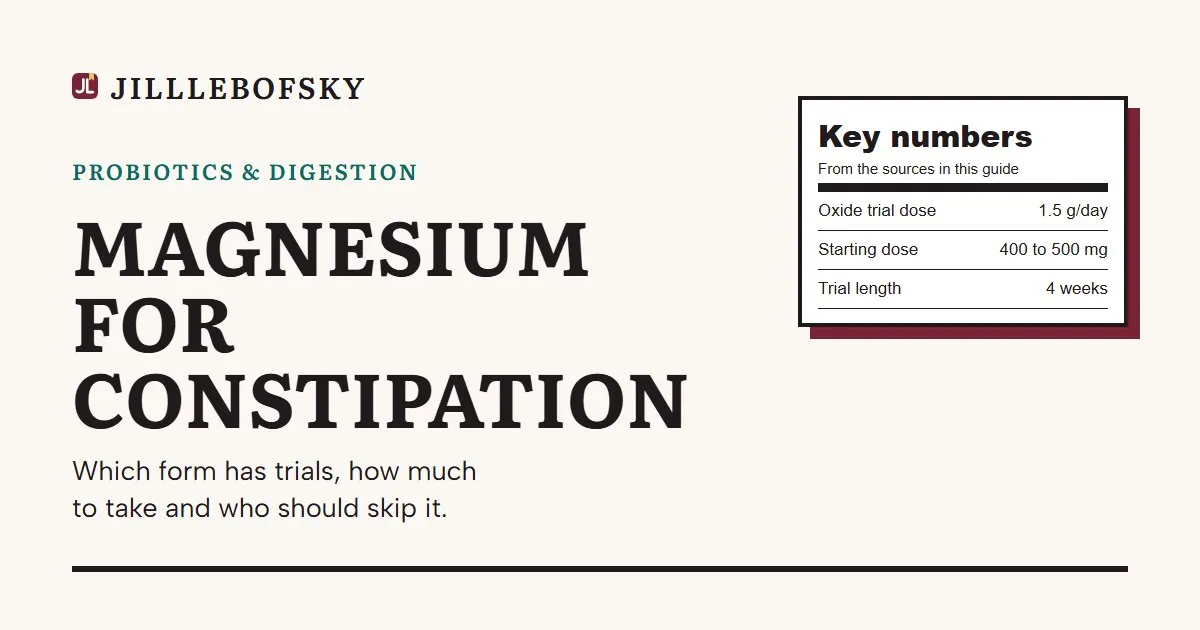
Magnesium for constipation works by pulling water into the bowel. Only magnesium oxide has placebo-controlled trials: at 1.5 g a day for four weeks, 68% of adults responded compared with 19% on placebo. Guidelines suggest starting at 400 to 500 mg a day. People with kidney disease should avoid it, and citrate or glycinate forms are untested for chronic constipation.
Magnesium for constipation works as an osmotic laxative: magnesium your gut does not absorb pulls water into the bowel and softens stool. We read the NIDDK constipation pages, the NIH Office of Dietary Supplements fact sheet, two gastroenterology and dietetics guidelines, a meta-analysis, a 2026 systematic review and five trials before writing this guide.[1][5][6][7]
The short answer: only magnesium oxide has placebo-controlled trials, and at 1.5 g a day for four weeks 68% of people responded compared with 19% on placebo.[8] Other forms, such as citrate or glycinate, have not been tested for chronic constipation.[6]
| What it is | A mineral that acts as an osmotic laxative when much of it stays in the gut[5] |
|---|---|
| Form with trials | Magnesium oxide only; other forms are untested for chronic constipation[6] |
| Trial dose | 1.5 g magnesium oxide a day for 4 weeks[6] |
| Typical starting dose | 400 to 500 mg magnesium oxide a day, raised only if needed[6] |
| Best evidence | 2 trials, 94 people; 68% vs 19% responded[7][8] |
| Main risk | Too much magnesium in the blood, mostly with kidney disease[6][13] |
| Who should avoid it | People with kidney problems; check with a clinician in pregnancy[6] |
How does magnesium for constipation work?
Magnesium for constipation works by holding water in the bowel. Magnesium that is not absorbed stays inside the gut and draws water in, which makes stool softer and easier to pass. The NIH fact sheet calls this the osmotic activity of unabsorbed magnesium salts, plus a push on gut movement.[5]
That is why the NIDDK lists Milk of Magnesia next to MiraLAX as an osmotic agent, a different class from stimulant laxatives such as Dulcolax.[1] The 2023 American Gastroenterological Association and American College of Gastroenterology (AGA-ACG) guideline describes the same mechanism: nonabsorbed magnesium creates an osmotic gradient that pulls water and salts into the bowel.[6]
Constipation is common. About 16 in 100 adults have it, rising to about 33 in 100 adults aged 60 and older.[3] Doctors usually define it as fewer than three bowel movements a week, often with hard, dry stool that is painful to pass.[2]
The forms that cause the most loose stool are the ones that stay in the gut. The NIH fact sheet names magnesium carbonate, chloride, gluconate and oxide as the forms most often linked to diarrhea.[5] People taking magnesium for sleep see that as a side effect; for constipation it is the effect you want.
What do the trials on magnesium oxide show?
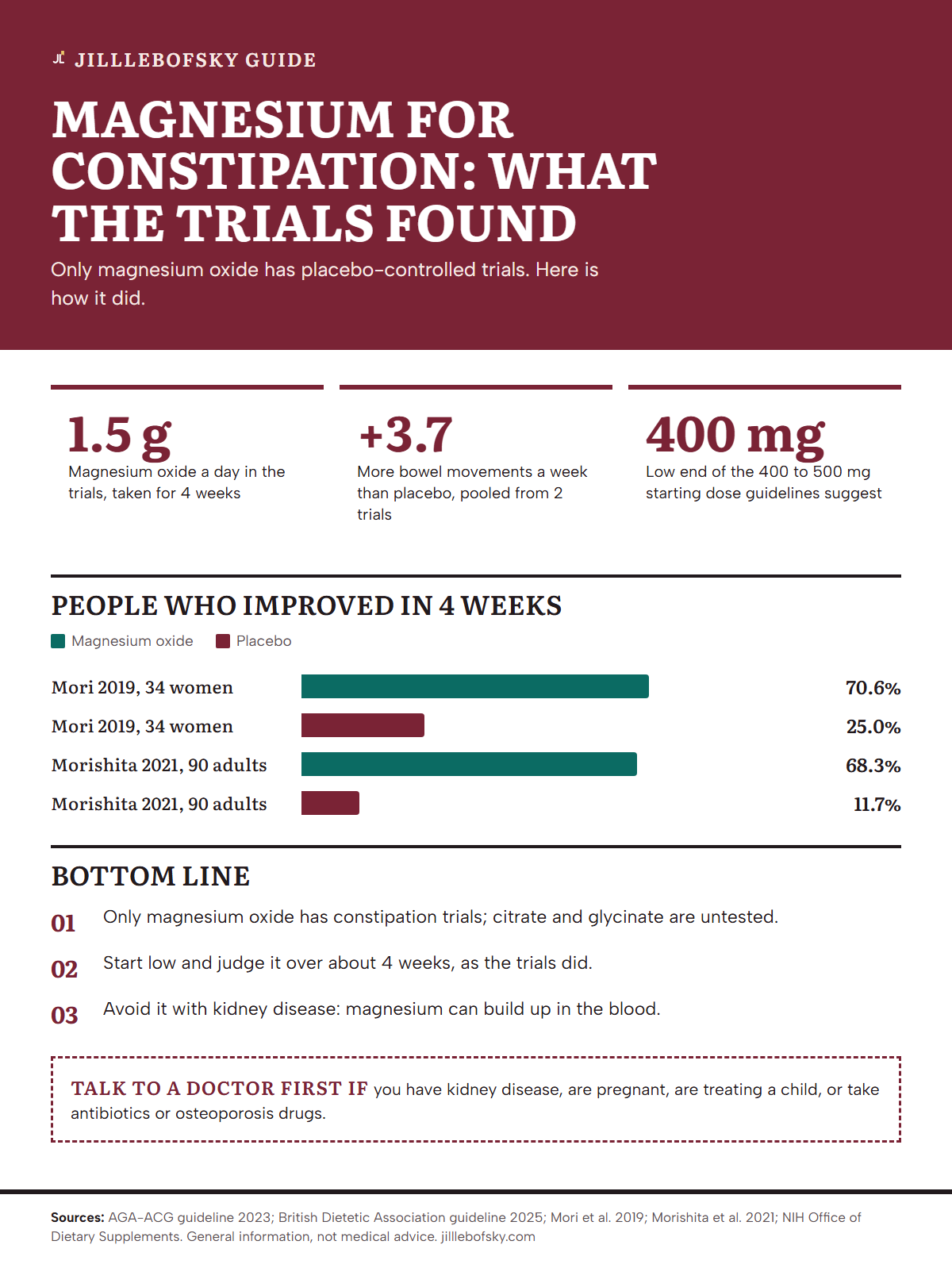
Two small Japanese trials found magnesium oxide clearly beat placebo over four weeks. In pooled data from 94 adults, 68% responded to magnesium oxide and 19% to placebo, with about 3.7 more bowel movements a week. Both guidelines treat these results as real, though the trials were small.[7][8]
| Study | Who and how long | Dose | Result |
|---|---|---|---|
| Mori, 2019[9] | 34 women with mild to moderate constipation, 28 days | 0.5 g magnesium oxide 3 times a day | 70.6% improved vs 25.0% on placebo |
| Morishita, 2021[10] | 90 adults, mean age 42, 28 days | 1.5 g magnesium oxide or 1.0 g senna | 68.3% magnesium, 69.2% senna, 11.7% placebo |
| van der Schoot, 2023[8] | Meta-analysis of 8 trials, 787 people (2 on magnesium) | Magnesium oxide arms | 68% vs 19% responded; softer stool |
| Kadhem, 2026[11] | Review of 7 studies, 690 people, infants to adults | Mostly magnesium oxide | 4 of 7 improved frequency; not enough for a firm recommendation |
The Morishita trial also tested senna, a stimulant laxative. Both worked about equally well, with no severe treatment-related side effects.[10]
The AGA-ACG panel rated the overall certainty of evidence as very low, because the trials were small, all were run in Japan, and 93% of the people in them were women.[6] The British Dietetic Association (BDA) still gave magnesium oxide a strong recommendation with moderate evidence for response, stool frequency and stool softness.[7]
Which type of magnesium is best for constipation?
Magnesium oxide is the only form with constipation trials, so it is the evidence-based pick. The AGA-ACG guideline says the effect of citrate, glycinate, lactate, malate and sulfate on chronic constipation is unknown. A 2026 review agreed that its oxide results cannot be assumed to apply to other forms.[6][11]
Supplement marketing often says otherwise. Glycinate is often sold as gentle on the stomach, which is a reason it is a poor fit if you want a laxative effect. Citrate is sold for both, but no chronic constipation trial has tested it.[6]
| Form | Constipation trials | What to know |
|---|---|---|
| Magnesium oxide | Yes, 2 placebo-controlled trials | The form both guidelines back[6][7] |
| Magnesium hydroxide (Milk of Magnesia) | No modern placebo trials found | Sold as an over-the-counter laxative; 500 mg magnesium per tablespoon[1][5] |
| Magnesium citrate | None for chronic constipation | Efficacy unknown[6] |
| Magnesium glycinate | None | Efficacy unknown[6] |
| Magnesium-rich mineral water | 4 trials, 755 people | More responders, no change in weekly bowel movements[7] |
So if you choose a supplement, pick one that lists magnesium oxide. If a product blends several forms, you cannot tell how much of the dose matches the trials.
How much magnesium should you take for constipation?
The trials used 1.5 g of magnesium oxide a day, split through the day in one study. The AGA-ACG guideline suggests starting lower, at 400 to 500 mg of magnesium oxide a day, and raising the dose only if needed. Doses of 500 mg to 1 g a day are common in practice.[6][9]
Labels make this confusing. The Supplement Facts panel lists elemental magnesium, not the weight of the whole compound.[5] By our arithmetic, magnesium oxide is about 60% magnesium by weight, so the 1.5 g trial dose gives roughly 900 mg of magnesium. A label that says 250 mg of magnesium from oxide is close to a 400 mg oxide tablet.
That trial dose sits well above the 350 mg upper limit set for supplemental magnesium in healthy adults.[5] The NIH fact sheet notes that laxative doses can exceed that limit because much of the magnesium passes out unabsorbed.[5] Even so, this is a medicine-level dose, so plan it with a clinician rather than climbing on your own.
| Situation | What the sources support |
|---|---|
| Starting out, healthy kidneys | 400 to 500 mg magnesium oxide a day[6] |
| No change after a week or two | Ask a clinician before moving toward 1 to 1.5 g a day[6] |
| Kidney disease | Avoid; risk of high blood magnesium[6] |
| Pregnancy | Use only with your prenatal provider's advice[6] |
How long does magnesium take to work for constipation?
Every placebo-controlled trial measured results over four weeks, not hours. Response in the magnesium oxide trials was judged across 28 days of daily use, so a fair test is several weeks, not one dose. We found no trial that timed the first bowel movement after a single supplement dose.[9][10]
Mineral water studies give one more clue. In a 2026 German trial, adults with chronic constipation drank 1 L a day of sulfate- and magnesium-rich water or low-mineral water for three weeks.[12] The median time to respond was 9 days with the mineral water and 16 days with the control water.
The same trial missed its main goal. Bowel movements rose more with the mineral water at week two, but the difference at week three was not significant.[12] That fits the BDA's pooled finding: high-mineral water raised the number of people who felt better, but did not change weekly bowel movement counts.[7]
If nothing improves after about four weeks at a sensible dose, magnesium is probably not the right tool for you. That is a good point to talk to your doctor about other options.
Who should not take magnesium for constipation?
People with kidney disease should not take magnesium for constipation without a doctor. Healthy kidneys clear extra magnesium, so weak kidneys let it build up in the blood, a condition called hypermagnesemia. The AGA-ACG guideline says to avoid magnesium oxide in people with renal insufficiency.[5][6]
In a Japanese hospital study of 320 patients prescribed magnesium oxide, 75 (23%) developed high blood magnesium.[13] Risk rose with reduced kidney function, doses of 1,650 mg a day or more, and use for 36 days or longer. Very large doses from laxatives and antacids, typically over 5,000 mg a day, have caused fatal toxicity.[5]
Medicines that interact
- Osteoporosis drugs called bisphosphonates: take them at least 2 hours apart from magnesium.[5]
- Tetracycline and quinolone antibiotics: take the antibiotic 2 hours before or 4 to 6 hours after magnesium.[5]
- Diuretics and long-term acid reducers can change magnesium levels, so ask your pharmacist.[5]
See a doctor right away if you have
- Bleeding from the rectum or blood in your stool[2]
- Constant belly pain, vomiting or a fever[2]
- Trouble passing gas, lower back pain, or weight loss without trying[2]
Children are a separate case. A trial in 60 children under six found magnesium oxide softened stool, but the NIDDK advises against giving a child any laxative unless a doctor says so.[14][1]
What do doctors use first for constipation?
Doctors usually start with diet, fluids and routine changes, then add a laxative if needed. The NIDDK recommends 22 to 34 grams of fiber a day for adults, plus enough liquid to help the fiber work. Using the toilet after breakfast and putting your feet on a footstool can also help.[1]
If you are unsure how close you are to that target, our guide to how much fiber per day by age and sex breaks it down. Psyllium is the fiber supplement with the strongest record, covered in our psyllium husk dose and safety guide.
The AGA-ACG guideline strongly recommends polyethylene glycol (MiraLAX) and gives magnesium oxide a conditional recommendation.[6] It places magnesium oxide either after a trial of fiber or alongside it. MedlinePlus adds that most constipation is short-lived and not serious, and that laxatives belong in the plan only when your provider says so.[4]
If constipation swaps with diarrhea and comes with belly pain, the cause may be irritable bowel syndrome. Our page on IBS symptoms and red flags explains when to ask about it.
What should you check on a magnesium label?
A label check takes a minute and tells you whether a product matches the trials. Look for magnesium oxide named as the form, and read the elemental magnesium per serving on the Supplement Facts panel. Those two facts let you compare a product with the 400 to 500 mg oxide starting dose.[5][6]
- Confirm the form is magnesium oxide, not a blend of several salts.[6]
- Read the elemental magnesium per serving and work back to the oxide amount (oxide is about 60% magnesium).
- Check the serving size: some products need two or three capsules for the listed amount.
- Avoid stacking magnesium from a laxative, an antacid and a daily multivitamin without counting the total.[5]
- Look for a refund policy, since the trials judged results over four weeks.[9]
- Skip any product that promises a permanent fix for constipation; no trial has shown one.
We use the same checks when we score products, as set out in how we review supplements. More gut guides sit in our probiotics and digestion section.
Is magnesium worth trying for constipation?
For many adults with healthy kidneys, magnesium oxide is a reasonable, low-cost option after fiber and fluids. It is the only magnesium form with constipation trials, and two guidelines support it, though the evidence comes from fewer than 100 people. The AGA-ACG panel called its mix of benefit, tolerability and low cost attractive.[6][7]
Our judgement: start with fiber and water, and add magnesium oxide at a low dose if that is not enough. Skip citrate or glycinate products sold for regularity until trials exist.
If you have kidney disease, take several daily medicines, are pregnant, or are treating a child, ask a clinician before using any magnesium laxative. See a doctor promptly for new constipation with bleeding or weight loss.[2]
Frequently asked questions
Can I take magnesium for constipation while pregnant?
Only with your prenatal provider's advice. The AGA-ACG guideline lists pregnancy as a reason for caution with magnesium oxide, and the trials did not study pregnant people. Your provider can suggest fiber, fluids or a laxative with a better safety record for pregnancy.
Can children take magnesium for constipation?
Not without a doctor. One trial in 60 children under six found magnesium oxide softened stool, but the NIDDK says a child should not get any laxative unless a doctor recommends it. Doses for children differ from adult doses.
Is Milk of Magnesia the same as a magnesium supplement?
No. Milk of Magnesia is an over-the-counter laxative made from magnesium hydroxide, with 500 mg of magnesium per tablespoon. Supplements usually hold far less per serving, and the constipation trials tested magnesium oxide tablets, not either of these products.
Does magnesium-rich mineral water help constipation?
It may help a little. Four trials with 755 people found more people felt better on high-mineral water, but weekly bowel movements did not change. Studies used 0.5 to 1.5 liters a day for two to six weeks.
Can I take magnesium with psyllium or other fiber?
Yes, for most adults. The AGA-ACG guideline places magnesium oxide either after a trial of fiber or together with it. Take fiber with plenty of water, and keep magnesium apart from antibiotics and osteoporosis drugs as the label or pharmacist advises.
Sources
- Treatment for Constipation. NIDDK, National Institutes of Health
- Symptoms & Causes of Constipation. NIDDK, National Institutes of Health
- Definition & Facts for Constipation. NIDDK, National Institutes of Health
- Constipation. MedlinePlus, National Library of Medicine
- Magnesium: Fact Sheet for Health Professionals. NIH Office of Dietary Supplements, 2026
- AGA-ACG Clinical Practice Guideline: Pharmacological Management of Chronic Idiopathic Constipation. Chang et al., American Journal of Gastroenterology, 2023
- British Dietetic Association Guidelines for the Dietary Management of Chronic Constipation in Adults. Dimidi et al., Neurogastroenterology and Motility, 2025
- The effect of food, vitamin, or mineral supplements on chronic constipation in adults: systematic review and meta-analysis. van der Schoot et al., Neurogastroenterology and Motility, 2023
- A Randomized Double-blind Placebo-controlled Trial on the Effect of Magnesium Oxide in Patients With Chronic Constipation. Mori et al., Journal of Neurogastroenterology and Motility, 2019
- Senna Versus Magnesium Oxide for the Treatment of Chronic Constipation: A Randomized, Placebo-Controlled Trial. Morishita et al., American Journal of Gastroenterology, 2021
- Efficacy of Magnesium Supplementation in Functional Constipation: A Systematic Review. Kadhem et al., Cureus, 2026
- Daily consumption of sulfate- and magnesium-rich mineral water enhances bowel function in adults with chronic constipation. Mansouri et al., Frontiers in Nutrition, 2026
- Risk factors for the development of hypermagnesemia in patients prescribed magnesium oxide. Wakai et al., Journal of Pharmaceutical Health Care and Sciences, 2019
- Lactobacillus reuteri DSM 17938 and Magnesium Oxide in Children with Functional Chronic Constipation. Kubota et al., Nutrients, 2020
This page is general information, not medical advice. Talk to your doctor or pharmacist before you start any supplement, especially if you are pregnant, take medicine or have a health condition. Read our medical disclaimer and how we review.