IBS symptoms are repeated belly pain linked to bowel movements, plus diarrhea, constipation or both, often with bloating. About 12% of Americans have IBS. Doctors diagnose it from the Rome IV pattern: pain at least 1 day a week for 3 months. Bleeding, black stools, weight loss and anemia are not IBS. A limited low FODMAP trial and soluble fiber are common first steps.
To explain IBS symptoms, we read the NIDDK pages on IBS symptoms, diagnosis, diet and treatment, the MedlinePlus and NCCIH summaries, the 2021 American College of Gastroenterology (ACG) guideline, a review of the Rome IV criteria, and three meta-analyses on the low FODMAP diet, fiber and talk therapies. Our review method explains how we pick and grade sources.
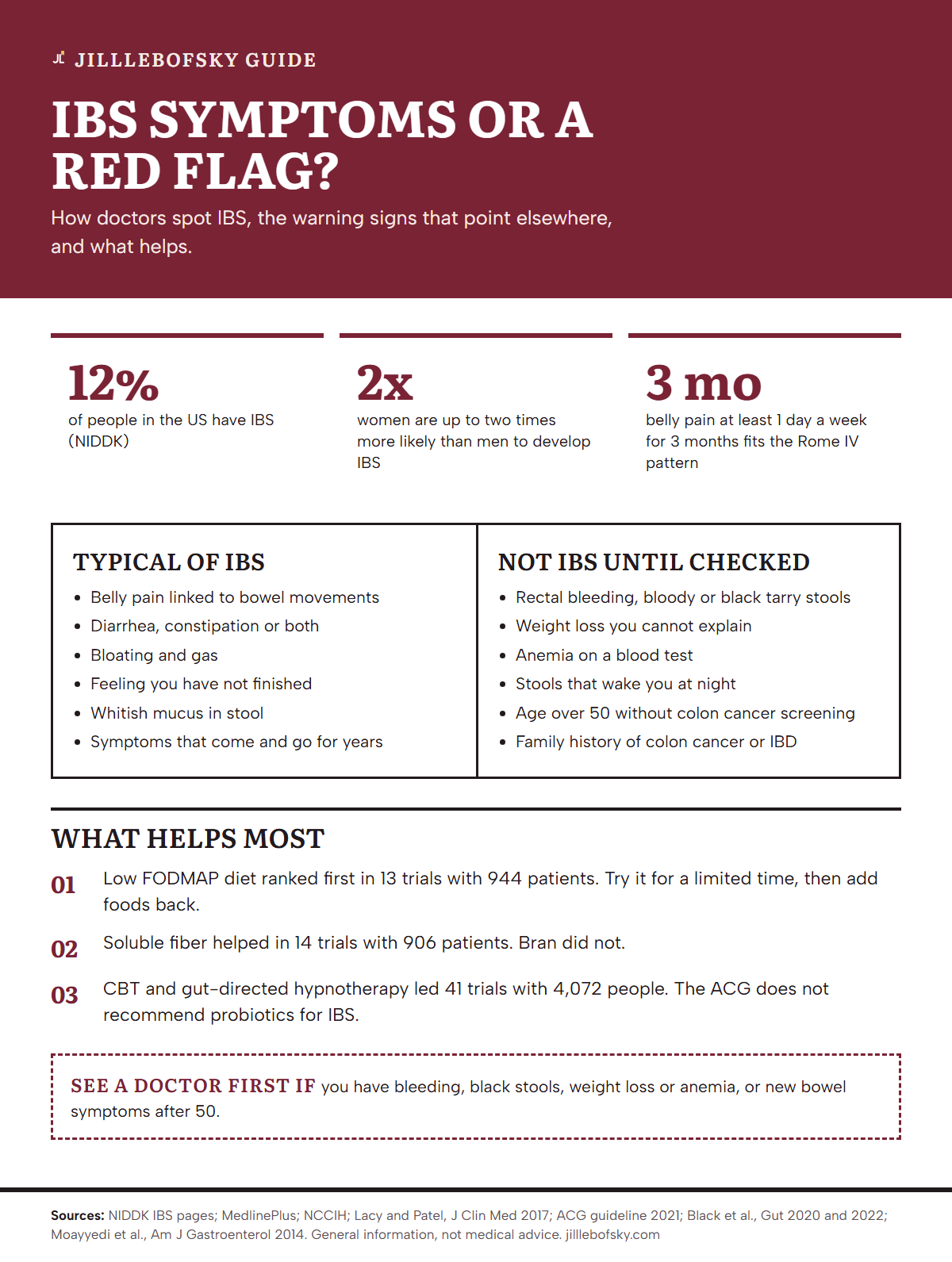
The short answer: IBS causes repeated belly pain linked to bowel movements, plus diarrhea, constipation or both, with no visible damage to the gut, and it affects about 12% of people in the United States.[1]
| What it is | A long-term disorder of how the gut and brain work together, with no visible damage or disease in the digestive tract[1] |
|---|---|
| Main symptoms | Belly pain often tied to bowel movements, diarrhea or constipation or both, bloating, a feeling of not being finished, whitish mucus in stool[2] |
| How common | About 12% of people in the US; women are up to two times more likely than men to develop it[1] |
| How it is diagnosed | Belly pain at least 1 day a week for the last 3 months, with symptoms that began at least 6 months ago[3][8] |
| Best evidence for relief | Low FODMAP diet (13 trials), soluble fiber (14 trials), CBT and gut-directed hypnotherapy (41 trials of talk therapies)[10][11][12] |
| Safety | IBS can be painful but does not damage the digestive tract or lead to other health problems[2] |
| Not IBS until checked | Rectal bleeding, black or bloody stools, weight loss, anemia, or age over 50 without colon cancer screening[3][8] |
What are the most common IBS symptoms?
The most common IBS symptoms are pain in the belly that is often related to bowel movements and a change in bowel habits: diarrhea, constipation or both.[2] IBS is a disorder of gut-brain interaction, which means the gut is more sensitive and the bowel muscles contract differently, without any visible damage.[1]
The pain may ease or get worse after you pass a stool.[3] Other common symptoms include:
- bloating or a swollen-feeling belly[2]
- the feeling that you have not finished a bowel movement[2]
- whitish mucus in the stool[2]
- more symptoms during menstrual periods for many women[2]
The Rome IV committee now lists bloating and distention as common IBS symptoms, a change from older criteria.[8] Many people have normal bowel movements on some days and abnormal ones on others.[1]
IBS is chronic. It often lasts for years, but the symptoms tend to come and go.[2] People with IBS also often have fibromyalgia, chronic fatigue syndrome, chronic pelvic pain, reflux, indigestion, anxiety or depression.[1] Doctors once called it spastic colon, mucous colitis or nervous colon.[1]
MedlinePlus adds that IBS can be very uncomfortable but does not harm the intestines.[6]
What are the types of IBS: IBS-C, IBS-D and IBS-M?
Doctors sort IBS into three main types by looking at your stools on the days when bowel movements are abnormal.[1] The type depends on whether more than a quarter of those stools are hard or lumpy, loose or watery, or both.[1] Knowing the type matters because some medicines help only one type and can make another worse.[1]
| Type | Hard or lumpy stools | Loose or watery stools |
|---|---|---|
| IBS-C (constipation) | More than a quarter[1] | Less than a quarter[1] |
| IBS-D (diarrhea) | Less than a quarter[1] | More than a quarter[1] |
| IBS-M (mixed) | More than a quarter[1] | More than a quarter[1] |
A fourth label, IBS unsubtyped, covers people who do not fit one pattern.[8] Doctors often use the Bristol stool form scale to describe stools. Types 1 and 2 (hard, lumpy) point to constipation, types 6 and 7 (mushy or watery) point to diarrhea, and types 3 and 4 are normal.[8]
For the most accurate type, the Rome review suggests keeping a 14-day bowel diary when it fits the clinical setting.[8] Your doctor can still diagnose IBS if your pattern does not fit one type neatly.[1]
What causes IBS, and what triggers a flare?
Doctors are not sure what causes IBS, and different factors may drive it in different people.[2] In some people with IBS, food moves too fast or too slowly through the gut, and a normal amount of gas or stool causes pain.[2]
Problems that are more common in people with IBS, and may play a role, include:[2]
- stressful or difficult early life events, such as physical or sexual abuse
- anxiety, depression and somatic symptom disorder
- bacterial infections in the digestive tract
- small intestinal bacterial overgrowth (SIBO)
- food intolerances or sensitivities
Genes may also make some people more likely to develop IBS.[2] A family member with IBS and a severe gut infection both raise the odds.[1] IBS is more common in people younger than 50,[1] and MedlinePlus says it is most often found in people younger than 45.[6]
Common food triggers are FODMAPs, a group of carbohydrates that are hard to digest. Examples include apples, pears, watermelon, onions, garlic, beans, milk, wheat, honey and sweeteners such as sorbitol and xylitol.[5] Adding a lot of fiber at once can also cause gas that sets off symptoms.[5] Some people feel worse after gluten even without celiac disease.[5]
Which symptoms are not IBS?
Some symptoms do not fit IBS and suggest another health problem.[3] Bleeding from the rectum, bloody or black tarry stools, weight loss and anemia are warning signs that need a doctor's check before anyone calls it IBS.[3]
A review of the Rome IV approach adds more warning signs that doctors rule out first:[8]
- age over 50 without prior colon cancer screening
- passing stools at night that wake you up
- unintentional weight loss
- a family history of inflammatory bowel disease or colorectal cancer
- a recent change in bowel habits
- a lump that can be felt in the belly
Age matters because IBS usually starts earlier in life. People younger than 50 are more likely to develop it than people older than 50,[1] so new bowel symptoms that start later deserve a closer look. A family history of celiac disease, colon cancer or inflammatory bowel disease also changes which tests a doctor orders.[3]
Conditions that can mimic IBS include celiac disease, lactose intolerance, SIBO, inflammatory bowel disease and colon cancer. Doctors check for these with blood tests, stool tests, a breath test, an upper endoscopy or a colonoscopy.[3]
How do doctors diagnose IBS?
There is no specific test for IBS.[6] Doctors diagnose IBS mainly from a symptom pattern known as the Rome IV criteria, together with your medical and family history and a physical exam.[3][8]
Under Rome IV, you have recurring belly pain on average at least 1 day a week in the last 3 months, linked to two or more of these:[8]
- The pain is related to having a bowel movement.
- The pain comes with a change in how often you go.
- The pain comes with a change in how your stool looks.
Symptoms must have started at least 6 months before diagnosis, though a doctor may still diagnose IBS after a shorter time.[3]
In most cases, doctors do not need tests to diagnose IBS.[3] The 2021 ACG guideline suggests a positive diagnosis based on symptoms rather than testing for everything else first. For people with diarrhea, it suggests a blood test for celiac disease and a stool test called fecal calprotectin to rule out inflammatory bowel disease.[9] A hydrogen breath test, an upper endoscopy or a colonoscopy are used when results or symptoms point to another condition.[3]
What is the best IBS treatment to try first?
Most people start with changes to what they eat and how they live, then add medicine or a gut-brain therapy if symptoms continue.[4] The low FODMAP diet has the strongest diet evidence: a 2022 analysis of 13 trials with 944 patients ranked it first for overall symptoms.[10]
The ACG recommends only a limited trial of low FODMAP eating.[9] NIDDK describes cutting high-FODMAP foods for a few weeks, then slowly adding them back to find your personal triggers.[5] Most of the trials took place in specialist clinics and did not test the add-back phase, so a dietitian's help is worth asking for.[10][5]
Soluble fiber is the other strong first step. A 2014 meta-analysis of 14 trials with 906 patients found fiber helped IBS overall, and the benefit came from soluble fiber such as psyllium. Bran did not help.[11] Adults need 22 to 34 grams of fiber a day, and adding 2 to 3 grams a day at a time helps prevent gas and bloating.[5] We compare fiber products in our guide to gut health supplements.
Being more active, lowering stress where you can and getting enough sleep may also help.[4]
Which first step fits your IBS symptoms?
| If your main problem is | A common first step to discuss | What a doctor may add |
|---|---|---|
| Constipation (IBS-C) | More soluble fiber, added slowly[5] | Fiber supplements, laxatives, lubiprostone, linaclotide or plecanatide[4] |
| Diarrhea (IBS-D) | A limited low FODMAP trial[9] | Loperamide, rifaximin, eluxadoline or alosetron[4] |
| Belly pain and cramps | Tracking food and stress triggers[2] | Antispasmodics, low-dose antidepressants, coated peppermint oil[4] |
| Bloating | A limited low FODMAP trial[10] | A dietitian to guide food reintroduction[5] |
| Stress makes it worse | Sleep and activity habits[4] | CBT or gut-directed hypnotherapy[12] |
What does the research show for IBS treatment?
The best-studied options are diet changes, soluble fiber and talk therapies, while probiotics and prebiotics have weaker or mixed results.[7][10][11][12] No single option works for everyone, and NIDDK notes that you may have to try a few treatments.[4]
| Review | Size | Main result |
|---|---|---|
| Low FODMAP diet (Black, Gut 2022) | 13 trials, 944 patients | Ranked first of all diets for overall symptoms, pain and bloating[10] |
| Fiber (Moayyedi, Am J Gastroenterol 2014) | 14 trials, 906 patients | Soluble fiber helped: one extra person improved for every 7 treated; bran did not[11] |
| Talk therapies (Black, Gut 2020) | 41 trials, 4,072 people | CBT and gut-directed hypnotherapy helped most; trials had high risk of bias[12] |
| Probiotics (2020 review cited by NCCIH) | 35 studies, 3,452 people | May ease pain, bloating and gas over 4 weeks; unclear which types work[7] |
| Peppermint oil (2020 review cited by NCCIH) | 11 studies, 684 people | Short-term relief of overall symptoms[7] |
| Prebiotics (2019 review cited by NCCIH) | 11 studies, 729 people | No improvement in gut symptoms or quality of life[7] |
What medicines do doctors use for IBS?
Doctors pick IBS medicines by type, because a drug that eases diarrhea can worsen constipation.[1] For IBS-D, options include loperamide, the antibiotic rifaximin, eluxadoline and alosetron; for IBS-C, options include laxatives, lubiprostone, linaclotide and plecanatide.[4]
The ACG guideline recommends rifaximin for overall IBS-D symptoms and recommends two drug classes for IBS-C: chloride channel activators (lubiprostone) and guanylate cyclase activators (linaclotide, plecanatide).[9][4] Alosetron is prescribed only to women and comes with special warnings.[4]
For belly pain, doctors may suggest antispasmodics, low doses of tricyclic antidepressants or SSRIs, or coated peppermint oil capsules.[4] Here the antidepressants are given at low doses to ease gut pain. Follow your doctor's dosing and ask what side effects to watch for.[4]
These medicines are standard care, and no supplement replaces them. NIDDK notes that you may have to try a few treatments to find what works.[4]
Do probiotics help IBS symptoms?
Probiotics may help some people with IBS, but the evidence is not strong enough to know for sure.[7] The 2021 ACG guideline does not recommend probiotics for IBS, because many different strains were tested in mostly small studies with mixed results.[7]
A 2020 review of 35 studies with 3,452 people found probiotics taken for 4 weeks may relieve pain, bloating and gas, with combinations doing better than single strains. The authors could not say which types work best.[7] In IBS-C, a 2022 review of 10 studies with 757 people found probiotics improved stool consistency but not pain, bloating or quality of life.[7] NIDDK says researchers are still studying them.[4]
Side effects in IBS are usually minor, such as cramping and nausea. The risk of harm is greater in people who are seriously ill or have weak immune systems.[7] Prebiotics did not improve symptoms in a 2019 review, and more than 20 grams a day can cause gas, bloating and diarrhea.[7]
Peppermint oil has more support. Enteric-coated capsules gave short-term relief in a 2020 review of 11 studies with 684 people, though a 2021 trial of 133 people found no difference from placebo after 6 weeks.[7] It can cause heartburn and should be avoided with GERD or a hernia.[7]
Do gut-brain therapies help IBS?
Yes, talk therapies aimed at the gut-brain link have good support for IBS.[12] Cognitive behavioral therapy (CBT) and gut-directed hypnotherapy had the largest evidence base in a 2020 analysis of 41 trials with 4,072 people.[12]
CBT helps you change thought and behavior patterns that feed symptoms. Gut-directed hypnotherapy uses a relaxed, focused state to calm gut sensations.[4] Both worked whether delivered face to face or with minimal therapist contact, and none of the therapies beat the others.[12] The authors warn that the trials had a high risk of bias, so the benefit may be overstated.[12]
The ACG suggests gut-directed psychotherapy for overall IBS symptoms.[9] Using these therapies does not mean the symptoms are imagined; IBS involves real changes in how the brain and gut signal each other.[1] A 2021 review of 6 studies found relaxation therapy alone did not help belly pain or overall symptoms.[7]
When should you see a doctor about IBS symptoms?
See a doctor if your symptoms are like those of IBS, even if they are mild, so you can get a proper diagnosis.[3] Talk to a doctor before starting probiotics or any other complementary product, and ask how much to take and for how long.[4]
See a doctor right away if you have:[3][8]
- bleeding from your rectum, or bloody or black tarry stools
- weight loss you cannot explain
- anemia found on a blood test
- diarrhea that wakes you at night
- new bowel symptoms after age 50 and no colon cancer screening
- a family history of colon cancer, celiac disease or inflammatory bowel disease
Some treatments have their own cautions. Peppermint oil can worsen reflux.[7] Probiotics carry more risk if you are seriously ill or have a weak immune system.[7] Hypnosis could worsen symptoms in people with some mental health conditions.[7] If you are pregnant, ask before trying any new supplement or therapy.[7]
Practical checklist for IBS symptoms
- Keep a 2-week diary of stools, pain, food and stress, and bring it to your appointment.[8]
- Note which stool type you see most often on bad days so your doctor can name your IBS type.[1]
- Check for warning signs first: bleeding, black stools, weight loss or anemia.[3]
- Add soluble fiber slowly, about 2 to 3 grams a day more at a time.[5]
- Ask about a limited low FODMAP trial with a dietitian, then add foods back.[9][5]
- If you try a probiotic, know that the IBS studies lasted about 4 weeks, and ask your doctor how long to try one.[7][4]
- Ask whether CBT or gut-directed hypnotherapy is available to you.[12]
More digestion guides sit in our probiotics and digestion section, and our editorial policy explains how we handle medical topics.
Bottom line
IBS symptoms center on belly pain tied to bowel movements, with diarrhea, constipation or both, and they often come and go for years without damaging the gut.[1][2] Bleeding, black stools, weight loss, anemia and new symptoms after 50 are not typical of IBS and need a doctor first.[3][8]
For most people, a short, guided low FODMAP trial and slowly added soluble fiber are better first steps than a probiotic, because they have more trial support.[10][11][7] If symptoms persist, medicines matched to your IBS type and CBT or hypnotherapy have stronger evidence than any supplement.[4][12]
Frequently asked questions
What is the best IBS treatment?
There is no single best IBS treatment. Doctors usually start with diet changes such as a limited low FODMAP trial or more soluble fiber, then add medicines matched to IBS-C or IBS-D, or gut-directed talk therapy, if symptoms continue.
What does IBS pain feel like?
IBS pain is usually cramping belly pain that is linked to bowel movements. It may ease or get worse after you pass a stool, and it often comes with bloating, gas and a feeling that you have not finished.
Can IBS turn into cancer or damage the bowel?
No. NIDDK says IBS can be painful but does not damage the digestive tract or lead to other health problems. Bleeding, black stools or weight loss are not IBS symptoms, so they need a doctor's check.
Can stress cause IBS flare-ups?
Stress can make IBS symptoms worse because IBS involves the way the brain and gut signal each other. Reducing stress, sleeping enough and therapies such as CBT or gut-directed hypnotherapy may help some people.
How long does an IBS flare-up last?
There is no fixed length. IBS is a long-term condition, and symptoms come and go, sometimes for years. Many people have normal bowel days mixed with bad days. Keeping a diary helps you and your doctor spot patterns.
Sources
- Definition & Facts for Irritable Bowel Syndrome. NIDDK, reviewed 2017
- Symptoms & Causes of Irritable Bowel Syndrome. NIDDK, reviewed 2017
- Diagnosis of Irritable Bowel Syndrome. NIDDK, reviewed 2017
- Treatment for Irritable Bowel Syndrome. NIDDK, reviewed 2017
- Eating, Diet, & Nutrition for Irritable Bowel Syndrome. NIDDK, reviewed 2017
- Irritable Bowel Syndrome. MedlinePlus, National Library of Medicine, current
- Irritable Bowel Syndrome: What You Need To Know. NCCIH, current
- Rome Criteria and a Diagnostic Approach to Irritable Bowel Syndrome (Lacy and Patel). Journal of Clinical Medicine, 2017
- ACG Clinical Guideline: Management of Irritable Bowel Syndrome (Lacy et al.). American Journal of Gastroenterology, 2021
- Efficacy of a low FODMAP diet in irritable bowel syndrome: systematic review and network meta-analysis (Black et al.). Gut, 2022
- The effect of fiber supplementation on irritable bowel syndrome: a systematic review and meta-analysis (Moayyedi et al.). American Journal of Gastroenterology, 2014
- Efficacy of psychological therapies for irritable bowel syndrome: systematic review and network meta-analysis (Black et al.). Gut, 2020
This page is general information, not medical advice. Talk to your doctor or pharmacist before you start any supplement, especially if you are pregnant, take medicine or have a health condition. Read our medical disclaimer and how we review.