To improve gut health, raise fiber slowly toward 22 to 34 grams a day, eat a wide range of plants, add fermented foods with live cultures, stay active and use antibiotics only when needed. Probiotic supplements have solid evidence mainly for cutting antibiotic diarrhea. For IBS, Crohn's disease and ulcerative colitis, the AGA advises them only within clinical trials.

This guide shows how to improve gut health with steps that have human research behind them. We read the NIDDK pages on fiber and IBS, the NCCIH probiotic page, the 2020 American Gastroenterological Association (AGA) probiotic guideline, two large reviews, USDA fiber data and five human studies on diet, antibiotics and exercise. Our supplement review method explains how we pick and grade sources.
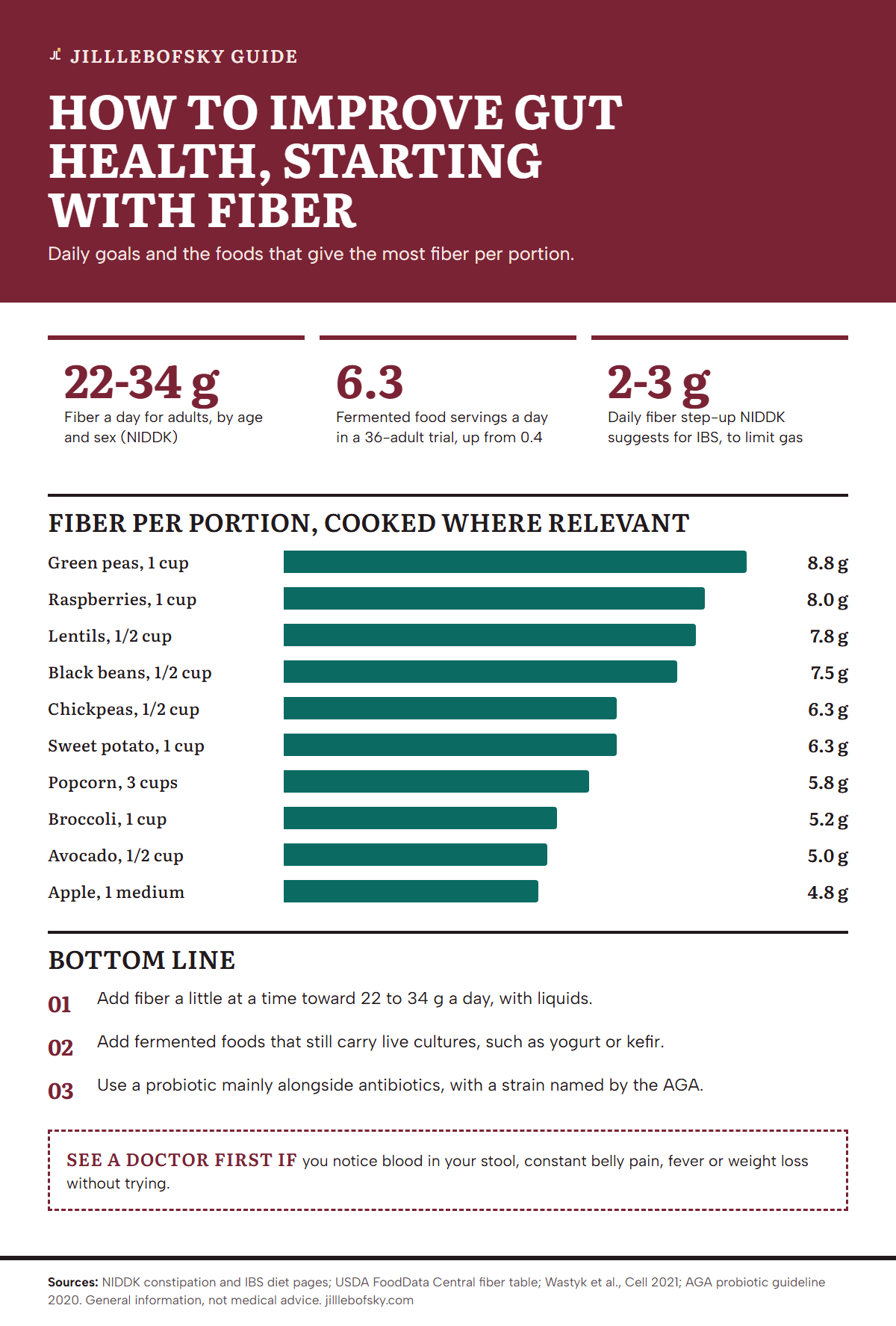
The short answer: eat more fiber, added slowly, toward the adult goal of 22 to 34 grams a day, add fermented foods with live cultures, and take antibiotics only when you need them.[1][5][12] A probiotic supplement has good evidence for one job, cutting antibiotic diarrhea, and much weaker evidence for everyday gut health.[8]
| Daily fiber goal for adults | 22 to 34 grams, depending on age and sex[1] |
|---|---|
| How fast to add fiber | A little at a time; for IBS, NIDDK suggests 2 to 3 grams more a day[1][14] |
| Strongest food evidence | 64 trials in 2,099 healthy adults: added fiber raised Bifidobacterium and Lactobacillus[4] |
| Fermented foods | In a trial of 36 adults, rising to 6.3 servings a day raised microbe diversity and lowered 19 of 93 inflammation proteins[5] |
| Probiotic supplements | About half the risk of antibiotic diarrhea in a 17-study review; the AGA advises them for IBS only in trials[8][9] |
| Main side effects | Fiber added too fast causes gas, bloating and cramps; probiotics carry more risk with a weak immune system[2][8] |
| See a doctor first if | You notice blood in your stool, constant belly pain, fever or weight loss without trying[15] |
How to improve gut health: 7 steps in order
The steps with the best evidence are food steps: more fiber, more kinds of plants and fermented foods with live cultures. Supplements come later, and only for specific jobs. Work down the list in order and add one change at a time, so you can tell which change helps and which one gives you gas.[1]
- Raise fiber slowly toward 22 to 34 grams a day, and drink liquids with it.[1]
- Build meals on beans, lentils and peas. Half a cup of cooked lentils gives 7.8 grams of fiber, and the same amount of black beans gives 7.5 grams.[3]
- Eat many different plants. In the American Gut project, people eating more than 30 plant types a week had different gut bacteria from people eating 10 or fewer.[7]
- Add a fermented food that still has live microbes, such as yogurt, kefir or unheated sauerkraut.[6]
- Take antibiotics only when you need them. They do nothing for viral infections, and one course cut gut diversity within 3 to 4 days in a small study.[12][10]
- Stay active. Six weeks of endurance training changed gut bacteria in 32 adults, though the changes faded once they stopped.[13]
- Use a probiotic only for a clear reason, such as a course of antibiotics, and pick a strain the AGA guideline names.[9]
More guides on fiber, probiotics and digestion sit in our probiotics and digestion section.
What the studies behind these steps found
Most gut studies are small and measure bacteria or blood markers, not disease. This table lists the human research the steps rest on, with its size and what it measured.
| Study | Who and how long | What changed | What it found |
|---|---|---|---|
| So, 2018 review[4] | 64 studies, 2,099 healthy adults | Added fiber | More Bifidobacterium and Lactobacillus; no change in diversity |
| Wastyk, 2021[5] | 36 adults, 17-week study | Fermented foods, 0.4 to 6.3 servings a day | Diversity rose; 19 of 93 inflammation proteins fell |
| Wastyk, 2021[5] | Same trial, fiber arm | Fiber, 21.5 to 45.1 grams a day | Diversity stayed stable |
| American Gut, 2018[7] | Over 10,000 volunteers, observational | More than 30 plant types a week vs 10 or fewer | Fewer antibiotic resistance genes |
| Dethlefsen, 2011[10] | 3 people, 10 months | Two ciprofloxacin courses | Diversity fell within 3 to 4 days; recovery often incomplete |
| Allen, 2018[13] | 32 sedentary adults, 6 weeks | Endurance exercise 3 days a week | Short-chain fatty acids rose in lean adults; changes reversed after stopping |
| Goldenberg, 2017 Cochrane[11] | 31 trials, 8,672 patients | Probiotics with antibiotics | C. difficile diarrhea 1.5% vs 4.0% |
How much fiber per day does your gut need?
NIDDK says adults should get 22 to 34 grams of fiber a day, with the exact goal set by age and sex.[1] MedlinePlus notes that most Americans do not eat enough.[2] In a review of 64 trials, extra fiber raised Bifidobacterium and Lactobacillus, two groups of bacteria often linked with a healthy gut.[4]
Adding fiber too quickly can cause gas, bloating and cramps.[2] NIDDK suggests that people with IBS raise intake by 2 to 3 grams a day to limit gas and bloating.[14] Drinking liquids helps fiber work.[1]
The same review found no change in overall diversity, meaning the number of different bacteria types.[4] Fiber shifts which bacteria thrive more than it adds new kinds. Our guide to how much fiber per day by age, sex and calorie level breaks the goal down further.
What foods improve gut health?
Beans, lentils, peas, berries, whole grains, nuts and seeds give the most fiber per portion. USDA data put a cup of cooked green peas at 8.8 grams of fiber and a cup of raspberries at 8.0 grams.[3] Fermented dairy and vegetables add live microbes on top of that fiber.[6]
| Food | Portion | Fiber (g) |
|---|---|---|
| Green peas, cooked | 1 cup | 8.8 |
| Raspberries | 1 cup | 8.0 |
| Lentils, cooked | 1/2 cup | 7.8 |
| Black beans, cooked | 1/2 cup | 7.5 |
| Chickpeas, cooked | 1/2 cup | 6.3 |
| Sweet potato, cooked | 1 cup | 6.3 |
| Popcorn | 3 cups | 5.8 |
| Broccoli, cooked | 1 cup | 5.2 |
| Avocado | 1/2 cup | 5.0 |
| Apple, with skin | 1 medium | 4.8 |
| Chia seeds | 1 Tbsp | 4.1 |
| Almonds | 1 ounce | 3.5 |
As an example, half a cup of lentils in soup at lunch, a cup of raspberries as a snack and a cup of broccoli at dinner add up to 21.0 grams of fiber.[3] Stir a tablespoon of chia seeds into breakfast and the day reaches 25.1 grams, inside the adult range.[1] If you eat little fiber now, build up to a day like this over a few weeks.
Do fermented foods improve gut health?
Fermented foods with live cultures raised gut microbe diversity in a 2021 trial of 36 adults. People who went from 0.4 to 6.3 servings a day saw 19 of 93 inflammation-linked blood proteins fall.[5] The study's main planned measure did not change in either group, so the result is promising but not settled.[5]
A serving in that trial was 6 ounces of yogurt, kefir or kombucha, or a quarter cup of kimchi or sauerkraut.[5] Six servings a day is a lot of food. The trial did not test smaller amounts, so one or two servings is a sensible start, with no proof of a minimum.
Not every fermented food still carries live microbes. The ISAPP consensus lists yogurt, kefir, most cheeses, miso, natto, tempeh, unheated fermented vegetables and most kombuchas as live. Bread, pasteurized sauerkraut, soy sauce, vinegar, wine and most beers are not.[6] The same paper says food microbes make up only about 0.1% to 1% of the bacteria in the large intestine, and they pass through for a while instead of settling for good.[6]
How can you improve gut health naturally?
The natural route is plant variety, regular activity and careful use of antibiotics, and it costs little. In the American Gut project, over 10,000 people sent in stool samples. Those eating more than 30 plant types a week carried fewer antibiotic resistance genes than people eating 10 or fewer.[7]
That project was observational, and its volunteers chose to take part, so it shows a link and not cause.[7] Counting plant types still gives you a simple weekly target: fruits, vegetables, beans, whole grains, nuts and seeds all count.
Exercise helps too, at least while you keep it up. In a 2018 study, 32 sedentary adults did endurance exercise 3 days a week for 6 weeks, 30 to 60 minutes a session. Short-chain fatty acids made by gut bacteria rose in lean people but not in people with obesity. The changes largely reversed once training stopped.[13]
Antibiotics save lives, but they also hit helpful gut bacteria. In a 2011 study, 3 people took two courses of ciprofloxacin over 10 months. Diversity dropped within 3 to 4 days of starting each course, and the return afterward was often incomplete.[10] MedlinePlus lists diarrhea among common side effects and says antibiotics do not work on viral infections such as colds and flu.[12] Never skip a needed antibiotic, but ask whether you need one.
Do gut supplements work?
Most gut supplements have weak or mixed evidence for general gut health, and they do not need FDA approval before they are sold.[8] Probiotics have the most research behind them. NCCIH notes that different probiotics may have different effects, so results depend on the strain and the problem.[8]
NCCIH summarizes the main reviews. In a 2017 review of 17 studies with 3,631 outpatients, probiotics taken with antibiotics cut the chance of antibiotic diarrhea by about half, though study quality was only moderate. For IBS, a 2018 review of 53 studies with 5,545 people could not reach firm conclusions. For constipation, 14 studies with 1,182 people showed some benefit, mostly for Bifidobacterium lactis.[8]
A 2017 Cochrane review of 31 trials and 8,672 patients found C. difficile diarrhea in 1.5% of people taking probiotics with antibiotics, against 4.0% of those who did not, a 60% lower risk.[11] Our list of gut health supplements graded by the evidence rates eight ingredients one by one. Claims about sealing the gut lining are covered in our leaky gut explainer.
What is the best probiotic for gut health?
No single probiotic is best for gut health in general, because each strain is tested for a specific use.[8] For people on antibiotics, the 2020 AGA guideline suggests Saccharomyces boulardii or certain named two-, three- and four-strain mixes to help prevent C. difficile infection.[9]
The same guideline recommends probiotics for IBS, Crohn's disease and ulcerative colitis only within clinical trials.[9] If IBS relief is your goal, a general gut probiotic is a weak bet, and a talk with your doctor is a better first move. If you are weighing fiber against bacteria, our guide to prebiotics vs probiotics explains which to try first.
Before you buy, check the label for these points:
- The full strain name, such as Lactobacillus acidophilus CL1285, not just the species.[9]
- A use that matches what that strain was tested for, such as use alongside antibiotics.[9]
- Independent testing of contents, since some products held microbes not listed on the label.[8]
- Wording that stays within structure and function claims; a label may not say it lowers disease risk without FDA consent.[8]
Who should be careful, and when should you see a doctor?
People with a weak immune system or a severe illness face more risk from probiotics, and anyone with warning signs needs a doctor before any gut plan.[8] Fiber is safe for most people, but adding it too fast causes gas, bloating and cramps.[2]
NCCIH advises asking your health care provider before taking a probiotic, especially if you have health problems.[8] That includes pregnancy, cancer treatment and any medicine that lowers immunity. In the Cochrane review, short-term probiotic use looked safe for people who were not immunocompromised or severely weakened.[11]
See a doctor right away if you notice any of these. NIDDK lists them as signs that need prompt care when they come with constipation or other bowel changes:[15]
- Bleeding from the rectum or blood in your stool
- Constant pain in your belly
- Being unable to pass gas
- Vomiting or fever
- Lower back pain
- Losing weight without trying
What doctors use first
For constipation, the first advice is more fiber and more liquids.[1] For IBS, NIDDK lists diet changes such as slowly adding fiber, and a doctor may suggest a low FODMAP diet.[14] A probiotic is not a substitute for that care. NCCIH says not to use one as a reason to put off seeing your provider.[8] For a diagnosed condition such as Crohn's disease or ulcerative colitis, the AGA advises probiotics only within clinical trials, so the treatment plan from your gastroenterologist comes first.[9]
Practical checklist
- Write down your usual fiber intake for three days, then add a few grams at a time.[14]
- Put beans, lentils or peas in at least one meal a day.[3]
- Aim for more plant types each week, not just more servings.[7]
- Choose fermented foods kept cold and labeled with live cultures.[6]
- Ask your prescriber whether an antibiotic is needed, and whether a probiotic makes sense with it.[9]
- Skip any probiotic that lists only a species and no strain.[8]
What should you try first?
For most people, fiber from whole foods is a better first step than any supplement, because it has the largest body of trials and costs least.[4] Add it slowly, mix in fermented foods with live cultures, and keep moving.[1][5][13]
Save probiotics for a clear reason, mainly a course of antibiotics, and pick a strain with trials behind it.[9] If you have IBS or warning signs, see a doctor before buying anything.[15] If you change only one thing, add half a cup of beans or lentils most days. At 7.5 to 7.8 grams a portion, that covers about a third of the low end of the daily goal.[3]
Frequently asked questions
How do I improve my gut health quickly?
Start with fiber, but add it slowly, because a fast jump causes gas and cramps. Gut bacteria react within days, as antibiotic studies show, yet lasting change needs steady habits. Exercise effects faded within weeks once training stopped.
Is fiber or a probiotic better for gut health?
Fiber has the larger body of evidence for healthy adults: 64 trials found it raised helpful bacteria. Probiotics are best supported for one job, lowering the risk of diarrhea from antibiotics. Most people should start with fiber from food.
Should I take a probiotic with antibiotics?
It is a reasonable option to discuss with your prescriber. The 2020 AGA guideline suggests Saccharomyces boulardii or certain named strain mixes to help prevent C. difficile infection. People with weak immune systems should ask first.
Are gut health and probiotics the same thing?
No. Gut health covers digestion and the whole community of gut microbes. Probiotics are live microbes taken in food or pills, and each strain has its own evidence. Diet, activity and antibiotic use shape your gut far more.
How long does it take to improve gut health?
No study gives a set timeline. Gut bacteria can shift within days, as antibiotic studies show. The fermented food trial ran its diet change for 10 weeks. Keep changes up, since benefits seen in exercise studies faded after stopping.
Sources
- Eating, Diet, and Nutrition for Constipation. NIDDK
- Dietary Fiber. MedlinePlus, National Library of Medicine
- Food Sources of Dietary Fiber (FoodData Central data). USDA and HHS, Dietary Guidelines 2020-2025
- Dietary fiber intervention on gut microbiota composition in healthy adults: a systematic review and meta-analysis (So et al.). American Journal of Clinical Nutrition, 2018
- Gut-microbiota-targeted diets modulate human immune status (Wastyk et al.). Cell, 2021
- ISAPP consensus statement on fermented foods (Marco et al.). Nature Reviews Gastroenterology and Hepatology, 2021
- American Gut: an open platform for citizen science microbiome research (McDonald et al.). mSystems, 2018
- Probiotics: Usefulness and Safety. NCCIH
- AGA Clinical Practice Guidelines on the Role of Probiotics in the Management of Gastrointestinal Disorders. American Gastroenterological Association, 2020
- Incomplete recovery and individualized responses of the human distal gut microbiota to repeated antibiotic perturbation (Dethlefsen and Relman). PNAS, 2011
- Probiotics for the prevention of Clostridium difficile-associated diarrhea in adults and children (Goldenberg et al.). Cochrane Database of Systematic Reviews, 2017
- Antibiotics. MedlinePlus, National Library of Medicine
- Exercise alters gut microbiota composition and function in lean and obese humans (Allen et al.). Medicine and Science in Sports and Exercise, 2018
- Eating, Diet, and Nutrition for Irritable Bowel Syndrome. NIDDK
- Symptoms and Causes of Constipation. NIDDK
This page is general information, not medical advice. Talk to your doctor or pharmacist before you start any supplement, especially if you are pregnant, take medicine or have a health condition. Read our medical disclaimer and how we review.