Digestive enzymes are proteins your mouth, stomach, pancreas and small intestine make to break food into nutrients. As supplements, lactase for dairy and alpha-galactosidase for beans have small trials behind them. Broad store-bought enzyme blends have little independent evidence for bloating or indigestion. People with pancreatic insufficiency need prescription enzymes dosed by a doctor.
Digestive enzymes are proteins that split food into pieces small enough to absorb, and the same enzymes are sold as tablets, drops and capsules. We read the NIDDK pages on digestion, lactose intolerance, gas, indigestion and pancreatitis, two American Gastroenterological Association (AGA) practice updates, and 11 trials and reviews before writing this guide.[1][10][19]
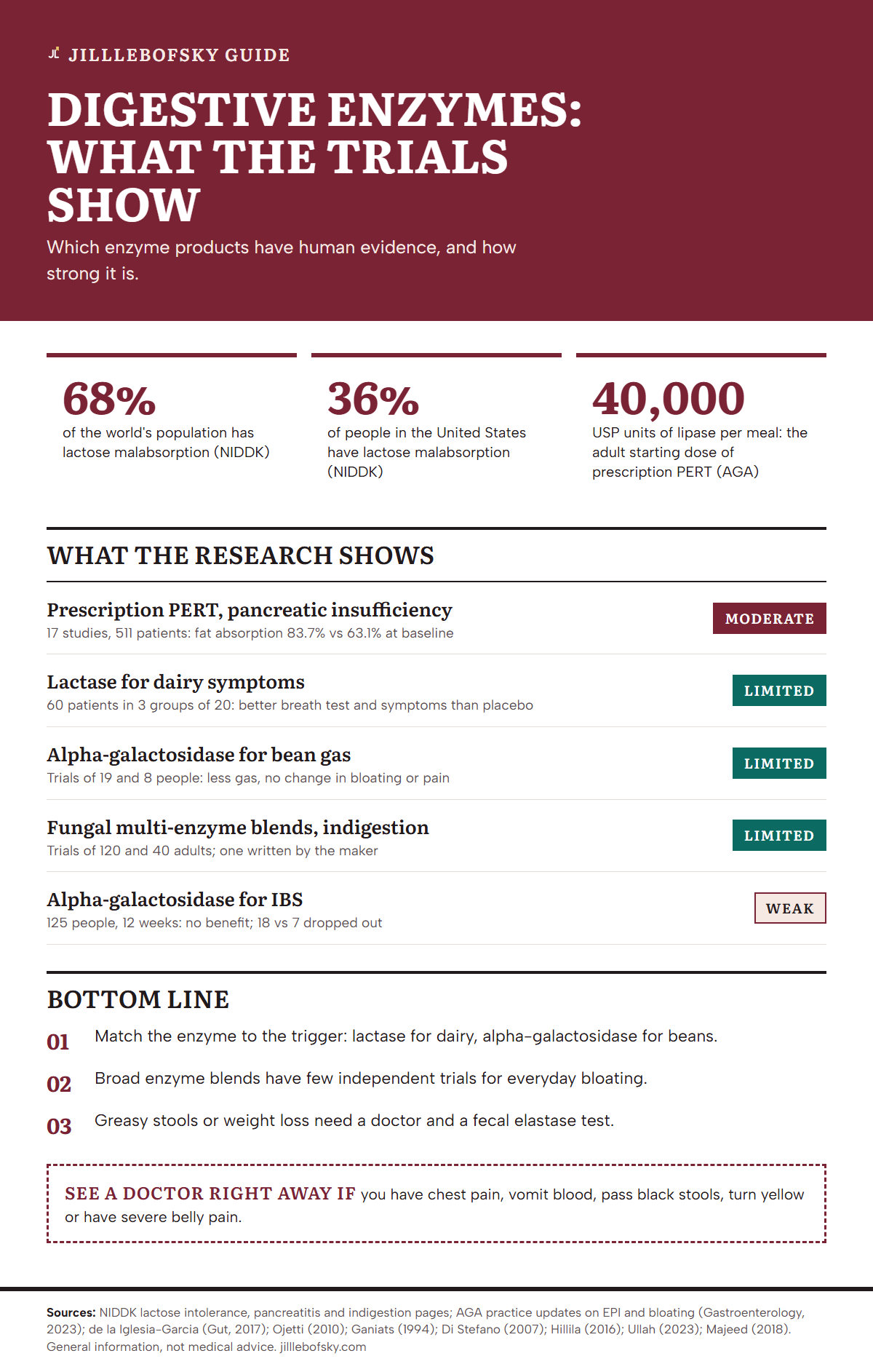
Lactase and alpha-galactosidase have small trials for dairy and bean symptoms, prescription pancreatic enzymes raised fat absorption from 63.1% to 83.7% in chronic pancreatitis, and broad store-bought blends have little independent proof.[13][15][16]
| What they are | Proteins made in the mouth, stomach, pancreas and small intestine that break down carbohydrates, fats and proteins[1] |
|---|---|
| Supplement types | Lactase for dairy, alpha-galactosidase for beans, fungal multi-enzyme blends, and prescription pancreatic enzymes (PERT)[3][12][17][20] |
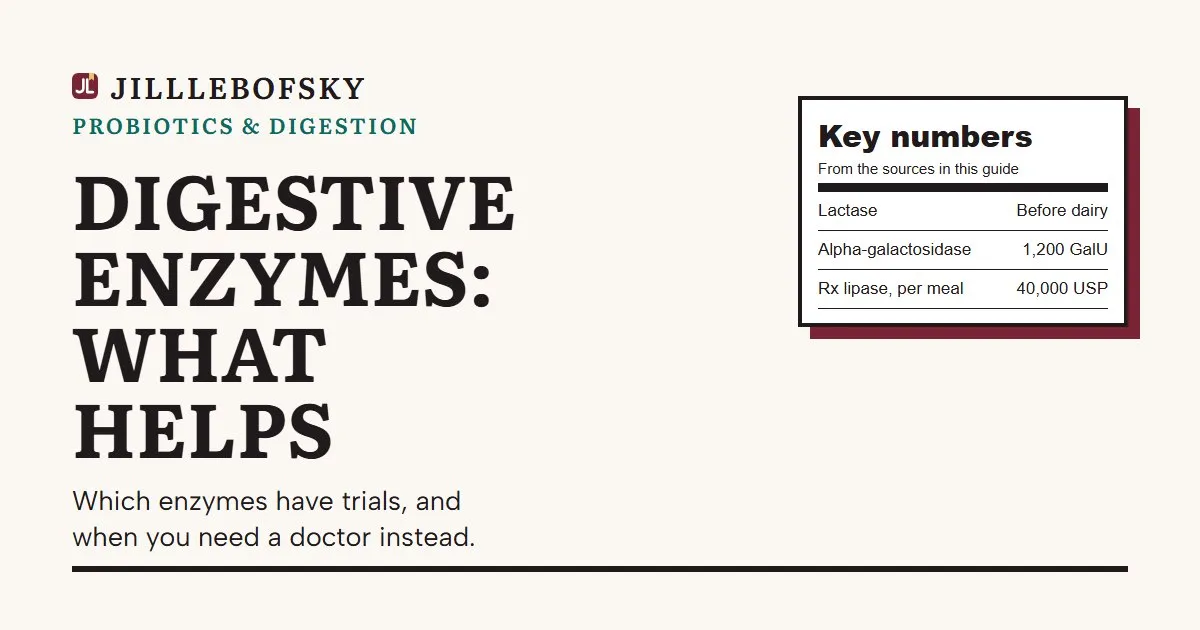
| Amounts studied | Lactase taken before dairy; 1,200 GalU alpha-galactosidase in one bean study; PERT starting at 40,000 USP units of lipase per meal[3][10][17] |
| Best evidence | Prescription PERT in chronic pancreatitis: 17 studies, 511 patients[13] |
| Weakest evidence | Broad blends for everyday bloating; alpha-galactosidase did not help IBS in a 125-person trial[18][19] |
| Safety | The FDA does not review supplements for safety and effectiveness before sale[9] |
| Check with a doctor first | Young children, pregnant or breastfeeding women, and anyone with greasy stools, weight loss or pancreatitis[3][5][10] |
What are digestive enzymes?
Digestive enzymes are proteins that cut large food molecules into smaller pieces your gut can absorb. Saliva starts on starch, the stomach adds acid and enzymes, and the pancreas sends a juice into the small intestine that breaks down carbohydrates, fats and proteins.[1]
Each enzyme has one main job. Amylase works on starch, protease on protein and lipase on fat, and prescription enzyme pills contain all three.[11] Lactase splits lactose, the sugar in milk. When lactase runs low, the result is lactose malabsorption, a reduced ability to digest lactose.[2]
Experts estimate that about 68% of the world's population and about 36% of people in the United States have lactose malabsorption.[2] Lactose intolerance is the name for the symptoms that can follow, such as bloating, diarrhea and gas.[2]
When the pancreas makes too little enzyme, fat passes through undigested and shows up as greasy stools, weight loss and low levels of fat-soluble vitamins.[10] Supplements copy these enzymes from fungal or pig sources, and sellers group them under the label of digestive supplements.[12][20]
Which digestive enzyme supplements have research behind them?
Single enzymes matched to one food have the clearest trials, and prescription pancreatic enzymes have the strongest data overall. Lactase helped lactose symptoms in a small trial, alpha-galactosidase cut gas after beans, and multi-enzyme blends have a few small trials, one of them written by the company that sells the product.[13][15][17][21]
| Study | Who and how many | Dose and length | Result |
|---|---|---|---|
| de la Iglesia-Garcia, 2017 | 17 studies, 511 people with chronic pancreatitis | Prescription PERT, various doses | Fat absorption 83.7% vs 63.1% at baseline, 67.4% on placebo[13] |
| Shaukat, 2010 | 36 randomized studies, lactose intolerance | Lactase and other products | Evidence on treatments insufficient[14] |
| Ojetti, 2010 | 60 lactose-intolerant patients | Tilactase (a lactase) 15 minutes before lactose | Better breath test and symptoms than placebo[15] |
| Ganiats, 1994 | 19 people eating meatless chili | 8 drops of Beano (alpha-galactosidase) | Fewer gas passages; no change in bloating or pain[16] |
| Di Stefano, 2007 | 8 healthy volunteers, 420 g cooked beans | 1,200 GalU alpha-galactosidase | Less breath hydrogen and flatulence[17] |
| Hillila, 2016 | 125 people with IBS | Alpha-galactosidase with meals, 12 weeks | No benefit; 18 quit vs 7 on placebo[18] |
| Ullah, 2023 | 120 adults with functional dyspepsia | 2 capsules a day of a 200 mg fungal blend, 2 months | Better scores than placebo[20] |
| Majeed, 2018 | 40 people with functional dyspepsia | 50 mg blend 3 times a day, 60 days | Better symptom scores; authors work for the maker[21] |
How much weight these trials carry
Most of these trials are small and short, and each one tests a single product. The PERT meta-analysis pooled the most people, though its authors reported consulting ties to a drug maker.[13] The lactase review looked at 36 randomized studies and still found the evidence on treatments too thin to rank them.[14]
The 2018 blend trial was written by staff of the company that sells the product.[21] We treat the blend trials as limited evidence until independent teams repeat them with more people.
Do digestive enzymes help with bloating, gas and indigestion?
For everyday bloating, the evidence behind store-bought enzyme blends is thin. A 2023 AGA practice update on belching, bloating and distention advises ruling out carbohydrate enzyme deficiencies with diet changes or breath tests, and none of its advice statements recommends an over-the-counter enzyme blend.[19]
Gas after beans has a little more support. In a 1994 trial of 19 people who ate meatless chili, 8 drops of Beano reduced gas passages but did not change bloating or pain.[16] A 2007 study of 8 volunteers who ate 420 grams of beans found less breath hydrogen and flatulence with 1,200 GalU of alpha-galactosidase.[17]
In a 12-week trial of 125 people with IBS, alpha-galactosidase did no better than placebo, and 18 people quit the enzyme group compared with 7 on placebo, often because of belly pain or diarrhea.[18] Our guide to IBS symptoms explains how doctors diagnose the condition.
For indigestion, a 2023 trial gave 120 adults with functional dyspepsia a fungal enzyme blend or placebo for 2 months, and the blend group reported better scores.[20] That is a single trial of one product, so the evidence is limited. NIDDK lists acid reducers such as H2 blockers and PPIs as common over-the-counter options for indigestion.[8]
How is prescription enzyme therapy different from digestive supplements?
Prescription pancreatic enzyme replacement therapy (PERT) is an FDA-approved drug, while digestive supplements are not reviewed by the FDA before sale. PERT is for exocrine pancreatic insufficiency (EPI), when the pancreas makes too little enzyme, and doctors dose it by lipase units at each meal.[9][10][11]
Pancreatic enzyme products were once sold without a formal FDA review. After the agency found large differences in how well the products worked, it required approval of all of them by April 2010.[11] US brands include Creon, Zenpep, Pancreaze and Pertzye, which are enteric coated, and Viokace, which is not. All of them come from pigs.[12]
The 2023 AGA update says adults start on at least 40,000 USP units of lipase with each meal and half that with snacks.[10] It also warns that feeling better on a trial of enzymes is not a reliable way to diagnose EPI. A fecal elastase stool test comes first, and a level under 100 micrograms per gram is good evidence of EPI.[10]
Doctors suspect EPI in chronic pancreatitis, pancreatic cancer, cystic fibrosis and after pancreatic surgery.[10] About 80% of people with cystic fibrosis have pancreatic insufficiency.[12] A store-bought blend is no substitute for PERT in any of these conditions.
How do you pick the best digestive enzymes for your symptom?
The best digestive enzymes are the ones matched to a known cause, such as lactase for dairy or alpha-galactosidase for beans. If you do not know the cause, a food diary or a test is a better first step than a broad blend, since the AGA advises ruling out enzyme shortfalls with diet changes or breath tests.[3][19]
| If this happens | Likely match | What to do first |
|---|---|---|
| Gas, bloating or diarrhea after milk or ice cream | Lactose intolerance | Limit lactose, or try lactase tablets before dairy or drops in milk[3] |
| Gas after a bean meal | Bean sugars your gut cannot split | Alpha-galactosidase with the meal; trials are small[16][17] |
| Greasy, foul-smelling stools or weight loss | Possible EPI or chronic pancreatitis | See a doctor for a fecal elastase test; do not self-treat[5][10] |
| Upper belly pain or fullness after meals | Indigestion (dyspepsia) | Talk to a doctor; H2 blockers or PPIs are common options[8] |
| Ongoing bloating with pain and changed bowel habits | Possible IBS | Get a diagnosis; alpha-galactosidase did not help in an IBS trial[18] |
A dairy trigger rarely means giving up milk entirely. The 2010 review found that most adults can handle 12 to 15 grams of lactose, about 1 cup of milk, without much trouble.[14] If constipation or loose stools are the main issue, our psyllium husk fiber guide covers a different kind of supplement, and the gut health supplements guide compares the wider options.
Are digestive enzymes safe, and who should avoid them?
Safety data on store-bought enzyme blends is limited, because the FDA does not review supplements for safety and effectiveness before they are sold. NIDDK says to check with your doctor before using lactase products, and some people, such as young children and pregnant or breastfeeding women, may not be able to use them.[3][9]
Side effects did show up in trials. In the IBS study, more people quit alpha-galactosidase than placebo, mostly for belly pain and diarrhea.[18] Very high doses of prescription enzymes have been linked to fibrosing colonopathy, a scarring of the colon, so doctors keep doses below 10,000 lipase units per kilogram of body weight per day.[12]
NCCIH notes that many supplements have not been tested in pregnant women, nursing mothers or children. If you get side effects, stop the supplement and contact your health care provider.[9]
Call 911 or see a doctor right away if
- You have pain in your chest, jaw, neck or arm, or shortness of breath[7]
- You vomit blood, or pass black, tarlike stools[7]
- Belly pain is severe and constant, or keeps getting worse[5][7]
- You vomit often, or have fever, chills or a fast heartbeat with belly pain[5][7]
- Your skin or the whites of your eyes turn yellow[5][7]
- Swallowing is hard or painful, or you lose weight without trying[7]
See a doctor at a regular visit if indigestion does not get better or bloating lasts a long time.[7]
What do doctors use first for digestive symptoms?
Doctors find the cause first and then treat that cause. For lactose intolerance, the first step is limiting or avoiding foods with lactose, with lactase products as one option. For indigestion, NIDDK lists diet changes, H2 blockers or PPIs, and antibiotics when an H. pylori infection is found.[3][8]
For gas, NIDDK says doctors may suggest diet changes and products such as lactase, and advises talking with your doctor before using supplements.[4] For chronic pancreatitis, doctors may give enzyme pills to help with digestion, plus vitamins A, D, E and K when fat is not being absorbed.[6]
For bloating, the 2023 AGA update uses the Rome IV criteria to diagnose functional bloating, checks for celiac disease with blood tests, and says probiotics should not be used to treat bloating.[19] In our reading, an enzyme supplement makes the most sense once a doctor has a working diagnosis that points to a specific enzyme.
What should you check on a digestive enzyme label?
A useful label names each enzyme, gives its activity in units, and makes no disease claims. Milligrams tell you weight, not how much work the enzyme can do. Prescription lipase is dosed in USP units, and the bean study measured alpha-galactosidase in GalU units, so look for activity units on any product.[10][17]
- Match the enzyme to your trigger: lactase for dairy, alpha-galactosidase for beans.[3][17]
- Look for activity units per serving, not only a milligram total for a proprietary blend.[10][17]
- Skip products that claim to treat IBS, pancreatitis or EPI. Supplements are not reviewed by the FDA before sale.[9]
- Check the source if you avoid pork. Prescription pancreatic enzymes all come from pigs, and pancreatin is the same type of ingredient.[12]
- Compare the label dose with the trial dose. The 2023 dyspepsia trial used 2 capsules of 200 mg a day.[20]
- Follow the label, and stop and call your provider if side effects start.[9]
Our how we review supplements page explains how we compare label doses with trial doses, and our editorial policy covers how we choose sources.
Bottom line
For most people with gas or bloating, finding the trigger food is a better first step than buying a broad enzyme blend, because the AGA bloating update does not recommend those blends.[19] If dairy or beans are the clear trigger, lactase or alpha-galactosidase is a reasonable thing to try, with modest trial support.[15][16]
Greasy stools, weight loss or a known pancreas condition call for a doctor and prescription enzymes, dosed by lipase units at each meal.[10] For more on related topics, browse our probiotics and digestion guides.
Frequently asked questions
Are digestive supplements the same as digestive enzymes?
Not always. Digestive supplements is a broad shelf label that can include enzymes, probiotics and fiber. Digestive enzymes are one type: products such as lactase or alpha-galactosidase that break down a specific part of food.
When should you take a digestive enzyme?
With the food it targets. NIDDK says lactase tablets go before you eat or drink milk products, or drops go into milk first. In one trial, lactase was taken 15 minutes before lactose. Prescription enzymes are taken with each meal and snack.
Are digestive enzymes FDA approved?
Only prescription pancreatic enzymes such as Creon, Zenpep, Pancreaze, Pertzye and Viokace are FDA-approved drugs. Over-the-counter enzyme supplements are not reviewed by the FDA for safety or effectiveness before they are sold.
Can a digestive enzyme supplement replace prescription enzymes?
No. Prescription enzymes are dosed by lipase units, starting at 40,000 USP units per meal for adults with pancreatic insufficiency. Supplements are not tested to that standard, so anyone with a pancreas condition should use the drug their doctor prescribes.
Do probiotics and digestive enzymes do the same thing?
No. Enzymes break down food directly, while probiotics are live microbes. The 2023 AGA bloating update says probiotics should not be used to treat bloating, and it does not recommend over-the-counter enzyme blends for bloating either.
Sources
- Your Digestive System & How It Works. NIDDK, National Institutes of Health
- Definition & Facts for Lactose Intolerance. NIDDK, National Institutes of Health
- Treatment for Lactose Intolerance. NIDDK, National Institutes of Health
- Treatment for Gas in the Digestive Tract. NIDDK, 2021
- Symptoms & Causes of Pancreatitis. NIDDK, National Institutes of Health
- Treatment for Pancreatitis. NIDDK, National Institutes of Health
- Symptoms & Causes of Indigestion. NIDDK, National Institutes of Health
- Treatment of Indigestion. NIDDK, National Institutes of Health
- Using Dietary Supplements Wisely. NCCIH, National Institutes of Health
- AGA Clinical Practice Update on the Epidemiology, Evaluation, and Management of Exocrine Pancreatic Insufficiency: Expert Review. Whitcomb et al., Gastroenterology, 2023
- Pancreatic enzyme products: digesting the changes. Giuliano et al., Annals of Pharmacotherapy, 2011
- Pancreatic Enzyme Replacement Therapy: A Concise Review. Brennan and Saif, JOP, 2019
- Efficacy of pancreatic enzyme replacement therapy in chronic pancreatitis: systematic review and meta-analysis. de la Iglesia-Garcia et al., Gut, 2017
- Systematic review: effective management strategies for lactose intolerance. Shaukat et al., Annals of Internal Medicine, 2010
- The effect of oral supplementation with Lactobacillus reuteri or tilactase in lactose intolerant patients: randomized trial. Ojetti et al., European Review for Medical and Pharmacological Sciences, 2010
- Does Beano prevent gas? A double-blind crossover study of oral alpha-galactosidase to treat dietary oligosaccharide intolerance. Ganiats et al., Journal of Family Practice, 1994
- The effect of oral alpha-galactosidase on intestinal gas production and gas-related symptoms. Di Stefano et al., Digestive Diseases and Sciences, 2007
- Does oral alpha-galactosidase relieve irritable bowel symptoms?. Hillila et al., Scandinavian Journal of Gastroenterology, 2016
- AGA Clinical Practice Update on Evaluation and Management of Belching, Abdominal Bloating, and Distention: Expert Review. Moshiree et al., Gastroenterology, 2023
- Efficacy of digestive enzyme supplementation in functional dyspepsia: a randomized, double-blind, placebo-controlled trial. Ullah et al., Biomedicine and Pharmacotherapy, 2023
- Evaluation of the Safety and Efficacy of a Multienzyme Complex in Patients with Functional Dyspepsia. Majeed et al., Journal of Medicinal Food, 2018
This page is general information, not medical advice. Talk to your doctor or pharmacist before you start any supplement, especially if you are pregnant, take medicine or have a health condition. Read our medical disclaimer and how we review.