Colon polyps are growths on the lining of the colon or rectum, found in 15 to 40 percent of adults. Most cause no symptoms and most are not cancer, but adenomas, including tubular adenomas, and serrated polyps are pre-cancers that doctors remove during colonoscopy. One or two small tubular adenomas usually mean 7 to 10 years to the next exam. No supplement has been shown to prevent polyps.
To explain colon polyps, we read the NIDDK pages on polyp facts, symptoms, diagnosis, treatment and diet, the MedlinePlus and National Cancer Institute summaries, the American Cancer Society guide to pathology reports, and the 2020 US Multi-Society Task Force follow-up guideline. We also read the main trials on polyp removal, fiber, calcium and vitamin D. Our review method explains how we pick and grade sources.
The short answer: polyps are small growths on the lining of the colon or rectum that 15 to 40 percent of adults may have, and most are not cancer, though some types can turn into cancer over time if they stay in place.[1]
| What they are | Growths on the lining of the colon or rectum; most are not cancerous[1] |
|---|---|
| How common | 15 to 40 percent of adults, more often men and older adults[1] |
| Main types | Hyperplastic polyps (usually harmless), adenomas such as tubular adenomas, and serrated polyps (both pre-cancers)[7] |
| Symptoms | Usually none; sometimes rectal bleeding, blood in the stool or tiredness from anemia[2] |
| Treatment | Removal during colonoscopy, almost always without surgery, then testing by a pathologist[4] |
| Safety of removal | Bleeding in about 15 and a tear in about 3 of every 10,000 colonoscopies[10] |
| Who should be screened | Adults 45 to 75 at average risk; a personal choice from 76 to 85[11] |
What are colon polyps?
Colon polyps are growths on the lining of the colon or rectum, the last part of the digestive tract. Anywhere from 15 to 40 percent of adults may have at least one. They are more common in men and in older adults, and most of them are not cancerous.[1]
The concern is that some kinds grow and change slowly, and a few become colorectal cancer over time.[1] Doctors cannot tell for sure which polyp is which by looking. To be safe, they remove polyps and send them for testing.[6]
The lab result is what shapes your follow-up plan. It names the polyp type, its growth pattern and how abnormal the cells look.[7] That report, plus the number and size of the polyps, sets the date of your next colonoscopy.[8]
Doctors look for polyps so they can take them out: the NCI notes that removing polyps larger than 1 centimeter, about the size of a pea, may lower the risk of colorectal cancer.[9]
What is a tubular adenoma of the colon?
A tubular adenoma is the most common growth pattern of adenoma, a type of polyp that counts as a pre-cancer. Most small adenomas, under half an inch, are tubular. Finding one or two small ones is the mildest adenoma result, and it usually means 7 to 10 years before the next colonoscopy.[7][8]
Adenomas grow in two main patterns, tubular and villous. Many mix both, and pathologists call those tubulovillous adenomas.[7] Larger adenomas and adenomas with a villous pattern are more likely to contain cancer cells.[7]
Your report may also grade dysplasia, which describes how much the cells look like cancer. Low-grade dysplasia is usually not a cause for concern. High-grade dysplasia can mean an earlier repeat colonoscopy.[7]
The 2020 US Multi-Society Task Force advises a repeat exam in 7 to 10 years after one or two tubular adenomas under 10 mm, and in 3 to 5 years after three or four.[8] An adenoma of 10 mm or more, a villous pattern or high-grade dysplasia makes it an advanced adenoma, with a 3-year interval.[8]
Which polyps in the colon can turn into cancer?
Adenomas and serrated polyps can turn into cancer, while small hyperplastic polyps usually do not. The National Cancer Institute notes that most colorectal polyps are adenomas, which may develop into cancer. Still, most people with a serrated pre-cancer never develop colon or rectal cancer, especially once it is removed.[9][7]
| Polyp type | What it means | Next colonoscopy |
|---|---|---|
| Hyperplastic, under 10 mm | Typically benign, not a pre-cancer | 10 years[8] |
| Tubular adenoma, under 10 mm | Pre-cancer, most common pattern | 7 to 10 years[8] |
| Tubulovillous or villous adenoma | Pre-cancer, more likely to hold cancer cells | 3 years[8] |
| Sessile serrated lesion, under 10 mm | Pre-cancer that must be removed completely | 5 to 10 years[8] |
| Traditional serrated adenoma | Pre-cancer that must be removed completely | 3 years[8] |
The serrated pathway accounts for about 15 to 30 percent of colorectal cancers, and serrated polyps have high rates of incomplete removal.[15]
How fast does an advanced adenoma change? A study of 840,149 screening colonoscopies estimated the yearly chance of an advanced adenoma becoming cancer at 2.6 percent at ages 55 to 59. That rose to 5.6 percent in women and 5.1 percent in men aged 80 and older.[14] Over 10 years, the estimated risk was about 25 percent at age 55 and about 40 percent at 80. These figures describe advanced adenomas left in place.[14]
Do colon polyps cause symptoms?
Most people with colon polyps have no symptoms, so screening is the only reliable way to find them. When symptoms do appear, the usual ones are bleeding from the rectum, blood in the stool that looks red or black, and tiredness from anemia caused by slow blood loss over time.[2]
MedlinePlus also lists constipation or diarrhea that lasts more than a week.[6] Many other health problems cause the same signs, so they call for a doctor's check.[2] If you are sorting out gut symptoms, our guide to IBS symptoms and red flags explains which signs do not fit IBS.
See a doctor right away if
NIDDK advises contacting your doctor right away for any bleeding from the rectum or blood in the stool.[2] After a polyp is removed, bleeding can show up as late as 2 weeks later.[10] Get care right away after a polypectomy or colonoscopy if you have:[4][10]
- severe pain in your belly
- fever
- bloody bowel movements that do not get better
- bleeding from the anus that does not stop
- dizziness or weakness
If bleeding is heavy, or you feel faint, dizzy or very weak, call 911 or go to an emergency room instead of waiting for a call back. Those signs can point to the bleeding or tear that NIDDK lists as the main risks.[10]
What causes polyps in the colon?
Experts are not sure what causes polyps in the colon, but certain factors raise your chances of getting them. NIDDK names age 45 or older, a personal or family history of polyps or colorectal cancer, inflammatory bowel disease, obesity and smoking as the main ones. Men also get them more often than women.[1][2]
MedlinePlus adds having had polyps before and a family member with polyps or colon cancer.[6] The NCI links both smoking and alcohol to adenomas.[9]
A small group of people inherit a syndrome. Familial adenomatous polyposis (FAP), caused by changes in the APC gene, produces hundreds to thousands of polyps. About 95 percent of people with FAP have polyps by age 35, and without surgery to remove the colon, at least 90 percent develop colon cancer by age 50.[16] FAP affects about 1 in 8,500 people and accounts for about 0.5 percent of colorectal cancers.[16]
Some risk factors can be changed. NIDDK suggests regular physical activity, not smoking, avoiding alcohol and losing weight if you have overweight.[4]
How are colon polyps found and removed?
Doctors find colon polyps with tests that look inside the colon, and they treat them by removing them. Colonoscopy is the main tool, because the doctor can see and remove almost all polyps during the same exam, without surgery. Each polyp then goes to a pathologist, who checks it for cancer.[3][4]
Other tests can spot polyps. Flexible sigmoidoscopy looks at the lower part of the colon. Virtual colonoscopy uses a CT scan, but doctors cannot remove polyps during it. A lower GI series uses X-rays.[3] A polyp that is too large to remove safely during colonoscopy may need surgery.[7]
Serious problems are uncommon. NIDDK puts bleeding at about 15 and perforation, a tear in the colon wall, at about 3 of every 10,000 colonoscopies. Most cases happen in people who are older or who have polyps removed.[10] The NCI lists the same two harms for polyp removal.[9]
Standard care is screening, removal of what is found, and repeat exams on a schedule set by the pathology report.[4][8] The USPSTF recommends screening for adults 45 to 75 at average risk, with colonoscopy every 10 years when results are normal, and a personal decision from 76 to 85.[11] No pill, cleanse or supplement replaces this.
How often do you need a colonoscopy after a polyp?
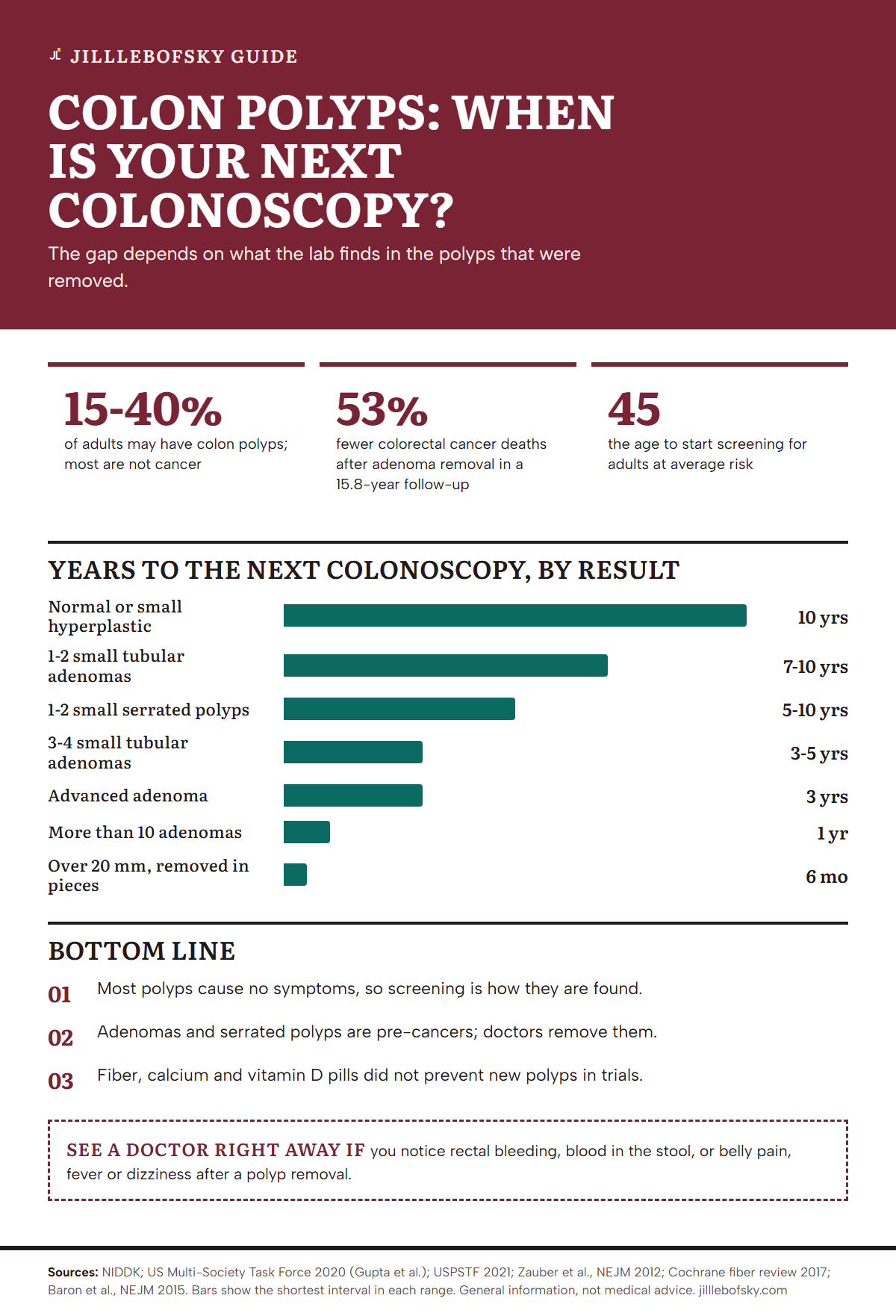
Your next colonoscopy depends on how many polyps were found, how big they were and what type they were. Under the 2020 US Multi-Society Task Force guidance, the gap ranges from 6 months after a large polyp removed in pieces to 10 years after a normal exam or small hyperplastic polyps.[8]
| If your report shows | Next colonoscopy |
|---|---|
| Normal exam, or hyperplastic polyps under 10 mm | 10 years[8] |
| 1 or 2 tubular adenomas under 10 mm | 7 to 10 years[8] |
| 3 or 4 tubular adenomas under 10 mm | 3 to 5 years[8] |
| 5 to 10 tubular adenomas under 10 mm | 3 years[8] |
| Adenoma 10 mm or larger, villous, or with high-grade dysplasia | 3 years[8] |
| 1 or 2 sessile serrated polyps under 10 mm | 5 to 10 years[8] |
| Serrated polyp 10 mm or larger, with dysplasia, or a traditional serrated adenoma | 3 years[8] |
| More than 10 adenomas | 1 year[8] |
| Polyp over 20 mm removed in pieces | 6 months[8] |
How a polyp comes out also counts. Pooled data from 33 studies found polyp tissue came back about 20 percent of the time after piecemeal removal, against 3 percent after removal in one piece.[8] For adults over 75, the guideline calls the balance of benefit and risk uncertain, so the next exam is a decision to make with your doctor.[8]
Your follow-up checklist
- Get a copy of the pathology report and find the polyp type, the size in millimeters and any mention of dysplasia.[7]
- Ask whether every polyp was removed completely and whether any came out in pieces.[8]
- Match your result to the table above and put the due date in your calendar.[8]
- Tell parents, siblings and children about any adenoma or serrated polyp, since family history raises their risk.[1]
- Report bleeding, black stools or bowel changes that last more than a week instead of waiting for the next exam.[2][6]
- Skip any product sold to shrink or flush out polyps; the trials below found no supplement that does this.[17][19]
Can fiber or supplements prevent colon polyps?
No supplement has been shown to prevent polyps, and the best trials of fiber, calcium and vitamin D found little or no benefit. A 2017 Cochrane review of five fiber trials with 4,798 people who had past adenomas found no drop in repeat adenomas over three to four years.[17]
| Study | Who | What was tested | Result |
|---|---|---|---|
| Cochrane fiber review, 2017 | 4,798 adults with past adenomas, 5 trials | Wheat bran, ispaghula (psyllium) husk or a high-fiber diet | No fewer repeat adenomas (RR 1.04, low-quality evidence)[17] |
| Psyllium trial in the same review | 376 adults | Ispaghula husk | More repeat adenomas than control (RR 1.45)[17] |
| Cochrane calcium review, 2008 | 1,346 adults with past adenomas, 2 trials | 1,200 mg a day for about 4 years, or 2,000 mg a day for 3 years | Moderate drop in repeat adenomas (OR 0.74), not enough to recommend[18] |
| Baron trial, 2015 | 2,259 adults after adenoma removal | Vitamin D3 1,000 IU, calcium 1,200 mg, or both, for 3 to 5 years | No significant drop; 43 percent had a new adenoma[19] |
| National Polyp Study, 1993 | 1,418 patients | Colonoscopy with polyp removal | 76 to 90 percent fewer cancers than expected[12] |
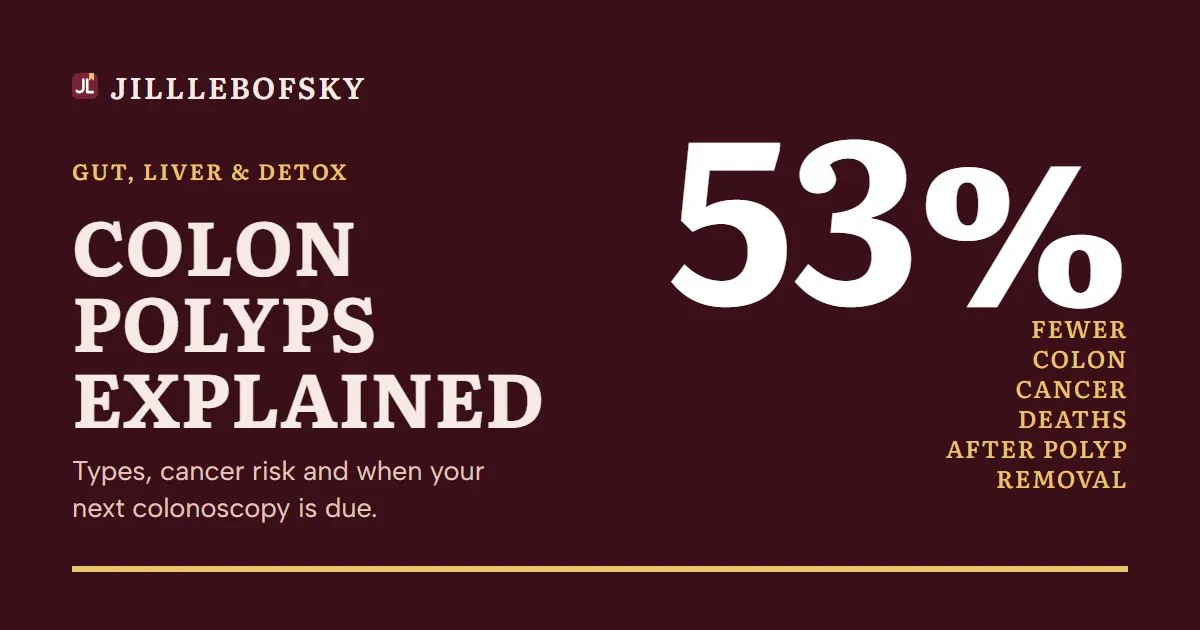
| Zauber follow-up, 2012 | 2,602 patients, median 15.8 years | Removal of adenomas | 53 percent fewer colorectal cancer deaths than expected[13] |
What this means for psyllium, pills and diet
Removing polyps has decades of outcome data behind it. Fiber, psyllium and vitamin D did no better than placebo after polyp removal, and the modest calcium signal from two older trials did not hold up in the larger 2015 trial.[18][19]
Psyllium has other uses, covered with their own sources in our psyllium husk dose and label guide, but this review gives no reason to take it for polyps.[17] The same caution applies to the products in our gut health supplements guide: none has trial data for polyps.
For food, NIDDK suggests more fruit, vegetables and fiber such as beans and bran cereal, and less fatty food, red meat and processed meat, which may lower your chances of polyps.[5] More guides on the colon and digestion sit in our gut, liver and detox section.
Bottom line on colon polyps
Colon polyps are common and usually silent, and most are harmless, but adenomas and serrated polyps are pre-cancers worth removing. A tubular adenoma under 10 mm is the mildest of these, and one or two usually mean 7 to 10 years before the next look.[8]
For most people the better first step is to book the screening that is due rather than buy a supplement. Removal cut colorectal cancer deaths by 53 percent in one long follow-up, while fiber, calcium and vitamin D pills did not hold up in trials.[13][17][19] Our editorial policy explains how we keep these guides independent.
Frequently asked questions
Is a colon polyp always cancer?
No. Most colon polyps are not cancerous. Hyperplastic polyps are typically benign, while adenomas and serrated polyps are pre-cancers that doctors remove so they cannot grow. The pathology report from your colonoscopy tells you which type you had.
Is a small colon polyp serious?
Usually not. Small hyperplastic polyps under 10 mm count the same as a normal exam, with a 10-year follow-up. One or two small tubular adenomas are pre-cancers, but guidelines still allow 7 to 10 years before the next colonoscopy.
Can colon polyps come back after removal?
New polyps can form, which is why doctors ask for repeat colonoscopies once polyps are found. Polyp tissue also came back in about 20 percent of cases after large polyps were removed in pieces, against 3 percent after one-piece removal.
How long does it take a colon polyp to turn into cancer?
No single timeline fits every polyp. For advanced adenomas left in place, one study of 840,149 colonoscopies estimated a yearly chance of becoming cancer of 2.6 percent at ages 55 to 59, rising to about 5 percent at 80 and older.
Does a family history of colon polyps raise my risk?
Yes. A family history of polyps or colorectal cancer raises your chances of getting polyps, and inherited syndromes such as FAP cause hundreds to thousands of them. Tell your doctor about it, because it shapes your screening plan.
Sources
- Definition & Facts for Colon Polyps. NIDDK, reviewed 2017
- Symptoms & Causes of Colon Polyps. NIDDK, reviewed 2017
- Diagnosis of Colon Polyps. NIDDK, reviewed 2017
- Treatment for Colon Polyps. NIDDK, reviewed 2017
- Eating, Diet, & Nutrition for Colon Polyps. NIDDK, reviewed 2017
- Colonic Polyps. MedlinePlus, National Library of Medicine
- Your Colon or Rectal Pathology Report: Polyps (Including Serrated Adenomas). American Cancer Society
- Recommendations for Follow-Up After Colonoscopy and Polypectomy: US Multi-Society Task Force. Gupta et al., Gastroenterology, 2020
- Colorectal Cancer Prevention (PDQ), Patient Version. National Cancer Institute
- Colonoscopy. NIDDK
- Colorectal Cancer: Screening. US Preventive Services Task Force, 2021
- Prevention of colorectal cancer by colonoscopic polypectomy (National Polyp Study). Winawer et al., N Engl J Med, 1993
- Colonoscopic polypectomy and long-term prevention of colorectal-cancer deaths. Zauber et al., N Engl J Med, 2012
- Risk of progression of advanced adenomas to colorectal cancer by age and sex. Brenner et al., Gut, 2007
- Serrated polyps and polyposis of the colon. Hyun et al., Can J Surg, 2021
- Familial adenomatous polyposis. MedlinePlus Genetics
- Dietary fibre for the prevention of recurrent colorectal adenomas and carcinomas. Yao et al., Cochrane Database Syst Rev, 2017
- Dietary calcium supplementation for preventing colorectal cancer and adenomatous polyps. Weingarten et al., Cochrane Database Syst Rev, 2008
- A Trial of Calcium and Vitamin D for the Prevention of Colorectal Adenomas. Baron et al., N Engl J Med, 2015
This page is general information, not medical advice. Talk to your doctor or pharmacist before you start any supplement, especially if you are pregnant, take medicine or have a health condition. Read our medical disclaimer and how we review.