Kidney stones form when calcium, oxalate, phosphorus or uric acid builds up in urine that is too concentrated. Low fluid intake, high sodium, a lot of animal protein, obesity, a family history, gout, hyperparathyroidism and some long-term medicines raise the risk. Calcium from food does not. Up to half of people get another stone, so finding the stone type guides prevention.
What causes kidney stones is mostly a matter of urine chemistry: too much calcium, oxalate, phosphorus or uric acid, in too little water. We read the NIDDK kidney stone pages, two MedlinePlus pages and eight large studies on weight, family history, diet, drinks, vitamin C and heat.[1][5]
The short answer: stones form when stone-forming minerals build up in concentrated urine, and about 11 percent of U.S. men and 6 percent of U.S. women get one at least once.[1][2]
| What they are | Hard, pebble-like pieces that form in one or both kidneys when urine holds high levels of certain minerals[2] |
|---|---|
| Direct cause | High levels of calcium, oxalate and phosphorus in the urine[1] |
| Most common type | Calcium stones, mainly calcium oxalate[2] |
| Main everyday triggers | Too little fluid, a diet high in sodium and animal protein, and obesity[3][5] |
| Higher risk | Men, a family history, a past stone, gout, hyperparathyroidism and some long-term medicines[2] |
| Chance of another stone | Up to 50 percent of people with one stone develop more[5] |
| Get care right away | Severe pain, blood in the urine, fever or chills, or vomiting[1] |
What causes kidney stones to form?
Kidney stones form when minerals that are normally dissolved in urine reach levels too high to stay dissolved, so they crystallize and clump together.[1] NIDDK names high levels of calcium, oxalate and phosphorus in the urine as the cause, and says these minerals cause no problems at low levels.[1]
Two things push those levels up. One is the amount of mineral the body sends into the urine. The other is the amount of water carrying it. MedlinePlus Genetics explains that dehydration makes urine more concentrated, which lets minerals cluster into stones.[5]
Most stones come from several causes at once. Common gene changes, diet, fluid habits, body weight, health conditions and medicines all add up. Not everyone with a risk factor gets a stone, but a person with genetic risk who also has lifestyle risks is more likely to form one.[5]
Stones range from the size of a grain of sand to a pea, and rarely as large as a golf ball. A small one may pass with little pain. A larger one can get stuck and block urine flow.[2] Our guide to kidney stone symptoms, pain and urine signs covers what that feels like.
What are the main types of kidney stones and their causes?
There are four main types of kidney stones, and each has its own cause: calcium stones, uric acid stones, struvite stones and cystine stones.[2] Calcium stones are the most common, and calcium oxalate stones are more common than calcium phosphate stones.[2] Knowing the type guides treatment.[5]
| Type | What drives it | Who is more likely to get it |
|---|---|---|
| Calcium (oxalate or phosphate) | Calcium that is not used by bones and muscles stays in the kidneys and joins other waste products[2] | People with hypercalciuria, hyperoxaluria or hyperparathyroidism[2] |
| Uric acid | Urine that holds too much acid[2] | People who eat a lot of fish, shellfish and meat, especially organ meat, and people with gout[2] |
| Struvite | A urinary tract infection; these stones can grow large quickly[2] | People with repeated UTIs[2] |
| Cystine | Cystinuria, an inherited disorder that lets the amino acid cystine leak into urine[2] | People who inherit cystinuria from their parents[6] |
MedlinePlus lists uric acid as another common type, cystine as uncommon and struvite as the least common.[6] The cause of your own stone matters, because the advice for a uric acid stone differs from the advice for a calcium stone.[3]
Does dehydration cause kidney stones?
Yes. MedlinePlus Genetics calls too little water in the body a common cause of kidney stones, because concentrated urine lets minerals cluster.[5] NIDDK says drinking enough liquid, mainly water, is the most important thing you can do to prevent kidney stones.[3] Low fluid intake is on its list of risk factors.[2]
Unless you have kidney failure, NIDDK says many health care professionals recommend six to eight 8-ounce glasses a day.[3] A 24-hour urine test can show whether you make too little urine. NIDDK notes that people who do not make enough urine each day are more likely to form stones.[4]
Can hot weather cause kidney stones?
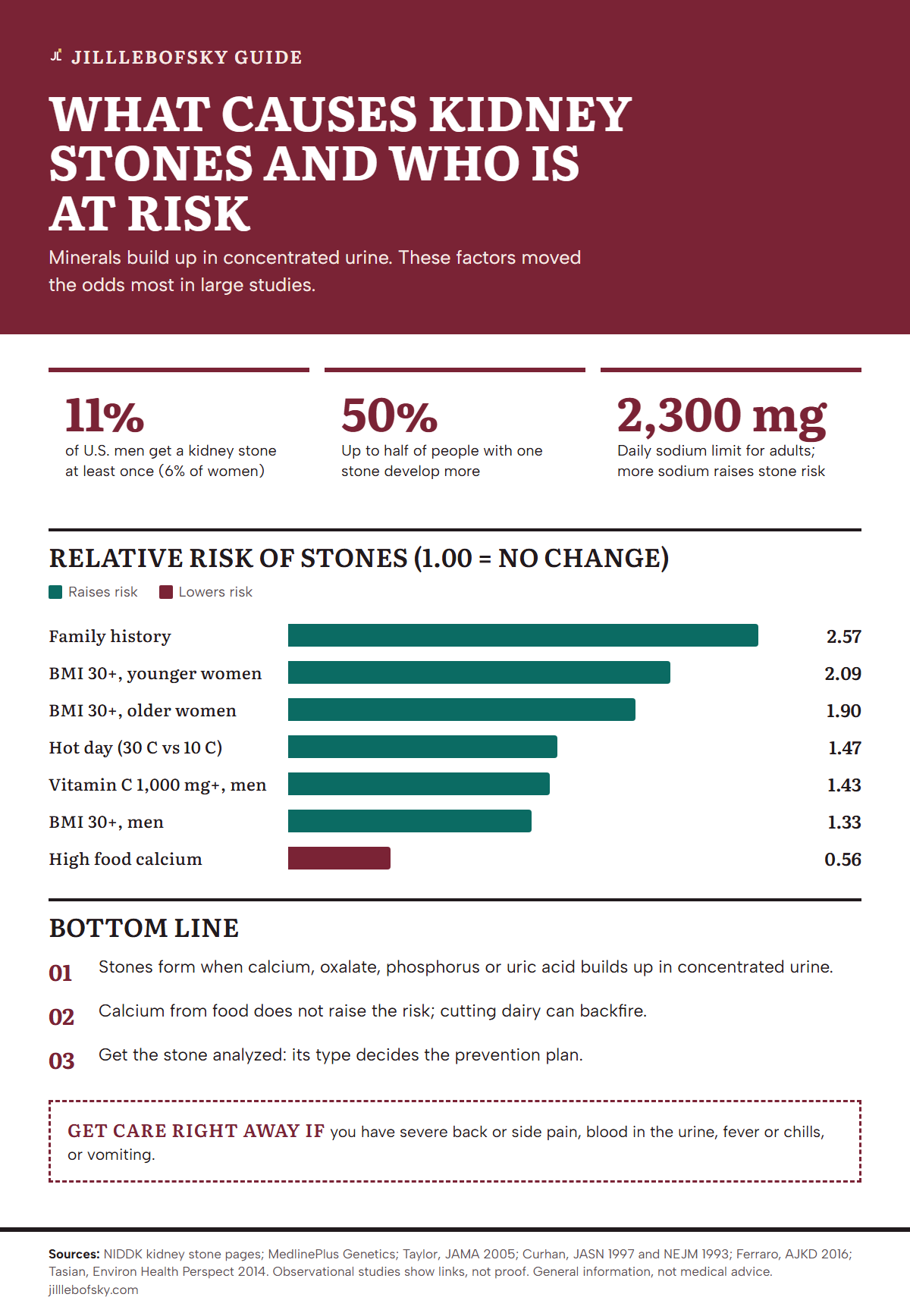
Heat raises fluid loss through sweat, and NIDDK says people who live, work or exercise in hot weather may need more liquid.[4] A 2014 study of 60,433 patients in five U.S. cities found that stone visits rose on hot days.[15]
Compared with a daily mean of 10 degrees Celsius (50 F), a day averaging 30 degrees Celsius (86 F) carried a relative risk of 1.36 in Dallas, 1.38 in Atlanta and 1.47 in Philadelphia. The strongest link came within 3 days of the heat.[15] Because the study is observational, it shows a pattern and cannot prove cause.
Which foods and drinks cause kidney stones?
No single food causes kidney stones, but some eating patterns raise the risk. NIDDK says your chance of a kidney stone rises when you eat more sodium, and that animal protein may raise it too.[3] For calcium oxalate stones, it also lists nuts, peanuts, rhubarb, spinach and wheat bran as high-oxalate foods to watch.[3]
Sodium hides in canned, packaged and fast foods, condiments and meats. NIDDK advises adults to aim for less than 2,300 mg a day, and one teaspoon of table salt holds 2,325 mg.[3]
Drinks matter too. A 2013 analysis of 194,095 adults linked the highest intake of sugar-sweetened cola to a 23 percent higher stone risk and sugar-sweetened non-cola soda to a 33 percent higher risk.[13] Coffee, tea and orange juice were linked to lower risk in the same data, but those links are observational.[13]
Does calcium cause kidney stones?
Calcium from food does not raise the risk of calcium oxalate stones, according to NIDDK.[2] In the right amounts, food calcium can block other substances in the gut that may lead to stones.[3]
The research below is why doctors stopped telling most stone formers to cut calcium.
| Study | Who and how long | What was compared | Result |
|---|---|---|---|
| Curhan, NEJM 1993[11] | 45,619 men, 4 years | Highest vs lowest food calcium; highest vs lowest animal protein | Relative risk 0.56 for high calcium; 1.33 for high animal protein |
| Borghi, NEJM 2002 (trial)[12] | 120 men with repeat calcium oxalate stones, 5 years | Normal calcium with less animal protein and salt vs a low-calcium diet | 12 of 60 vs 23 of 60 had another stone (relative risk 0.49) |
| Ferraro, CJASN 2013[13] | 194,095 adults, 8+ years | Highest vs lowest sugar-sweetened soda | 23 percent (cola) and 33 percent (non-cola) higher risk |
| Ferraro, AJKD 2016[14] | 197,271 adults, about 11 years | Total vitamin C of 1,000 mg a day or more vs under 90 mg | Hazard ratio 1.43 in men; no link in women |
In the Borghi trial, urine oxalate went up on the low-calcium diet and went down on the normal-calcium diet, so cutting dairy on your own can work against you.[12]
Can vitamins, supplements or medicines cause kidney stones?
Some can. MedlinePlus lists some supplements and medicines among the things that raise kidney stone risk.[6] NIDDK names four medicines that raise risk when taken over a long period: diuretics, calcium-based antacids, indinavir and topiramate.[2] Do not stop a prescribed medicine on your own; ask the prescriber.
Vitamin C is the supplement with the clearest signal. In a 2016 analysis of 156,735 women and 40,536 men followed for about 11 years, men taking 1,000 mg or more of supplemental vitamin C a day had a 19 percent higher risk (hazard ratio 1.19).[14]
The same analysis found no link in women, and vitamin C from food was not linked to stones in either group.[14] It is observational, so it cannot prove cause. If you have had a stone, it makes sense to check how much vitamin C your supplements add up to. Our how we review supplements page explains how we read a label dose against the research.
What health conditions and genes raise the risk of kidney stones?
Several health conditions change urine chemistry, either by sending more calcium, oxalate or uric acid into the urine or by making urine more acidic, and that raises the risk. NIDDK lists gout, hypercalciuria, hyperoxaluria, hyperparathyroidism, obesity, repeated UTIs, chronic bowel inflammation, past gut surgery, cystic kidney disease and renal tubular acidosis.[2] MedlinePlus Genetics adds type 2 diabetes.[5]
Weight shows a clear pattern. In three cohorts of more than 240,000 adults, a BMI of 30 or more carried a relative risk of 1.33 in men and 1.90 and 2.09 in older and younger women.[9] A national survey found stones in 11.2 percent of adults with obesity and 6.1 percent of normal-weight adults.[8]
In primary hyperparathyroidism, the glands make too much parathyroid hormone, blood calcium rises, and extra calcium spills into the urine.[7]
Are kidney stones genetic?
Partly. In 37,999 men followed for 8 years, a family history of stones carried a relative risk of 2.57.[10] Most cases come from common gene changes plus lifestyle. A single rare gene, as in cystinuria, Dent disease or primary hyperoxaluria, is more likely with a family history, repeat stones or stones at a young age.[5]
A family history does not mean a stone is certain. It is a reason to keep fluids up, watch sodium and tell your doctor, who may suggest a urine test after a first stone.[3][4]
When should you see a doctor about kidney stones?
See a health care professional right away if you have symptoms that may mean a kidney stone. NIDDK says these symptoms may also mean a more serious condition, so they need to be checked.[1] Treated stones rarely cause lasting harm, but untreated stones can lead to infections and loss of kidney function.[2]
Get care right away if you have:[1]
- sharp pain in your back, side, lower belly or groin
- pink, red or brown urine
- pain while urinating, or you can pass only a little urine or none
- fever and chills, or nausea and vomiting with the pain
- cloudy or bad-smelling urine
How do doctors find the cause and treat it?
Once a stone passes or is removed, it goes to a lab. A kidney stone analysis shows what it is made of, which shapes the plan to prevent more.[4][6] A doctor may also ask you to collect urine for 24 hours to measure volume and mineral levels.[4]
After fluids and diet changes, prescription medicine depends on the stone type. Potassium citrate or a diuretic is used for calcium stones, allopurinol for uric acid stones, antibiotics for 1 to 6 weeks or longer for struvite stones, and tiopronin for cystine stones.[4] Surgery to remove an overactive parathyroid gland can prevent stones caused by hyperparathyroidism.[4] A supplement is not a substitute for any of these.
How do you prevent kidney stones once you know the cause?
Prevention works best when it matches the cause and the stone type. For almost every stone type, drinking enough liquid to keep urine diluted is the first step, according to NIDDK.[4] The other changes depend on what the lab finds, so ask which type of stone you had before changing your diet.[3]
| If you had or have | Start with | Avoid |
|---|---|---|
| Calcium oxalate stones | Fluids, less sodium, normal calcium from food[3] | Cutting calcium; large amounts of nuts, spinach, rhubarb or wheat bran[3] |
| Uric acid stones | Less animal protein; weight loss if overweight[3] | Large servings of meat, organ meat and shellfish[2] |
| Struvite stones | Treating the urinary infection with your doctor[4] | Leaving repeat UTIs unchecked[2] |
| Cystine stones | Even more liquid than usual[4] | Skipping fluids on hot or busy days[4] |
| Long-term diuretic, topiramate or calcium antacid use | A talk with the prescriber about stone risk[2] | Stopping the medicine on your own |
Our kidney and bladder health guides cover related topics. Stones and long-term kidney damage are linked in research, and our explainer on chronic kidney disease stages and eGFR ranges shows how kidney function is measured.[5]
Checklist after a first kidney stone
A short checklist for anyone who has had one stone:
- Ask for the stone to be sent for analysis, and write down the type.[6]
- Drink six to eight 8-ounce glasses of liquid a day, or the amount your doctor sets.[3]
- Keep sodium under 2,300 mg a day by checking the %DV on food labels.[3]
- Swap some sugar-sweetened soda for water.[13]
- Add up the vitamin C on every supplement label you take.[14]
- Bring your medicine and supplement list to your next visit.[2]
Bottom line
Kidney stones form when calcium, oxalate, phosphorus or uric acid builds up in urine that is too concentrated. Low fluid, high sodium, a lot of animal protein, obesity, family history and a handful of conditions and medicines push the odds up.[1][2][5]
For most people who have had one stone, the better first step is to find out its type and drink more, rather than buy a supplement or cut out dairy. Up to half of people get another stone, so ask for that lab test.[5] Our editorial policy explains how we choose and check sources.
Frequently asked questions
How to prevent kidney stones?
Drink enough liquid, mainly water, to keep urine diluted, which NIDDK calls the most important step. Keep sodium under 2,300 mg a day, limit animal protein, get calcium from food, and ask your doctor which stone type you had.
Can drinking too much coffee or tea cause kidney stones?
Large cohort data linked caffeinated coffee to a 26 percent lower stone risk and tea to an 11 percent lower risk. Sugar-sweetened soda was linked to higher risk. These are observational links, so they do not prove cause.
At what age do kidney stones usually start?
MedlinePlus Genetics says kidney stones occur most often between ages 40 and 60, though they can develop at any age. Stones at a young age raise the chance of a rare single-gene cause, especially with a family history.
Why do men get more kidney stones than women?
NIDDK says men are more likely to develop stones, about 11 percent of men versus 6 percent of women at least once. The NIH pages we read do not explain why, so be wary of any single reason you see online.
Can a urinary tract infection cause a kidney stone?
Yes. Struvite stones may form after a urinary tract infection and can grow large quickly, according to NIDDK. Repeated UTIs are on its list of risk factors, and treating the infection with antibiotics is part of struvite stone care.
Sources
- Symptoms & Causes of Kidney Stones. NIDDK, reviewed 2017
- Definition & Facts for Kidney Stones. NIDDK, reviewed 2017
- Eating, Diet, & Nutrition for Kidney Stones. NIDDK, reviewed 2017
- Treatment for Kidney Stones. NIDDK, reviewed 2017
- Kidney stones (MedlinePlus Genetics). MedlinePlus, National Library of Medicine
- Kidney Stone Analysis. MedlinePlus, National Library of Medicine
- Primary Hyperparathyroidism. NIDDK
- Prevalence of kidney stones in the United States. Scales et al., European Urology, 2012
- Obesity, weight gain, and the risk of kidney stones. Taylor et al., JAMA, 2005
- Family history and risk of kidney stones. Curhan et al., Journal of the American Society of Nephrology, 1997
- A prospective study of dietary calcium and other nutrients and the risk of symptomatic kidney stones. Curhan et al., New England Journal of Medicine, 1993
- Comparison of two diets for the prevention of recurrent stones in idiopathic hypercalciuria. Borghi et al., New England Journal of Medicine, 2002
- Soda and other beverages and the risk of kidney stones. Ferraro et al., Clinical Journal of the American Society of Nephrology, 2013
- Total, Dietary, and Supplemental Vitamin C Intake and Risk of Incident Kidney Stones. Ferraro et al., American Journal of Kidney Diseases, 2016
- Daily mean temperature and clinical kidney stone presentation in five U.S. metropolitan areas. Tasian et al., Environmental Health Perspectives, 2014
This page is general information, not medical advice. Talk to your doctor or pharmacist before you start any supplement, especially if you are pregnant, take medicine or have a health condition. Read our medical disclaimer and how we review.