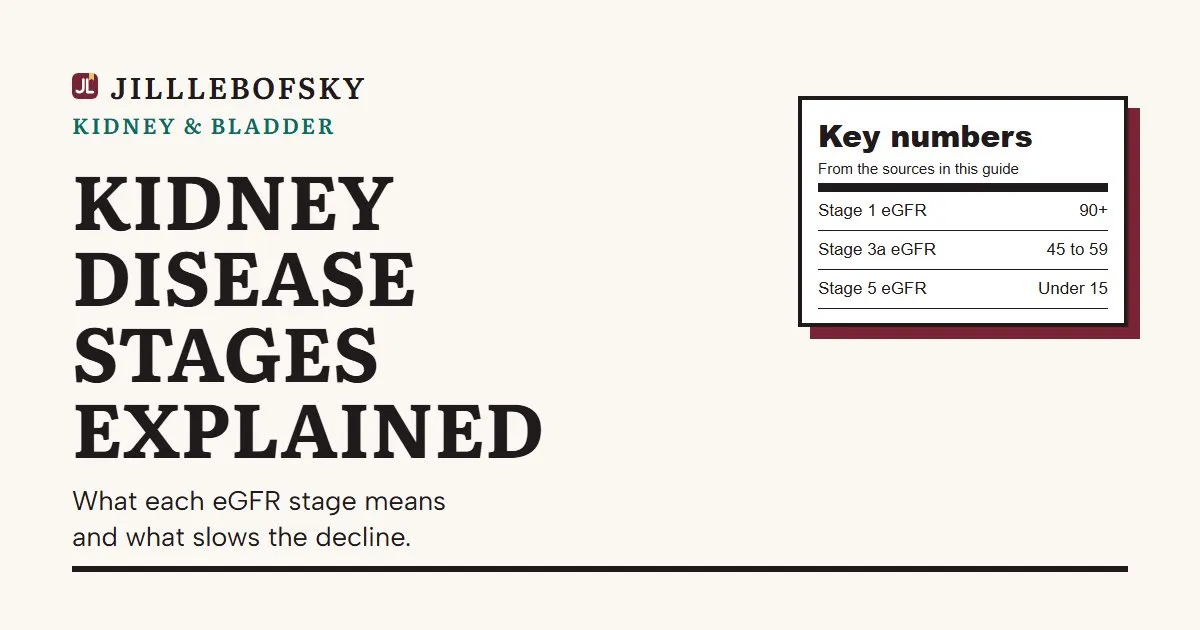
Chronic kidney disease stages are set by your eGFR blood test, from stage 1 (90 or higher, with damage) to stage 5 (under 15, kidney failure). Stage 3a means an eGFR of 45 to 59 for at least 3 months. A urine albumin test adds risk on top of the stage. You cannot raise a lost GFR, but blood pressure control and the right medicines can slow the decline.
Chronic kidney disease stages run from stage 1 to stage 5, and two lab tests decide which one you are in: an eGFR blood test and a urine albumin test. We read the KDIGO 2024 guideline, seven NIDDK pages, two MedlinePlus pages, two large drug trials and two research reviews to explain what each stage means.[3][2]
The short answer: stage 3a means an eGFR of 45 to 59 that lasts at least 3 months, and stage 5 means an eGFR under 15, which is kidney failure.[3]
| What it is | Kidney damage or reduced filtering that lasts at least 3 months[3] |
|---|---|
| How the stage is set | eGFR category G1 to G5, plus urine albumin category A1 to A3[3] |
| How common | 35.5 million US adults, more than 1 in 7; as many as 9 in 10 do not know they have it[4] |
| Main causes | Diabetes and high blood pressure[5] |
| Early symptoms | Usually none; blood and urine tests are the only way to know[1][5] |
| Can it be reversed | Advanced, long-lasting CKD typically cannot; treatment may slow it[1][5] |
| Standard care | Blood pressure control, often an ACE inhibitor or ARB, and an SGLT2 inhibitor for many adults[6][3] |
What are the chronic kidney disease stages?
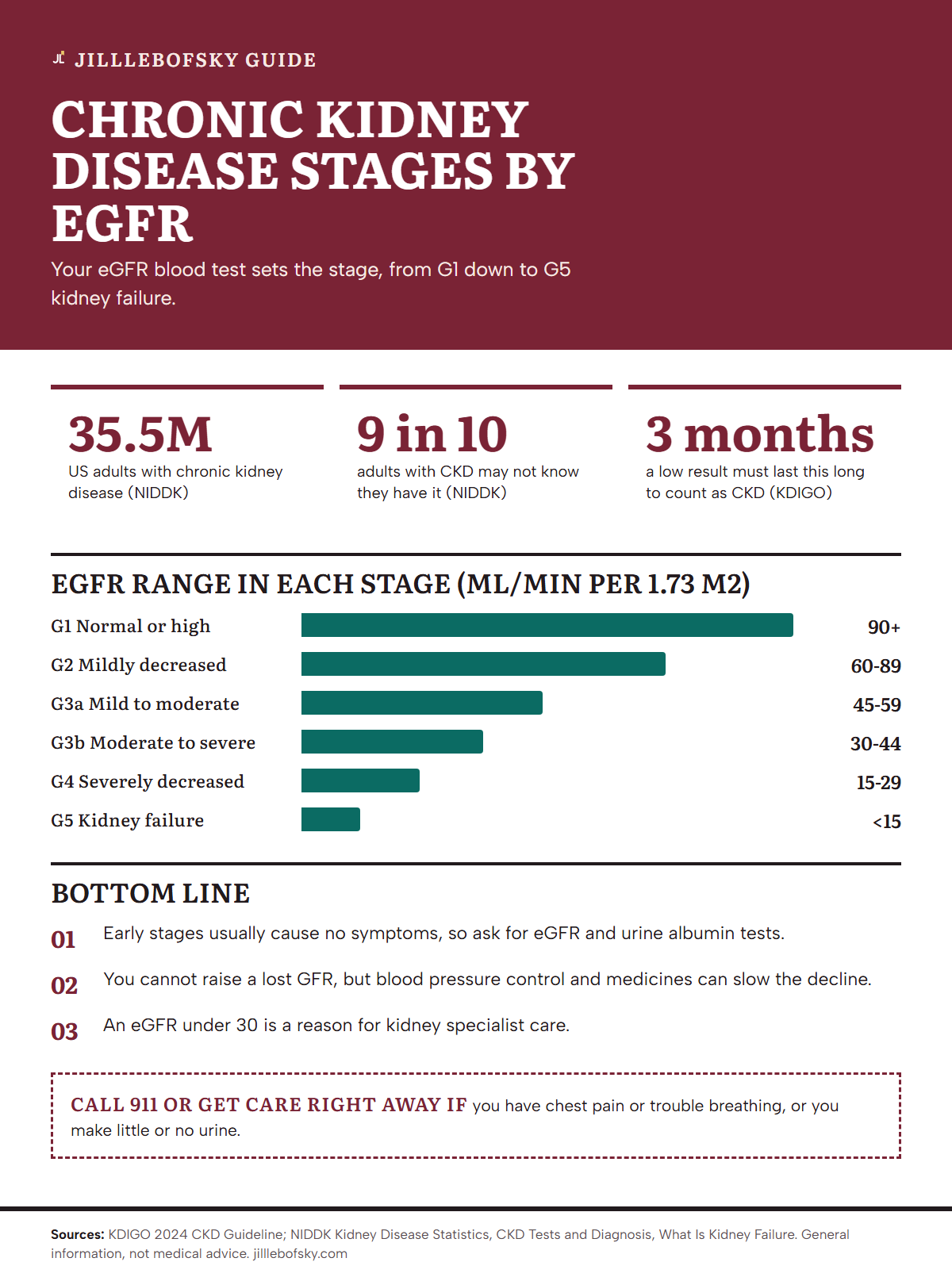
There are five main stages of chronic kidney disease, numbered by eGFR, and stage 3 is split into 3a and 3b. Stage 1 is an eGFR of 90 or higher with signs of kidney damage, and stage 5 is an eGFR under 15, called kidney failure. Each step down means the kidneys clean less blood per minute.[3]
| Stage | eGFR (mL/min per 1.73 m2) | KDIGO term | What it usually means |
|---|---|---|---|
| G1 | 90 or higher | Normal or high | Filtering is normal, but damage shows up in urine, scans or a biopsy[3] |
| G2 | 60 to 89 | Mildly decreased | Counts as CKD only when another sign of damage is present[3] |
| G3a | 45 to 59 | Mildly to moderately decreased | CKD on the eGFR alone once it lasts 3 months[3][2] |
| G3b | 30 to 44 | Moderately to severely decreased | Doctors watch for anemia, bone and mineral changes and high potassium[1] |
| G4 | 15 to 29 | Severely decreased | KDIGO lists an eGFR under 30 as a reason for kidney specialist care[3] |
| G5 | Under 15 | Kidney failure | Most people below this level need dialysis or a transplant[2] |
Stages 1 and 2 need proof of damage, such as albumin in the urine, because an eGFR of 60 or more is in the normal range.[2] An eGFR under 60 that lasts 3 months counts as CKD on its own.[3]
How do doctors work out your CKD stage?
Doctors use two simple tests. A blood test for creatinine gives your estimated glomerular filtration rate (eGFR), and a urine test gives your albumin-to-creatinine ratio (UACR). The eGFR sets the G stage. The UACR sets the A category, which adds risk on top of the stage.[2][3]
- A1: UACR under 30 mg/g, normal to mildly increased.[3]
- A2: 30 to 300 mg/g, moderately increased.[3]
- A3: over 300 mg/g, severely increased.[3]
So a full KDIGO label reads like G3a A2. KDIGO calls this the CGA system, for cause, GFR and albuminuria.[3] One low result is not enough for a diagnosis, because the change has to last at least 3 months.[3]
Age also affects the result. In carefully screened healthy kidney donors, GFR fell about 6.3 mL/min per decade, and the authors raised concern that some older adults are being labeled with CKD too readily.[14] KDIGO advises checking eGFR and urine albumin at least once a year in people with CKD, and more often for those at higher risk.[3]
What is chronic kidney disease stage 3a?
Chronic kidney disease stage 3a means an eGFR of 45 to 59 that has lasted at least 3 months. KDIGO calls it mildly to moderately decreased function. It is the first stage where the eGFR alone confirms CKD, even with no other sign of damage, and most people at this point feel well.[3][1]
Stage 3a is common later in life. CKD affects 34% of US adults aged 65 and older, compared with 12% of those 45 to 64 and 6% of those 18 to 44.[4]
The albumin result also shifts the risk. On the KDIGO risk chart, G3a with A1 albumin is a lower-risk group than G3a with A3 albumin, so ask for both numbers.[3]
At this stage, care usually turns to blood pressure, blood sugar, urine albumin and a review of every medicine and supplement. KDIGO suggests protein of about 0.8 g per kg of body weight a day from stage 3 onward, and advises against going over 1.3 g per kg.[3] Stage 3b starts when the eGFR stays below 45.
We found no official source giving an average time people spend at stage 3a. Progress varies a lot between people, so be wary of any single figure you see online.
What symptoms come with each stage?
Most people in the early stages of CKD have no symptoms at all. Many people have none until the disease is advanced. That is why NIDDK and MedlinePlus say blood and urine tests are the only reliable way to find kidney disease early, long before you would feel any change.[1][5]
As CKD advances, NIDDK lists these symptoms:[1][9]
- Swelling (edema) in the legs, feet or ankles, and less often the hands or face
- Loss of appetite, nausea or vomiting
- Tiredness, sleep problems and trouble concentrating
- A change in how often you urinate, or foamy urine
- Itching, dry or darkened skin, and muscle cramps
Sudden, sharp pain in your side or back points to other problems, such as a stone. Our guide to kidney stones symptoms and warning signs covers that pain. You can find related topics in our kidney and bladder health guides.
Call 911 or see a doctor right away if
Call 911 for chest pain or trouble breathing. Get same-day care for the other signs on this list.[1][9]
- You have chest pain or shortness of breath.[1]
- You make little or no urine.[9]
- You feel confused or cannot focus.[9]
- Swelling gets worse fast.[1]
- You have new weakness or numbness, since CKD can push blood potassium too high.[1][9]
- You feel very ill after an illness, injury or new medicine, because CKD raises the risk of acute kidney injury.[1]
How can I improve my kidney function?
NIDDK says you cannot raise a lost GFR, but you can try to keep it from going lower. Blood pressure control, blood sugar control, less sodium, avoiding regular NSAID use, staying active and taking the right medicines are the steps with the best support for slowing CKD.[2][6]
NIDDK calls blood pressure control the most important step and gives a goal under 140/90 for most people. KDIGO suggests a systolic target under 120 when it is tolerated.[6][3] Our guide on how to lower blood pressure with diet and habits covers the steps.
Many people with diabetes aim for an A1C below 7%.[6] Our blood sugar support evidence guide explains which supplements have trial data and which do not.
NIDDK sets sodium at no more than 2,300 mg a day, and KDIGO suggests under 2 g.[7][3] KDIGO recommends at least 150 minutes of moderate activity a week.[3] NIDDK adds 7 to 8 hours of sleep, no smoking, and alcohol limits of one drink a day for women and two for men.[6][8]
What to focus on at each stage
| If your stage is | Main focus | Ask about |
|---|---|---|
| G1 or G2 | Find and treat the cause, often diabetes or high blood pressure[5] | Yearly eGFR and UACR[3] |
| G3a or G3b | Blood pressure, protein near 0.8 g/kg, medicine review[3] | An ACE inhibitor or ARB, an SGLT2 inhibitor, a dietitian[3][7] |
| G4 | Kidney specialist care and limits on potassium and phosphorus if needed[3][7] | Planning early for kidney failure treatment[10] |
| G5 | Dialysis, a transplant or conservative care[9] | The benefits and drawbacks of each option[11] |
Can you improve kidney function naturally with supplements?
No supplement, tea or cleanse has been shown to raise eGFR or move anyone back a stage. The natural steps that help are the everyday ones: less salt, regular activity, good sleep and not smoking. Some supplements also carry extra risk for people with CKD.[2][3][6]
KDIGO tells clinicians to review and limit over-the-counter medicines and dietary or herbal remedies that may harm people with CKD.[3] A 2018 review in CJASN linked some herbal products to acute kidney injury and CKD, naming aristolochic acids and other plant alkaloids, plus contamination and adulteration.[15]
Watch for these label problems:
- Salt substitutes can be high in potassium.[7]
- Ingredients with PHOS in the name add phosphorus.[7]
- Ibuprofen and naproxen are NSAIDs, which can damage the kidneys.[6]
Tell your pharmacist about every supplement you take.[6] If you could become pregnant, ask about each medicine's safety; KDIGO asks prescribers to review this.[3] Our supplement review method explains how we grade the evidence.
What do doctors use first to slow CKD?
Standard care starts with blood pressure control and, for many people, an ACE inhibitor or ARB. KDIGO also recommends an SGLT2 inhibitor for adults with an eGFR of 20 or more and a urine ACR of 200 mg/g or more, or with heart failure. These drugs slow decline in trials and do not cure CKD.[6][3][5]
ACE inhibitor names end in -pril and ARB names end in -sartan. NIDDK says they may slow kidney disease even in people without high blood pressure.[6]
| Trial | Who took part | Length | Result |
|---|---|---|---|
| DAPA-CKD, 2020 | 4,304 adults, eGFR 25 to 75, with or without type 2 diabetes; dapagliflozin 10 mg | Median 2.4 years | Main kidney or death outcome in 9.2% vs 14.5% on placebo[12] |
| EMPA-KIDNEY, 2023 | 6,609 adults, eGFR 20 to 89 with set albumin levels; empagliflozin 10 mg | Median 2.0 years | Kidney progression or heart death in 13.1% vs 16.9% on placebo[13] |
Both trials were funded by the drug makers. Results were similar with and without diabetes.[12][13]
Stage 5: dialysis, transplant or conservative care
Kidney failure means function below 15 percent of normal. The three options are hemodialysis, peritoneal dialysis and a kidney transplant, and some people choose care without dialysis.[9] Each option has benefits and drawbacks.[11] NIDDK advises talking about these choices early, before you need any of them.[10]
Kidney failure treated with dialysis or a transplant is also called end-stage renal disease, or ESRD.[9] Its symptoms can start so slowly that people do not notice them at first.[9] Whichever treatment you choose, you will need some changes in how you eat and plan your activities. NIDDK says treatment will help you feel better and live longer.[11][10]
What should you check at each kidney visit?
Bring a short list to every visit so your stage is read with all the numbers that matter. The stage number alone leaves out the albumin result and the trend over time. These checks come from the KDIGO and NIDDK advice above and fit any stage from 1 to 5.[3][6]
- Ask for your eGFR and your UACR, and write both down with the date.[3]
- Ask what your full label is, such as G3a A1, and whether the result has lasted 3 months.[3]
- Ask what your blood pressure goal is and how you are tracking.[6]
- Ask whether an ACE inhibitor, ARB or SGLT2 inhibitor fits you.[3]
- Bring every pill bottle, including pain relievers and supplements.[6]
- Ask whether you need a dietitian for sodium, protein, potassium or phosphorus.[7]
- Ask when you need a kidney specialist.[6]
Bottom line
Chronic kidney disease stages describe how well the kidneys filter, and the urine albumin result tells you how much risk sits behind that number. Early stages usually cause no symptoms, so testing is the only way to know.[3][5]
For most people with a new stage 3a result, the better first step is a repeat eGFR plus a urine albumin test, then a blood pressure plan, because one result does not confirm the stage. We found no trial showing that a kidney cleanse product slows CKD, while the drugs that slowed decline in trials need a prescription. Our editorial policy explains how we source pages like this one.[3][12]
Frequently asked questions
Can stage 3 kidney disease go back to stage 2?
A single eGFR can move up or down between tests, which is why a stage needs 3 months to confirm. Once function is truly lost, NIDDK says you cannot raise your GFR, but treatment can help keep it from falling further.
Is stage 3a kidney disease serious?
Stage 3a is a moderate loss of filtering, and many people at this stage feel well. The risk depends heavily on urine albumin: G3a with A1 albumin is a lower-risk group than G3a with A3 on the KDIGO chart.
How often should kidney function be checked?
KDIGO advises checking eGFR and urine albumin at least once a year in people with CKD, and more often for those at higher risk. NIDDK advises yearly kidney checks for people with diabetes, even before any kidney problem appears.
What is a normal eGFR for my age?
An eGFR of 60 or more is in the normal range. Filtering slowly drops with age: in healthy kidney donors, GFR fell about 6.3 mL/min per decade. Ask your doctor how your result compares with what is expected for you.
When do you need a kidney specialist for CKD?
KDIGO lists an eGFR under 30, which is stage 4 or 5, and a urine ACR of 300 mg/g or more among reasons to refer someone to kidney specialist care. Your doctor may refer sooner if the cause is unclear.
Sources
- What Is Chronic Kidney Disease in Adults?. NIDDK, 2025
- Chronic Kidney Disease Tests and Diagnosis. NIDDK
- KDIGO 2024 Clinical Practice Guideline for the Evaluation and Management of Chronic Kidney Disease. KDIGO, Kidney International, 2024
- Kidney Disease Statistics for the United States. NIDDK, 2024
- Chronic Kidney Disease. MedlinePlus, National Library of Medicine
- Managing Chronic Kidney Disease. NIDDK
- Healthy Eating for Adults with Chronic Kidney Disease. NIDDK, 2025
- Preventing Chronic Kidney Disease. NIDDK
- What Is Kidney Failure?. NIDDK
- Choosing a Treatment for Kidney Failure. NIDDK
- Kidney Failure. MedlinePlus, National Library of Medicine
- Dapagliflozin in Patients with Chronic Kidney Disease (DAPA-CKD). Heerspink et al., New England Journal of Medicine, 2020
- Empagliflozin in Patients with Chronic Kidney Disease (EMPA-KIDNEY). EMPA-KIDNEY Collaborative Group, New England Journal of Medicine, 2023
- Structural and Functional Changes With the Aging Kidney. Denic, Glassock and Rule, Advances in Chronic Kidney Disease, 2016
- Nephrotoxicity and Chinese Herbal Medicine. Yang et al., Clinical Journal of the American Society of Nephrology, 2018
This page is general information, not medical advice. Talk to your doctor or pharmacist before you start any supplement, especially if you are pregnant, take medicine or have a health condition. Read our medical disclaimer and how we review.