Kidney stones symptoms usually begin with sharp pain in the back, side, lower belly or groin that comes and goes in waves. Many people also notice pink, red or brown urine, pain when peeing or a constant urge to go. Get care the same day for fever with pain, inability to pass urine, or severe pain with vomiting.
Kidney stones symptoms usually start with sharp pain in the back, side, lower belly or groin, often with blood in the urine or pain when you pee. We read the NIDDK pages on symptoms, causes, diagnosis, treatment and diet, two MedlinePlus pages, a national survey and five trials and reviews on passing and preventing stones.[1][6]
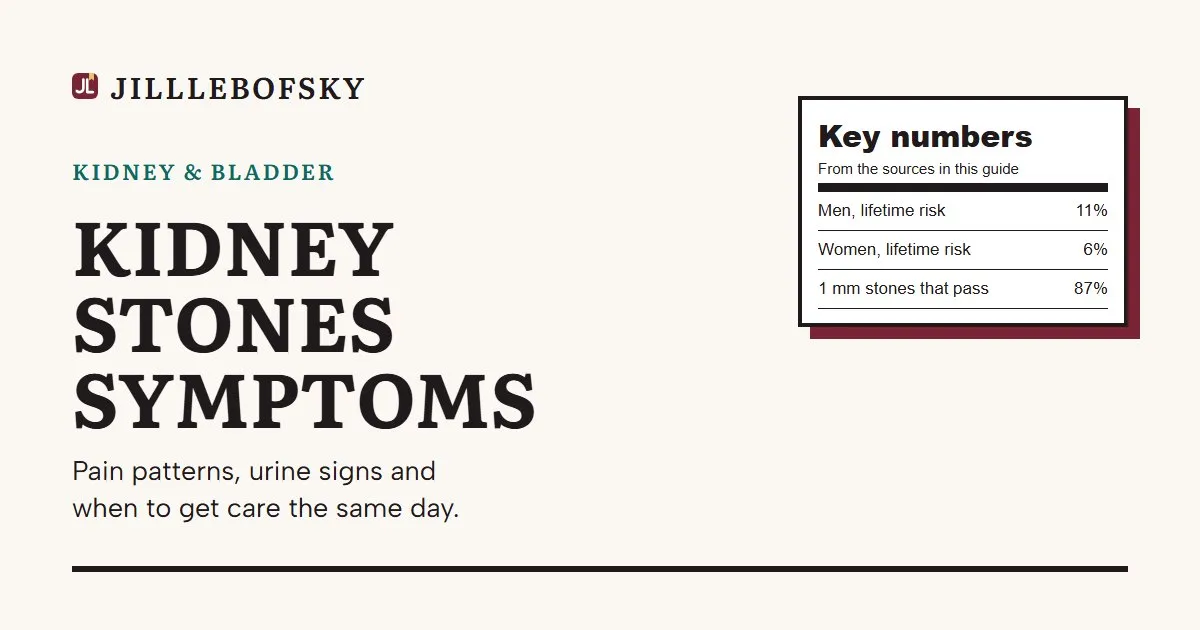
The short answer: about 11% of men and 6% of women in the United States get a kidney stone at least once, and the warning sign most people notice first is pain that comes and goes in waves.[2][1]
| What it is | A hard, pebble-like piece of minerals that forms in the kidney, from the size of a grain of sand to a pea, rarely a golf ball[2] |
|---|---|
| Main symptoms | Sharp pain in the back, side, lower abdomen or groin; pink, red or brown urine; urgent or painful urination[1] |
| How common | About 11% of men and 6% of women at least once; 8.8% of adults in a 2007 to 2010 national survey[2][8] |
| Most common type | Calcium stones, mostly calcium oxalate[2] |
| How it is found | Urine and blood tests plus imaging, most often a CT scan without contrast[3] |
| Best-studied prevention | Enough fluid, mainly water: six to eight 8-ounce glasses a day unless you have kidney failure[5] |
| Get care right away | Fever and chills, vomiting, pain that will not go away, or trouble passing urine[1][6] |
Kidney stones symptoms: what are the first signs?
The first sign of a kidney stone is usually a sharp pain in your back, side, lower belly or groin.[1] Many people also see pink, red or brown urine, feel a constant need to pee, or feel pain while urinating. Some can pass only a small amount of urine, or none at all.[1]
The National Institute of Diabetes and Digestive and Kidney Diseases (NIDDK) lists these signs:[1]
- Sharp pain in the back, side, lower abdomen or groin
- Pink, red or brown blood in the urine, called hematuria
- A constant need to urinate
- Pain while urinating
- Being unable to urinate, or passing only a small amount
- Cloudy or bad-smelling urine
Nausea and vomiting often come with the pain. Fever and chills can also appear.[1] MedlinePlus adds a burning feeling when you urinate to the list of signs that need a doctor.[6]
Not every stone hurts. A small one may pass through the urinary tract on its own with little or no pain.[2] Pain usually starts when a larger stone gets stuck and blocks the flow of urine, which can cause severe pain or bleeding.[2]
Where do you feel kidney stone pain, and does it come in waves?
Kidney stone pain is usually felt in the back or side, and it can spread to the lower belly and groin.[1] NIDDK says the pain may last a short or long time, or it may come and go in waves.[1]
Where the pain sits often tracks where the stone is. A stone that is still in the kidney may cause little pain. Once it moves into the ureter, the thin tube that carries urine to the bladder, it can block the flow and cause severe pain.[2] Doctors call this ureteric or renal colic.[11][12]
Pain that is extreme, sits in your back or side and will not go away is one of the MedlinePlus signs that you need a doctor.[6] Pain with nausea and vomiting is common, and if the vomiting leaves you dehydrated you may need fluids through an IV in the hospital.[1][4]
What causes kidney stones?
Kidney stones form when urine carries high levels of minerals such as calcium, oxalate and phosphorus.[1] These minerals are normal in urine and cause no problem at low levels. When levels climb, or when you make too little urine, crystals can join into a stone.[1][4]
Not drinking enough liquid raises the chance.[2] So does eating more sodium, and eating a lot of animal protein can raise it in people prone to stones.[5] Certain foods only matter for people who are already more likely to form stones.[1]
The four main types of kidney stones
The type matters because treatment and prevention depend on what the stone is made of.[2][7]
| Type | How common | What drives it | Medicines a doctor may prescribe |
|---|---|---|---|
| Calcium (oxalate or phosphate) | Most common[2] | Extra calcium joins with waste in the kidney; calcium from food does not raise the risk[2] | Potassium citrate, diuretics[4] |
| Uric acid | Common[7] | Urine that is too acidic; lots of fish, shellfish and meat, especially organ meat[2] | Allopurinol, potassium citrate[4] |
| Struvite | Least common[7] | Forms after a urinary tract infection; can grow large quickly[2] | Antibiotics, acetohydroxamic acid[4] |
| Cystine | Uncommon[7] | Cystinuria, an inherited disorder that leaks cystine into urine[2] | Tiopronin (mercaptopropionyl glycine), potassium citrate[4] |
Who is more likely to get kidney stones?
Men get stones more often than women. A family history raises your risk, and once you have had one stone you are more likely to have another.[2] In the 2007 to 2010 national survey of 12,110 people, 10.6% of men and 7.1% of women reported a stone. The rate was 11.2% in people with obesity and 6.1% in people at a normal weight.[8] A one-time survey like this cannot show what causes stones.[8]
NIDDK also lists conditions that raise risk, including gout, hyperparathyroidism, obesity, repeated urinary tract infections, chronic bowel inflammation and past digestive surgery. Hypercalciuria, which runs in families, is the most common finding in people who form calcium stones.[2] Long-term use of diuretics, calcium-based antacids, indinavir or topiramate can also raise the chance.[2]
How do doctors diagnose kidney stones?
Doctors diagnose kidney stones with your history, a physical exam, urine and blood tests, and imaging.[3] They will ask about past stones, family history and what you usually eat, then test your urine for blood, minerals and signs of infection.[3]
- Urinalysis shows blood and stone-forming minerals. White blood cells and bacteria suggest a urinary tract infection.[3]
- Blood tests look for high levels of minerals that can lead to stones.[3]
- Abdominal x-ray can show where a stone is, though not every stone shows up.[3]
- CT scan, usually without contrast dye, shows the size and location of a stone and whether it blocks the urinary tract.[3]
If you pass a stone, your provider may ask you to catch it with a strainer so a lab can tell what it is made of. MedlinePlus says to filter all your urine, keep the stone dry, and never tape it or wrap it in tissue.[7] After a stone passes or is removed, a 24-hour urine collection can show whether you make too little urine or have high mineral levels.[4]
Can a kidney stone pass on its own?
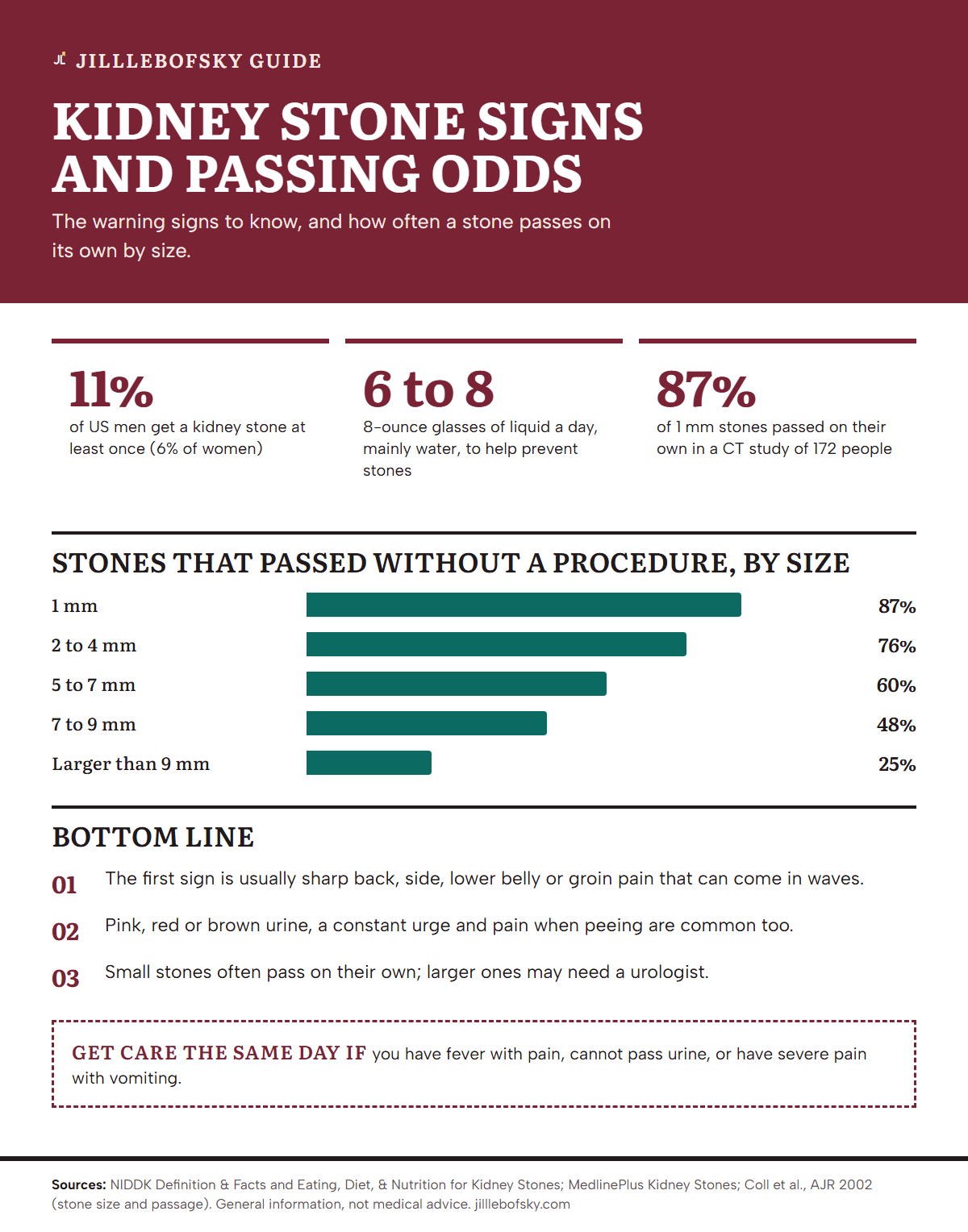
Yes, most kidney stones pass out of the body without help from a doctor, and the smaller the stone, the better the odds.[6] A 2002 CT study of 172 people with stones in the ureter found that 87% of 1 mm stones passed on their own, compared with 25% of stones larger than 9 mm.[9]
| Stone size on CT | Passed without a procedure | What this usually means |
|---|---|---|
| 1 mm | 87%[9] | Most pass; your doctor may advise fluids and pain relief[4] |
| 2 to 4 mm | 76%[9] | Good odds of passing; keep the stone for testing[7] |
| 5 to 7 mm | 60%[9] | Close follow-up; a procedure is more likely[4] |
| 7 to 9 mm | 48%[9] | About half need a procedure[9] |
| Larger than 9 mm | 25%[9] | Most need removal by a urologist[4][9] |
Location mattered too. Stones near the bladder passed 79% of the time, compared with 48% for stones high in the ureter.[9] These figures come from one hospital and a look back at past records, so treat them as a rough guide.[9]
How are kidney stones treated?
Treatment depends on the stone's size, location and type, and small stones are often managed with fluids and pain medicine while they pass.[4] Larger stones, stones that block urine flow, or stones that cause great pain may need urgent care from a urologist.[4]
The standard procedures are:[4]
- Shock wave lithotripsy breaks the stone into small pieces that pass in the urine. It is an outpatient procedure.
- Ureteroscopy passes a thin scope up through the urethra to find the stone, then removes it or breaks it up. Most people go home the same day.
- Percutaneous nephrolithotomy removes larger stones through a small cut in the back. It may mean several days in the hospital.
A urologist may leave a thin tube called a ureteral stent to help urine flow.[4] The larger trials on pain relief, stone passage and repeat stones are summed up below.
| Study | Who and how many | What was tested | Result |
|---|---|---|---|
| Pathan, Lancet 2016[12] | 1,645 adults with renal colic in an emergency department | Diclofenac injection vs IV paracetamol vs IV morphine | Pain fell by half in 30 minutes for 68%, 66% and 61%; fewer side effects than with morphine |
| Hollingsworth, BMJ 2016[10] | 55 randomized trials | Alpha blockers, such as tamsulosin, vs placebo or usual care | Stones passed more often (risk ratio 1.49) and 3.79 days sooner; no clear benefit for small stones |
| Pickard, SUSPEND 2015[11] | 1,167 adults with one stone of 10 mm or less, 24 UK hospitals | Tamsulosin 400 mcg or nifedipine 30 mg vs placebo, up to 4 weeks | No difference in stones passed |
| Borghi, J Urol 1996[13] | 199 people after a first calcium stone, 5 years | High water intake vs no specific advice | Stones came back in 12 of 99 vs 27 of 100 |
The alpha blocker evidence is mixed. The review pooled many small trials, while the single large SUSPEND trial found no gain.[10][11] Both drugs need a prescription, so the decision belongs with your doctor.
When should you see a doctor right away for kidney stones?
See a doctor right away if stone pain comes with fever, if you cannot pass urine, or if severe pain comes with vomiting.[1][6] NIDDK says to see a health care professional right away for any stone symptom, because the same signs can point to a more serious condition.[1]
Go to urgent care or an emergency department if you have:
- Fever or chills with back, side or groin pain. Untreated stones can lead to urinary tract and kidney infections.[2][6]
- Inability to urinate, or only a few drops. A stuck stone can block the flow of urine.[1][2]
- Severe pain with vomiting. If you are vomiting and dehydrated, you may need IV fluids in the hospital.[4]
- Extreme pain in your back or side that will not go away.[6]
- Blood in your urine, or cloudy, bad-smelling urine with burning.[6]
| If you have | Then |
|---|---|
| Fever, chills, or vomiting with flank pain | Get same-day emergency care[4][6] |
| Pain plus little or no urine | Get same-day emergency care[1] |
| Mild pain that comes and goes, normal urine flow, no fever | Call your doctor soon for testing; drink fluids if you can[1][4] |
| A stone that already passed | Keep it dry and ask about stone analysis[7] |
Kidney stones rarely cause lasting damage when treated.[2] Left untreated, they can lead to bleeding, severe pain, infections and loss of kidney function.[2] MedlinePlus notes that stones also raise the risk of chronic kidney disease.[7] If you are pregnant, or you take medicine every day, tell the care team before you use any pain reliever.
How can you prevent kidney stones with fluids and diet?
Drinking enough liquid, mainly water, is the most important thing you can do to prevent kidney stones.[5] NIDDK suggests six to eight 8-ounce glasses a day unless you have kidney failure, and more in hot weather or with heavy exercise.[4][5] In the Borghi trial, people told to drink more water had fewer repeat stones over 5 years.[13]
Citrus drinks such as lemonade and orange juice contain citrate, which stops crystals from turning into stones, although water is still best.[4] Diet changes depend on your stone type, so ask which type you had first.[5]
- Keep sodium under 2,300 mg a day. One teaspoon of table salt holds 2,325 mg.[5]
- Get calcium from food. Calcium from food does not raise the risk of calcium oxalate stones, and MedlinePlus says dairy can help prevent calcium stones.[2][7]
- If you had calcium oxalate stones, ask about limiting peanuts, rhubarb, spinach and wheat bran.[5]
- Eat less animal protein and swap in beans, dried peas and lentils.[5]
- Lose weight if you are overweight, especially after a uric acid stone. The DASH eating plan has been linked to lower risk.[5]
What to check on supplement labels
At JillLebofsky we check label doses against the research, as our how we review page explains. For stones, two label checks matter. Long-term use of calcium-based antacids is on the NIDDK list of medicines that raise risk.[2] In a large study of 40,536 men, those taking 1,000 mg or more of supplemental vitamin C a day had a 19% higher rate of stones (hazard ratio 1.19), with no clear link in women.[14] Because the study only observed people, it cannot prove the vitamin caused the stones.[14]
No supplement has been shown to dissolve stones. The potassium citrate used for stones is a prescription medicine, often taken 1 to 3 times a day under a doctor's care.[4] You can find more guides in our kidney and bladder health guides, and our editorial policy explains how we pick sources.
Bottom line
Kidney stones symptoms are hard to miss once a stone moves: waves of sharp back or side pain, often with blood in the urine and an urge to pee.[1] Most small stones pass on their own, while stones over about 9 mm usually need a urologist.[6][9]
For most people, the better first step after a stone is a lab test of the stone and a talk about fluids, because water has the strongest trial support for keeping stones from coming back.[7][13] Fever, no urine, or severe pain with vomiting means you should get care the same day.[4][6]
Frequently asked questions
Can you have a kidney stone without pain?
Yes. A small kidney stone can pass through the urinary tract on its own and cause little or no pain. Pain usually starts when a larger stone gets stuck and blocks the flow of urine.
What color is your urine with a kidney stone?
Urine can look pink, red or brown because of blood, which doctors call hematuria. It can also look cloudy or smell bad. Cloudy, bad-smelling urine with fever can point to an infection and needs a doctor.
Can drinking water flush out a kidney stone?
Doctors often advise plenty of liquids and pain medicine to help a small stone move along. Water cannot dissolve a stone. Stones that are large, stuck or very painful may need a procedure.
Do kidney stones come back?
They often do. Once you have had one stone, you are more likely to get another. In one 5-year trial, stones returned in 27 of 100 people given no specific advice and 12 of 99 who drank more water.
Does dairy cause kidney stones?
No. MedlinePlus says calcium stones are not caused by eating dairy, and dairy can help prevent them. NIDDK also says calcium from food does not raise the chance of calcium oxalate stones.
Are kidney stones dangerous?
Most are not dangerous when treated, and they rarely cause lasting damage. Left untreated, a stone can cause bleeding, infection and loss of kidney function, and stones raise the long-term risk of chronic kidney disease.
Sources
- Symptoms & Causes of Kidney Stones. NIDDK, reviewed 2017
- Definition & Facts for Kidney Stones. NIDDK, reviewed 2017
- Diagnosis of Kidney Stones. NIDDK, reviewed 2017
- Treatment for Kidney Stones. NIDDK, reviewed 2017
- Eating, Diet, & Nutrition for Kidney Stones. NIDDK, reviewed 2017
- Kidney Stones. MedlinePlus, National Library of Medicine, 2026
- Kidney Stone Analysis. MedlinePlus, National Library of Medicine, 2025
- Prevalence of kidney stones in the United States (Scales et al.). European Urology, 2012
- Relationship of spontaneous passage of ureteral calculi to stone size and location as revealed by unenhanced helical CT (Coll et al.). American Journal of Roentgenology, 2002
- Alpha blockers for treatment of ureteric stones: systematic review and meta-analysis (Hollingsworth et al.). BMJ, 2016
- Drug therapy for symptomatic ureteric stones: the SUSPEND trial (Pickard et al.). Health Technology Assessment, NIHR, 2015
- Delivering safe and effective analgesia for management of renal colic in the emergency department (Pathan et al.). The Lancet, 2016
- Urinary volume, water and recurrences in idiopathic calcium nephrolithiasis (Borghi et al.). Journal of Urology, 1996
- Total, dietary, and supplemental vitamin C intake and risk of incident kidney stones (Ferraro et al.). American Journal of Kidney Diseases, 2016
This page is general information, not medical advice. Talk to your doctor or pharmacist before you start any supplement, especially if you are pregnant, take medicine or have a health condition. Read our medical disclaimer and how we review.