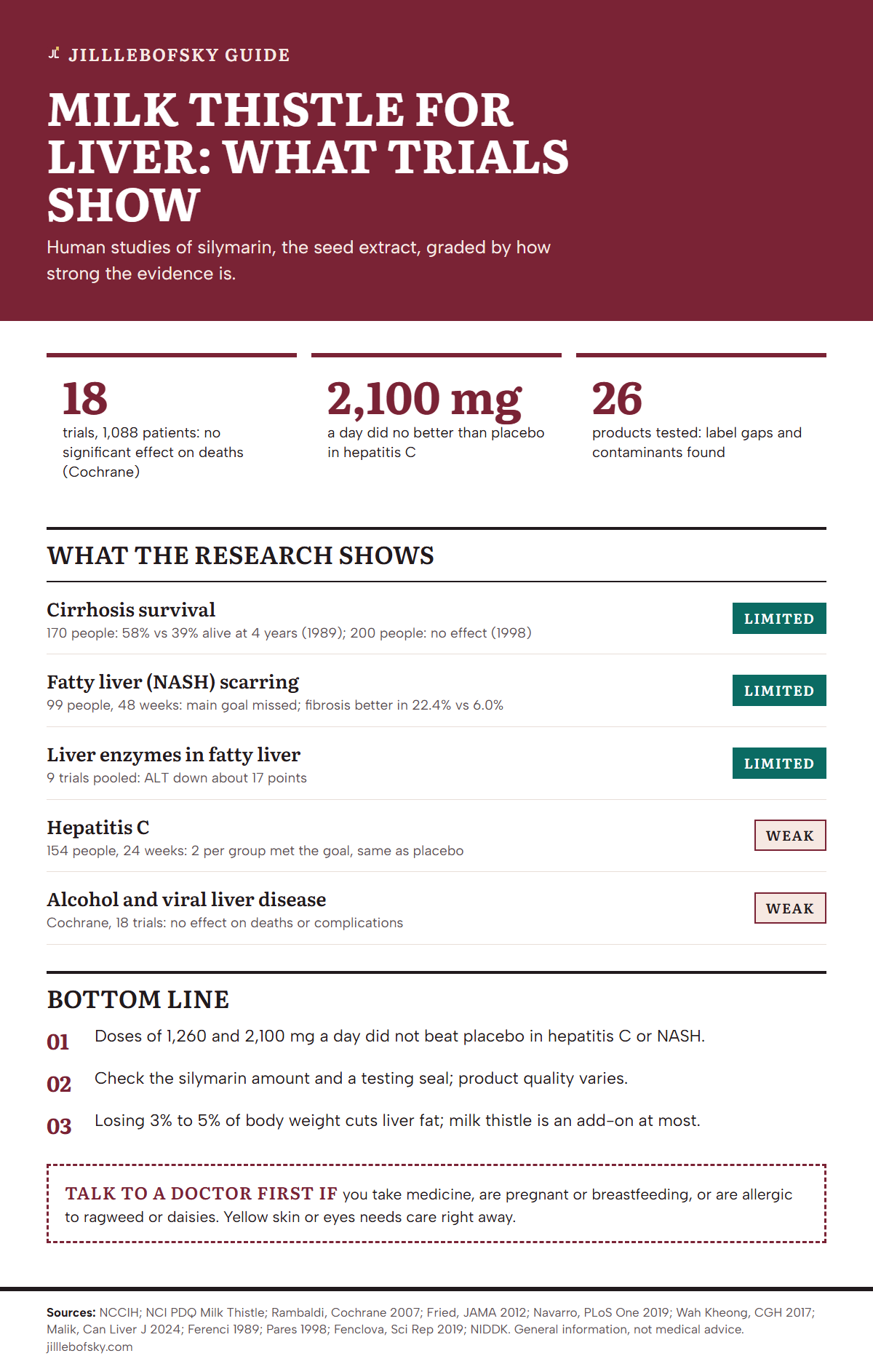
Milk thistle for liver disease has weak support in people. A Cochrane review of 18 trials found no effect on deaths, and two NIH-funded trials of high doses in hepatitis C and NASH showed no benefit. One 99-person trial hinted at less scarring. It appears safe for most adults, but label quality varies, and weight loss and medical care come first.
Milk thistle for liver health is one of the oldest herbal uses on record, so we checked whether the human trials back it up. We read the NCCIH and NCI summaries, a Cochrane review, five randomized trials, a 2024 meta-analysis, a lab test of 26 products and the AASLD fatty liver guidance.[1][2][3][11]
The short answer: across 18 trials and 1,088 patients, milk thistle did not change death rates, liver complications or liver biopsies.[3] It looks safe for most adults, but it is not a proven liver medicine.
| What it is | A plant (Silybum marianum) whose seed extract, silymarin, is a mix of compounds; silybin is the main one[1][2] |
|---|---|
| Used for | Liver and gallbladder complaints for more than 2,000 years[2] |
| Doses in trials | Most liver trials used 120 to 560 mg a day; recent US trials tested 420 or 700 mg three times a day[2][4] |
| Best evidence | Cochrane review of 18 trials: no significant effect on deaths or complications[3] |
| Safety | Usually well tolerated; bloating, nausea and gas are the most common complaints[1] |
| Who should ask first | People on medicine, pregnant or breastfeeding people, and anyone allergic to ragweed or daisies[1] |
What does milk thistle do for the liver?
In lab studies, milk thistle's extract steadies liver cell membranes and supports repair, but those effects have not turned into clear benefits in people. Silymarin is the extract made from milk thistle seeds, and it is the part studied in liver trials.[2] Human results have been mixed or negative.[1]
The NCI summary lists what lab work suggests: silymarin stabilizes cell membranes, stimulates detox pathways and stimulates the regrowth of liver tissue.[2] Those findings come from cells and animals. They explain the interest, yet they cannot tell us what a capsule does in a human liver.
Researchers only isolated silymarin from the seeds in 1968.[2] Its compounds dissolve poorly in water, which is why most products are extracts in capsules or tablets and not teas. Some brands bind silybin to phosphatidylcholine to raise absorption.[2]
In Europe, doctors give silybin through a vein for poisoning from the death cap mushroom, Amanita phalloides.[2] That is an emergency hospital treatment given by IV, so it tells us little about a daily capsule.
Is milk thistle good for your liver? What the trials show
For most liver diseases, the best trials found no clear benefit. NCCIH says there isn't enough high-quality evidence to reach definite conclusions about milk thistle for any health condition.[1] Results in alcohol-related liver disease, hepatitis B and C and fatty liver have been conflicting or too limited.
The Cochrane review pooled 18 randomized trials with 1,088 patients who had alcohol-related or viral liver disease. Only 28.6% of the trials reported high-quality methods.[3] Milk thistle had no significant effect on overall deaths, liver complications or liver tissue.
Liver-related deaths looked lower when all trials were counted, but the difference faded in the high-quality trials alone.[3] That pattern often means weaker studies inflated the result. Side effects were no more common than with placebo.
The main milk thistle studies side by side
| Study | Who and how many | Dose and length | Result |
|---|---|---|---|
| Cochrane review, 2007 | 18 trials, 1,088 patients with alcohol or hepatitis B or C liver disease | Any dose | No significant effect on deaths or complications[3] |
| Fried, JAMA 2012 | 154 adults with hepatitis C | 420 or 700 mg three times a day, 24 weeks | 2 people per group met the liver enzyme goal, same as placebo[4] |
| Navarro, PLoS One 2019 | 78 adults with NASH, no cirrhosis | 420 or 700 mg three times a day, 48 weeks | 15% and 19% improved vs 12% on placebo, not significant[5] |
| Wah Kheong, 2017 | 99 adults with NASH in Malaysia | 700 mg three times a day, 48 weeks | Main goal missed; fibrosis improved in 22.4% vs 6.0%[6] |
| Ferenci, 1989 | 170 adults with cirrhosis | 140 mg three times a day, mean 41 months | 4-year survival 58% vs 39%[8] |
| Pares, 1998 | 200 adults with alcohol-related cirrhosis | 150 mg three times a day, 2 years | No effect on survival[9] |
Does milk thistle help fatty liver disease?
It may lower liver enzymes a little, but it has not improved fatty liver on biopsy. The 2023 AASLD guidance says the effect of silymarin in NASH remains inconclusive.[11] Two phase 2 trials found it safe, yet neither improved the main tissue score. A possible effect on scarring still needs confirming.
The NCCIH-funded US trial gave 78 adults with NASH either 420 mg, 700 mg or placebo three times a day for 48 weeks. Improvement rates were 19%, 15% and 12%, which was not a significant difference.[5] A central review found 63% of people did not meet the entry criteria, which muddied the result.
A Malaysian trial of 99 adults gave 700 mg three times a day for 48 weeks. It missed its main goal (32.7% vs 26.0%). Fibrosis improved by at least one stage in 22.4% on silymarin and 6.0% on placebo.[6] The authors said a larger trial is needed to confirm it.
A 2024 meta-analysis of 9 trials found silymarin lowered ALT by about 17 points and AST by about 13 points.[7] A drop in enzymes is a lab result, and it does not show the liver itself got healthier. For the steps that do work, see our guide to fatty liver treatment and weight targets.
Can milk thistle help with cirrhosis or alcohol-related liver disease?
One old trial suggested longer survival, but a larger one did not repeat it. Cirrhosis is scarring that replaces healthy liver tissue, and no supplement has been shown to undo it. The Cochrane review found no significant drop in deaths when trials of alcohol-related liver disease were pooled.[3]
In 1989, an Austrian trial gave 170 people with cirrhosis either 140 mg of silymarin three times a day or placebo. Four-year survival was 58% with silymarin and 39% with placebo.[8] The benefit showed up mainly in alcohol-related cirrhosis and in milder disease.
A Spanish trial then tested 200 people with alcohol-related cirrhosis on 150 mg three times a day for 2 years. There were 15 deaths with silymarin and 14 with placebo, and the authors found no effect on survival or the course of disease.[9]
With two solid trials pointing in opposite directions, we read the benefit as unproven. Stopping alcohol matters far more. Our page on liver cirrhosis causes and how doctors find them covers the main risks.
Does milk thistle work for hepatitis C or hepatitis B?
No trial has shown it clears hepatitis virus or reliably improves liver tests. In the largest US hepatitis C trial, high-dose silymarin did no better than placebo.[4] Antiviral medicines from a doctor are the treatment for chronic hepatitis C and B.
The Fried trial enrolled 154 adults with hepatitis C whose earlier interferon treatment had failed. They took 420 mg, 700 mg or placebo three times a day for 24 weeks.[4] Only 2 people in each group reached the liver enzyme goal: 3.8%, 4.0% and 3.8%.
Liver enzymes, virus levels and quality of life did not differ between groups. Side effects were similar to placebo.[4] These doses were higher than most store products, so a stronger capsule is unlikely to change the picture.
Older hepatitis B studies are small. NCI notes one trial in hepatitis A and B that saw faster enzyme drops, and another in hepatitis B that saw no effect on the course of disease.[2]
How much milk thistle do liver trials use?
There is no official dose for liver health. Liver trials of silymarin have used a wide range, from 120 to 560 mg a day, with conflicting results.[2] The newer US trials tested much higher doses and still found no benefit, so more is not better.[4][5]
Use this table to compare a label with what was actually tested. Look at the silymarin amount per serving, not the weight of the whole extract or seed powder.
| Trial | Silymarin per day | Condition | Outcome |
|---|---|---|---|
| Ferenci 1989 | 420 mg (140 mg x 3) | Cirrhosis | Better survival in one trial[8] |
| Pares 1998 | 450 mg (150 mg x 3) | Alcohol-related cirrhosis | No survival effect[9] |
| Fried 2012 | 1,260 or 2,100 mg | Hepatitis C | Same as placebo[4] |
| Navarro 2019 | 1,260 or 2,100 mg | NASH | Not significant[5] |
| Wah Kheong 2017 | 2,100 mg | NASH | Main goal missed; less fibrosis[6] |
Two cautions apply. NCI notes mild allergic reactions at doses above 1,500 mg a day.[2] And the US trials used a standardized prescription-grade product, which store brands may not match.
Can you trust what is in a milk thistle supplement?
Not always. A 2019 lab study of 26 milk thistle supplements found large gaps between the silymarin on the label and the amount inside.[10] It also found mycotoxins and pesticides in every product tested, plus microbes. NCCIH flags the same quality problem.[1]
The study bought products in the US and Czech markets in 2016 and 2017. Silymarin content also changed from batch to batch of the same brand.[10] The authors said poor quality may explain why trial results are so inconsistent.
Supplements do not need FDA approval before they are sold. The company is responsible for safety and truthful labels.[14] That is why we check labels and third-party testing in every guide; our review method explains how.
Is milk thistle safe, and who should avoid it?
For most adults it seems safe in the short term. NCCIH says oral milk thistle appears to be well tolerated, with bloating, nausea and gas as the most common side effects.[1] Trials lasting up to two years and more reported few problems.[3][9]
Some people should talk to a doctor or pharmacist before taking it:
- Anyone allergic to ragweed, chrysanthemum, marigold or daisy, since milk thistle is in the same plant family.[1]
- People who are pregnant or breastfeeding, because little is known about safety.[1]
- Anyone on prescription medicine. Some herbs and drugs interact in harmful ways.[1][14]
- People on cancer drugs. Lab studies show silymarin can slow some drug-clearing enzymes, though at levels oral doses do not reach.[2]
NIDDK warns that some herbal remedies can damage the liver.[12] See a doctor right away if you notice yellow skin or eyes, swelling in the belly or legs, easy bruising or a change in stool or urine color.[13]
What do doctors use first for liver health?
Doctors start by finding the cause, then treat it directly. For fatty liver, the first step is losing weight: 3% to 5% of body weight can reduce liver fat, and 7% to 10% can ease inflammation and scarring.[12] Milk thistle is not part of standard care.
Liver disease has many causes, including hepatitis viruses, alcohol, medicines and inherited conditions.[13] Blood tests and imaging show which one is involved. Sometimes there are no symptoms at all, so testing matters.
The AASLD guidance adds steady exercise, a Mediterranean-style diet and stopping alcohol fully for people with moderate scarring. It notes coffee, 3 or more cups a day, may be fine for people with no reason to avoid it.[11]
Physical activity helps the liver even without weight loss, but crash diets can make liver disease worse.[12] If you are tempted by a cleanse, our look at liver detox teas, pills and cleanses covers what NIH sources say.
How to check a milk thistle label before you buy
If you and your doctor decide to try it, the label tells you most of what matters. Look for the silymarin amount per serving and a third-party testing seal, since product quality varies widely.[10] Then compare the dose with the trial table above.
- Find the silymarin content in milligrams, often listed as a standardized percentage of the extract.[2]
- Prefer a seal from an independent tester, given the contamination found in tested products.[10]
- Skip labels that promise to cure, detox or regenerate your liver. Supplements cannot legally make disease claims.[14]
- Bring the bottle to your doctor or pharmacist so they can check it against your medicines.[1]
- Ask for liver tests before and after, so you know whether anything changed.[13]
- Stop and call your doctor if new stomach upset, rash or yellowing appears.[1]
More guides on this topic sit in our liver health section.
Bottom line on milk thistle for liver
Milk thistle has a long history and a good safety record, but the strongest trials have not shown that it helps a damaged liver. High doses did not beat placebo in hepatitis C or NASH, and the Cochrane review found no effect on deaths.[3][4][5]
For most people, a liver test and a talk with a doctor is the better first step, because the real causes respond to weight loss, less alcohol and antiviral or MASH medicines. If you still want to try milk thistle, treat it as an add-on with weak evidence and pick a tested product.
Frequently asked questions
Can milk thistle lower liver enzymes?
It may lower them slightly. A 2024 meta-analysis of 9 fatty liver trials found ALT fell about 17 points, but a large hepatitis C trial saw no difference from placebo. Lower enzymes alone do not prove the liver is healthier.
How long does milk thistle take to work on the liver?
No source gives a timeline, because benefit is unproven. The liver trials ran from 24 weeks to about four years. If you try it, ask your doctor to repeat liver tests after a few months to see whether anything changed.
Can I take milk thistle every day?
Trials gave it daily for up to two years and more with few side effects, mostly bloating, nausea or gas. Check with your doctor first if you take medicine, are pregnant or breastfeeding, or are allergic to ragweed.
Does milk thistle detox the liver?
No human study shows it removes toxins. Lab work suggests it supports liver cells, but trials in people with liver disease were mixed or negative. Your liver clears waste on its own; cutting alcohol and losing extra weight help it most.
Is milk thistle tea as good as capsules?
Probably not. The main compounds dissolve poorly in water, so NCI notes milk thistle is usually taken as an extract in capsules or tablets. Tea likely delivers far less silymarin than the doses used in trials.
Sources
- Milk Thistle: Usefulness and Safety. NCCIH, 2025
- Milk Thistle (PDQ), Health Professional Version. National Cancer Institute, PDQ
- Milk thistle for alcoholic and/or hepatitis B or C virus liver diseases (Rambaldi et al.). Cochrane Database of Systematic Reviews, 2007
- Effect of silymarin (milk thistle) on liver disease in patients with chronic hepatitis C (Fried et al.). JAMA, 2012
- Silymarin in non-cirrhotics with non-alcoholic steatohepatitis (Navarro et al.). PLoS One, 2019
- A Randomized Trial of Silymarin for the Treatment of Nonalcoholic Steatohepatitis (Wah Kheong et al.). Clinical Gastroenterology and Hepatology, 2017
- Effects of silymarin use on liver enzymes and metabolic factors in MASLD: a systematic review and meta-analysis (Malik et al.). Canadian Liver Journal, 2024
- Randomized controlled trial of silymarin treatment in patients with cirrhosis of the liver (Ferenci et al.). Journal of Hepatology, 1989
- Effects of silymarin in alcoholic patients with cirrhosis of the liver (Pares et al.). Journal of Hepatology, 1998
- Poor chemical and microbiological quality of the commercial milk thistle-based dietary supplements (Fenclova et al.). Scientific Reports, 2019
- AASLD Practice Guidance on the clinical assessment and management of NAFLD (Rinella et al.). Hepatology, 2023
- Treatment for NAFLD and NASH. NIDDK, reviewed 2021
- Liver Diseases. MedlinePlus, National Library of Medicine
- Dietary Supplements: What You Need to Know. NIH Office of Dietary Supplements, 2023
This page is general information, not medical advice. Talk to your doctor or pharmacist before you start any supplement, especially if you are pregnant, take medicine or have a health condition. Read our medical disclaimer and how we review.