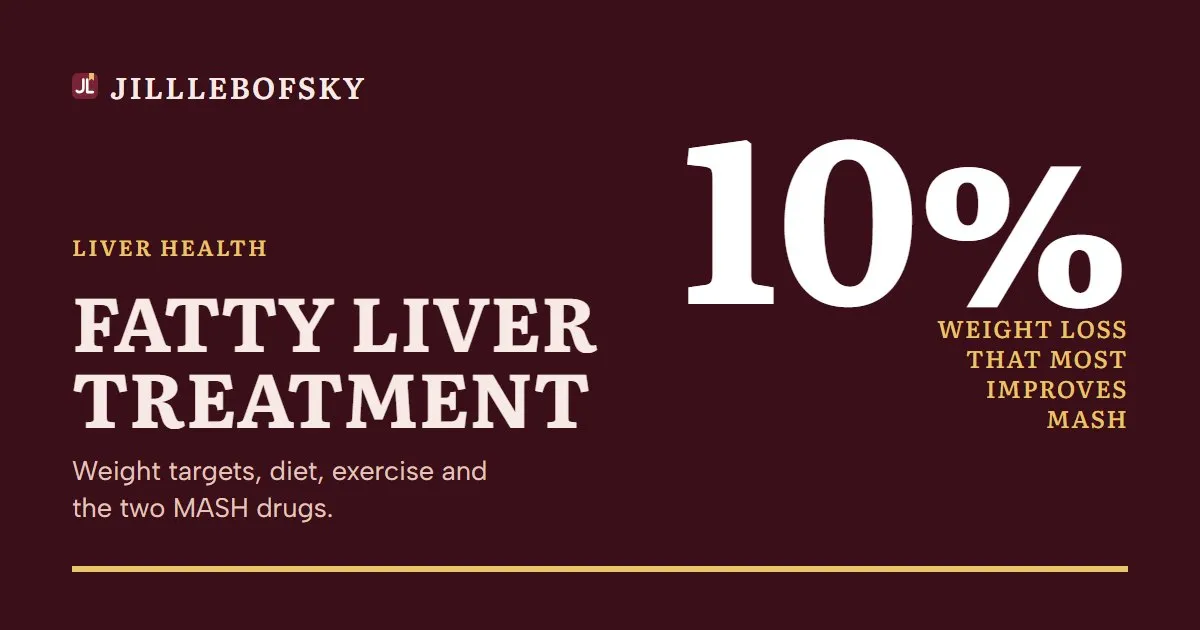
Fatty liver treatment starts with gradual weight loss. Losing 3% to 5% of body weight can cut liver fat, and 7% to 10% can ease inflammation and scarring. Add 150 minutes of exercise a week, a Mediterranean-style diet and less alcohol. Resmetirom and semaglutide are approved only for MASH with moderate to advanced fibrosis. No supplement is approved to treat it.
Fatty liver treatment starts with steady weight loss, a better diet, regular exercise and less alcohol, and two prescription drugs now exist for people with scarring. We read the NIDDK pages on treatment, facts and diagnosis, the MedlinePlus page on steatotic liver disease, the 2023 AASLD and 2024 EASL guidelines, the Rezdiffra label on DailyMed and four trials.[1][2][3][4][5][6]
The short answer: losing 3% to 5% of your body weight can cut liver fat, and losing 7% to 10% can reduce inflammation and scarring.[1]
| What it is | MASLD (formerly NAFLD) is extra fat in the liver; MASH (formerly NASH) adds inflammation and liver cell damage[4][6] |
|---|---|
| How common | About 24% of U.S. adults have NAFLD and 1.5% to 6.5% have NASH[2] |
| First step | Weight loss: 3% to 5% lowers liver fat, 7% to 10% helps inflammation and scarring[1][4] |
| Exercise target | At least 150 minutes a week of moderate activity, or 75 minutes of vigorous activity[5][6] |
| Approved medicines | Resmetirom (Rezdiffra) and semaglutide (Wegovy), only for MASH with moderate to advanced scarring[9][11] |
| Supplements | Vitamin E only for select patients under a doctor; milk thistle showed no benefit in an NIH-funded MASH trial[5][12] |
| Who needs a specialist | People with signs of advanced scarring or test results that disagree[5] |
What do MASLD and MASH mean?
MASLD, short for metabolic dysfunction-associated steatotic liver disease, is the new name for nonalcoholic fatty liver disease (NAFLD). MASH is the new name for nonalcoholic steatohepatitis (NASH), the form with inflammation and liver cell damage.[4][6] The names changed recently, so older pages and trials still use NAFLD and NASH. This guide uses both where a source does.
The split matters for treatment. Simple fatty liver typically does not progress to liver damage.[2] MASH can lead to scarring (fibrosis) and, over years, cirrhosis. Both prescription drugs in this guide are approved only for MASH with moderate to advanced fibrosis.[9][11]
Most people feel nothing. MedlinePlus notes that the disease often has few or no symptoms, though some people feel tired or have discomfort in the upper right belly.[4] Heart disease, not liver failure, is the most common cause of death in people with NAFLD, which is why doctors also treat blood pressure, cholesterol and blood sugar.[2]
What is the first fatty liver treatment doctors recommend?
The first fatty liver treatment is weight loss through diet and activity, if you carry extra weight. MedlinePlus says the first step in treating MASLD is usually weight loss.[4] NIDDK says losing at least 3% to 5% of your body weight can reduce liver fat, and up to 7% to 10% can reduce inflammation and fibrosis.[1]
The European guideline sets similar steps: 5% or more for liver fat, 7% to 10% for inflammation and 10% or more for fibrosis.[6] AASLD agrees that more than 10% is generally needed to improve MASH and scarring.[5]
| Weight lost | What it does | Example at 200 lb |
|---|---|---|
| 3% to 5% | Lowers liver fat[1][5] | 6 to 10 lb |
| 7% to 10% | Reduces inflammation and fibrosis[1][6] | 14 to 20 lb |
| 10% or more | Generally needed to improve MASH and scarring[5][6] | 20 lb or more |
People at a normal weight can have MASLD too. EASL still advises diet and exercise for them to reduce liver fat.[6]
Can you reverse fatty liver?
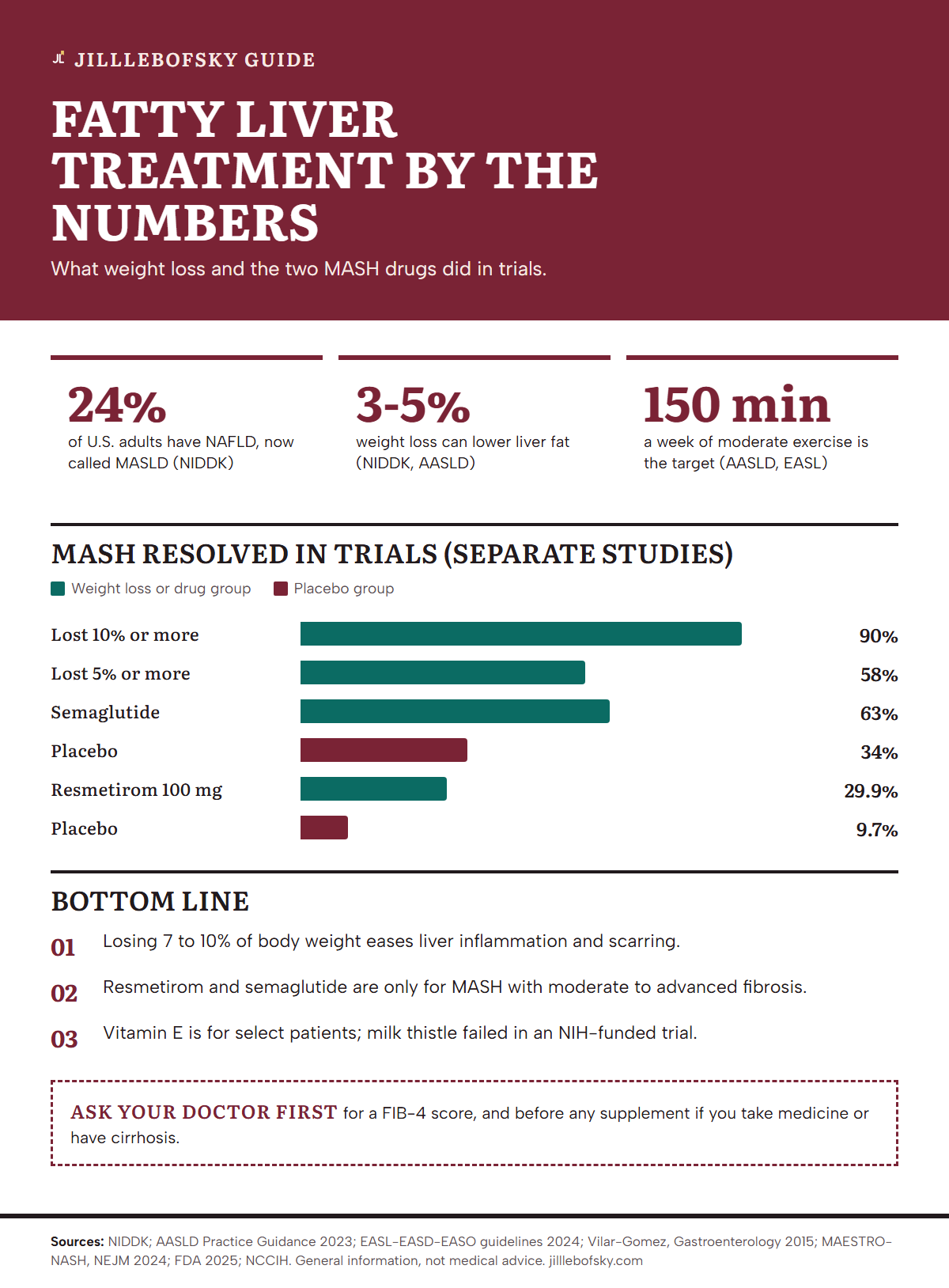
Yes, liver fat and even early scarring can improve, and the best data come from people who lost 10% of their weight. In a 52-week study of 293 adults with biopsy-proven NASH, 90% of those who lost 10% or more had their NASH resolve, and 45% saw fibrosis regress.[7]
Few people reached those targets. Only 30% of people lost 5% or more of their weight in a year.[7] AASLD says 10% or fewer of patients reach effective weight loss at one year.[5] So reversal is possible, but most people need support, and some need medicine or surgery.
| Study | Who and how long | Treatment | Result |
|---|---|---|---|
| Vilar-Gomez, 2015[7] | 293 adults with NASH, 52 weeks | Diet and exercise | NASH resolved in 90% of those who lost 10% or more, and 58% of those who lost 5% or more |
| PIVENS, 2010[8] | 247 adults without diabetes, 96 weeks | Vitamin E 800 IU a day | Liver improved in 43% vs 19% on placebo; no fibrosis benefit |
| MAESTRO-NASH, 2024[10] | 966 adults with NASH and fibrosis, 52 weeks | Resmetirom 80 or 100 mg | NASH resolved in 25.9% and 29.9% vs 9.7% on placebo |
| Semaglutide trial, FDA summary 2025[11] | 800 adults with MASH and fibrosis, 72 weeks | Semaglutide (Wegovy) | MASH resolved in 63% vs 34% on placebo |
Bariatric surgery is another route for people with obesity. AASLD reports MASH resolution in 80% of patients one year after surgery.[5]
How can you reduce fatty liver quickly?
There is no safe shortcut: crash diets can harm the liver, and NIDDK warns that rapid weight loss and malnutrition can make liver disease worse.[1] Gradual loss you can keep up is the goal. The trials that showed liver improvement ran for 52 to 96 weeks, so think in months, not days.[7][8]
What you can start this week is activity. NIDDK says physical activity alone, even without weight loss, is also beneficial.[1] Cutting sugary drinks and alcohol right away removes two common sources of liver fat and injury.[5][6]
Be wary of products that promise fast results. NIDDK warns that some herbal remedies can damage the liver.[1] Our guide to liver detox products covers why cleanses and detox teas do not replace these steps.
What diet helps treat fatty liver?
A Mediterranean-style diet with fewer refined carbs, less saturated fat, more fiber and no sugary drinks is the pattern both major guidelines support. AASLD says diets limited in carbohydrates and saturated fat and rich in fiber and unsaturated fats, such as the Mediterranean diet, should be encouraged.[5] EASL adds limiting ultra-processed food and avoiding sugar-sweetened drinks.[6]
AASLD also says low-carb, low-fat, intermittent fasting and Mediterranean plans appear comparable for weight loss, so the best plan is the one you can stay on.[5] MedlinePlus advises limiting salt and sugar and eating plenty of fruits, vegetables and whole grains.[4]
- Swap butter and fatty meats for olive oil, nuts and fish.[5]
- Replace soda, sweet tea and juice with water or unsweetened drinks.[6]
- Choose whole grains, beans and vegetables over white bread and pastries.[4][5]
- Coffee is allowed: AASLD says 3 or more cups a day could be recommended if you have no reason to avoid it, based on observational data.[5]
How much exercise helps reduce fatty liver?
Aim for more than 150 minutes a week of moderate exercise, such as brisk walking, or 75 minutes of vigorous exercise. That is the EASL target, and AASLD gives the same 150-minute figure.[5][6] Exercise helps the liver and heart even when the scale does not move.[1][5]
For most people, 150 minutes means about 30 minutes on five days. If you have heart disease, joint problems or cirrhosis, ask your doctor which activities are safe before you start.
Should you stop drinking alcohol with fatty liver?
Cutting back helps everyone with fatty liver, and people with significant scarring should stop drinking completely. AASLD says patients with fibrosis stage F2 or higher should abstain from alcohol.[5] EASL found no evidence that light or moderate drinking protects the liver, and says all alcohol should stop for good in advanced fibrosis or cirrhosis.[6]
If you do not know your fibrosis stage, treat alcohol as something to reduce now and discuss at your next visit. MedlinePlus also advises vaccines for hepatitis A and B, flu and pneumococcal disease, which protect a liver that is already under strain.[4]
How does diabetes control fit into fatty liver treatment?
Good blood sugar control is part of fatty liver treatment, and some diabetes drugs also help the liver. AASLD says pioglitazone improves NASH and can be considered for patients with NASH and type 2 diabetes, and semaglutide can be used for its approved uses in diabetes or obesity because it improves NASH and protects the heart.[5]
EASL advises incretin drugs such as semaglutide or tirzepatide for type 2 diabetes or obesity when indicated, and says they are safe in MASH, including compensated cirrhosis.[6] Metformin and SGLT2 inhibitors are safe to keep using for diabetes, but neither is a MASH treatment.[5][6] Our guide to blood sugar support supplements explains why pills sold for glucose do not replace these medicines.
Statins are safe in fatty liver, including compensated cirrhosis, and AASLD recommends them to lower heart risk.[5]
Which medicines are approved for MASH?
As of October 29, 2026, two drugs carry FDA approval for MASH, and both are limited to adults with moderate to advanced fibrosis (stages F2 to F3) who also follow diet and exercise. Neither is for simple fatty liver.[9][11]
Resmetirom (Rezdiffra) is a daily tablet. Its label, revised in July 2026, still lists accelerated approval for noncirrhotic MASH, which means continued approval depends on confirmatory trials.[9] The dose is 80 mg a day under 100 kg and 100 mg at 100 kg or more. The label says to avoid it in decompensated cirrhosis.[9] In the MAESTRO-NASH trial of 966 adults, fibrosis improved in 24.2% and 25.9% on the two doses vs 14.2% on placebo.[10]
Semaglutide (Wegovy) is a weekly injection the FDA approved for MASH with moderate to advanced fibrosis in 2025. In 800 trial participants, scarring improved in 37% vs 22% on placebo at week 72.[11] The FDA estimates that about 6% of U.S. adults, or 14.9 million people, have MASH.[11]
Do vitamin E and supplements help fatty liver?
No supplement is approved to treat fatty liver, and the only one with trial support, vitamin E, is for a narrow group under a doctor's care. In the PIVENS trial, 800 IU of vitamin E a day improved liver findings in 43% of adults without diabetes, vs 19% on placebo, but did not improve fibrosis.[8]
AASLD says vitamin E can be considered in select people without diabetes, and lists hemorrhagic stroke and a possible prostate cancer risk.[5] EASL goes further and says vitamin E cannot be recommended as a MASH treatment.[6]
Milk thistle does worse. NCCIH says studies in fatty liver are conflicting or too limited, and an NCCIH-funded MASH trial of silymarin showed no benefit.[12] AASLD lists silymarin among agents that should not be used to treat NASH.[5] MedlinePlus advises checking with your provider before using any supplement.[4]
What follow-up tests track fatty liver treatment?
Doctors track fatty liver with blood tests, a FIB-4 score and, when needed, a liver stiffness scan called elastography. NIDDK says routine blood tests can be used to calculate FIB-4 or APRI scores, which help rule advanced fibrosis in or out.[3]
AASLD advises repeating FIB-4 every 1 to 2 years in people with prediabetes, type 2 diabetes or 2 or more metabolic risk factors. If FIB-4 is 1.3 or higher, a stiffness test comes next.[5] On transient elastography, a reading under 8 kPa makes advanced fibrosis unlikely, and 12 kPa or more points to it.[5]
| Test | What it shows | Limit |
|---|---|---|
| Liver enzymes (ALT, AST)[3] | Possible liver injury | Other conditions can raise them |
| FIB-4 score[3][5] | Risk of advanced fibrosis | Less accurate in type 2 diabetes |
| Ultrasound, CT or MRI[3] | Fat in the liver | Cannot show inflammation or fibrosis |
| Elastography[3][5] | Liver stiffness, a sign of fibrosis | Cut points vary by device |
Which fatty liver treatment fits your stage?
The right plan depends on your fibrosis stage, so the first job is to find out where you stand. This table matches common situations to the steps the guidelines describe. Use it to prepare questions for your doctor, not to pick a drug yourself.
| If you have | The guidelines point to |
|---|---|
| Fat in the liver, low FIB-4 | Lose 3% to 5% if overweight, exercise 150 minutes a week, cut sugary drinks and alcohol[1][5][6] |
| MASH with F2 to F3 fibrosis | All lifestyle steps, no alcohol, and ask about resmetirom or semaglutide[5][9][11] |
| Type 2 diabetes or obesity | Ask whether semaglutide, tirzepatide or pioglitazone fits[5][6] |
| MASH, no diabetes, no cirrhosis | Vitamin E only if your doctor suggests it[5][8] |
| Cirrhosis | Specialist care; resmetirom is avoided if cirrhosis is decompensated[5][9] |
Who should be careful, and when should you see a doctor?
Anyone with a fatty liver diagnosis should have their fibrosis risk checked, and some treatments carry real side effects. Resmetirom can cause diarrhea, nausea, itching, vomiting, constipation, belly pain and dizziness. It interacts with gemfibrozil, clopidogrel and some statins, so your doctor may limit the statin dose.[9]
Ask a doctor before starting vitamin E, herbal products or any liver supplement, especially if you take blood thinners or other daily medicine.[4][5] If you are pregnant, follow your obstetric team's advice on weight and supplements.
See a doctor soon if:
- Your FIB-4 is 1.3 or higher, or your scan and blood tests disagree.[5]
- You have type 2 diabetes and have never had a liver fibrosis check.[5]
- You drink alcohol and have been told you have scarring.[5][6]
- You are on a crash diet and losing weight very fast.[1]
What should you check before buying a liver supplement?
Most liver supplements make claims their ingredients have not earned, so read the label before you pay. NIDDK warns that some herbal remedies can damage the liver, and AASLD lists silymarin among agents that should not be used to treat NASH.[1][5] Our review method uses these checks.
- Look for words like "reverses fatty liver" or "detox". No supplement has that evidence.[5][12]
- Check the vitamin E amount. The trial dose was 800 IU a day, and it is a doctor's call.[8]
- Check for herbal blends and show the label to your doctor, since some herbal remedies can damage the liver.[1][4]
- Read the refund terms and the price per month before you buy.
- Spend first on what works: a scale, walking shoes and a visit to check your FIB-4.[3][6]
For more on liver health topics, browse our liver health guides.
Bottom line
Fatty liver treatment is mostly lifestyle: lose 5% to 10% of your weight gradually, move for 150 minutes a week, drop sugary drinks and cut alcohol.[1][6] Two drugs, resmetirom and semaglutide, now help people with MASH and moderate to advanced scarring, alongside those habits.[9][11]
For most people, the better first step is a FIB-4 check and a realistic weight plan, because your fibrosis stage decides whether medicine is even on the table. A supplement should come last, if at all.[5][12]
Frequently asked questions
How do you cure fatty liver?
There is no single cure. Liver fat often falls with gradual weight loss of 3% to 5%, and losing 10% or more led to NASH resolution in 90% of people who reached it in one 52-week study.
How long does it take to reverse fatty liver?
No source gives an exact timeline. The trials that showed improvement ran from 52 to 96 weeks, so plan in months. Rapid weight loss can make liver disease worse, NIDDK warns.
How do you reduce fatty liver naturally?
Lose weight gradually if you carry extra, exercise at least 150 minutes a week, follow a Mediterranean-style diet, avoid sugary drinks and cut alcohol. Activity helps the liver even without weight loss.
Is coffee good for fatty liver?
AASLD says 3 or more cups a day could be recommended for people with fatty liver who have no reason to avoid coffee. The support comes from observational studies, so coffee is an add-on, not a treatment.
What vaccines do people with fatty liver need?
MedlinePlus advises vaccines for hepatitis A and B, flu and pneumococcal disease for people with steatotic liver disease. Ask your doctor which ones you still need based on your records.
Sources
- Treatment for NAFLD & NASH. NIDDK, National Institutes of Health, 2021
- Definition & Facts of NAFLD & NASH. NIDDK, National Institutes of Health, 2021
- Diagnosis of NAFLD & NASH. NIDDK, National Institutes of Health, 2021
- Steatotic Liver Disease. MedlinePlus, National Library of Medicine, 2026
- AASLD Practice Guidance on the clinical assessment and management of nonalcoholic fatty liver disease (Rinella et al.). Hepatology, 2023
- EASL-EASD-EASO Clinical Practice Guidelines on the management of MASLD: executive summary. Diabetologia, 2024
- Weight loss through lifestyle modification significantly reduces features of nonalcoholic steatohepatitis (Vilar-Gomez et al.). Gastroenterology, 2015
- Pioglitazone, Vitamin E, or Placebo for Nonalcoholic Steatohepatitis (PIVENS). New England Journal of Medicine, 2010
- REZDIFFRA (resmetirom) tablets: prescribing information. DailyMed, National Library of Medicine, label revised July 2026, checked October 29, 2026
- A Phase 3, Randomized, Controlled Trial of Resmetirom in NASH with Liver Fibrosis (MAESTRO-NASH). New England Journal of Medicine, 2024
- FDA Approves Treatment for Serious Liver Disease Known as MASH. U.S. Food and Drug Administration, 2025
- Milk Thistle: Usefulness and Safety. NCCIH, National Institutes of Health
This page is general information, not medical advice. Talk to your doctor or pharmacist before you start any supplement, especially if you are pregnant, take medicine or have a health condition. Read our medical disclaimer and how we review.