Liver cirrhosis causes are led by heavy alcohol use, fat buildup in the liver and long-term hepatitis C or B infection. Less common causes include autoimmune hepatitis, bile duct diseases, inherited iron or copper disorders, some long-term medicines, high daily vitamin A and heart failure. The scarring cannot be reversed, but treating the cause can slow or stop it, so finding the cause comes first.
Liver cirrhosis causes fall into a short list: heavy drinking, fat buildup in the liver, long-term hepatitis B or C, and a smaller group of immune, inherited and medicine-related conditions. We read the NIDDK cirrhosis pages, the MedlinePlus cirrhosis page, the NIDDK pages on each main cause and four peer-reviewed papers on alcohol, fatty liver naming, supplement injury and outcomes.[1][2][5]
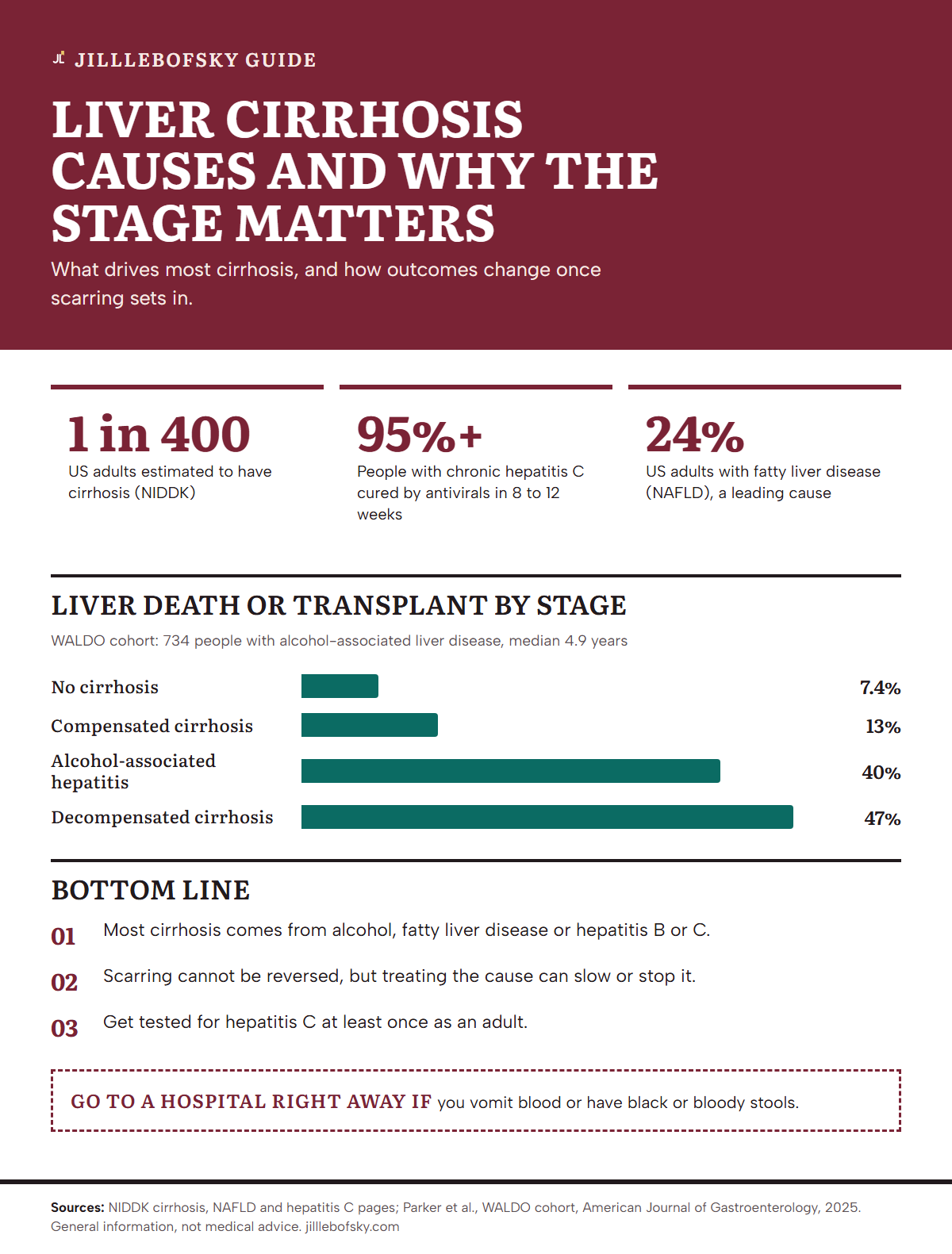
The short answer: about 1 in 400 U.S. adults has cirrhosis, and alcohol-associated liver disease, fatty liver disease and chronic hepatitis C or B cause most cases.[1][2]
| What it is | Scarring that permanently damages the liver; scar tissue cannot do what healthy liver tissue does[1][5] |
|---|---|
| How common | About 1 in 400 U.S. adults, likely more, since many early cases are never diagnosed[1] |
| Most common causes | Alcohol-associated liver disease, fatty liver disease (renamed MASLD in 2023) and chronic hepatitis C or B[2][7] |
| Less common causes | Autoimmune hepatitis, bile duct diseases, inherited conditions, some long-term medicines, high daily vitamin A, heart failure with liver congestion[2] |
| Higher risk | Heavy alcohol use, overweight or obesity, type 2 diabetes, men, age 40 or older[1] |
| Can it be undone | No treatment cures cirrhosis or reverses the damage; treating the cause can slow or stop it[4][5] |
| Urgent warning sign | Vomiting blood, or black or bloody stools: go to a hospital right away[4] |
What are the most common liver cirrhosis causes?
The most common liver cirrhosis causes are alcohol-associated liver disease, fat buildup in the liver and long-term infection with the hepatitis C or hepatitis B virus.[2] Cirrhosis is the late stage of years of liver injury, when scar tissue replaces healthy tissue and the liver stops working normally.[1][5]
Each of these causes injures the liver again and again. Every round of healing leaves scar tissue behind, and scar tissue cannot do the work that healthy liver tissue does.[5]
Some people have more than one cause.[2] The same cause does not hurt everyone equally. NIDDK notes that some people with these conditions get more liver damage than others, and research suggests inherited genes shape how much damage occurs.[2] For some people, no cause is ever found.[2]
Many people in the early stage have no symptoms, so the true number of cases is probably higher than the 1 in 400 estimate.[1]
What the key studies on causes found
| Study | Who and how many | Design | Main finding |
|---|---|---|---|
| Seitz, Nature Reviews Disease Primers, 2018 | People with alcohol-associated liver disease | Expert review | Most people drinking over 40 g of alcohol a day get fatty liver; only a subset progress further[8] |
| WALDO cohort, Am J Gastroenterol, 2025 | 734 adults with biopsy-proven alcohol-associated liver disease | Cohort, median 4.9 years | Liver death or transplant: 7.4% without cirrhosis, 13% compensated, 47% decompensated cirrhosis[15] |
| Rinella, Hepatology, 2023 | 236 panelists from 56 countries | Delphi consensus | Fatty liver renamed MASLD, defined by at least 1 of 5 cardiometabolic risk factors[7] |
| Navarro, Hepatology, 2017 | U.S. DILIN liver injury registry | Registry review | Supplement share of liver injury cases rose from 7% to 19%; injury was usually acute[14] |
How much alcohol does it take to cause cirrhosis?
No single amount applies to everyone. A 2018 review in Nature Reviews Disease Primers found that most people who drink more than 40 grams of alcohol a day develop fatty liver, but only a subset go on to more advanced disease.[8] Alcohol-associated liver disease moves in stages, from fatty liver to inflammation and then to fibrosis and cirrhosis.[8]
The review points to genetic, epigenetic and non-genetic factors to explain why two people with similar drinking end up with very different livers.[8] We did not find a source we trust that turns 40 grams into a fixed number of U.S. drinks, so we leave that conversion to your doctor.
Outcomes depend heavily on the stage at diagnosis. In the WALDO cohort of 734 people with biopsy-proven alcohol-associated liver disease, followed for a median of 4.9 years, liver death or transplant occurred in 7.4% of those without cirrhosis and 13% of those with compensated cirrhosis.[15] The figures were 47% for decompensated cirrhosis and 40% for alcohol-associated hepatitis.[15]
The review calls stopping alcohol the best treatment at every stage, and NIDDK advises people with cirrhosis not to drink at all.[8][4]
Can fatty liver disease cause cirrhosis?
Yes. Fat buildup in the liver, long called nonalcoholic fatty liver disease (NAFLD), is one of the most common causes of cirrhosis.[2] The inflamed form, nonalcoholic steatohepatitis (NASH), is the type that can progress to cirrhosis.[6] NIDDK estimates that about 24% of U.S. adults have NAFLD and 1.5% to 6.5% have NASH.[6]
In 2023 a consensus of 236 experts from 56 countries renamed the condition metabolic dysfunction-associated steatotic liver disease (MASLD).[7] The new label requires at least 1 of 5 cardiometabolic risk factors.[7] People with MASLD who also drink 140 to 350 grams of alcohol a week (women) or 210 to 420 grams (men) fall into a middle group called MetALD.[7]
Fatty liver tracks closely with blood sugar. NIDDK says one-third to two-thirds of people with type 2 diabetes have NAFLD.[6] If that applies to you, our guide to blood sugar support supplements explains what the label doses match in trials, and why diet and medicine come first.
For fatty liver, NIDDK lists weight loss as the main way to slow liver damage.[4] Products sold to clean the liver are not a treatment for cirrhosis; our liver detox supplement guide covers those labels separately.
How do hepatitis B and C lead to cirrhosis?
Long-term infection with hepatitis C or hepatitis B keeps the liver inflamed for years, and that slow damage can end in cirrhosis.[2] Hepatitis C often causes few or no symptoms until cirrhosis develops, which can be decades after infection.[9] This is why NIDDK says all adults should be tested for hepatitis C at least once.[9]
More than 2 million people in the United States have hepatitis C, and there is no vaccine for it.[9] Antiviral medicines cure more than 95% of people with chronic hepatitis C in 8 to 12 weeks.[4][9]
About 1.17 million people in the United States have chronic hepatitis B.[10] Whether an infection becomes chronic depends heavily on age:
| Age when infected | Chance of chronic infection |
|---|---|
| Infants under 1 year | 90%[10] |
| Children 1 to 5 years | 25% to 50%[10] |
| Adults | 5%[10] |
A hepatitis B vaccine has been available since the 1980s, and antiviral medicines can slow or stop liver damage from chronic hepatitis B.[10][4]
What are the less common causes of cirrhosis?
Less common causes include autoimmune hepatitis, diseases that damage or block the bile ducts, inherited conditions, long-term use of certain medicines, high daily doses of vitamin A and chronic heart failure with liver congestion.[2] Several of these causes have their own specific treatment, so naming the cause early can change the plan.[4][13]
These conditions are often found when the usual suspects do not fit, for example in someone who drinks little and has a normal weight. A doctor will look for them with antibody tests, other blood tests and, if needed, a biopsy.[3]
Autoimmune, bile duct and inherited diseases
In autoimmune hepatitis, the immune system attacks the liver. NIDDK notes that many people already have cirrhosis when they are first diagnosed, and 71% to 95% of adults with the disease are women.[11]
Primary biliary cholangitis inflames and destroys the small bile ducts. Bile then builds up in the liver and can cause cirrhosis.[12] A 2014 estimate found it in 58 per 100,000 U.S. women and 15 per 100,000 men.[12] Primary sclerosing cholangitis is another disease that damages the bile ducts and can lead to cirrhosis.[2]
Wilson disease, hemochromatosis and alpha-1 antitrypsin deficiency pass from parents to children through genes that affect how the liver works.[2] In hemochromatosis, the body stores too much iron, especially in the liver, heart and pancreas, and treatment removes blood to lower iron.[13]
Medicines, supplements, vitamin A and heart failure
NIDDK names long-term use of certain medicines and high doses of vitamin A taken daily as less common causes.[2] Chronic heart failure can also congest the liver by slowing blood flow out of it.[2]
Herbal and dietary supplements account for about 20% of U.S. liver injury cases in research data.[14] In the DILIN registry, 68% of supplement cases not involving anabolic steroids came from multi-ingredient products, and green tea extract was the most common single ingredient.[14] That injury was usually sudden, starting 1 to 4 months after use began. Our sources do not show supplements commonly causing cirrhosis.[14]
What are the first signs of cirrhosis?
You may have no symptoms in the earliest stage of cirrhosis.[2] When early symptoms do appear, NIDDK lists feeling tired or weak, itching, poor appetite, weight loss, nausea, mild discomfort in the upper right belly and muscle cramps.[2] These signs are vague and easy to put down to something else.
Later signs show the liver is failing. They include easy bruising or bleeding, confusion, swelling in the legs or belly, dark urine and yellow eyes or skin (jaundice).[2]
Cirrhosis can also lead to high pressure in the portal vein, enlarged veins in the food pipe that can bleed, brain changes from toxins (hepatic encephalopathy), infections, kidney failure and liver cancer.[1][5] NIDDK notes that most people who develop liver cancer already have cirrhosis.[1]
Call 911 or see a doctor right away if
These signs can point to internal bleeding, a failing liver or a serious infection. Do not wait for a routine appointment.[1][4]
- You vomit blood, or your stools are black or bloody. NIDDK says to go to a hospital right away.[4]
- You or someone with liver disease becomes confused, very drowsy or hard to wake, a sign of hepatic encephalopathy.[1][2]
- Your skin or the whites of your eyes turn yellow.[2]
- Your belly or legs swell quickly.[1][2]
- You have liver disease and develop a fever or other signs of infection.[1]
How do doctors find the cause of cirrhosis?
Doctors look for the cause with a medical history, a physical exam, blood tests and imaging, and sometimes a liver biopsy.[3] The history comes first: your doctor will ask how much alcohol you drink and which prescription medicines, over-the-counter medicines and herbal supplements you take.[3]
Blood tests check liver enzymes (ALT, AST, alkaline phosphatase), bilirubin, albumin and a complete blood count. Other tests look for hepatitis B and C and for autoimmune antibodies (ANA, SMA and AMA).[3] Ultrasound, CT, MRI and elastography look at the liver itself. Cirrhosis makes the liver stiffer, which elastography can measure.[3]
Which cause will a doctor check first?
The table below is our own decision aid built from those NIDDK pages. It shows which cause a doctor is likely to check first for a given situation. It does not replace a visit.
| If this fits you | Likely cause to check | How it is usually checked |
|---|---|---|
| Heavy drinking now or in the past | Alcohol-associated liver disease | History and liver blood tests[3][8] |
| Overweight, metabolic syndrome or type 2 diabetes | Fatty liver disease (MASLD) | Imaging and elastography[2][3][6] |
| Never tested for hepatitis | Hepatitis C or B | Hepatitis blood tests[3][9] |
| Abnormal liver tests with no alcohol or fat cause, especially in a woman | Autoimmune hepatitis or primary biliary cholangitis | ANA, SMA and AMA antibody tests[3][11][12] |
| Long-term medicines, daily vitamin A or many supplements | Medicine or supplement injury | A full list of every product you take[2][3] |
| Long-standing heart failure | Liver congestion | History, exam and imaging[2][3] |
If tests still leave doubt, a biopsy takes a small piece of liver to confirm the diagnosis and look for the cause.[3]
Can cirrhosis be stopped once the cause is treated?
Doctors have no treatment that cures cirrhosis or reverses the scarring, but treating the cause can slow or stop further damage.[4][5] That is why finding the cause comes first. Stopping alcohol, losing weight for fatty liver disease, and taking antiviral or immune-suppressing medicine each aim at a specific cause.[4]
What doctors use first depends on the cause. Hepatitis C antivirals cure more than 95% of people, hepatitis B antivirals slow or stop damage, autoimmune hepatitis is treated with immune-suppressing drugs, and hemochromatosis is treated by removing blood.[4][13] No supplement replaces any of these.
NIDDK also advises checks for liver cancer every 6 months, vaccines for hepatitis A and B, flu, pneumonia and shingles, and avoiding raw shellfish.[4] People with cirrhosis should ask a doctor before taking NSAID pain relievers, acetaminophen, sleep aids or herbal supplements.[4] When the liver fails, a transplant may be an option.[4]
Practical checklist
- Ask for a hepatitis C test if you have never had one.[9]
- Write down how much alcohol you drink in a usual week and share it honestly.[3]
- Bring every medicine, vitamin and supplement bottle to your appointment, including any vitamin A product.[2][3]
- Check supplement labels for multi-ingredient blends and green tea extract, the most common single ingredient in supplement liver injury.[14]
- If you have type 2 diabetes or carry extra weight, ask whether your liver should be checked for fat.[6]
- Get the vaccines NIDDK lists if your doctor agrees.[4]
Read how we review supplements and our editorial policy to see how we check sources. More guides sit in our liver health section.
Bottom line
Most cirrhosis comes from alcohol, fatty liver disease or long-term hepatitis B or C, with immune, inherited, medicine and heart causes behind them.[2] The scarring cannot be undone, but treating the cause can slow or stop it.[4][5]
For most people worried about their liver, a hepatitis C test and an honest look at weekly drinking are the better first steps, because hepatitis C can be cured in 8 to 12 weeks and alcohol is a cause you control.[4][8] Neither step depends on buying a liver supplement.
Frequently asked questions
Can you get cirrhosis without drinking alcohol?
Yes. Fatty liver disease, chronic hepatitis B or C, autoimmune hepatitis, bile duct diseases and inherited conditions can all cause cirrhosis in people who never drink. NIDDK lists fat buildup and hepatitis among the most common causes.
Is liver cirrhosis genetic?
Some causes are inherited. Wilson disease, hemochromatosis and alpha-1 antitrypsin deficiency pass from parents to children through genes. Research also suggests inherited genes affect how much damage alcohol, fatty liver or hepatitis does to one person's liver compared with another's.
Who is most at risk of cirrhosis?
NIDDK says cirrhosis is more common in people with a history of heavy alcohol use, overweight or obesity, or type 2 diabetes. It is also more common in men and in adults aged 40 or older.
Can heart failure cause cirrhosis?
Yes, though it is a less common cause. NIDDK lists chronic heart failure with liver congestion, where blood flow out of the liver is slowed, as one of the conditions that can lead to cirrhosis over time.
Can too much vitamin A damage the liver?
NIDDK lists high doses of vitamin A taken every day as a less common cause of cirrhosis. If you take a multivitamin plus a separate vitamin A product, show both labels to your doctor before continuing.
Sources
- Definition & Facts for Cirrhosis. NIDDK, reviewed 2023
- Symptoms & Causes of Cirrhosis. NIDDK, reviewed 2023
- Diagnosis of Cirrhosis. NIDDK, reviewed 2023
- Treatment for Cirrhosis. NIDDK, reviewed 2023
- Cirrhosis. MedlinePlus, National Library of Medicine
- Definition & Facts of NAFLD & NASH. NIDDK, reviewed 2021
- A multisociety Delphi consensus statement on new fatty liver disease nomenclature. Rinella et al., Hepatology, 2023
- Alcoholic liver disease. Seitz et al., Nature Reviews Disease Primers, 2018
- Hepatitis C. NIDDK
- Hepatitis B. NIDDK
- Definition & Facts for Autoimmune Hepatitis. NIDDK
- Definition & Facts of Primary Biliary Cholangitis. NIDDK
- Hemochromatosis. MedlinePlus, National Library of Medicine
- Liver Injury from Herbal and Dietary Supplements. Navarro et al., Hepatology, 2017
- Defining Risk in Alcohol-Associated Liver Disease Using the Model for End-Stage Liver Disease. Parker et al. (WALDO), American Journal of Gastroenterology, 2025
This page is general information, not medical advice. Talk to your doctor or pharmacist before you start any supplement, especially if you are pregnant, take medicine or have a health condition. Read our medical disclaimer and how we review.