Low blood pressure means a reading under 90/60. In many healthy people it is simply their normal. When it causes symptoms, the usual triggers are dehydration, blood pressure, depression or Parkinson's medicines, standing up too fast, large meals in older adults, heart rhythm problems and nerve damage. Shock signs, such as cold sweaty skin and a weak fast pulse, need 911.
What causes low blood pressure is usually one of a short list of things: lost fluid, a medicine, a body that cannot adjust fast enough when you stand or eat, or a heart, nerve or hormone problem. We read the NHLBI and MedlinePlus pages on low blood pressure, NINDS guidance on fainting and POTS, NIH pages on dehydration, adrenal insufficiency, sepsis and anaphylaxis, and four research reviews on older adults.[1][2][4][12][14]
The short answer: a reading under 90/60 mm Hg counts as low, it is often normal for the person who has it, and it only matters when it causes dizziness, fainting or, in extreme cases, shock.[1][2]
| What counts as low | A reading lower than 90/60 mm Hg; normal for most adults is under 120/80[1][2] |
|---|---|
| Most common triggers | Dehydration, blood loss, blood pressure, depression or Parkinson's medicines, pregnancy, heart rhythm problems and diabetes[1] |
| Drop on standing | A fall of 20 mm Hg systolic or 10 mm Hg diastolic within 3 minutes of standing is orthostatic hypotension[13] |
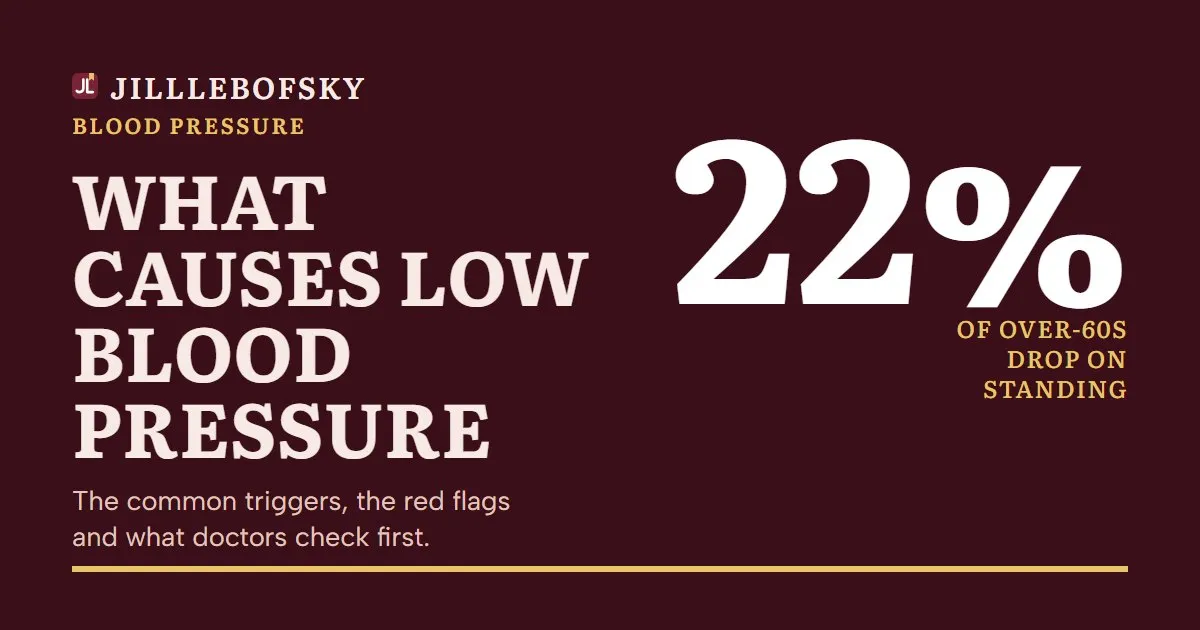
| How common in older adults | About 22% of people over 60 living at home have orthostatic hypotension[12] |
| Common symptoms | Dizziness, fainting, blurry vision, confusion, fatigue, nausea, headache, neck or back pain[1] |
| Emergency signs | Cold sweaty skin, rapid breathing, blue skin tone, weak and rapid pulse: call 911[1] |
| Usual first care | Find the cause, adjust medicines, drink enough fluid; some people need no treatment[1][13] |
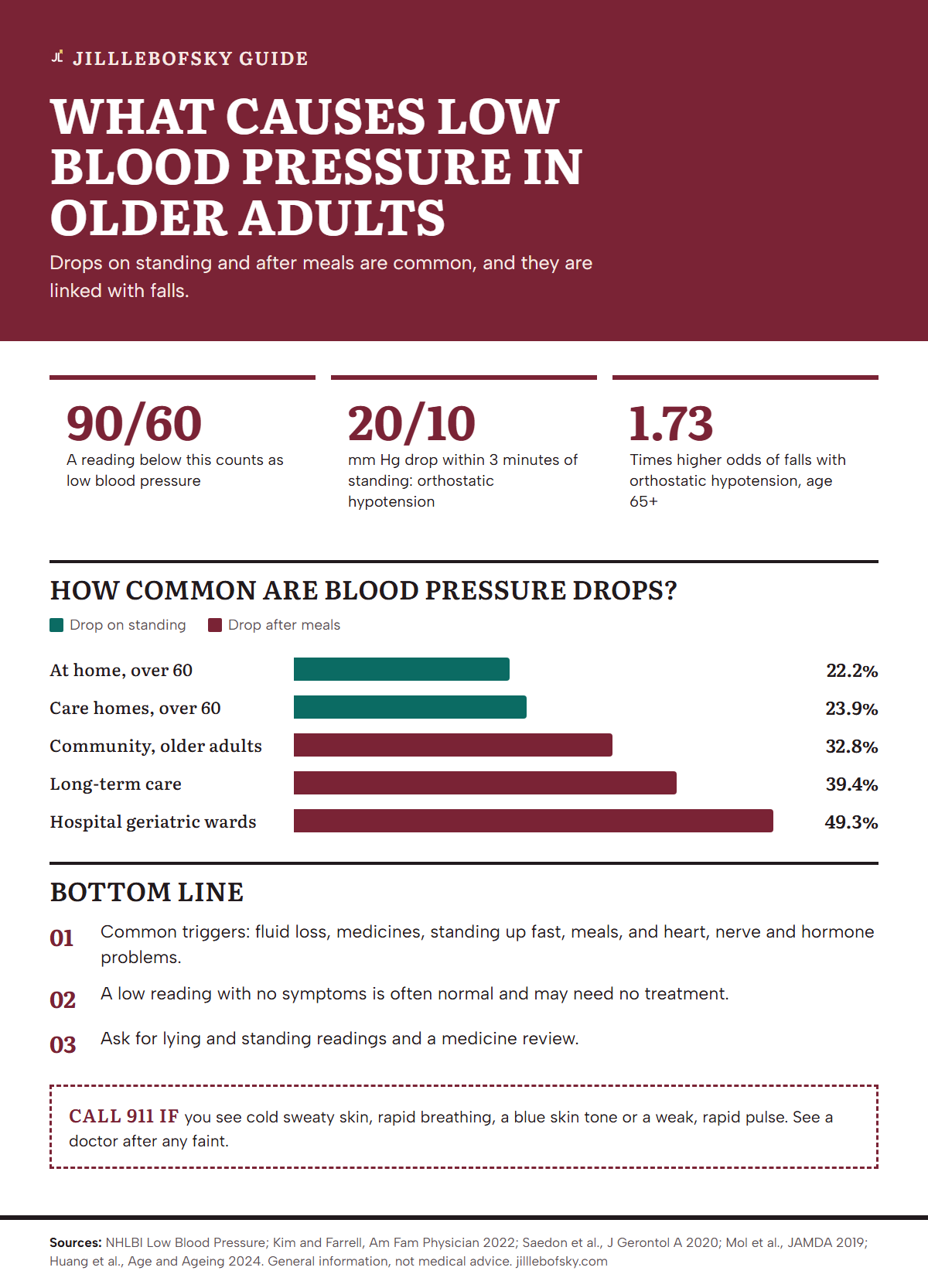
What causes low blood pressure?
Low blood pressure happens when something lowers the amount of blood in your vessels, relaxes the vessels, weakens the heart's pumping or blocks the nerve signals that tighten vessels. NHLBI names dehydration, blood loss, diabetes, heart rhythm problems, pregnancy, Parkinson's disease and some medicines as the main causes.[1]
Your organs, hormones and nerves all help hold blood pressure steady. The autonomic nervous system is the part that sends the fight-or-flight signal telling your heart and vessels to raise or lower pressure as needed.[1] When any part of that system slips, pressure can fall.
The causes differ in how fast they act:
- Sudden drops: standing up too quickly, fear or pain, heat, heavy bleeding, a severe allergic reaction or a fast-spreading infection.[1][3][4][9]
- Slow, steady lows: long-term medicines, nerve damage from diabetes or Parkinson's, and hormone problems such as adrenal insufficiency.[1][6]
- Your normal: some people run low all their lives with no symptoms, and for them a low reading is healthy.[1][2]
Older adults face more of these triggers at once. They are more likely to feel dizzy after standing or after a meal, and more likely to have low readings as a side effect of medicine taken for high blood pressure.[1]
What blood pressure is considered too low?
Doctors call a reading of 90/60 mm Hg or lower low blood pressure, or hypotension. The number alone does not make it a problem. MedlinePlus says low blood pressure matters only if it causes dizziness, fainting or, in extreme cases, shock.[2]
The top number, systolic pressure, is measured while your heart beats. The bottom number, diastolic pressure, is measured while the heart rests between beats.[2] Normal for most adults is under 120/80.[1] If you want to see where the high end starts, our guide to hypertension symptoms and red flags covers the other side of the scale.
What matters more than one reading is change. A person who usually sits at 125/80 and suddenly reads 88/55 is in a different situation from a fit runner who always reads 95/60. Doctors also watch for drops that happen only when you change position, which a seated reading can miss.[11][13]
Which medicines cause low blood pressure?
Medicines for high blood pressure, depression and Parkinson's disease are the drug groups NHLBI links most often with low blood pressure. Older adults are especially likely to develop low readings as a side effect of the pills they take to control high blood pressure.[1]
Medicines can also act indirectly. Some make you urinate or sweat more, which can tip you into dehydration.[5] Certain medicines are also a known trigger for fainting and for blood pressure drops when you stand.[3][4]
Steroids are a special case. Suddenly stopping corticosteroids after taking them for a long time is the most common cause of adrenal insufficiency, a hormone shortage that can bring low blood pressure that drops further when you stand.[6] Doctors avoid this by lowering the dose slowly over weeks or months.[6]
Never stop or cut a prescribed medicine on your own because of a low reading. Bring your full medicine list, including supplements, to your doctor or pharmacist. Adjusting the medicines that cause the drop is one of the first things doctors try.[1][13]
Why does blood pressure drop when you stand up?
When you stand, gravity pulls blood toward your legs, and your nerves must tighten vessels and speed the heart within seconds. If that response is slow, pressure falls. A drop of 20 mm Hg systolic or 10 mm Hg diastolic within 3 minutes of standing is called orthostatic hypotension.[13]
It is common. A 2020 review pooled 20 community studies with 24,967 people over 60 and found orthostatic hypotension in 22.2%, and in 23.9% of older people in long-term care.[12] In community settings, about 20% of older adults and 5% of middle-aged adults have it, and diabetes raises the rate at every age.[13]
Dehydration, certain medicines and Parkinson's disease all make the drop on standing more likely.[4] Symptoms include lightheadedness, headache, blurred vision and pain across the neck and shoulders, sometimes called coat hanger pain.[13]
A related condition, postural tachycardia syndrome (POTS), mainly causes a racing heart on standing: a rise of more than 30 beats per minute, or above 120, within 10 minutes. It mostly affects people aged 15 to 50 and is more common in women.[10] If dizziness on standing feels like spinning, our guide to the common causes of vertigo explains the inner ear causes.
Why does blood pressure drop after eating?
After a meal, blood flow shifts toward the gut, and in some older adults the body does not make up for it, so pressure falls. This is called postprandial hypotension, and NHLBI notes that older adults may feel dizzy after a meal as well as after standing.[1]
A 2024 review of 13 studies with 3,021 older adults found it in 40.5% overall.[15] Rates were 32.8% in the community, 39.4% in long-term care and 49.3% on hospital geriatric wards.[15]
Treat those numbers as rough. The studies used different tests and cut points, and the results varied a great deal, so the authors called for an agreed definition.[15] The same review links postprandial hypotension with falls, fainting and stroke in older adults.[15]
If you notice dizziness within a couple of hours of eating, write down what and how much you ate, and when the symptoms started. That log helps your doctor decide whether meal timing, meal size or a medicine dose is the likely trigger.
Which health conditions cause low blood pressure?
Heart rhythm problems, nerve damage from Parkinson's disease or diabetes, pregnancy and adrenal gland failure are the long-term conditions most tied to low blood pressure. Each one lowers pressure in a different way, so the fix depends on the cause.[1][6]
- Heart problems. Arrhythmias, or irregular heartbeats, can lower blood pressure.[1] Fainting from a heart problem is about 1 in 10 faints but can signal a serious condition, especially with chest pain or fainting during exercise.[4]
- Nerve problems. Parkinson's disease can damage the nerves that control blood vessels.[1] Diabetes is also linked to low blood pressure and raises the rate of orthostatic hypotension.[1][13]
- Pregnancy. NHLBI lists pregnancy as a cause of low blood pressure.[1] POTS also commonly begins after a pregnancy.[10]
- Adrenal insufficiency. In developed countries, autoimmune disease causes 8 or 9 of every 10 cases of Addison's disease. Symptoms include long-lasting fatigue, weight loss, salt craving and low blood pressure that worsens on standing.[6]
So a low reading that comes with new symptoms is worth a checkup, even if you otherwise feel well.
When is low blood pressure an emergency?
Low blood pressure becomes an emergency when organs stop getting enough blood, a state called shock. Signs include cold and sweaty skin, rapid breathing, a blue skin tone, and a weak, rapid pulse. NHLBI says to call 911 if you see these signs in yourself or anyone else.[1]
Three causes can bring on shock quickly:
- Blood loss from an injury, which causes a sudden drop in blood pressure.[1]
- Sepsis, the body's extreme response to an infection. Severe cases lead to septic shock, where blood pressure drops to a dangerous level and organs can fail.[7] At least 1.7 million US adults develop sepsis each year, and at least 350,000 die.[8]
- Anaphylaxis, a serious allergic reaction to foods such as peanuts, medicines or insect stings. It can cause a weak pulse, passing out and shock. Call 911 and use an epinephrine auto-injector right away if one is available.[9]
Call 911 or go to the emergency room right away if you or someone near you has:
- cold, clammy or sweaty skin with a weak, fast pulse or fast breathing[1]
- a blue or gray skin tone[1]
- fainting with chest pain, a sudden change in heart rate, or fainting during exercise[4]
- swelling of the lips, tongue or throat, wheezing or trouble breathing after a food, sting or medicine[9]
- confusion, fever or shivering, and clammy skin with a known infection[7]
- heavy bleeding from an injury[1]
- signs of severe dehydration: confusion, fainting, no urination, a rapid heartbeat or rapid breathing[5]
See a doctor soon, even if you feel fine afterward, after any faint. MedlinePlus says it is important to find out why it happened.[3]
What does the research say about low blood pressure on standing and after meals?
Large reviews agree that blood pressure drops on standing and after meals are common in older adults and are linked with falls. They show association, not proof that the drop caused each fall, and the studies measured blood pressure in different ways.[12][14][15]
| Study | Who and how many | What it measured | Main finding |
|---|---|---|---|
| Saedon 2020 review[12] | Over 60s; 24,967 at home (20 studies), 2,694 in care (6 studies) | Orthostatic hypotension | 22.2% at home, 23.9% in long-term care |
| Mol 2019 review[14] | Age 65 and over; 49,164 people in 50 studies | Orthostatic hypotension and falls | Odds of falling 1.73 times higher |
| Huang 2024 review[15] | Older adults; 3,021 people in 13 studies | Drop after meals | 40.5% overall, 49.3% on geriatric wards |
| Kim and Farrell 2022 review[13] | Community adults | Orthostatic hypotension | 20% of older and 5% of middle-aged adults; up to 50% higher relative risk of death |
The fall finding held across study designs, study quality and the way blood pressure was measured.[14] That is why the NIA advises older adults to stand up slowly and to have blood pressure checked both lying down and standing.[11]
How do doctors find the cause of low blood pressure?
Doctors start with blood pressure readings, then add blood, urine or imaging tests, and a tilt table test if you faint often. The goal is to find which cause is at work, because treatment follows the cause, and a careful history of when symptoms start often points the way.[1][4]
A common bedside check measures blood pressure and heart rate after 5 minutes lying down, then again 3 minutes after standing.[13] If you cannot stand safely, or the bedside test is normal but suspicion is high, a tilt table test is the next step. It records heart rate and blood pressure as a table tilts you upright.[4][13]
Because fainting can come from the heart, doctors often order an electrocardiogram (EKG).[4] Blood tests can show dehydration, electrolyte problems and kidney function, and a urine test can help confirm fluid loss.[5]
Which trigger fits your symptoms?
The decision table below shows how the timing of symptoms points to likely causes. Use it to prepare for the visit, not to diagnose yourself.
| If it happens | Likely trigger to ask about | Bring to the visit |
|---|---|---|
| Within 3 minutes of standing | Orthostatic hypotension, medicines, dehydration[4][13] | Lying and standing readings[11] |
| Within 10 minutes of standing, heart racing | POTS[10] | Standing heart rate log |
| After meals, in an older adult | Postprandial hypotension[1][15] | Meal and symptom times |
| After fear, pain or long standing | Reflex (vasovagal) fainting[4] | What happened just before |
| During exercise or with chest pain | Heart problem: urgent care[4] | Do not wait for a visit |
| With fatigue, weight loss, salt craving | Adrenal insufficiency[6] | Steroid history |
How is low blood pressure treated?
Many people with low blood pressure need no treatment at all. When symptoms need care, NHLBI lists more fluids to prevent dehydration, adjusting the medicines that lower pressure, medicines that raise it, changes to eating, careful sitting and standing, and compression stockings.[1]
For orthostatic hypotension, doctors treat the underlying cause first and review medicines. Next come diet changes, compression garments, physical moves and avoiding settings that make symptoms worse. Midodrine and droxidopa are the first-line prescription drugs; fludrocortisone helps symptoms but has concerning long-term effects.[13]
When you feel a faint coming on, NINDS suggests making a fist, crossing your legs, squeezing your thighs together, tightening your arm muscles, or sitting and leaning forward with your head between your knees.[4] After a faint, lie down for 10 to 15 minutes.[3][4]
For POTS, NINDS notes that more salt and fluid can help, and that drinking at least 16 ounces of water before getting up can give a short boost.[10] Ask your doctor before adding salt, since that advice is for specific conditions. No supplement has been shown to fix low blood pressure, which is why our review method starts with the standard care. If your problem is the opposite one, see our evidence-based steps to lower blood pressure.
Practical checklist for low blood pressure
Most of the useful steps are simple: track when symptoms happen, get lying and standing readings, drink enough fluid and review your medicines. The list below turns the NIH guidance into actions you can take before and during a doctor visit, without changing any prescription on your own.[1][11]
- Check readings at home when you have symptoms, and note the time, position and what you were doing.[1]
- Ask for blood pressure checks lying down and standing at your next visit.[11]
- Stand up slowly, and sit down at once if you feel dizzy.[1][11]
- Drink enough fluids, especially in heat or when ill with vomiting, diarrhea or fever.[5]
- Bring every medicine and supplement you take to your doctor or pharmacist for a review.[1][13]
- Never stop steroids or blood pressure pills suddenly without medical advice.[6]
- Learn the shock signs and call 911 if you see them.[1]
More guides on readings, medicines and home monitoring are in our blood pressure guides.
Bottom line
A low reading with no symptoms is often just your normal, and it does not need fixing. When low blood pressure causes dizziness or fainting, the usual culprits are fluid loss, medicines, a slow response to standing or eating, and heart, nerve or hormone problems.[1][2]
For most people, the most useful first step is a medicine review with lying and standing readings, because medicines and drops on standing are common and fixable causes.[1][11][13] If you see shock signs, call 911 at once.[1]
Frequently asked questions
Is a blood pressure of 90/60 too low?
A reading of 90/60 or lower meets the definition of low blood pressure. It is only a problem if it causes symptoms such as dizziness or fainting. Many healthy people sit near this level all the time with no trouble.
Can dehydration cause low blood pressure?
Yes. Losing more fluid than you take in, from vomiting, diarrhea, fever, heavy sweating or not drinking enough, can lower blood pressure and cause dizziness. Confusion, fainting, no urine or a racing heart need medical help right away.
Can stress or fear make your blood pressure drop?
It can. Fear, pain and emotional distress are common triggers of reflex (vasovagal) fainting, where the body overreacts, blood pressure falls and the heart may slow. It is brief and does not mean the heart or brain is damaged.
Can stopping steroid pills cause low blood pressure?
Stopping corticosteroids suddenly after long use is the most common cause of adrenal insufficiency. That condition can bring low blood pressure that drops further on standing. Doctors taper steroid doses over weeks or months to avoid it.
What should I do if my blood pressure drops suddenly?
Sit or lie down at once so you do not fall. If you faint, stay lying down for 10 to 15 minutes. Call 911 for cold sweaty skin, a blue skin tone, fast breathing, a weak fast pulse, chest pain or confusion.
Sources
- Low Blood Pressure. National Heart, Lung, and Blood Institute (NIH), 2022
- Low Blood Pressure. MedlinePlus, National Library of Medicine
- Fainting. MedlinePlus, National Library of Medicine
- Syncope (Fainting). National Institute of Neurological Disorders and Stroke (NIH)
- Dehydration. MedlinePlus, National Library of Medicine
- Symptoms and Causes of Adrenal Insufficiency and Addison's Disease. National Institute of Diabetes and Digestive and Kidney Diseases (NIH), 2018
- Sepsis. MedlinePlus, National Library of Medicine
- Sepsis fact sheet. National Institute of General Medical Sciences (NIH)
- Anaphylaxis. MedlinePlus, National Library of Medicine
- Postural Tachycardia Syndrome (POTS). National Institute of Neurological Disorders and Stroke (NIH)
- Falls and Fractures in Older Adults: Causes and Prevention. National Institute on Aging (NIH)
- The Prevalence of Orthostatic Hypotension: A Systematic Review and Meta-Analysis. Saedon et al., Journals of Gerontology Series A, 2020
- Orthostatic Hypotension: A Practical Approach. Kim and Farrell, American Family Physician, 2022
- Orthostatic Hypotension and Falls in Older Adults: A Systematic Review and Meta-analysis. Mol et al., Journal of the American Medical Directors Association, 2019
- Prevalence of postprandial hypotension in older adults: a systematic review and meta-analysis. Huang et al., Age and Ageing, 2024
This page is general information, not medical advice. Talk to your doctor or pharmacist before you start any supplement, especially if you are pregnant, take medicine or have a health condition. Read our medical disclaimer and how we review.